
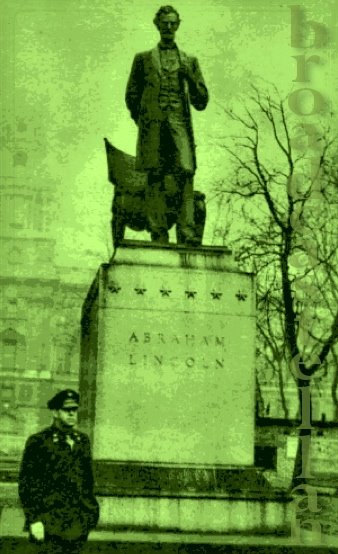
NBC, CBS, and Abe

On the eve of the 200th anniversary of Abraham Lincoln’s birth, I am once again lending an ear to the Great Emancipator. Franklin Delano Roosevelt may have been America’s “radio president”; but in the theater of the mind none among the heads of the States was heard talking more often than Honest Abe. On Friday, 12 February 1937, for instance, at least six nationwide broadcasts were dedicated to Lincoln and his legacy. NBC aired the Radio Guild‘s premiere of a biographical play titled “This Was a Man,” featuring four characters and a “negro chorus.” Heard over the same network was “Lincoln Goes to College,” a recreation of an 1858 debate between Lincoln and Democratic senator Stephen A. Douglas. Try pitching that piece of prime-time drama to network executives nowadays.

Following the Lincoln-Douglas debate was a speech by 1936 presidential candidate Alf Landon, live from the Annual Lincoln Day dinner of the National Republican Club in New York. Meanwhile, CBS was offering talks by Lincoln biographer Ida Tarbell and Glenn Frank, former president of the University of Wisconsin. From Lincoln’s tomb in Springfield, Illinois, the Gettysburg Address was being recited by a war veteran who was privileged to have heard the original speech back in 1863. Not only live and current, the Whitmanesque wireless also kept listeners alive to the past.

Most closely associated with portrayals of Lincoln on American radio is the voice of Raymond Massey, who thrice took on the role in Cavalcade of America presentations of Carl Sandburg’s Abraham Lincoln: The War Years; but more frequently cast was character actor Frank McGlynn.

According to the 14 June 1941 issue of Radio Guide, Lincoln “pop[ped] up” in Lux Radio Theater productions “on the average of seven times each year”; and, in order to “keep the martyred President’s voice sounding the same,” producers always assigned McGlynn the part he had inhabited in numerous motion pictures ever since the silent era. In the CBS serial Honest Abe, it was Ray Middleton who addressed the audience with the words: “My name is Abraham Lincoln, usually shortened to just Abe Lincoln.” The program ran for an entire year (1940-41).

The long and short of it is that, be it in eulogies, musical variety, or drama, Lincoln was given plenty of airtime on national radio, an institution whose personalities paid homage by visiting memorials erected in his honor (like the London one, next to which singer Morton Downey poses above). Nor were the producers of weekly programs whose broadcast dates did not coincide with the anniversary amiss in acknowledging the nation’s debt to the “Captain.” On Sunday, 11 February 1945—celebrated as “Race Relations Sunday”—Canada Lee was heard in a New World A-Coming adaptation of John Washington’s They Knew Lincoln, “They” being the black contemporaries who made an impression on young Abe and influenced his politics. Among them, William de Fleurville.

“Yes,” Lee related,

in Billy’s barbershop, Lincoln learned all about Haiti.  And one of the things he did when he got to the White House was to have a bill passed recognizing the independence of Haiti.  And he did more than that, too.  Lincoln received the first colored ambassador to the United States, the ambassador from the island home of Billy the Barber.  And he was accorded all the honors given to any great diplomat in the Capitol of the United States.  Yes, the people of Harmony have no doubt that Billy’s friendship with ole Abe had more than a lot to do with it.

Six years later, in 1951, Tallulah Bankhead concluded the frivolities of her weekly Big Show broadcast on NBC with a moving recital of Lincoln’s letter to Mrs. Bixby. That same day, The Eternal Light, which aired on NBC under the auspices of the Jewish Theological Seminary of America, presented “The Lincoln Highway.” Drawing on poet-biographer Sandburg’s “complete” works, it created in words and music the “living arterial highway moving across state lines from coast to coast to the murmur ‘Be good to each other, sisters. Don’t fight, brothers.’”

Once, the American networks were an extension of that “Highway,” however scarce the minority voices in what they carried. Four score and seven years ago broadcasting got underway in earnest when one of the oldest stations, WGY, Schenectady, went on the air; but what remains now of the venerable institution of radio is in a serious state of neglect. An expanse of billboards, a field of battles lost, the landscape through which it winds is a vast dust bowl of deregulation uniformity.

Related recording
“They Knew Lincoln,” New World A-Coming (11 Feb. 1945)
Toward the close of this Big Show broadcast, Bankhead recites Lincoln’s letter to Mrs. Bixby (11 Feb. 1951)
“Lincoln Highway,” The Eternal Light (11 February 1951)
My Tallulah salute

Related writings
“Spotting ‘The Mole on Lincoln’s Cheek'”
”Langston Hughes, Destination Freedom, . . .”
A Mind for Biography: Norman Corwin, ‘Ann Rutledge,’ and . . .”
”Carl Sandburg Talks (to) the People”
“The Wannsee Konferenz Maps Out the Final Solution” (on the Eternal Lightproduction of “Battle of the Warsaw Ghetto”)

Carl Sandburg Makes a Confession

Well, I didn’t get a pumpkin to carve and, the weather excepting, there is no sign of Halloween around the house. As a German, I did not grow up with the custom; before they realized how to make a killing by marketing this un-holy day, something that did not happen until the 1990s, my country(wo)men skipped the dressing up, parading, and trick-or-treating and went straight to the cemetery to remember the dead, November 1 being a national holiday.

Halloween struck me as an odd mixture of carnival (when Germans do put on costumes to make a spectacle of themselves) and the feast of St. Martins (when, on November 11, their children light lanterns and go caroling from door to door begging for candy); except that, rather than symbolically splitting St. Martin’s mantle in the spirit of charity, some folks in Hollywood decided it was high time to slice open a few random souls in the spirit of Friday, the 13th.

At any rate, donning fanciful guises, stepping into the crowd to be gawked at or approaching the public in hopes of a swift, sweet and easy pay-off is not just a Halloween tradition. It pretty much sums up the advertising racket. On this day, 31 October, in 1939, American poet Carl Sandburg went so far as to assume the role of a quiz show panelist to spread the word about his latest work.

Mind you, that show was Information, Please!, the most longhair or highbrow of all the popular quiz programs on the air. As I argued in a previous entry in the broadcastellan journal, Information, Please! had an ingenious formula that attracted both to the erudite and the illiterate, since questions were sent in by the audience for the express purpose of stumping the so-called experts.

The regular (and rather generously remunerated) panelists—Franklin P. Adams, John Kieran, and Oscar Levant (all pictured above)—were joined by a special guest expert, a noted author, film director, explorer, politician or actor. Would the public succeed in cutting those luminaries down to size? Would these articulate, gifted celebrities falter behind the microphone? That, along with the ensuing banter, accounted for the appeal and success of the program.

The people? No, Mr. Sandburg did not seem to mind them. Indeed, he was so eager to present himself as one of the commoners that the first question posed to him by master of ceremonies Clifton Fadiman, the literary critic of the New Yorker, extracted somewhat of a confession: “What notorious living American author was thrown out on account of his ignorance of arithmetic when he tried to break into the West Point Military Academy?” “Should I answer ‘me’ or give my name?” the poet inquired and, when encouraged to recount the incident, affirmed that he was indeed the “notorious” one, his attempt to enter West Point having been foiled some forty years earlier, back in 1899.

A little while later in the program, Sandburg is again given a question relating to his own life when asked whether he knew of a poem (a word used loosely, since even advertising slogans were deemed acceptable as answers) featuring a description or mere mention of fog. “Little ridiculous,” Sandburg chuckled with a note of embarrassment in his voice. After all, he was being prompted to recall one of his own works describing just such a weather condition (“Fog”):

The fog comes
on little cat feet. 

It sits looking
over harbor and city
on silent haunches
and then moves on.

Again, the author let listeners in on a secret: it had taken him just “about five minutes” to compose those lines—yet, to his professed astonishment, they were not only the best known in all his works, but practically the only ones the general public could recall.

While managing to mention John Wilkes Booth in one of their answers, another nod to Sandburg’s Lincoln biography, panelists did rather poorly that night, failing to recall how the regretful Miss Otis met her death or from which ports Gulliver embarked on his travels, and struggling to come up with five flowers with “masculine names,” Mr. Sandburg advancing “frankincense.” I gather this bit of silliness might have been a relief to its author, considering that there weren’t as many occasions to plant a pun in a serious (and eventually Pulitzer Prize-winning) history than there are opportunities to plant a plug for such a tome in a quiz program.

On This Day in 1941: Carl Sandburg Talks (to) the People

Well, the castellan is back in his element, which is air, preferably arid. Surely it is not water. I am still drying out—coughing, sneezing, and slowly recovering—from the why-not folly of riding a rollercoaster on a rain-soaked night in Blackpool, England. Listening to the soundwaves of old broadcasts seems a comparatively safer contact with the air—and a more edifying one at that—than having one’s aged bones twirled and one’s addled brains twisted in a series of gravity-defying thrill rides.

Yet while there might have been little instruction in this bathetic experience of fairground gothics, there still was a thought to be distilled thereafter from the confines of my soused cranium. It was the thought of one who stood by in spirit that night, one taking notes while passing through a sea of everyday people; it was a passing thought of one once known as the people’s poet, America’s Carl Sandburg.

A while ago, I asked what a soundscape of Britain might turn out to be, if ever there were such an exhibition devoted to regional noise. The voicescape of the United Kingdom has been quite thoroughly mapped since then, with the BBC’s voices project capturing the diverse accents of the British Isles in hundreds of recordings now online, including a group of Blackpool Romany.

For anyone moving here with memories of Dick Van Dyke Cockney, finding everyday British voices charted like this is a revelation (even though I doubt whether my own German high school English gone Nu Yawk and Wales is represented in this mix). Carl Sandburg, who set out to render and represent the thought and speech of the American every(wo)man in the 1920s and ‘30s, might have embraced such a charting of diction—even though a map like this still calls for the voice of a poet to make it sing and signify. Sandburg attempted just that.

On this day in 1941, when the United States anxiously eyed a United Kingdom at war, Sandburg addressed American radio listeners on the long-running Cavalcade of America program in an effort to celebrate a unified diversity. The play, “Native Land,” opened with words read by actor Burgess Meredith, who reminded all tuning in of the timeliness of the lines to follow:

Monday, September 22, 1941. A number on a calendar, arrived at after a million years of watching the stars, of telling the time of harvest by a shadow foreshortening, and the time of planting by the sun in the equinox. September 22, 1941. We will start at the beginning; for the beginning was the land and the stars moving overhead. And that is today, this week, the land America—a beginning. And the land is what people have made of it, what people are making of it in this fourth week of September. . . .

The ensuing broadcast, which interwove excerpts of Sandburg’s verse with its author’s autobiography, expounded on the thought that a “poet must do a lot of listening before he begins to talk.”

“Where do we get these languages?” Sandburg wondered, as actor’s voiced snippets from everyday speech picked up on the streets of the poet’s home turf, Chicago. Now that the “people in cities had forgotten the old sayings,” they “talked a new lingo,” a vocal vibrancy to which the program was meant to be an anything-but-mute testimonial. The voices of the people were worth preserving, the broadcast suggested. Yet, with war in the offing, a task larger than one to be undertaken by a librarian and curator of sounds was at hand—the preservation of the people itself.

In keeping with the at times sanctimonious patriotics of the DuPont-sponsored Cavalcade program, the broadcast concluded with Sandburg’s appropriation of words from Abraham Lincoln’s Second Annual Message to Congress (1 December 1862); they were, Sandburg remarked, “Lincoln words for now, for this hour”:

The dogmas of the quiet past are inadequate to the stormy present. The occasion is piled high with difficulty, and we must rise with the occasion. As our case is new, so we must think anew, and act anew. We must disenthrall ourselves, and then we shall save our country.

In his own words compiled and adapted from his 1936 voice-collage The People, Yes, Sandburg insisted in cautious optimism that the “learning and blundering people will live on”:

This old anvil,
the people, yes,
This old anvil laughs at many broken hammers. . . .

Today, in our own “stormy present,” the internet has become the new smithy of thought. It is the workshop in which the “old anvil” is sounded anew, where people may “think anew” and speak anew, not only to suit new cases, but to revisit old. Now, I wonder whether my own language is suited to the task to revisit and reacquaint, whether I should not spent more time listening before speaking.

It sure felt comforting to hop on the rollercoaster in Blackpool, just to scream and laugh for a change. Queer and quaint, my verbiage seems ill-chosen at times to communicate my thoughts, to argue my cases old and new. . . . Still, it is my tongue, and I must have it out.