Give Me Liberty and Give Me Love

So, Carole Lombard and Clark Gable got married on this day, 29 March, back in 1939. Ginger Rogers tied the proverbial knot with someone or other in 1929; dear Molly Sugden, whom most folks today know as Mrs. Slocombe, a woman closest to her pussy, was Being Served, be it well or ill, with a license to wed in 1958; and the to me unspeakable ex-Prime Minister Tony Blair proved that he had popped the question fruitfully by walking down the aisle with someone named Cherie. It is a time-honored institution, no doubt; and one that has protected many a woman before her sex was granted the right to vote; but it is concept I find difficult to honor and impossible to obey nonetheless (which explains my love for the first three quarters of the average screwball comedy, the genre in which Lombard excelled).

Republicans should be appalled by the very idea of such sanctioning from above—but they are generally too narrow-minded to realize or mind, having little regard for what lies outside the norm protected by law, the norm that is a mere construct of law.

Let’s face it, what has government to do with the union of two consenting adults, whether for the purpose of business, procreation, or recreation? It is, or ought to be, a legally binding contract that, even if is was got into romantically or else for reasons of stability intended for the safety of the issues that may (or very well may not) result from such a bond, and thus a matter of business, however romanticized.

As Francis Bacon put it, the

most ordinary cause of a single life, is liberty, especially in certain self-pleasing and humorous minds, which are so sensible of every restraint, as they will go near to think their girdles and garters, to be bonds and shackles. Unmarried men are best friends, best masters, best servants; but not always best subjects; for they are light to run away; and almost all fugitives, are of that condition.

Even the most fleeting acquaintance with historical facts will tell you that marriage is chiefly a matter of politics and trade. Love does not require securities, even it it is often without granted rights and legal protection. Indeed, some of the strongest relationships and greatest partnerships were forged in the face of and as a response to oppression and persecution. I have little respect and less love for an institution which itself is not merely the product but the cause of oppression. Keep the rice and boil it!

“. . . some day we’ll have a woman President”; Carole Lombard Predicts

Well, it may not sound outrageous or far-fetched today, but on 22 January, back in 1939, Carole Lombard, whom past generations may have called feisty without being accused of sexism, floored them with views on the role and future of women in the US. To be sure, Lombard was merely reading the script prepared for her; but there was conviction in her voice when she declared: “You can mark my words, Cary Grant. Some day we’ll have a woman President.” Together with Grant and host Ronald Colman, Lombard was featured on the aforementioned variety program The Circle, whose writers gave the punchline to her male co-star: “She’ll never be father of her country.” Upon which Lombard expounded on the “feminine point of view,” accusing Grant of “deliberately trying to belittle the idea and bemuddle the issue. If there’s anything I hate more than a belittler is a bemuddler, and you’re a bemuddler.”

“I didn’t say a woman couldn’t be President,” Grant protested. “I know how you feel about it,” Lombard countered; by this time, hilarity had given way to some serious pamphleteering. “You’re scared. A woman will only get to be President over your dead body, which might be a very good idea.” “Well, now look, Carole. I can’t answer for the rest of the men. But I’d probably vote for this hypothetical woman,” if only to “see what would happen.”

“Well, I’ll tell you what would happen,” Lombard replied, by now stirred enough to flub her lines:

If [. . .] women ran this world it would be a better world, if you really want to know.  It wouldn’t be such a sorry mess of a world.  It wouldn’t be the kind of a world that bombs kids in the street and taxes their [. . .] parents to pay for the bombs.  It [. . .] wouldn’t be a world where people would starve with surplus of stuff to eat around, and it would be a cleaner place, saner place, and a finer place. Because why? Because women are realists.  They wouldn’t permit war because everybody knows nobody can win a war.  They wouldn’t permit slums and filth and disease and poverty because those things cost everybody money.  Do you know what causes war and poverty? All right, all right, I’ll tell you.  Male stupidity, male sentiment and male greed.  Oh, I now women are greedy, too, but they know how to get what they want, you know.  They don’t let stupid sentimental considerations get in their way.  They wouldn’t start a war to get a new trade or raw materials or a swell head when they know darn well they’ll end up headless and bankrupt.  It all comes down to this: men are children and women are realists.  Take it or leave it, gents, take it or leave it.

Three years later, very nearly to the day, the star of To Be or Not to Be would give her life in the effort to rally support and funds for the war (as I mentioned here). Was Lombard, a regular in a Circle of male stars including Groucho and Chico Marx called upon to reaffirm the nurturing role men assign to the supposedly fairer sex, however vehemently the position was stated? Was she a mouthpiece for isolationists, her speech a product of “[m]ale stupidity, male sentiment and male greed”?

Parody or propaganda, the words Lombard hurled into NBC’s unevenly drawn—and quickly withdrawn—Circle make for one of the most intriguing moments in the history of US American network radio entertainment. As to the accuracy of her White House prediction, at least, we may be close to getting an answer.

On This Day in 1937: Claudette Colbert Gets Her “Hands” on Lombard’s Part

Well, we’ve all got them, I guess. Those lists of favorite books, or blogs, or breakfast cereals, or some such itemized accounts of our current predilections. They are supposed to tell others something we deem important about ourselves at some point of our lives; but, looked upon in retrospect, they can become a revelation to us, confronting us with time capsules of our likes, longings, and limitations. Here, for instance, are the top three entries on a list of all-time favorite movies as I compiled it back in 1986:

  1. Holiday (George Cukor; 1938)
  2. Hands Across the Table (Mitchell Leisen; 1935)
  3. Fade to Black (Vernon Zimmerman; 1980)

Now, I have not seen Fade to Black since the 1980s. It is a slasher movie for cinemaniacs, which is why I could identify with it back then. For reasons I did not yet fully comprehend, I was drawn, fairly early in my life, to the films and figure of Mitchell Leisen, a tremendously successful designer-director, but not a particularly well-remembered or highly regarded craftsman nowadays.

Claudette Colbert and Joel McCrea
on Lux Radio Theatre

Hands Across the Table is a simple you-can-have-your-beefcake-and-eat-it romance starring Carole Lombard as a penniless manicurist, Ralph Bellamy as a rich invalid who’d like to get his hands on her, and Fred MacMurray as a carefree man-about-town with dubious work ethics who eventually sweeps her off her feet. That pretty much sums it up—unless, of course, I’d have to explain the feeling of being torn between having my nails polished by gorgeous Lombard and running my fingers through MacMurray’s hair.

On this day, 3 May, in 1937, Hands Across the Table went on the air in an adaptation produced by that most prestigious and popular of radio theatricals, the Cecil B. DeMille hosted Lux Radio Theatre. It was this series, along with my love for 1930s and early 1940s screwball comedies that got me interested in old-time radio.

Once you have exhausted the classics, you will find a worthwhile substitute in American radio programs like Lux, which give you not only an opportunity to catch a different reading of films so familiar to you that they play before your mind’s eye, but also allow you to re-imagine them with alternate casts.

What, for instance, if Suspicion had starred Olivia de Havilland, rather than her sister, Joan Fontaine? How would Barbara Stanwyck or Ida Lupino fare in Merle Oberon’s role as Cathy in Wuthering Heights [thanks to André Soares for editing]? And what, if anything, could Loretta Young do when called upon to take over for Bette Davis in Jezebel? It all happened on the Lux program.

In Lux‘s audio version of Hands Across the Table, Carole Lombard’s role was performed by Claudette Colbert, who would later be Leisen’s leading lady in Midnight (1939). It was Colbert’s fourth appearance on the show, whose sponsors not only paid handsomely for such brief encounters with the microphone (up to $5000 for top-notchers), but also promoted the stars’ movie careers (by mentioning, in Colbert’s case, the upcoming releases I Met Him in Paris and Tovarich).

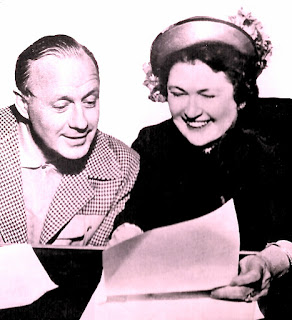
Heard in the Fred MacMurray part is Colbert’s Palm Beach Story co-star Joel McCrea (pictured above, with Colbert, reading the “Hands Across” script). Introducing the two leads, showman DeMille credited himself with their discovery:

Greetings from Hollywood.  Tonight’s event, with its glittering stage, its scientific wizardry that carries our voices to all corners of the earth and its audience of millions is a thing that I couldn’t have predicted when I first knew Claudette Colbert and Joel McCrea.  The Lux Radio Theater was then as remote from Hollywood as the moon.  But I predicted the eventual triumph of these two young people and was privileged to contribute to it.  I gave Joel McCrea his first motion picture contract.  Claudette was not then the favorite of millions, allowed to choose her stories, directors, and writers. The studio insisted I give her a dialogue test before casting her.  I did—and starred her in The Sign of the Cross and Cleopatra.

For the privilege of putting her hands on Lombard’s part—and the generous remuneration on the table—Colbert was obliged to declare that they had touched nothing but Lux toilet soap ever since her first appearance on the New York stage (in the 1920s). As I put it in Etherized Victorians, my doctoral study on old-time radio, it was all a matter of one hand washing the other.

Wireless Women, Clueless Men: Louella Parsons, Dirt Dispenser

Today, I am closing my series of tributes to women in American radio by devoting this final edition to one of the biggest names in Tinseltown hearsay: Hearstian columnist Louella Parsons. I leave it to Ms. Parsons to dish a little dirt about her on-air scandalmongering, even though that dirt is no more messy than a dusting of confectionary sugar on a well turned cuff. “Well,” Parsons told readers of Radio and Television Mirror Magazine (from an issue of which this picture has been taken), “I can safely say that no one else in the business can boast that her program was almost a radio casualty because of a toothache, a can of soup, and Audie Murphy’s cold! Likewise, I’m the only woman in these parts who’d had the dubious distinction of being almost ‘stood-up’ by Clark Gable. . . .”

Now, she does say “almost.” As it turns out, Gable was scheduled to appear on Parsons’s Hollywood Hotel when he got “snarled up” in a traffic accident. Shortly before the broadcast, he showed up with assorted bruises, welts, and a torn coat; but, according to Parsons, he insisted on going ahead with the live broadcast as scheduled, since, as the enterprising secret sharer put it, “he knew the program was very important to me, and didn’t want to disappoint me.”

He also knew better than to stand up this formidable career ender. So, Parsons’s wounded pride was mended—and Gable’s stardom secure. “Since that day,” Parsons added, “he has had a very special place in my book of friends.” Merely pencilled in, no doubt. This lady dealt in muck, after all, which in her profession is more precious than friendship.

I’ve mentioned Joan Crawford’s mike fright before in this journal. It was a well-known fact the first lady of gossip enjoyed repeating, claiming that the star “ran like a startled faun” every time a microphone was as much as “mentioned” to her. Eventually, the actress’s fear of bad press must have been more pronounced than her microphonophobia, as Parsons got her to go on the air talking about “what an advantage it was to be born on the wrong side of the tracks.”

Carole Lombard, on the other hand, was “completely unruffled when she lost two whole pages of her script. She merely ad libbed her way through, without a pause, and you’d never have known the difference.” Abbott and Costello, in turn, “turned the tables” on Parsons by reading her lines instead of their own. So, the chat hostess obliged by reading theirs, and, “as mad as it may sound,” she discovered that “the program had some semblance of sense to it.” These recollections are not exactly an endorsement of Parsons’s writing; but, by her own admission, “lack of talent has never dimmed [her] enthusiasm.”

Her first program, Hollywood Hotel, was off to a shaky start back in 1934: “My show was probably the worst in existence—I wrote, produced, and directed it all by myself.” Perhaps, it was not so much the writing and directing that were most amiss. Unlike rival columnist Hedda Hopper, Parsons did not have a trained voice, let alone a pleasing one; but she “knew too that is wasn’t how [she] said anything that mattered, because people were interested in what [she] was talking about.”

Sure, she couldn’t “close [her] eyes to television indefinitely,” she concluded. “But until better make-up and lighting are developed,” she vowed to “stick with [her] Hooper” (Hollywood jargon for radio audience).  And stick she did, for better and worse.

On This Day in 1942: Death Upsets the Pudding Trade

Only a few days ago I commemorated my 100th entry into the broadcastellan journal by going in search of fellow old-time radio bloggers. Not a week later, the subject has become considerably more prominent among bloggers with an entire classroom of neophytes posting their thoughts on radio’s “imagined community” and reviewing individual programs selected by their instructor. It remains to be seen whether the thought-sharing extends beyond the virtual college annex, or just how long the on-air engagement with “yesterday’s internet” (as Gerald Nachman called the radio) will last. “Tired of the everyday routine? Ever dream of a life of romantic adventure? Want to get away from it all?” Just hop over to technorati and type in “Three Skeleton Key,” the title of the first radio play on the group’s listening list.

Speaking of “everyday routine,” it was hardly business as usual on Jack Benny’s Jell-O program on this day, 18 January, in 1942. “Jack Benny will not be with us tonight,” announcer Don Wilson informed those tuning in for some fun and laughter. Instead, the half-hour was filled with song and band music, with the reassurance that Jack would be back on the following Sunday to entertain America. Was the beloved comedian out sick, as he would be for five weeks in 1943, when George Burns and Orson Welles guest-hosted the show?

No, it was the violent death of glamorous, 33-year old motion picture actress Carole Lombard, Benny’s co-star in the Lubitsch comedy To Be or Not to Be, then in post-production. Lombard’s death on 16 January—and Benny’s cancellation of his scheduled performance two days later—were solemn reminders how the war, into which the US had just entered in December, would alter the everyday lives of all Americans, service(wo)men, celebrities, and civilians alike. The Academy Award-nominated actress had been returning from a War Bond Drive in Indianapolis when her plane crashed and killed all passengers on board. For her contribution to the war effort, Lombard was later awarded the Presidential Medal of Freedom.

To be sure, there were no references to Lombard’s death during the 18 January broadcast, news unlikely to have a favorable impact on the sale of gelatine puddings, the manufacturers of which sponsored the popular program. On the following Sunday, Benny’s writers even found humor in dealing with the comedian’s fictive car crash.

For one night, though, Benny’s conspicuous absence spoke volumes louder than this speech in Hamlet, the play from which Lombard’s last movie borrowed its title and which presented the miser from Waukegan in a preposterous impersonation of the miserable prince (pictured above). Asked to explain just what “seems” to be the matter with him, Hamlet replies:

‘Tis not alone my inky cloak, [. . .],
Nor customary suits of solemn black,
Nor windy suspiration of forced breath,
No, not the fruitful river in the eye,
Nor the dejected haviour of the visage,
Together with all forms, moods, shows of grief
That can denote me truly. These indeed “seem,”
For they are actions that a man might play;
But I have that within which passeth show—
These but the trappings and the suits of woe.

Comedy can do only so much to combat grief, solemn speeches so little to capture it. Beyond the domain of the airwaves, the rest is silence.