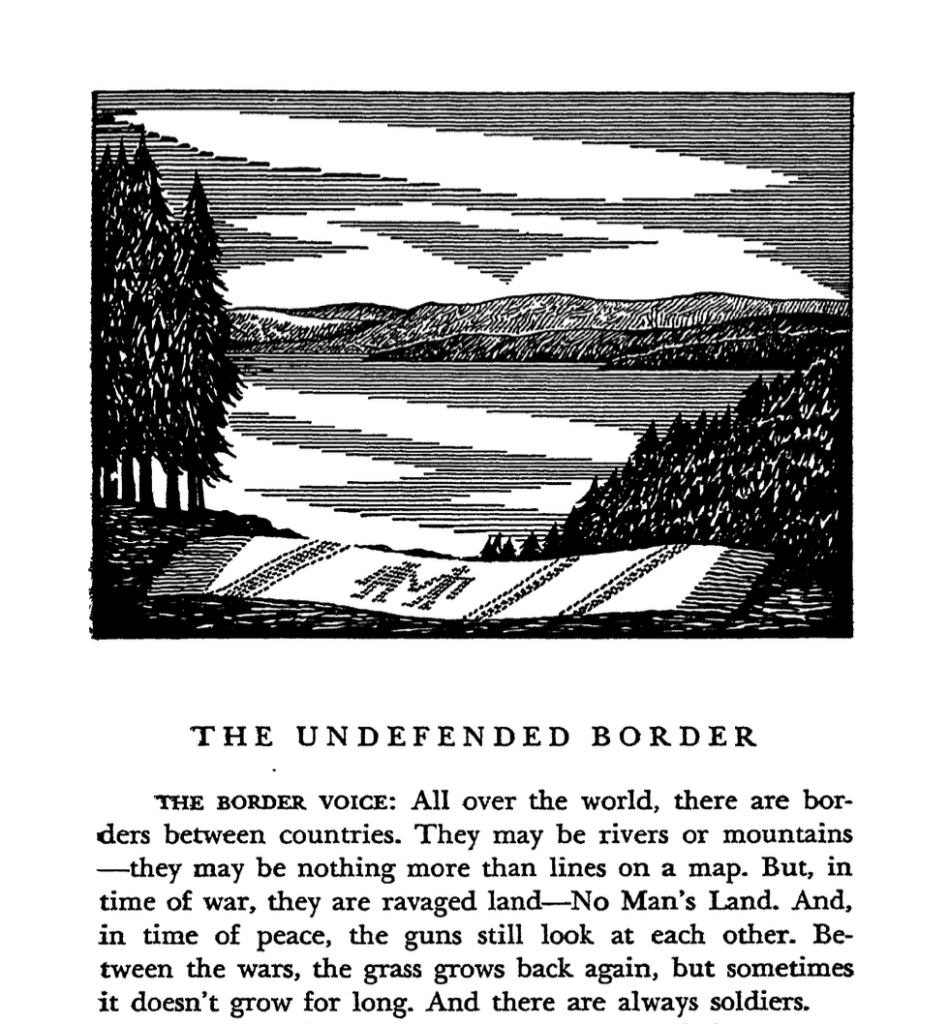
The published script as it appeared in We Stand United, an anthology of radio plays by Stephen Vincent Benét and “decorated” by Ernest Stock.
I commenced this journal back in 2005. It was intended as a continuation of, and promotional vehicle for, my doctoral study “Etherized Victorians: Drama, Narrative, and the American Radio Play, 1929–1954.” Its title, broadcastellan, was meant to declare me to be keeper of a vast Luftschloss—a neglected alcazar of the air, immaterially composed of numberless radio recordings I determined to play back.
As of this post, broadcastellan is nearing its twentieth anniversary. While I do not take this as an opportunity, let alone an excuse, to reissue older posts, I nonetheless wonder: When history seems to be repeating itself, perhaps I may be justified to do the same, if only to demonstrate that not every “been there” necessarily translates into a feeling of “done that,” and that not all twice-told tales are a rehash—not, at least, when you approach them from a perspective that has profoundly, even fundamentally, changed along with the context, your life experience and your attitude toward the world.
I devoted one early entry to “The Undefended Border” (1940), a play by Pulitzer Prize-winning poet Stephen Vincent Benét (1898–1943). Revisiting it now, in the age of the MAGA tariff wars and annexation threats, I cannot but think of the loose cannon that is recklessly flouting, or at any rate tarnishing, the legacy of the rusty “lone cannon” commemorated in Benét’s play.
Well, the afternoon is about as lively as a cancelled séance whose medium walked out due to death in the family. For the past few days, picking up where I left off a long time ago, I’ve been flicking through two sets of an English literature anthology. Rather than tossing out the old for the new, something I’d be happy to do with a pair of shoes, I’ve been comparing the volumes, pondering the expulsion or demotion of canonical authors whose once prominent works have been removed from subsequent editions. One such author now represented by fewer works is Victorian poet laureate Alfred, Lord Tennyson.
Now, reading Tennyson on a gloomy day does little to brighten the mood; but the following lines, from “In the Valley of Cauteretz” (1864), seem worth reviving, if only to remind me of my present state of mind.
The speaker of the poem, whom we may or may not take to be Tennyson himself, returns to a stream he once visited with a friend, now dead:
Thy living voice to me was as the voice of the dead, And all along the valley, by rock and cave and tree, The voice of the dead was a living voice to me.
Tennyson may have been revisited by the memories of his dead friend Arthur Hallam; but to me these lines somehow echo my own noisy yet quiet present, conjuring up my life among the voices of the past, my dwelling and revelling in recorded speech. Why do many of the radio voices I replay each day, transcribed sounds of live broadcasts featuring people now living no longer, sound so much more alive or closer to me than the voices of the present day?
Radio, back in the 1940s, when thousands of men were dying in battle far from home, was complicit in this sense of being visited by those gone or lost, a conjuring act achieved by a mere twist of the dial. Radio often presented itself as a spiritual medium, a modern device capable of annihilating space as well as time. On this day, 2 October, in 1944, for instance, Walter Huston introduced a play about the life of Thomas Paine by remarking that the words of this man called “Common Sense” still speak the
thoughts of many of us even today, in the year of 1944. And because of many other thoughts that this man put into words, we, in these troubled times, reach across the years to shake hands with him, to shake hands with Thomas Paine.
Sure, Thomas Paine sounds an awful lot like Edward G. Robinson, in whose hands lay Robert L. Richards’s script for that broadcast of “The Voice on the Stairs,” produced by the Cavalcade of America. Still, the phonic handshake was neither phoney nor merely symbolic; it was an act symptomatic of radio’s exploitation of our sense of revenance when we hear a voice from the past.
I am reminded of a friend of mine (the one with whom I went to the mystery book store a while back) who threw out her answering machine after playing back the voice of her dead father, still calling for her from the sonic loop of an old tape recording. When we look at pictures of dead people, the subject does not spring to life in the process of beholding; instead, pictures of the past or dead tend to serve as memento mori. They are a representation that does not quite render present, a reminder that is merely an aid to the act of calling to mind, whereas a recorded voice—sound being alive for the duration of its occurrence—streams through the ear canal into the now of our presence before fading into memory. Emanating from the living or the dead, it comes to life anew with each listening.
Dead, alive? The living dead? Or, speaking Tennyson, “Death in Life”? Perhaps I have dwelled among these sonic revenants for too long, becoming in turn, like Widmark’s character in the Inner Sanctum thriller “The Shadow of Death” (also cast on this day, back in 1945), dead to the world. Being engaged in this kind of séance, in the retrieval and re-presentation of past voices, I at times sense being shut out from and slipping out of touch with the living. Just like being caught in the internet, living in a world of sound is, after all, only the exposure to an echo of life—a reverberation produced by the clashing bones of a life stripped of flesh.
Sure, his life near Concord, Massachusetts, as he describes it in Walden, was a quiet one. Thoreau “kept neither dog, cat, cow, pig, nor hens, so that you would have said there was a deficiency of domestic sounds; neither the chum, nor the spinning-wheel, nor even the singing of the kettle, nor the hissing of the urn, nor children crying, to comfort one. An old-fashioned man would have lost his senses or died of ennui before this.”
There is violence in the phrase. And for once I can sense it. Silence being “broken,” I mean. For the next two months or so, my life will be less quiet than I have come to live and like it of late. There will be old friends visiting in July and September, there will be travels in good company, and there will be reunions in New York and in New England this August. I shall endeavor to keep my journal all the while; but journals like this are so much easier to keep in the monotone and silence of a retiring life, a life which need not be tired or tiresome as long as there are thoughts to be spun from whatever impulses and impressions there are to be got and gathered in the everyday. Such contemplative quiet, which to some might spell disquietude, was experienced by Henry David Thoreau, who was born on this day, 12 July, in 1817.
Yet even in its remoteness, his life was still filled with the “Sounds” to which Thoreau dedicated a chapter of Walden. In it, he argues that, while “confined to books,” we are “in danger of forgetting the language which all things and events speak without metaphor, which alone is copious and standard. Much is published, but little printed.” What he found being made public were the sounds that not only surrounded but defined his everyday. During that first summer at Walden, Thoreau did not read. Instead, he looked, listened, and took in:
I had this advantage, at least, in my mode of life, over those who were obliged to look abroad for amusement, to society and the theatre, that my life itself was become my amusement and never ceased to be novel. It was a drama of many scenes and without an end.
Even then, the drama of the scheduled, orderly life of the city was penetrating the quiet woods, sounds that told of a life governed by the ticking of clocks rather than the time told by the elements and the stirrings of nature:
The whistle of the locomotive penetrates my woods summer and winter, sounding like the scream of a hawk sailing over some farmer’s yard, informing me that many restless city merchants are arriving within the circle of the town, or adventurous country traders from the other side. As they come under one horizon, they shout their warning to get off the track to the other, heard sometimes through the circles of two towns. Here come your groceries, country; your rations, countrymen! Nor is there any man so independent on his farm that he can say them nay. And here’s your pay for them! screams the countryman’s whistle; timber like long battering-rams going twenty miles an hour against the city’s walls, and chairs enough to seat all the weary and heavy-laden that dwell within them. With such huge and lumbering civility the country hands a chair to the city. All the Indian huckleberry hills are stripped, all the cranberry meadows are raked into the city. Up comes the cotton, down goes the woven cloth; up comes the silk, down goes the woollen; up come the books, but down goes the wit that writes them.
The wits writing plays for old-time radio, who often lent Walt Whitman their ear, very rarely listened to Thoreau, even though a sound effects artist might have appreciated the noise that lent rhythm to Thoreau’s seemingly disorderly existence. Perhaps, his civil disobedience went against the grain of those laboring in a mass medium whose commercial sponsors counted on conformity.
An impersonation of Thoreau was heard, however briefly, in “The Heart and the Fountain,” a radio play about his contemporary, Margaret Fuller. Produced by the Cavalcade of America it was presented on 28 April 1941—at a time when it suited American broadcasters to be quiet about the war in Europe, a time when life on a commune like Brook Farm sounded like escapism,” a Blithedale Romance to blot out thoughts of Blighty.
Getting away from modernity need not be an escape; it can be a chance to come to your senses by subjecting yourself to silence and simplicity—a challenge that, in an age of over-stimulation, may very well drive us out of our narrow minds.
Well, I’ve only been back some forty-eight hours, but the sunny interlude in Cornwall, so poorly captured by my camera, already seems a distant memory. It was Thomas Jefferson—born on this day, 13 April, in 1743—who argued that travelling makes “men wiser, but less happy.” Is this true? “When men of sober age travel,” Jefferson claimed, they may gather useful knowledge, but “are subject ever after to recollections mixed with regret; their affections are weakened by being extended over more objects; and they learn new habits which cannot be gratified when they return home.” Should we limit our exposure to the world by concentrating on what is closest or by selecting a specific if narrow field of inquiry whose soil we continue to till skilfully to reap a rich harvest?
My field, of course, is so-called old-time radio, and I seem to take the fruits of my research along with me or take soil samples wherever I travel. Jefferson would not have approved of my preoccupation with American radio drama and with western popular culture in general, since he held storytelling in rather low esteem:
A great obstacle to good education is the inordinate passion prevalent for novels, and the time lost in that reading which should be instructively employed. When this poison infects the mind, it destroys its tone and revolts it against wholesome reading. Reason and fact, plain an unadorned, are rejected. Nothing can engage attention unless dressed in all the figments of fancy, and nothing so bedecked comes amiss. The result is a bloated imagination, sickly judgment, and disgust towards all the real businesses of life.
Now, in the 20th century, it was beginning to become clear that the “real businesses of life,” as interpreted by Americans, was big business: producing goods, advertising them, generating sales and making profits. So, when Jefferson was being celebrated some 195 years after his birth, his life, too, was turned into a promotional opportunity. The opportunist, in this case, was the du Pont company, who, in order to improve their image as a wartime profiteer, came up with the slogan “Better living through chemistry” and sponsored a series of historical radio dramas called Cavalcade of America. It is a fascinating merger of history, entertainment, and advertising I’ve explored in my dissertation and previously discussed here on several occasions.
On this day in 1938, Jefferson’s connections to the du Pont family were thoroughly exploited to suggest that, like Jefferson—the founder of the University of Virginia—the du Pont Company was chiefly interested in educating America, rather than amassing riches from the manufacture of gunpowder.
In “Thomas Jefferson, Pioneer in Education,” the future US President meets Pierre Samuel du Pont de Nemours (1739-1817), a French economist whose son, Eleuthère Irénée turned to gunpower manufacture during the volatile and dangerous days of the French Revolution. No mention is made of the source of the du Pont fortune, leaving listeners with the impression that the du Pont clan were a group of benevolent scholars who admired the United States chiefly for its advancements in education.
Children in the United States, the old Monsieur du Pont told Jefferson in the Cavalcade‘s version of history, “are encouraged to read and comment. Controversy has developed argumentation and given room for the exercise of logic. This country has a large proportion of moderately well-informed men. But that does not mean that the general education cannot be improved. And if improvement is a possibility, it is a duty.”
To underscore this message, a great-great grandson of papa du Pont seizes the microphone for a curtain call, in which it is suggested that his family played a substantial role in American education. Cited for “good taste in advertising,” the Cavalcade program, much reviled by erstwhile contributors like the aforementioned Arthur Miller, seems to have counted on the “moderately well-informed” and done its share to remove all traces of “controversy” and “argumentation” from the cleverly crafted infomercials it passed off as history lessons. Was this “better re-living through chemistry”?
The retrograde activity of keeping up with the out-of-date seems generally ill-suited to blogging. I doubt whether to keep looking back—and looking forward to doing so as I do—is such a forward-looking thing to do. A blog signifies little to most readers if it cannot bring them up-to-date on its declared subject matter, be it popular culture, politics, or fly-fishing. I have often felt compelled—and more often been compelled by others—to defend my engagement with the outmoded; indeed, the first comment left for me in the Blog Explosion directory was a terse “why?”
The answer, if I felt obliged to dignify such a monosyllabic and misologic remark with a reply, is this: I enjoy the challenge of discovering the relevance of a cultural artefact or an obscure piece of writing not created with me or my present in mind, and debating to what degree my thinking and being might be indebted to the attitudes reflected in such products. Besides, not being able to relate or connect to the supposed bygone is a personal loss, and, given the potential of history repeating itself, often a dangerous one at that.
Now, it would require some degree of mental obduracy or lack of imagination not to be able to relate to “An American Is Born,” a play that aired on US radio on this day, 19 January, in 1942. After all, “An American Is Born” deals with persecution and immigration in wartime, which makes it eminently topical. It is also a deliberate and unabashed work of propaganda, composed at a time when the word did not yet carry quite as negative a connotation as is attached to it these days.
Just how accepting would today’s audiences be of a play like “An American Is Born”? How likely would they find it produced and disseminated by the mass media?
“An American Is Born” was adapted by radio playwright Arch Oboler from a novella by Peter Jefferson Packer and Fanya Lawrence Foss. Written when the US had not yet entered World War II, and first sound-staged in late 1940 with Elisabeth Bergner in the lead, it was again produced a little over a year later for the Cavalcade of America program, with Bette Davis heading the cast. Clearly, this “American” was reborn to be recruited for home front duty.
In the 1942 production, Davis, who was one of Oboler’s favorite leading ladies, played opposite the versatile radio actor Raymond Edward Johnson. Johnson and Davis took on the roles of Czech immigrants Karl Kroft and his pregnant wife Marta. Their US visa having expired, the young couple cross the border to Mexico, where they wait for their quota numbers to come up. “With the left foot first,” Marta insists as they touch Mexican soil. “That means we’ll be back soon.”
Marta, whose father fought for democracy in her native Prague, desires nothing more than for her child to “be an American from his first cry.” In a “world gone mad with the ravings of little men, he should be born in a country that remains sane and firm. A country that believes that man, as an individual, has certain inalienable rights.”
Initially as idealistic and hopeful as the speech Oboler puts in her mouth, Marta is confident that their stay will only last a few days; but she is soon undeceived about the process of immigration. For those waiting, the weeks and months across the border are filled with uncertainties, threatened by corruption, extortion, and political persecution.
When a fellow European offers to assist the young couple, Marta little suspects that he is a member of the Gestapo. She is unaware as well that her openness about her father’s political convictions endangers the lives of her parent and her unborn child.
Another immigrant who is thus intimidated commits suicide, but not before doing away with the enemy in their midst. At the risk of her own life and that of her unborn child, Marta manages to convince Karl to make a run for it. As the title suggests, the two find their way across the border to the US, where their child takes the first breath of freedom as an American citizen.
When was it that such an overtly propagandistic melodrama last reached a large American audience? The 1991 movie adaptation of the Reagan-era bestseller Not Without My Daughter comes to mind, a film in which even a Coca-Cola sign in a Turkish bordertown was greeted as a herald of US American freedom. Seeing it as an international student living in New York City, I thought the film distressingly simplistic, shamelessly manipulative and, in the context of the Gulf War, rather nauseating at the time.
Are narratives like “An American Is Born” rarer now because Americans have less to be proud of as a nation or because today’s purveyors of popular culture, with an international market in mind, doubt that the brand of one-message-suits-all patriotism can still reach a sizeable enough audience to make it pay off.
US network radio did much to hold a nation together, both during the Depression and the Second World War. I suspect, especially on the subject of immigration, this is no longer a role the media are ready, willing, or even able to play.
Just a little while ago, I was following Jack Benny and Mary Livingstone into a Beverly Hills department store, where, on this day, 18 December, in 1949, they found themselves in a stampede of bargain hunters. As the doors of the emporium opened, the valued customers were greeted with a whip and shouts of “mule train, mule train”—a regular muletide treat.
Accounts of penny-pinching Mr. Benny as a latter-day Scrooge tasked with the challenge of Christmas shopping were a seasonal feature on US network radio. Having had a few chuckles, but not enough material for this online journal, I continued to raid my library of scripts and recordings and came across a play I hadn’t read or heard in a while. It’s a play for all seasons, but one conveying a message particularly well received toward the end of the year: the promise—and the reality—of peace.
The play is “The Undefended Border” by Pulitzer Prize winning poet Stephen Vincent Benét. Written especially for radio, it was first heard on the Cavalcade of America program on 18 December 1940—about a year before the US entered into war with Japan and Germany. As I discuss it in Etherized Victorians, my doctoral study on old-time radio, both networks and sponsors were squeamish about any overt commentary on the war then being waged in Europe. Broadcasters were not permitted to play “advocate,” to endorse an anti-isolationist position, or any other political position, for that matter.
Engaged in a comprehensive campaign to adjust its corporate image in the wake of a report about the company’s profiteering during World War I, the DuPont company commissioned an advertising agency to design a series of historical dramas dedicated to telling American stories of peace and progress. A well-respected writer of historical and patriotic verse, an author whose death in 1943 was argued by one contemporary critic to be “an even greater loss to radio than to poetry,” Benét was just the man to deliver such a message—but not without indirectly signalling his support for Britain in the war against fascism.
“The Undefended Border” celebrates the peace between the United States and Canada. Both countries were at war in 1812; but there existed friendships between those living along the border. Benét tells of such a friendship and how it encouraged an American citizen to go on mission to Washington to urge the Acting Secretary of State, Richard Rush, and the representative of the British crown, Sir Charles Bagot, to create a border that would foster rather than endanger friendly relations between the neighboring countries.
“All over the world, there are borders between countries,” Benét begins his play, narrated by character actor Raymond Massey:
They may be rivers or mountains—they may be nothing more than lines on a map. But, in time of war, they are ravaged land—No Man’s Land. And, in time of peace, the guns still look at each other. Between the wars, the grass grows back again, but sometimes it doesn’t grow for long. And there are always soldiers.
But from New Brunswick to Puget Sound there runs a border between two great nations of proud people, individual people, people with their own customs and beliefs and ways, and that border has not one fort, not one ship of battle, not one hidden or usable gun. There is a lone cannon. And they point it out to tourists as a memory of the past.
The Rush-Bagot Agreement was signed in April 1817, and the two countries went on to create a “great house of freedom.” Was it the doing of that one farmer who travelled on foot to Washington to have his say?
Can the spirit of Benét’s play endure? Or will it be the doing of today’s anxious politicians to tear down our freedoms by putting up new fences? Love Thy Neighbor, I say. Just don’t ask for assistance from stubbornly feuding misers like Mr. Benny.


 There is violence in the phrase. And for once I can sense it. Silence being “broken,” I mean. For the next two months or so, my life will be less quiet than I have come to live and like it of late. There will be old friends visiting in July and September, there will be travels in good company, and there will be reunions in New York and in New England this August. I shall endeavor to keep my journal all the while; but journals like this are so much easier to keep in the monotone and silence of a retiring life, a life which need not be tired or tiresome as long as there are thoughts to be spun from whatever impulses and impressions there are to be got and gathered in the everyday. Such contemplative quiet, which to some might spell disquietude, was experienced by Henry David Thoreau, who was born on this day, 12 July, in 1817.
 Well, I’ve only been back some forty-eight hours, but the sunny interlude in Cornwall, so poorly captured by my camera, already seems a distant memory. It was Thomas Jefferson—born on this day, 13 April, in 1743—who argued that travelling makes “men wiser, but less happy.” Is this true? “When men of sober age travel,” Jefferson claimed, they may gather useful knowledge, but “are subject ever after to recollections mixed with regret; their affections are weakened by being extended over more objects; and they learn new habits which cannot be gratified when they return home.” Should we limit our exposure to the world by concentrating on what is closest or by selecting a specific if narrow field of inquiry whose soil we continue to till skilfully to reap a rich harvest?
 Just a little while ago, I was following Jack Benny and Mary Livingstone into a Beverly Hills department store, where, on this day, 18 December, in 1949, they found themselves in a stampede of bargain hunters. As the doors of the emporium opened, the valued customers were greeted with a whip and shouts of “mule train, mule train”—a regular muletide treat.
 Harry Heuser