
“The terror of the unforeseen”; or, Missing The Plot

While not entirely lacking in fancy or imagination, I generally avoid speculating about roads not taken, avoid taking in prospects retrospectively by asking “What if . . . ?” What if I had never gone to America? What if I had not left again some fifteen years later? What if what I had left had not been a country whose majority had just re-elected George W. Bush? While I would not go so far or sink so low as to substitute that “What if” with a nonchalant “So what,” I much rather ask “What now?” or justify whatever decision I made with a defiant “So there!”

I suppose dismissing the value of such speculations by arguing that any alternate of myself would not be myself at all is a way to avoid accusing myself of not always having chosen the best or most sensible path. Perhaps, a little foresight might have worked wonders greater than could ever be performed by getting myself worked up wondering, in hindsight, what I might have been; but to compound the failure to see the future with the failure of facing up to the past as is strikes me as perversely self-destructive . . .

Now, this is not about me sighing for what might have been. Since I don’t ask “What if,” such regrets rarely present themselves—itself ample justification for not indulging in morosely remorseful constructions of alternate biographies. This is about the alternate history I took with me on that trip back in early November 2004, when I left America for a new life in a part of the old world I had never seen let alone set foot on. The book in my hand luggage was Philip Roth’s The Plot Against America—which, I thought, was just the volume for the occasion, just right for the moment of leaving behind what had been home to me and what, owing to the hysterical war-on-terror politics in the shaping of which I had no right to take part, had felt increasingly less like the freest, the friendliest, much less the only place to be.

In The Plot Against America, Roth considers what might have happened if Charles A. Lindbergh had defeated Franklin D. Roosevelt in 1941 to become President, largely on the strength of a persuasive if false—and unfulfillable—promise of “an independent destiny for America.”

Roth conceives of an alternate 22 June 1941, five months after Lindbergh’s inauguration, while yet adhering to the historical fact that it was the day on which the Treaty of Non-Aggression between Germany and the Soviet Union was broken when the former nation embarked upon Operation Barbarossa in an attempt to conquer the latter.

On that 22 June in AR (Anno Roth) 1941, Lindbergh, as President, addresses his countrymen and women by expressing himself “grateful” that Hitler was waging a war against “Soviet Bolshevism,” a war that “would otherwise have had to be fought by American troops.” Listening with dread to that address over the radio are the central characters of Roth’s nightmarish revision, a Jewish family from New Jersey who are terrorized by the thought that the pursuit of an ostensibly “independent destiny for America” means the alignment with a regime engaged in the Holocaust, that putting America first means putting an end to their civil liberties, which means “destroying everything that America stands for.”

“The terror of the unforeseen,” Roth writes, “is what the science of history hides, turning a disaster into an epic.” Good histories, including alternate ones, may yet provoke terror by not swaddling in the paper logic of hindsight causalities what, however palpable, is yet uncertain and unascertainable as events unfold, and by reminding us not to mistake the unforeseen with the unforeseeable.

I remember opening The Plot sitting at a New York airport named after another American president and finding myself distracted by a German family visibly disquieted by the book’s cover art. There, staring at them was a swastika, the symbol of the terror that could have been foreseen. I was so self-conscious of this act of provocation that I was unable to read on; and once I had arrived in Wales, I was too absorbed in my own altered state—the detachment from what I had known and been—to have much use for any engagement with any alternate past one.

This week, for no particular reason, I picked up the book anew, and I read it as a commentary on two historical pasts—1941 and a 2004 (mis)informed by 11 September 2001—that somehow seems too comfortably remote, the anxieties that had given rise to its creation and my purchase of it being past as well. I can now amuse myself by pointing out that the day I read the abovementioned passage in Roth’s book coincided not only with the anniversary of that imaginary radio address but also with the birthday of Lindbergh’s spouse Anne; I can appreciate references to popular radio programs (“You should be on Information Please”) and personalities like Walter Winchell that render The Plot verisimilitudinous, conveniently to extract them for the sake of yet another cursory entry into this essentially escapist journal whose raison d’être was the sense of homelessness and estrangement I felt when I arrived in Britain on the eve of Guy Fawkes, that celebrated plot against King and Parliament.

What if I had not mislaid—and not even missed—The Plot all these years? What if I had avoided the impulse of discontinuity, of creating for myself a virtual space and time capsule of extra-historic hence fictitious isolation and had made more of an effort instead to participate in the real debates that are shaping my future? By refusing to ask myself “What if . . .?” as I belatedly re-enter The Plot I seem to be defusing Roth’s argument, fully aware that, by doing so, I may well expose myself to—rather than becoming exempt from—that certain “terror” of not foreseeing.
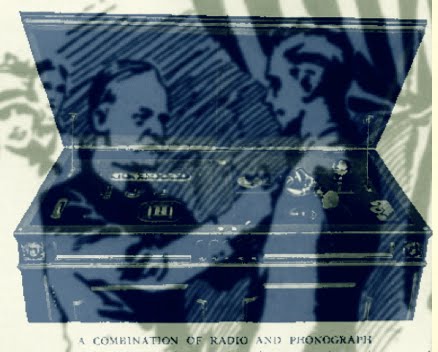
For the Record: Lindbergh and the Electrola

Announcer Graham McNamee called it the “most terrific broadcast [he] ever took part in.” He was referring to NBC’s on-the-spot coverage of Colonel Charles L. Lindbergh’s return from France to the United States on this day, 11 June, in 1927. It certainly was a technical achievement worthy of “this new world hero, this new ambassador of America to all other countries,” as McNamee heralded the “unassuming, quiet boy” who was anxiously awaited “not only the crowd of us ordinary folks but the cabinet of the President of the United States, high officials of the army and of the navy [. . .].”

According to the September 1927 issue of Radio Broadcast, NBC’s coverage of the event set a “new record,” requiring fourteen thousand miles of “wire line” and involved three-hundred and fifty engineers.

Now, the figures differ depending on who does the counting and recounting. In Empire of the Air, for instance, Tom Lewis claims it took twelve thousand miles of wire and four hundred engineers. But never mind those figures now—or the fact that the figure of Lindbergh itself differs now that the man must be held accountable for his fascist views and Third Reich sympathies. It was an historical event on and in the air, in aviation and broadcasting alike.

Awarding him with the Flying Cross, President Coolidge called Lindbergh a “[c]onqueror of the air and strengthener of the ties which bind us to our sister nations across the sea.” When it came to strengthening ties, the public-conquering airwaves were second to none. Not only was NBC’s coverage of Lindbergh’s return home the biggest network hookup to date, it was also, as McNamee reminded listeners, “the first time band music or music has been transmitted from the Atlantic coast to the Pacific coast, which is another epoch.”

As columnist John Wallace argued in the September 1927 issue of Radio Broadcast, the

making known of great national events, while they are actually taking place is, after all, radio’s unique contribution, and the one field in which it reigns supreme without competition from phonographs, theaters, churches, or newspapers.  And it is greatly to radio’s credit that it does this job so thoroughly and well.

Seizing the day, NBC may have rather overdone its coverage of the “hullabaloo incidental to Lindbergh’s arrival.” Commenting on the banquet given in the aviator’s honor, Wallace remarked that he

would have been quite content had all the speeches of eulogy been omitted and only that of the flyer broadcast.  Never have we heard worse blah sprung at a banquet, and sprung by such eminent leaders, divines and statesmen!

Aware that his was no doubt a minority report, the journalist added that “the nation as a whole was interested in every and any detail of the flyer’s reception and credit must be given to the National Broadcasting Company for slipping up on no smallest part.”

What, though, of all those who were unable to be part of that moment because they were away both from Washington, D. C., where the celebrations took place, and from the wireless? Able to annihilate space, radio was nonetheless time-bound. Given the “ephemeral” nature of broadcasting, the effort and money set aside to capture and yet not hold this historic moment seemed almost perverse:

Thousands of dollars are spent to engage talent, wires covering half a continent are hired, advertising is scheduled in newspapers, several studio rehearsals are held, and finally the elaborate program is put on the air. For an hour it lasts but it can never be repeated. If you did not hear it, all the king’s horses and all the king’s men couldn’t put it into your loud speaker again.

For some time, radio listeners had been able to appreciate the voices of their radio favorites on their phonographs. Not only could they take home Sam ‘n’ Henry, Vaughn De Leath, or the Happiness Boys—radio had made that happen—but they could hold and keep them there. “A very great number of well-known radio artists are regularly recording for each of the important phonograph companies,” Radio Broadcast pointed out—and supplied a list of

fine recordings made by the favorites of the Atwater Kent hour, and the famous artists of the Victor, Brunswick and Columbia hours. As for the jazz bands, the comedy duos, and other entertainers with a more local fame, they, too, are forever at your beck and call on the black discs.

What makes the festivities in honor of Lindbergh’s return to America another milestone in the history of radio is that, for the first time, phonograph records of the live broadcast were made available for sale. As Radio Broadcast reported,

Victor has the distinction of pioneering and they offer three double-face records of the national welcome to Colonel Charles A. Lindbergh at Washington. On these three records you have the voice of President Coolidge, the interspersed announcements of Graham McNamee, a short address by Colonel Lindbergh, and his longer speech at the National Press Club. It’s all there and if you close your eyes, it isn’t hard to imagine that the events are just taking place.

True, what has been preserved for us is an edited copy of the live event; the “ceremonies were recorded on forty-six record surfaces” and “edited down” to six. True, editing is judging what matters; it is, to a degree, falsification, intentional or otherwise. Still, without the technology available back then, without the efforts of those broadcasting pioneers, I would not be writing about radio today.

As much as I at times deplore my second-hand experiences, my removal in time and space from thrilling events and fascinating personages, I, as a belated auditor, am indebted to those records. And I am grateful, too, for the “new record” in aviation that marked the beginning of an age in which sound was no barrier.

Related recording
Graham McNamee on Lindbergh’s return to America (11 June 1927)
Recollections at 30, featuring the 11 June 1927 broadcast (26 December 1956)