
Totalitarian Vistas, Orwellian Dystopias, and the Myopics of Chernobyl

Well, are you ready for United 93, the movie dramatizing the experience aboard one of the planes hijacked on 11 September 2001? New Yorkers were the first to view the film, which premiered last night at the Tribeca Film Festival, where it is being screened alongside sequels and remakes like Mission: Impossible III and Poseidon. Are the popcorn-littered, digital surround-sound blasting multiplexes the most appropriate places to remember the past and commemorate the dead?

Having lived in Manhattan during the terror and aftermath of the World Trade Center attacks—days of fear, frustration, anger and uncertainty—I am doubtful that any traditional film narrative, whether somber of sensational, could deepen our understanding of terrorism, let alone supersede the horrific images that continue to replay in our minds.

Our desire to see for ourselves is sometimes best left unsatisfied, unless the act of seeing—and of not finding—drives home that we must probe not elsewhere, but differently. However impressive, suggestive or manipulative, pictures cannot show us our thoughts that, at best, they can merely provoke. More often, they become too overwhelming or altogether numbing, leaving us in a state of stupefaction in which complex ideas become dim and indistinct, a state quite advantageous to propagandist efforts. I am reminded of the description of the movie theater experience in George Orwell’s Nineteen Eighty-Four, a devastating portrait of an insensate mind:

April 4th, 1984. Last night to the flicks. All war films. One very good one of a ship full of refugees being bombed somewhere in the Mediterranean. Audience much amused by shots of a great huge fat man trying to swim away with a helicopter after him, first you saw him wallowing along in the water like a porpoise [. . .]. then you saw a lifeboat full of children with a helicopter hovering over it. there was a middle-aged woman [ . . .] sitting up in the bow with a little boy about three years old in her arms. little boy screaming with fright and hiding his head between her breasts as if he was trying to burrow right into her and the woman putting her arms round him and comforting him although she was blue with fright herself [. . .]. then the helicopter planted a 20 kilo bomb in among them terrific flash and the boat went all to matchwood. then there was a wonderful shot of a child’s arm going up up up right up into the air a helicopter with a camera in its nose must have followed it up and there was a lot of applause. [. . .]

Orwell’s dystopian fiction proved highly useful during the Eisenhower years, when it was appropriated for the purpose of demonizing communist ideals and socialist ideas that, in the depression-stricken period of the FDR administration, had been widely embraced, sanctioned, and partially implemented. A radio adaptation of Nineteen Eighty-Four that aired on this day, 26 April, in 1953, underscored the timeliness of Orwell’s “prophetic reporting of the future,” by casting newscaster Kenneth Banghart in the role of the narrator.

“Perhaps you’re wondering why a newsman is appearing in a Theatre Guild on the Air dramatization,” Banghart introduced himself and the play.

It’s because George Orwell’s great novel, Nineteen Eighty-Four, deals with the most terrifying subject in the news today: the threat to all free men of communism or totalitarian domination in any form. In fiction, Orwell creates for us a picture of what life might be, should the totalitarian forces succeed with their plan to become the earth’s masters.

It was a masterplan that—according to the disposable logic of America’s emerging consumer culture—was the due course of communism itself.

Thirty-three years after this broadcast—on 26 April, in 1986—the iron curtain was still firmly in place, keeping much from view and leaving more to the imagination of cold-war stirred westerners. It did not keep the radioactive cloud from moving westward, however well guarded the secret of the nuclear disaster of Chernobyl—or of its extent, at any rate—might have been. The boundaries we create in our minds, those we mind, and those we mindlessly accept, are no hindrances to the invisible force of destruction unleashed by hubris, ignorance, and greed.

Being pointed to it by someone who is generally a purveyor of visual treats, I took a virtual tour of the wasteland that is the area around Chernobyl today: a ghost world that will remain uninhabitable for generations to come. Not surprisingly, what renders these images—and the video clip above—most profound is what we do not get to see, what becomes tangible only to our receptive minds: the hazards of the half-life, the sorrow of lives lost, and the misery of life’s blind ambitions.
Trivializing History Is a Dangerous Assignment

Well, I have always been somewhat of a ham, even though my own life has remained the only long-running drama in which I have had the good fortune to play a sizable part. Yesterday, the cured meat was of the smoked variety. I spent the weekend, it having been a sufficiently dry one, at last, watching our gargantuan compost heap go up in flames (or smolder, at any rate). As the plumes wafted over the fields, I was reminded of the invisible cloud that, back in April 1986, made its way westward across Europe.  

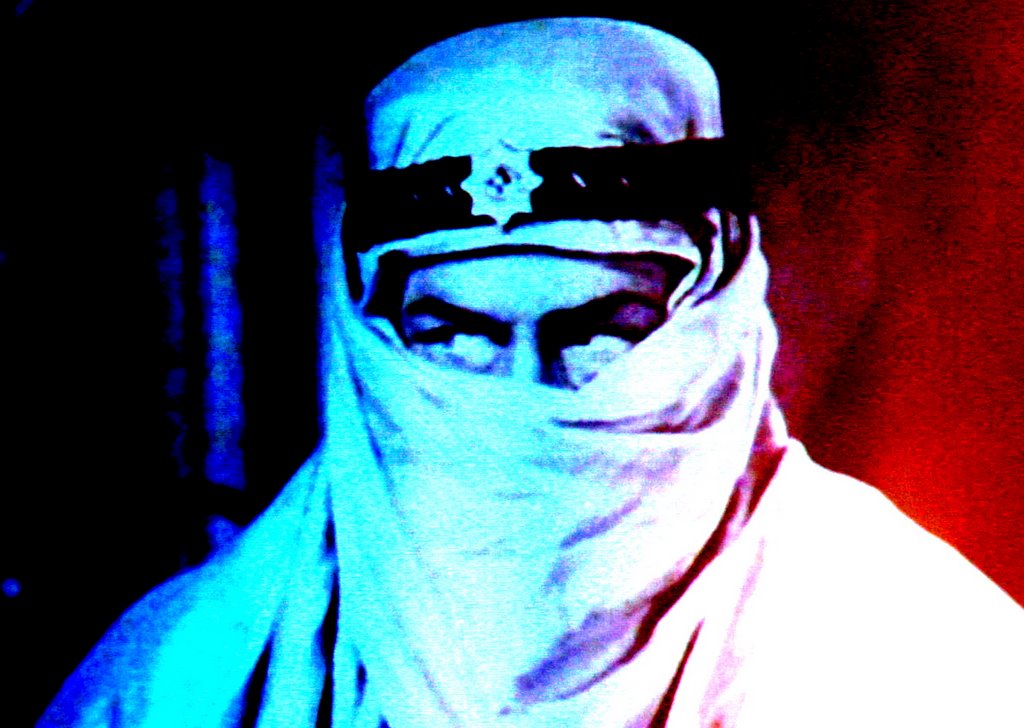
Brian Donlevy in the television version of Dangerous Assignment

I am referring, of course, to the nuclear disaster at the Chernobyl power station, the fallout and immediate aftermath of which I well remember as I saw polluted playgrounds being closed in Germany, pharmacists profit from outbreaks of hysteria, and toxic milk vanish from supermarket shelves (to be shipped, in powered form, to apparently immune consumers in the Middle East). It was a disconcerting experience worth recalling today, as oil prices in the West are rising nearly as fast as concerns about emerging nuclear powers in the East.

Is there any drama equal to the times in which we live? Is it in need of fictionalization? Can—and should—our fears—as far as they are felt by those who prefer to numb their pain or ignore its sources—be melodramatized and acted out for us in order to bring distant terror home and to render vague anxieties concrete?

During World War II, the mass media of radio and film tried to do just that—letting the home front see and vicariously experience what was at stake overseas. Such blatant propaganda would hardly be Hollywood-endorsed or swallowed whole today, be the objective ever so unobjectionable to the many.

I thought about this again last night, when I caught the Basil Rathbone/Nigel Bruce thriller Sherlock Holmes and the Voice of Terror (1942), which was shown on the British cable channel UK Drama. In it, the wireless becomes a tool used by the enemy—my ancestors from Germany—to instill fear and doubt in the British people. The air is contaminated by the less than subtle influences of a demoralizing force not unlike that exerted by the infamous Lord Haw Haw.

The thriller sought to counter this terrifying voice by giving the speaker a face, by turning fascism into a concrete figure—and a single one at that. As ideas become flesh, they not only seem more readily conquerable, they very nearly vanish altogether behind the mask created for the purpose of propaganda.

Melodrama operates by processing the abstract—the tangled roots of a problem—into a visible, tangible entity. What makes melodrama unlike life is not that it offers a happy ending—not all melodramas end happily, no matter how strongly our viewpoint might be enforced—but that it embodies and thereby obscures what is most potent and problematic in its disembodiment: the war of ideas.

Melodrama does not encourage its audience to perceive the ideological bases of any problem. It deals in specifics, thereby encouraging us to believe a problem to be solvable if only its manifestations can be overcome. Instead of making us question the sources of our fears—which may well be our own ignorance—melodrama provides more or less ready answers, for which reason it is the idiom of propaganda, used by politicians the world over with considerable success.

What has this to do with Chernobyl, you might ask. Well, the atomic age got under way by creating the illusion that nuclear power is safe as long as it is in the right hands—which means, of course, our own. It was a belief instilled in western minds ever since the dropping of the bomb that ended World War II. Popular storytelling, whether overtly propagandist or not, has assisted in selling atomic power as a safe source of energy and in justifying the nuclear arms race of the cold war.

On this day, 24 April, in 1950, for instance, Steve Mitchell (portrayed by Brian Donlevy) went on another Dangerous Assignment (in a US series of episodic radio thrillers so titled), this time in search of a missing nuclear physicist. A few weeks earlier, Mitchell (pictured above, in one of his TV adventures) had been sent to the Middle East to prevent a uranium-enriched sheik from creating an atomic bomb. The peril, such fictions insisted, lay not in the substance, but in its possessor.

As I shall explore in subsequent essays, the airwaves carried a great deal of such propagandist fiction into US homes during decade following the end of the Second World War; some of these stories trivialized uranium in everyday American life while most others demonized foreigners with a hankering after atomic might.