
Ephemerabiliaphilia: The (Unreturned) Love of Re-Collecting the Largely Neglected

My memory is poor, generally, and getting worse.  My desire to remember the forgotten – the ostensibly unmemorable – remains strong.  It is a love rooted in the need to champion the unloved, or, rather, the dis-loved, and to abandon myself to the abandoned.  It is a queer thing, to my thinking, which is queer always and could not be otherwise.  To love, perversely, what has been discarded or deemed unworthy of consideration, means disregarding what is widely held to matter and instead be drawn – draw on and draw out – what is devalued as immaterial.  It involves questioning systems of valuation and creating oppositional values.

Commenced in 2005, this journal was dedicated to what I termed “unpopular culture,” the uncollected leftovers that linger on a trash heap beyond our mythical collective memory.  To this day, down to my current project, Asphalt Expressionism – a curated collection of images engaging with the visual culture of New York City sidewalks – I carry on caring about the uncared-for and neglected, the everyday past which others tend to walk without taking notice.

There is no such thing as trivial matter.  Nothing is negligible in itself.  What makes something worthless is not a particular quality or lack thereof.  Rather, it is an attitude, an approach, a judgment – itself often a product of a cultural conditioning.  Nothing is intrinsically trivial, but anything may be trivialized.  As I put it, years ago, when I curated (Im)memorabilia, an exhibition largely of mass-produced prints entirely from my collection – “Trivia is knowledge we refuse the potential to matter,” whereas “Memorabilia is matter we grant the capacity to mean differently.”
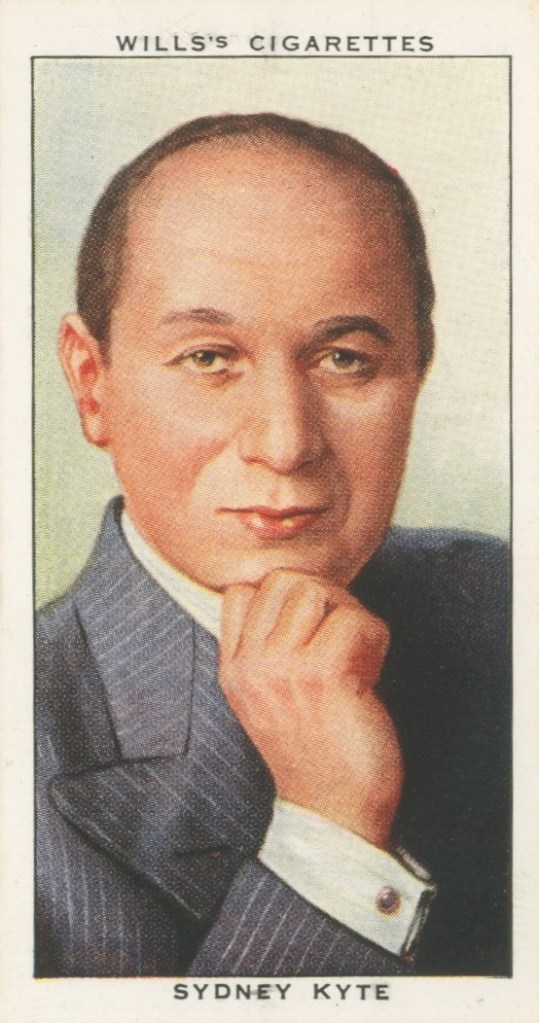
Low as a Kyte? A 1934 Wills’s Cigarette card featuring Sydney Kyte, a bandleader to whom no Wikipedia page is dedicated. The card sells online for under £1.

A 1930s cigarette card, for instance, may have once served the purpose of boosting sales by prompting smokers to collect cheaply mass-produced images of film stars or flowers or tropical fish.  Collecting them nearly a century later – long after the advertising campaign has folded and the image has become removed from the product it was designed to promote – means to extend the lives of such devalued objects by moving them into the sphere of our own temporary existence of which they in turn become extensions.  

Whether or not we take measures to preserve their afterlife, we instill collectibles with new meaning, give them value by investing them with our longings.  I, for one, never regard my belongings as financial investments; I do not collect calculatedly, anticipating that what I gather might be the worth something to someone else some day.

I also refuse to intellectualize my desires; I am wary of turning passion into an academic exercise.  That is, I do not rescue the marginalized for the purpose of demarginalizing my own existence by convincing others of the cultural value or historical significance of devalued objects – and of the case I make for their value.  Still, there is that longing to be loved, to feel validated, for all the reasons that many, I suspect, would regard as wrong.  

Why waste time on what is waste? Why dig up – and dig – what has become infra-dig through the process of devaluing, a hostile attitude toward the multiple, the unoriginal and commercially tainted to which we appear to be conditioned in a capitalist system that makes us feel lesser for consuming the mass-produced within our means so that we aim to live beyond those means, always abandoning one product for another supposedly superior?  There can be no upgrading without degradation, no aspiration without a looking down at what has been relegated to refuse.

I remember a gay friend telling me, decades ago, that when he was a child, drawing in kindergarten or elementary with other children, he would pick the color that was least liked by his fellow creatives.  I did the same thing when toys were being shared.  This unwanted thing could be me – this is me – is what must have gone through my mind when I took temporary ownership of the object of just about nobody’s affection.  And this, I believe, is at the heart of my impulse to make keepsakes of the largely forsaken.

I started writing this on the one-hundredth anniversary of the first radio broadcast in Britain – 14 November 1922 – by what was then not yet the BBC.  Sound, after all, is the ultimate ephemera, fleeting if uncollected, lost if not cared for.  The BBC used to erase recordings of its broadcasts, turning the potentially memorable into the immemorabilia beyond my grasp, and, in turn, turning my determination to lift them into my presence into futile longing, a nostalgia for the unrecoverable past.
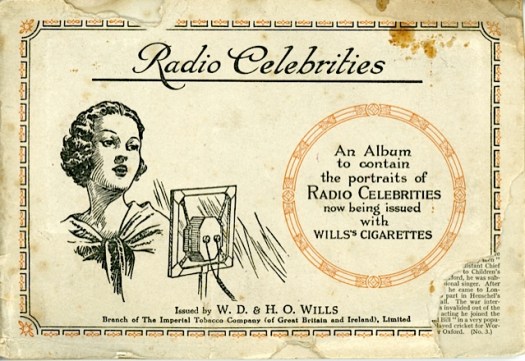
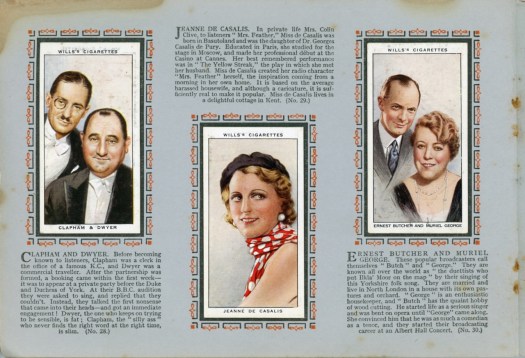
Smoke Gets in Your Ears; or, What Price “Butch" and "George”?

A keepsake that hasn’t been looked after

The other day, Bob and I drove down to Leominster, England.  The objective was to pick up a painting at a local auction house; but we made a day of it, during which we discovered Leominster to be a great town for antiquing.  Now, when it comes to treasure hunts, my definition of “priceless” is “unvalued,” a label (or stigma) attached to objects that somehow don’t matter much and therefore sell for next to nothing.  It is to those less prized items that I tend to be drawn—provided they have something to do with the undervalued performance art of radio. 

So, for about one hundredth of the cost of our latest oil, I took home a complete if somewhat tatty album of cigarette cards dating from 1934.  Since it was issued in Britain (by W. D. & H. O. Wills), the “celebrities” displayed in it are all folks heard on the BBC at the time—and rarely heard of thereafter.

Unlike their American counterparts, whose voices or musical talents are preserved on recordings anyone can readily retrieve online, most of these BBC personalities would be truly forgotten today if they had not made a name for themselves in other media.  Yet even if we remember the performer we are likely to be ignorant of the performance that brought them fame on the air.

A few years ago, Telegraph columnist Christopher Howse happened upon the same album now in my hands and remarked that the “world seen in [it] is as unfamiliar as the clipped tones of the celebrities it contains.”  Flicking through these pages means facing indifference and neglect.  How can we presume to know the 1930s if we can’t recall the names that then were household words, let alone put a voice to them?

Radio Celebrities—an oxymoron, perhaps?

Back then, the reverse was to be accomplished by those cigarette card collectibles: to put a face to the unseen visitors that millions welcomed into their homes.  No doubt, the chief purpose was to sell tobacco products—but aside from fueling an addiction these albums satisfied the need to turn word to flesh and hold on to fleeting sound by way of printed image.

“For many years,” the “Radio Celebrities” album reminded the purchaser, anno 1934, “broadcasting artistes, announcers and speakers remained rather mysteriously aloof—in the air, as it were!” No more.  The “Wireless” and their personalities were becoming “increasingly popular”; and the portraits to be collected and appreciated in this way were meant to “add a personal touch to names” that were already so “familiar to listeners.”

From time to time, I shall return to this album to report on the radio careers of Clapham & Dwyer, “Butch” (Ernest Butcher) and (Muriel) “George,” Jeanne De Casalis, and the forty-seven other “Radio Celebrities” that hit it big on the Beeb.

Bookshelf Cowboy

Well, howdy. His handsome mug is before me whenever I grab a book from my shelves. Randolph Scott, Series two, Number 385 of Zuban’s “Bunte Filmbilder” (a German line of cigarette cards, issued in 1937). I caught a glimpse of Scott this afternoon when I turned on TV, switching channels for an update on the stock market, the Heath Ledger autopsy, and whatever else made news today. Rage at Dawn (1955) was playing on Channel 4. Checking the Internet Movie Database, I realized that it might have been shown in commemoration of Scott’s birth, on this day, back in 1898.

Now, my frequent encounters with him in my library notwithstanding, I rarely come across his appealing phizog. This is mainly because I don’t care much for the genre in which Scott made his mark. Stagecoach aside, which to me is more of a small-scale Grand Hotel on wheels, I rarely watch Westerns (even though a certain—if unlikely—Texas Lady is prominently displayed in my bedroom). True, Scott co-starred in My Favorite Wife and played opposite Marlene Dietrich on two occasions; but otherwise, there isn’t much on his extensive resume that appeals to me. So, I am once again twisting the dial, the ether being Hollywood’s parallel universe.

Sure enough, apart from recreating his roles in Pittsburgh and Belle of the Yukon, Scott can be heard co-starring aforementioned Texas Lady, Claudette Colbert, in an adaptation of Preston Sturges’s Palm Beach Story (15 March 1943), filling the shoes of Joel McCrea. He was to do so again, a few months later, when McCrea did not appear, as scheduled, on the Cavalcade of America program, starring in the propaganda drama ”Vengeance of Torpedo 8” (20 September 1943).

While he did not get much to do or say in the rather dull rehash of Palm Beach Story, Scott was given a chance to prove his comedy skills on a number of occasions. Opposite Gene Tierney, for instance, he was cast in “A Lady Takes a Chance” on the Harold Lloyd hosted Old Gold Comedy Hour (unfortunately no longer available in the Internet Archive). For more laughs, Scott joined Paulette Goddard for a parodic “Saga of the Old West” on Command Performance (21 June 1945). Assigning the parts, Goddard declared: “Randy, you play yourself. A real, two-gun cowboy.”

Turns out that Scott got a chance to play the Ringo Kid, after all. On 4 May 1946, he took on John Wayne’s role in the Academy Award production of Stagecoach. Sharing the microphone with him to reprise the role of Dallas was Claire Trevor, radio’s original Lorelei Kilbourne of Big Town (whom I recently saw in Born to Kill).

To me, the more intriguing performances were Scott’s curtain calls, during which he got to address the audience. Having delivered his lines in the digest of “Palm Beach Story,” the actor was called upon to put his southern charm to work for the war effort, reminding the women on the home front that “it’s men like your own sons and brothers, your husband or sweetheart whom the Red Cross is serving. This year, don’t measure by ordinary standards. Make your contribution to the Red Cross War Fund just as generous as possible.”

“For most of us the war is a distant terror,” he told listeners of the Cavalcade broadcast, “until it is brought forcefully home by those very close to our own lives. Let’s match their effort at the front with ours at home. Back the attack with War Bonds.”

Of course, Scott’s commitment to the war effort went further than those appeals; he was, after all, a veteran of the first World War. And, like many of his fellow actors, he went on tour with the USO (an experience he shared with listeners of Hollywood Star Time).

Meanwhile, the gentleman from Virginia has gone back on the shelf. I shall see him again soon enough, as I reach for another volume on old-time radio. For this spur-of-the-moment tribute to him, Scott made me round up Cavalcade of America and Radio Drama by Martin Grams, as well as John Dunning’s On the Air.