With Claudia Williams at one of her exhibition openings following the publication of An Intimate Acquaintance
I had not long arrived in sweltering New York City for a month-long stay in my old neighbourhood on the Upper East Side when I learned that, across the pond, in my second adopted home in Wales, the painter Claudia Williams had died at the age of 90. I first met Williams in 2005. She was conducting research on a series of drawings and paintings commemorating the flooding of a rural Welsh community to create a reservoir designed to benefit industrial England. With my husband and frequent collaborator Robert Meyrick, who had known Williams for years and staged a major exhibition on her in 2000, I co-authored An Intimate Acquaintance, a monograph on the painter in 2013.
A decade later, an article by me on Williams’ paintings was published online by ArtUK on 28 May 2024; and just days before her death on 17 June 2024, I had been interviewed on her work by the National Library of Wales. So, when given the opportunity to write a 1000-word obituary for the London Times, I felt sufficiently rehearsed to sketch an outline of her life and career, as I had done previously on the occasion of her artist-husband Gwilym Prichard’s death in 2015.
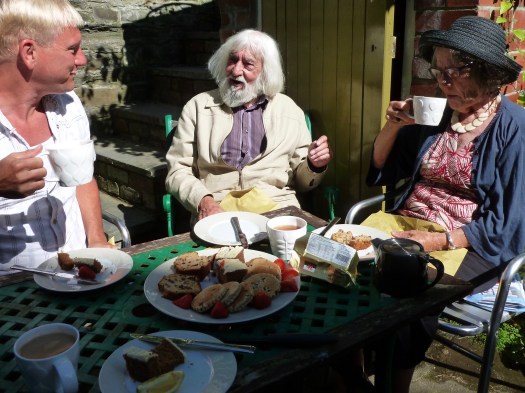
Lunch in the yard with Gwilym Prichard and Claudia Williams
All the same, I was concerned that it might be challenging to write another “original” essay, as stipulated by the Times, on an artist about whom I had already said so much and whose accomplishments I was meant to sum up without waxing philosophical or sharing personal reminiscences. In an obituary, salient facts are called for, in chronological order, as is a writer’s ability to determine on and highlight the essentials.
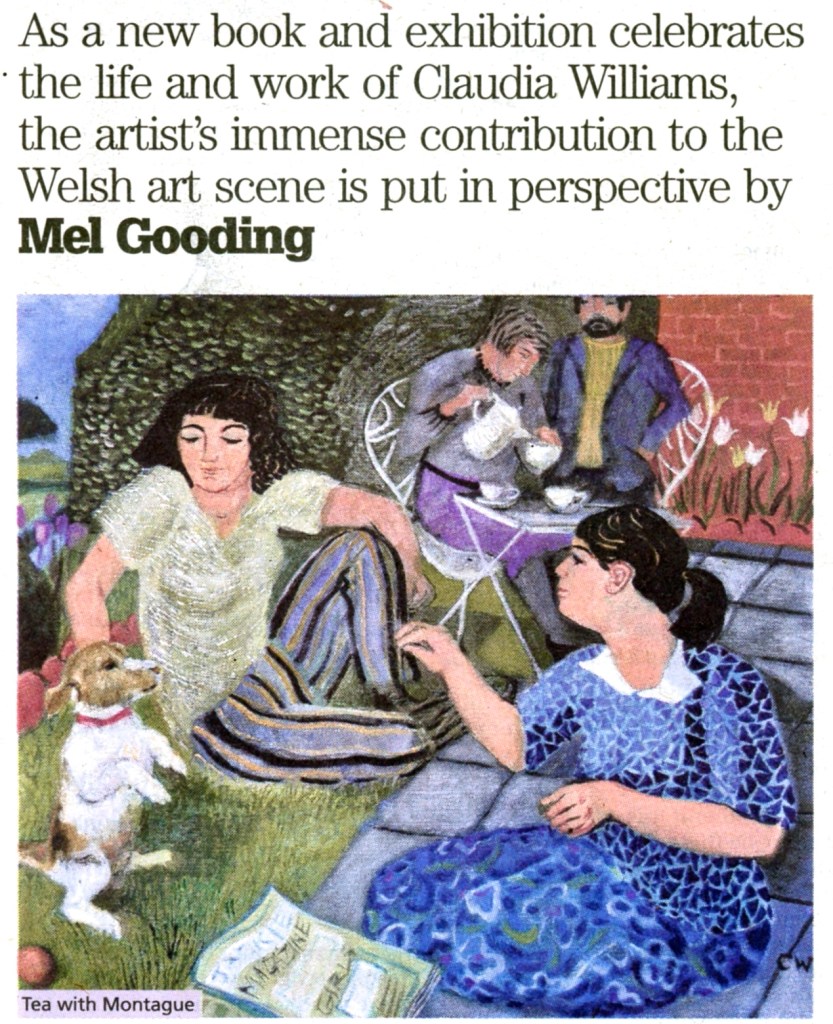
So I omitted recalling the enjoyment Williams derived from watching my Jack Russell terrier begging for food on his hind legs, a sight that inspired her painting Tea with Montague, or the “Mon Dieu” emanating from our bathroom when Williams and her husband, both in their seventies, intrepidly and jointly stepped into the whirlpool bathtub – slight episodes that, for me, capture Williams’ joie de vivre and her enthusiasm for the everyday.
Clipping of a newspaper article on An Intimate Acquaintance featuring my dog Montague as painted by Claudia Williams
In preparation for the monograph, Williams had entrusted me with her teenage diaries and other autobiographical writings, which meant there was plenty of material left on which to draw. Rather than commenting authoritatively on her contributions to British culture, I wanted to let Williams speak as much as possible in her own voice, just as her paintings speak to us, even though we might not always realize how much Williams spoke through them about herself.
What follows is the tribute I submitted to the Times.
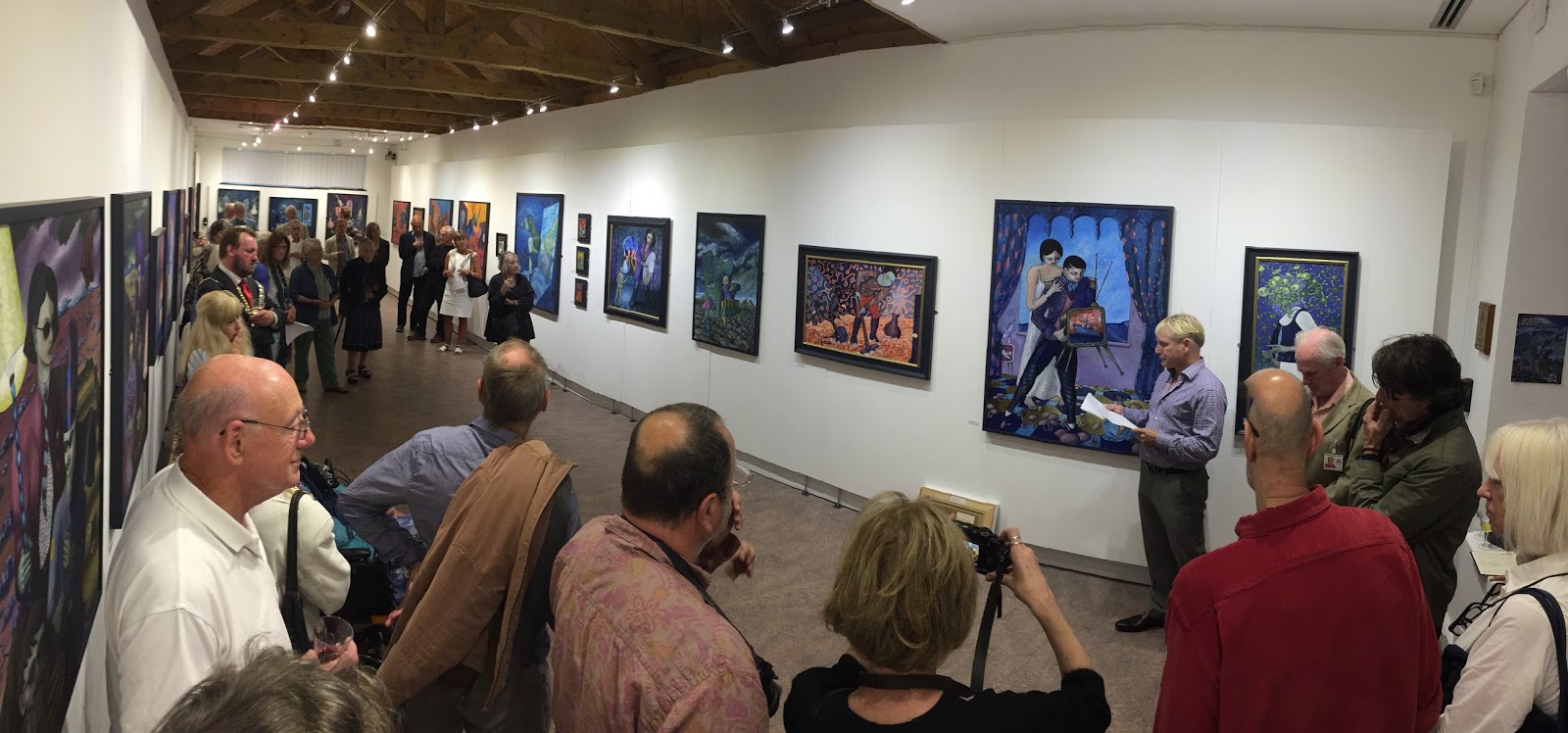
Ceri H. Pritchard at his solo exhibition Paradoxes, MOMA Machynlleth, 18 Sept. 2021
Some creative sparks managed to rekindle themselves during the pandemic; stoked up by a keenly felt sense of do-or-die urgency, they keep generating alternative realities – or alternatives to reality – out of the deepest blue of mind-numbing, soul-crumbling chaos. While I do not quite succeed in numbering among those motivated mortals, visual artist Ceri H. Pritchard certainly does.
In front of Metamorphosis I at MOMA Machynlleth, with a temporarily unmasked Ceri H. Pritchard
His prodigious output, mordant wit and renewed openness to experimentation are on full display in his latest of a slew of solo shows. Ceri H. Pritchard’s Paradoxes opened on 18 September 2021 at MOMA Machynlleth, one of Wales’s most distinguished contemporary art galleries, and is on view there until 13 November 2021. I have been keeping up with Ceri’s work and am excited to see it transmogrify. I said as much, or as little, in the introductory text panel I was glad to contribute to his exhibition:
Ceri first invited me into his studio in 2015. A few years earlier, I had co-authored monographs on his parents, figurative painter Claudia Williams and the late landscape artist Gwilym Prichard. At the time, I was as yet unfamiliar with Ceri’s decades-spanning international career. It was an unexpected, disorientating encounter – in his parents’ house, no less – with what Ceri here terms ‘Paradoxes.’
I was perhaps too quick to label his paintings ‘neo-surrealist’ in an effort to get an art historical handle on the uncanny with which I was confronted: an otherworldly territory strewn with the detritus of modernity, with outcast and less-than-easy chairs, outmoded models of disconnected television sets, and displaced floor lamps shedding no light on matters.
Resisting further temptations to make sense of it all by trying to place the work, I did not initially consider – but subsequently discussed with Ceri – how his conspicuous enthusiasm for colour and his partiality for patterns is prominent as well in his mother’s work, although in subject and mood Ceri’s paintings could not be further removed from Claudia’s figure compositions expressive of the bond between mother and child.
And yet, the patterns in Ceri’s paintings, too, suggest blood bonds – biological ties, be it the universality of our molecular make-up or the common experience of life and death in the strange new age of COVID-19. Those repeated shapes bespeak at once commonality and change, circulation and evolution – and they remind us that what we share can also keep us apart.
Gwilym Prichard, Landscape (1960), detail
The mostly unpopulated landscapes painted by Ceri’s father, Gwilym, meanwhile, showed a preoccupation with home and belonging, with the uncovering of roots in ancient soil rather than the representation of the iconic sites of his native Wales. Ceri’s work, too, is concerned with home – but his approach to the question of belonging to particular cultures and traditions – is entirely different. It is the paradox of being at home with dislocation and familiar with estrangement.
Claudia Williams, The Toy Basket (1989) detail
The paradoxes that Ceri’s work communicate are not the consolidation of a calculated career move, an effort to set himself apart as much as possible from the tradition represented by his artist parents. They are felt, not fabricated. Ceri’s practice is informed by an international outlook, a transnational engagement with diverse cultures, high and low, in France, Mexico and the United States. The unresolved tension of paradox at play in his compositions reflects and responds to decades of being abroad and of returning as an artist whose paintings redefine the tradition of what it means to be living and working here and now – in twenty-first century Wales.
Upon first seeing Ceri’s work, I felt as if I were about to be let in on a secret: canvases that were still underway, waiting – ready or reluctant – to come out into the open. Catching up with his evolving work in his studio years later, in the middle of the pandemic, I sensed a renewed purpose, a conviction of having arrived at something worth the departure and of forging ahead, destination unknowable.
This is a body of work distinguished by something other than its now familiar set of iconography and ready tropes packaged for public exhibition. There is continued experimentation both in subject and technique – not just a recycling of a haunting image repertoire but a repurposing of found materials as well and an increasing openness to change and chance.
Ceri H. Pritchard, The State of Things (2021)
That air of mystery has not dissipated since I opened Ceri’s solo exhibition The Strange Edge of Reality at Tenby Museum and Art Gallery in 2016. And although encounters with art may become less personal in a museum setting, an institutional space can also contribute to our sense of discovery by making us become more aware of alternative approaches and canonical outliers we may not have expected to find there. Surprise, mystification, and a darkly humorous take on what it means to be alive at a time it seems impossible for future generations to get nostalgic about – all that may be experienced here, but also the realisation of being prompted to become part of a compelling narrative in the making.
Rather than look at Ceri’s paradoxes as puzzles to be solved it might be useful to regard them as open invitations to question our assumptions about culture, heritage, and about art produced in Wales today.
‘Mysteries,’ are ‘like the sun,’ the metaphysical poet John Donne wrote, ‘dazzling, yet plain to all eyes.’ And not unlike the metaphysical poets, Ceri’s compositions yoke together opposites to achieve a kind of reconciliation, a discordia concors (harmonious discord), even though, in Ceri’s case, the aim is not harmony: it is to become reconciled to remaining unsettled.
I was asked to say a few words at the opening of Ceri Pritchard’s solo exhibition The Strange Edge of Reality at Tenby Museum and Art Gallery on 6 August 2016. Here is what I said:
Opening Ceri Pritchard’s solo exhibition The Strange Edge of Reality, 6 August 2016, at Tenby Museum and Art Gallery, Tenby, Wales
Last December, Ceri Pritchard invited me to see some of his latest work, which he puts before us today in this gallery. Walking up the steps to his studio here in Tenby, I felt as if I were about to be let in on a secret: canvases that were still underway, waiting – ready or reluctant – to come out into the open.
That air of mystery hardly dissipated at the sight of those canvases. It was an unexpected, exciting introduction. And although introductions are rather more formalised in a gallery setting, anyone stepping into this room may experience what I felt then. Surprise, mystification. Yes, but also that sense of being prompted, compelled to take part in a narrative unfolding.
What we witness here are not interior monologues. We are not prying into someone else’s secrets, at least not without consent. Ceri’s compositions are carefully staged. They are spectacular set pieces with props, masks, and harlequin costumes fit for the Commedia dell’arte – if pantomimes were created by Franz Kafka and produced by Sigmund Freud. The dramatic lighting and overall theatricality of Ceri’s paintings set them apart from the illusionistic. We are not just taking in a performance. We wonder what’s happening behind the scenes.
These compositions are finished in execution only. In all other respects, they are incomplete – open to the complex mind games we call, for lack of a better word, “interpretation.”
Now, Ceri Pritchard is standing right over there. But it would be our loss to turn this into an opportunity for putting him on a psychiatrist’s couch, as it were, and ask him: just what were you thinking when you painted those figures? Where does all this come from?
As if artists had – or should have – all the answers, let alone the last word on whatever they bring into being.
Instead of pointing in Ceri’s direction, why not accept the invitation proffered by his paintings and ask: what might they tell us about ourselves? About our desires, our doubts and our demons?
What a work of art has to say depends to a large – and often underestimated – degree on our receptiveness, on our willingness to let it speak to us, and perhaps of us.
Ceri Pritchard, The Atomic Age (2016)
When I look at a painting like The Atomic Age, for instance, I am reminded of the Cold War – the space race and the terror of nuclear proliferation – that became the stuff of childhood nightmares and, in my case, gave rise to compensatory fantasies. There are plenty of mushrooms in Ceri’s paintings – not all of them suggestive of atomic clouds. Some may be sprouting alternatives that the sensible – or insensitive – among us call “pipe dreams.”
The Strange Edge of Reality is an apt title for this exhibition. The works we see here are on the verge, teetering between worlds, not only in their set of imagery but also in their sense of place in art history and the art world of today.
Edginess is almost a prerequisite in contemporary art. But few edges remain sharp for long. And some become very blunt indeed – smooth and safe like a well-trodden threshold – a boundary with which to maintain our footing. If it isn’t our voracious appetites that dull our senses to the cutting edge, it is our need to demarcate the terrain in which we might otherwise lose ourselves.
In our appreciation of art, we tend to rely on classifications. We might say, for instance, that Ceri’s work is surrealist, which would permit us to conclude that it is derived from or indebted to a certain, well-charted movement that originated in France in 1924.
Now, there is surrealist activity with a lower case “s.” Henry Moore, for instance, argued that
[a]ll good art has contained both abstract and surrealist elements, just as it has contained both classical and romantic elements—order and surprise, intellect and imagination, conscious and unconscious.
This may be so vague as to take the edge off surrealism altogether, which is why such general applicationsof the term were frowned upon by Surrealists to whom the movement was an imperative.
“Movement” implies the coherence of a group through the adherence to a manifesto. But Ceri, who adopted the term “neo-surrealist” to refer to his latest work, did not sign up to be part of a movement – there exists no Surrealist movement in Britain today. What makes Ceri’s work edgy is that it reclaims a visual language that has long been neglected, at least in the medium of painting.
Among the artists and writers who influenced him, Ceri names the Surrealists André Breton, Francis Picabia, Salvador Dalí, and Max Ernst. Not that Ceri’s work is an homage to them, much less a lament for a lost cause. Rather, it makes a case for our renewed engagement with practices associated with the movement – a movement that first startled the British public at the International Surrealist Exhibition in London eighty years ago, in 1936, at a moment in history when suspicion dawned that Britain was no longer a post-war society but a pre-war one.
The English poet David Gascoyne, who organised the London exhibition together with the artist Roland Penrose and the critic Herbert Read, declared surrealism to be a revolutionary “instrument” – a means of making us aware of the insufficiency – and the fallacy – of an order we accept as “reality.”
According to Gascoyne, the “fundamental ambition of surrealism is to dismantle all formal distinctions between dream and reality, and subjectivity and objectivity” – so that a new vision may emerge. We can see such dismantling operating in Ceri’s paintings, in which opposites not simply clash but fuse.
The strange edge of reality isn’t simply an outer limit. It is also a line along which meetings occur, as well as separations. The danger may lie not on the other side but in our tendency to take sides, to dismiss alternatives or to deny the other within our self.
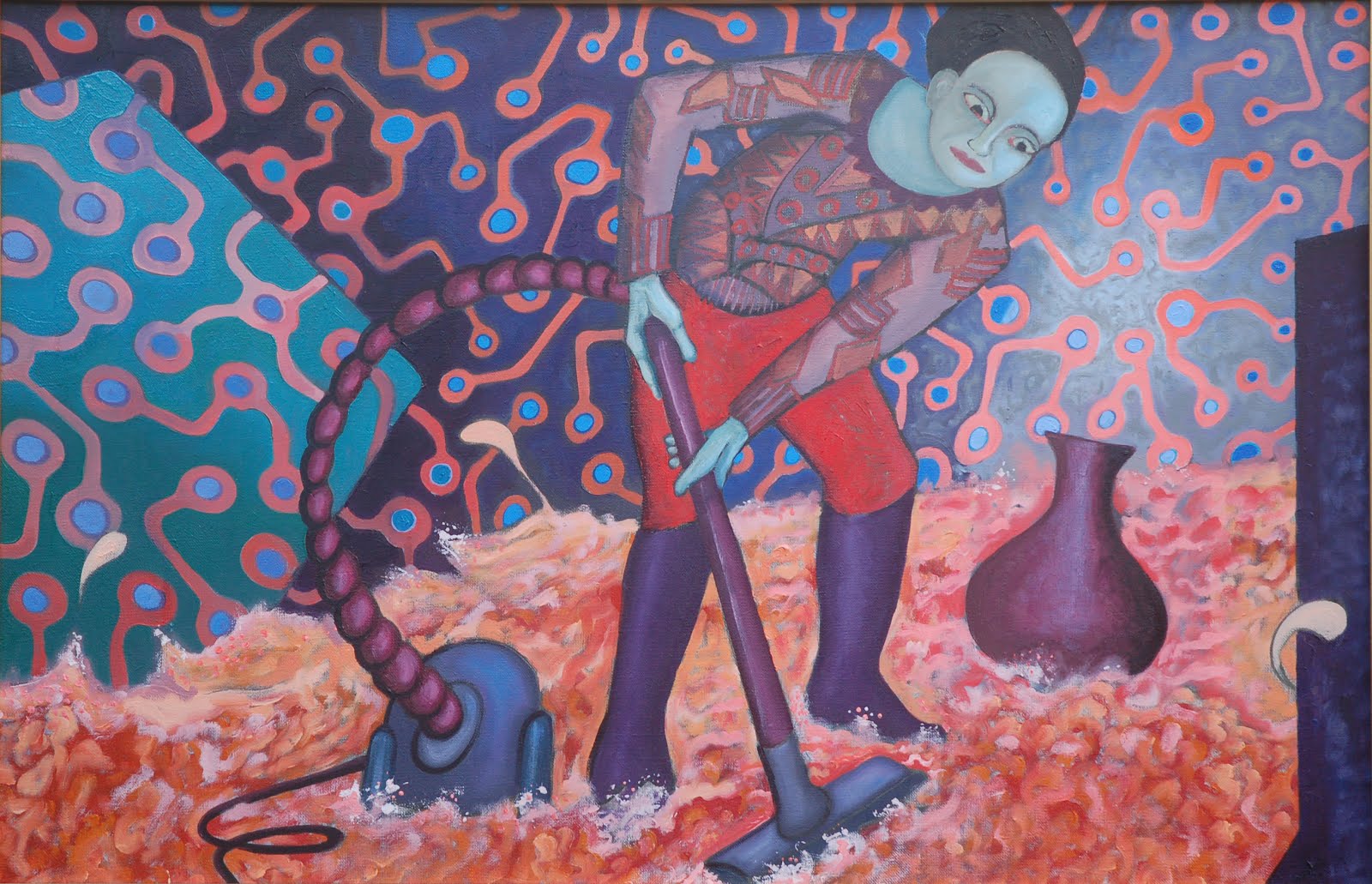
When it comes to making a clean break, to draw the line between chaos and order, there is nothing like a vacuum cleaner. You will come across a number of those in Ceri’s paintings. But, in Ceri’s invasion scenarios, hoovering proves futile. Whatever we try to push away or keep apart from us creeps in from the margins to assume centre stage: fungi spreading over an interior floor space, insects crawling toward artificial light, and microbes taking over our grey cells.
Ceri Pritchard, La Limpiadora
And who is handling the equipment, anyway? The cleaner in La Limpiadora, for instance. The creatures with which Ceri populates his scenes look like experiments conducted on the Island of Doctor Moreau, freaks of nature assembled in a game of Exquisite Corpse. Anthropomorphic, androgynous – they defy the polarities of either/or we find so reassuring.
Ceri’s paintings call to mind the disorientation we experience not while dreaming but at the stage of waking, the state of being in and out of it at once. It creates the unnerving sensation of estrangement that Freud termed the uncanny.
Such dislocations are also experienced when moving between cultures. Ceri has long lived abroad, away from his native Wales. Even the home that he has presumably come back to is not the Wales he knew as a child up in Anglesey. Ceri, who studied art in England, has worked and exhibited in France, the United States and in Mexico – all countries, coincidentally, in which Surrealism thrived.
Unlike ‘Modernism’ or ‘Art Deco,’ ‘Surrealism’ did not make it into the index of The Tradition: A New History of Welsh Art, 1400 – 1990, Peter Lord’s monumental new book on the visual culture of Wales. That is not to say that those who look for it won’t find surrealist connections in Wales. At that International Surrealist Exhibition in London, for instance, it was Dylan Thomas who handed out cups of plain water with a piece of string in it, which he offered to serve “weak or strong.” But as tempting as it may be to identify national or regional influences in these paintings, Ceri’s neo-surrealism, like the work of the Surrealists before him, is cosmopolitan rather than parochial, and its expressions of our inner worlds are universal.
Ceri’s work resists being defined by – or confined to – any one place. Trying to pin Ceri down by tracing his life story and his influences in his current paintings would mean to diminish the mystery and the trippy wondrousness of that work. It is clear that he has been under the influence. Ceri’s mind has altered many times. That is to say, it has defied the pressure of being made up.
Ceri has experimented in many media, including sculpture, video and collage. He has also been an abstract painter. Figurative painting is where he is at the moment. And that moment is also a time of introspection – a self-conscious exploration of the role of the artist and the function of art.
Many of the paintings in this exhibition are expressive of a tension between creative freedom and the demand placed on art to reflect the external world, that is, to be both mimetic and relevant, to resemble in order to matter.
Ceri Pritchard, Golau y Myfyrio
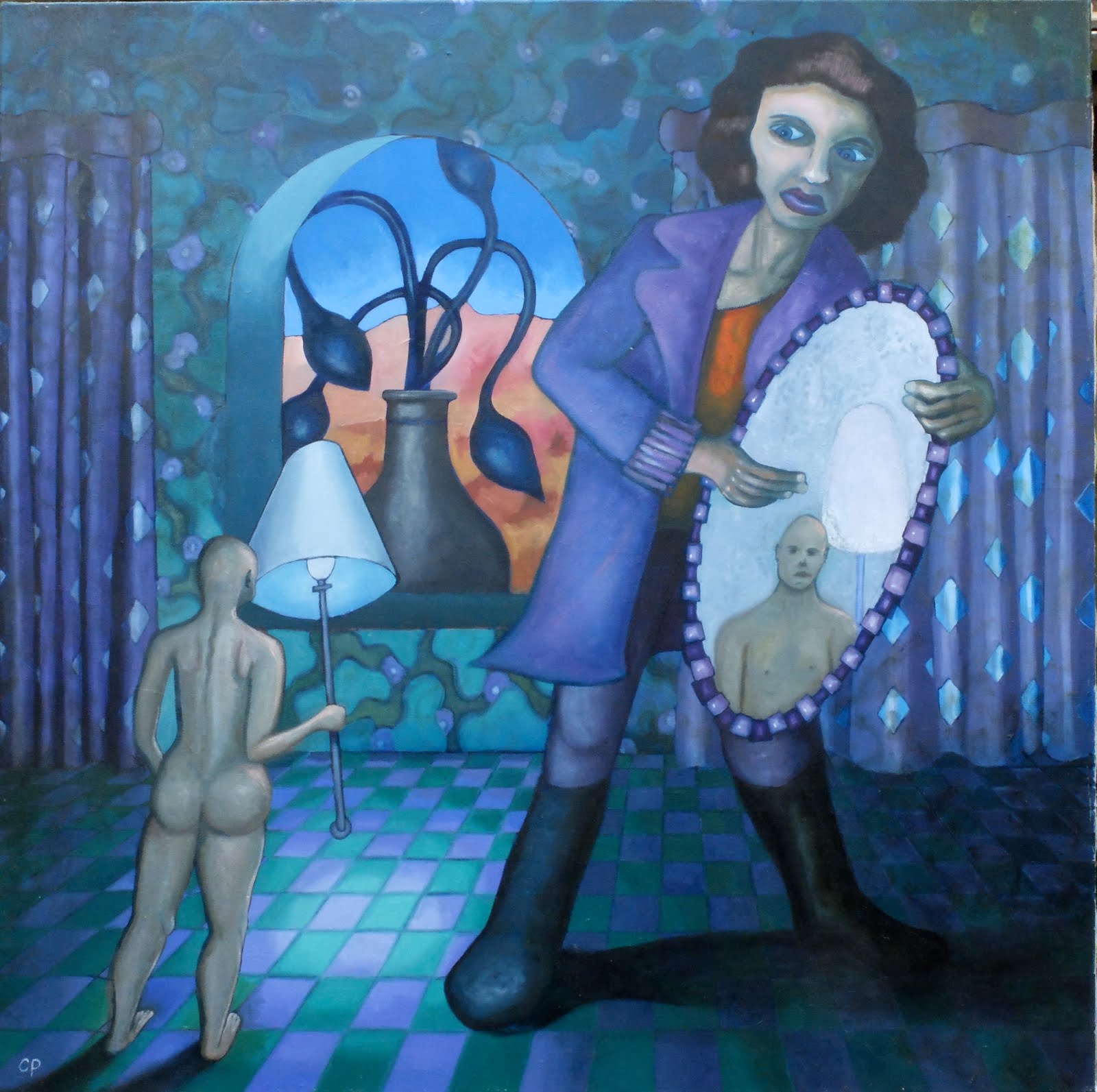
This restrictive view is countered by an ambition to shine a light on our infinite inner world instead of reflecting the system that tends to delimit the world outside and our place in it. This dichotomy is summed up by the title Golau y Myfyrio – “Reflecting the Light” – and is rendered pictorial through the mirrors with which the figures in Ceri’s paintings are taunted and tormented, and the lamps that put them in another light.
That the title is Welsh suggests, in the absence of any stereotypically Welsh iconography, a continued processing of that ostensible homecoming.
Ceri’s current work has been described as “mature.” It is meant to be a compliment, no doubt, but there is to me something too finite about the word. What Ceri has managed through decades of artistic practice is to remain in his “formative years.”
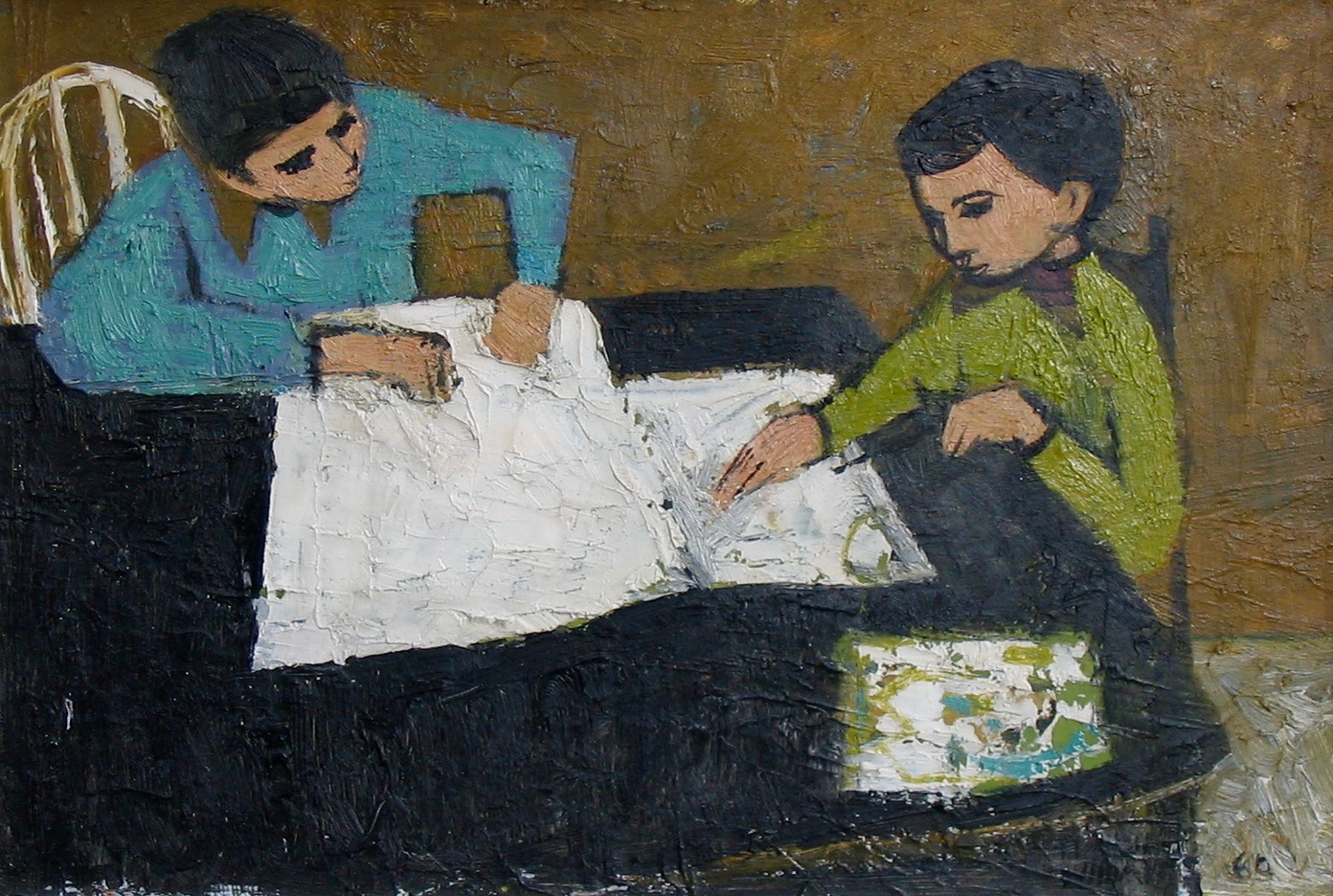
Claudia Williams, Children Painting (1960)
Now, I have, on a wall in my house, a reminder of Ceri’s lifelong creativity in the form of this painting of him by his mother, Claudia Williams. Here he is, aged six years old. And there he is, never mind how many years later. Ceri Pritchard has kept alive the urge to create by being alive to strangeness and by insisting on looking askance at “reality,” perched, as he is, on the edge.





 Harry Heuser