“The lights have gone out!”: Commemorating One Hundred Years of Plays for Radio

First slide of my presentation

Taking the radio play to the library has long been an ambition of mine, given that dramatic and literary works written for the medium of sound broadcasting occupy comparatively little space on the bookshelves.  Taking the first of its kind to a national librarythe National Library of Wales, no less—is a chance of a lifetime amounting to poetic justice.  Allow me to shed a modicum of light on that, and on my benightedness besides.

So that meaningful conclusions may be drawn from my peculiar challenge of commemorating one hundred years of radio dramatics in just a few minutes, it strikes me as essential that the centenary first be quartered, a fate I hope to escape on 22 February 2024, the date set for the event.

Continue reading ““The lights have gone out!”: Commemorating One Hundred Years of Plays for Radio”

“ . . . only a generation older than radio”; or, Thinking Comfort

Comfort, Aldous Huxley once remarked, “is a thing of recent growth, younger than steam, a child when telegraphy was born, [and] only a generation older than radio.” With a few million listeners guaranteed to sit down for it, the aforementioned Columbia Workshop embroidered on that reference and, on this day, 4 August, in 1946, presented radio critic and historian Robert J. Landry’s digest of Huxley’s essay in a broadcast proposing “Happy Thoughts for a Hot Afternoon” (the second being given to “Laughter”).

“Exactly. Comfort is new,” the narrator concurs with Huxley; and while not an “American invention,” it was an “American enthusiasm.” That much is irrefutable; but is “comfort” truly an invention peculiar—and in its origins traceable—to any particular age? After all, was it not a state responsible for the fall of the Roman Empire? Perhaps, it is merely a new term for an age-old desire the fulfilment of which came within the no-need-for-stretching-much reach of a New World catering to it, for a price?

Surely, the Neanderthal knew better than to rest his aching head on a pillow of granite; but he might not have had the nerve or need to sell the idea to anyone inclined to recline and ready to cave in upon being hit over the noggin with the padded yet relentless hammer of persuasion so adroitly wielded in consumer cultures.

Apparently, “comfort” is not even a new term, considering that “kunfort” (from the Latin “confortare”) has been part of the English language for centuries preceding the ostensibly New World, even though it might have been applied only to those rare, restful moments in the lives of the few who could make the Old World believe they had a divine right to experiencing it.

In the Middle Ages, Huxley suggests, comfort was a neglected ideal; and it was not until the dawn of the 20th century that the “padded chair, the well-sprung bed, the sofa, central heating, and the regular hot bath—these and a host of other comforts enter into the daily lives of even the most moderately prosperous of the Anglo-Saxon bourgeoisie.”

Lolling about on a none too hot afternoon, more comfortable than a 1940s audience deficient in conditioned air, I tuned in belatedly and ever so lazily to hear what the Workshop made of Huxley’s “Comfort” and how, a decade before handing the microphone to its author, CBS went about comforting its listeners with what it insisted on turning into “Happy Thoughts.”

Landry, it appears, was sold on the idea that “comfort” is modern, at least in the technological sense:

Announcer. Now, sir, without straining a muscle, I think you can reach one of those mother-of-pearl buttons.

[Biz: Switch.]

Fine. That’s remote control for the twelve-tubed radio receiver hidden in the mirrored refreshment bar across the room. Now we should get some soft music.
[Soft Music.]

Dependable, easy, effortless bedside radio music. Lullabies for grown-ups.

Listener (drowsily). Does the . . . radio shut off automatically if you fall asleep?

What the narrator-announcer promised is just what broadcasters were often accused of proffering: inoffensive and largely forgettable fare. Outspoken in his critic of radio elsewhere, Landry is rather coy here, suggesting only that programmers would do well to keep their audience by keeping it awake. Giving listeners what they want might well translate into a general want of listeners.

“Happy Thoughts” dwells on “comfort” as a feature and enabler of democracy, a political system that begot radio as the voice of—or at least for—the common folk. It refers to fascist Germany as a dictatorship that had no use for—and reason to be wary of—comfort, just as the rulers of the past depended on a populace that was never quite at ease. That the medium may have more detrimental effects than being soporific, that the Third Reich made great use of it in herding the masses, are thoughts too uncomfortable for Landry to ponder on this “Happy” occasion.

“Yes,” the audio essay concludes, “I guess we’ve got a lot of comforts to be grateful for nowadays. Happy thought, comfort!” In its gentle mockery of our insistence on contentment, the Workshop lecture makes a shortcut straight to the easy chair. Whereas Huxley held comfort to be a worthy “means to an end” in that it “facilitates mental life”—just as “[d]iscomfort handicaps thought” when a “cold and aching” body inhibits the use of the mind—he went on to caution that the “modern world seems to regard it as an end in itself, an absolute good. One day, perhaps, the earth will have been turned into one vast feather-bed, with man’s body dozing on top of it and his mind underneath, like Desdemona, smothered.”

Now, I am not sure whether Desdemona would have been better off being stoned to death by a solid idea than being choked by a foolish notion; but I wonder whether I should not opt for a boulder in lieu of a comforter sometime. May not a restless night produce thoughts capable of pushing us forward instead of returning us to the site of comfort for more of the same? Should we continue to pad our cells so as not to crack our brains on disquieting thoughts brought on by deprivation?

It might be a thought that strikes many of us as barbaric as the prehistoric, but, as those spineless and far from fortified creatures aboard that Brave New World of a space cruiser in WALL-E reminded me recently, “comfort” has the discomfiting side-effect of effecting nothing . . .

Sound Construction

Well, it has been particularly blustery of late; and, according to the BBC, Welsh coastal dwellers are to brace themselves for the fierce storms announcing themselves so boisterously. I am used to such noisy tidings by now. They are part of the seasonal soundscape of the Welsh coast, the otherwise quiet place to which I, romantically propelled, betook myself from the din of the metropolis.

Yes, I can take it now, the sound of the gales pushing against our cottage, the telling rattle of the letterbox long after the postal workers have made their rounds, the creaking of the beams and the lashing of rain against the glass drum of our conservatory, orchestrally augmented by the high-pitched screeching of the twisted willow branches scraping against the panes. Then there is that dictionary-challenging, onomatopoeia-defying shhhshing of the wind, as if nature were insisting on airtime, determined to shut me up, shut in as I am, surrounded by those ominous and still strange sounds.

Before heading out into that storm tonight, for company and a few drinks, I wrapped myself up in a sound cape of my own choosing, a blanket at once muffling and eloquent. BBC Radio 4 offered just that: “The Castle: A Portrait in Sound” (available here until 13 December). A portrait not unlike those produced by the Columbia Workshop in the 1930s and the CBS Radio Workshop in the ’50s (as discussed here), “The Castle” recalls the past of a Scottish stronghold rendered in spoken words, its present, the after-liveliness of its ruins, being captured by natural sounds.

When its palette is not muted by the welcome commentary that gives names to its noisemakers, the sonic portrait of “The Castle” reverberates with the spray of the sea, now stormy, now calm, with the buzz of insects and the chatter of swallows, of skylarks and kittiwakes, and the rather obscene squawks of the shags. The fabled invasion of Daphne du Maurier’s avian agitators (last heard here and currently being readied for another big screen attack) was brought vividly to mind.

If only the wind and rain were not messing with the wires again, making it difficult for me to sustain a wireless reception sound enough to get this “Castle” on the air . . .

Out of the Bag: The Fiction of Laetitia Prism

She could have run Hollywood. Miss Prism, I mean. You know, the governess in The Importance of Being Earnest who couldn’t tell a book from a baby. Summing up the ends (the conclusion as well as the purpose) of her novel, she explains: “The good ended happily, and the bad unhappily. That is what Fiction means.”  We know where her story ended up, of course; but what end did Miss Prism face, and what ends might she have served after and beyond Wilde?

Where do fictional characters go once their creators are done with them? What do they think, dream, or do between chapters or acts? Where have they been before entering the story their creators had in mind for them? Those are the question tackled by Celluloid Extras, a series of sketches now playing on BBC Radio 4.

What every governess knows: It is impolitic to point.

The practice of picking up familiar characters from the world of literature, disentangling them from the plots that contained them, and getting them back onto a public stage to let them tell us something else about themselves is hardly a novel idea. In January 1937, for instance, the familiar characters of Alice in Wonderland were released from the confines of “Copyright Lane” to mingle with Hamlet and assorted originals from Dickens’s Pickwick Papers and Martin Chuzzlewit in the free-for all of radio’s “Public Domain,” a play produced by the aforementioned Columbia Workshop. It is a tongue-in-cheek approach to pastiche that is both liberating and controlling of the afterlife and private lives of imaginary personages, who, even without those efforts, often do quite well in the minds of those who recall them from their excursions into drama and literature.

Natalia Power’s “Miss Prism, or the Dreadful Secret,” the first of those five Celluloid Extras promises the untold story of the absent-minded governess, whom last we saw being embraced by Dr. Chasuble, much to her delight. Now, I might have picked up some queer vibes, given that the Miss Prism I last experienced on stage was impersonated by a male actor; but Power seems to have gotten a similar impression, however her conclusions were drawn. And yet, Miss Prism seems to have been coerced into speaking up, if indeed the words coming out of her mouth were not put there by another. If it was her mouth.

In “The Decay of Lying,” one of the fictional characters through which Wilde spoke in his dialogued essays, remarked that the “only real people are the people who never existed.” In a postmodern dismissal of boundaries and binaries that would not have done for Wilde, whose stage plays and word plays depend on them, Power suggests that Miss Prism did exist as something other than the prism or lens of our changing mores, that she was, in fact, an acquaintance of the playwright to whom we are indebted for immortalizing her. By telling the fictive truth about imaginary people, “Miss Prism, or the Dreadful Secret” seems to be degrading the art of lying to a practice as indelicate and vile as tabloid journalism.

Giving Miss Prism a dirty secret (aside from the ones already out of the bag when the curtain falls on Wilde’s comedy) and by extracting it in a moment of alcohol-induced carelessness means to imitate life and, according to Wilde’s logic, to take it. Now that is character assassination.

Moby-Dick, Squeezed into a Can of Sardines

Well, call me . . . whatever you like, but I am prickly when it comes to the protection of endangered species; those of the literary kind, I mean. Take Moby-Dick, for instance. Go ahead, so many have taken it before you, ripped out its guts and turned it into some cautionary tale warning against blind ambition and nature-defying obsession. Moral lessons are like sardines: readily tinned and easily stored until dispensed; but they become offensive when examined closely and exposed for much longer than it takes to swallow them.

Not far from where I live now, in the Welsh town of Fishguard (pictured), Gregory Peck was once seen impersonating the mad Captain Ahab, who, in the eyes and minds of many non-readers, became the scene-chomping villain in control of Herman Melville’s tough-to-steer vessel of a book. On this day, 19 October, in 1946, Moby-Dick was being chopped to pieces for the airwaves. It had come under the knife of Ernest Kinoy. who did this sort of hack job on a weekly basis; the remains were tossed onto the soundstage of the Columbia Workshop, ready to be delivered to American homes like a quick if none too nutritious meal.

Radio was a regular cannery row back then. Now, the Workshop was a classier establishment than most of radio’s story factories. As I last mentioned here, it was billed as “radio’s foremost laboratory of writing and production technique.” Its producers knew better than to present the entire volume in a twenty-five minute synopsis. A little better, that is. Instead, as if inspired by the hyphen that harpoons the original title, they allotted two installments for its audio-dramatic rend(er)ing of the old mammal. They had done as much in their treatments of Hamlet and Alice in Wonderland (as well as its sequel). They were still a thousand nautical miles away from approaching what E. M. Forster referred to as “the song” of the book.

As Forster remarked, Moby-Dick is “an easy book, as long as we read it as a yarn or an account of whaling interspersed with snatches of poetry. But as soon as we catch the song in it, it grows difficult and immensely important.” The “prophetic song” of Moby-Dick “flows athwart the action and the surface morality like an undercurrent. It lies outside words.” It certainly “lies outside” the domain of sound effects and choric shanties—the readily reproduced impressions of the sea.

I wonder whether Hemingway was listening in or taking notes that day (and on 26 October, when the Workshop presumed to have done justice to—or simply be done with—the book ). On radio, at least, Moby-Dick sounded like an extended version of The Old Man and the Sea, written a century later. Aside from the famous opening line and the hunt for the titular creature (which takes up the three concluding chapters of Melville’s 135-chapters-spanning tome), little blubber and less bone remains of Moby-Dick; or, The Whale, a book known to many and read by few.

To those picking it up for the first time, the humanity and gentle mankindliness of Moby-Dick—especially its tenth chapter—must come as a surprise. What has happened to popular culture in America that it balks at such pre-Wildean sentiment but gorges instead on the book’s supposed machismo appeal? Is it possible, perhaps, to take another look at this Brokeback Mountain of a whale?

“All my books are botches,” Melville declared to Nathaniel Hawthorne, to whom the book is inscribed. They most certainly are, once they fall into the hands of adaptors like Mr. Kinoy.

Dark of Day: "Danger" and the Drama Invisible

Well, it was a scorcher of a day—the first I experienced here in temperate Wales. The unexpected heat brings back memories of my many summers in New York City and will prepare me for my return to the asphalt jungle this August. Moving to rural Wales from that bustling metropolis took more of an adjustment than adding a few layers of clothing; but anyone ready to weave life according to E. M. Forster’s motto “Only connect,” which is not a bad motto to live by, there is the comfort of that web of relations that, however remote or isolated you might believe yourself to be, will place you smack in the middle of the world, like a spider resting in the assurance that flies are bound to drop in, by and by.

Here is one such moment in the web in which I find myself. You might have to stretch your antennae a bit to get caught up in it.

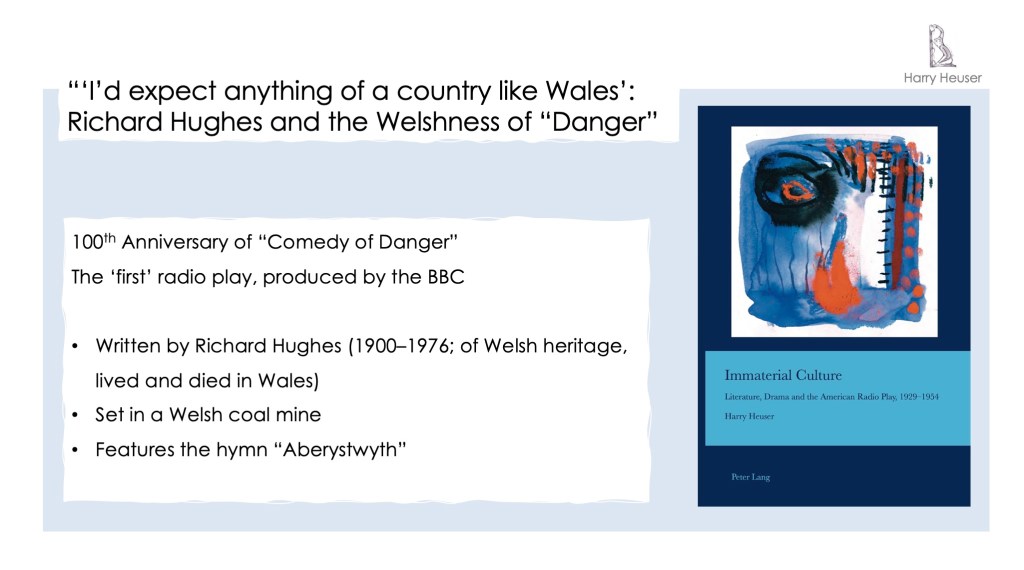
Picture this: New York City, on this day, 18 July, in 1936. It’s the premiere of The Columbia Workshop, the most experimental and innovative of all the radio dramatic series produced during the so-called “golden age” of old-time radio. For that first broadcast, the Workshop revived what is generally considered to be the first original play for radio: The Comedy of Danger, by British playwright-novelist Richard Hughes, better known for A High Wind in Jamaica (1929), an adventure story that has been ranked among the hundred best novels of the twentieth century.

Danger is a sort of Poseidon Adventure staged in utter darkness; a spectacular melodrama of disaster involving three people about to drown in a collapsed coal mine. It is a scenario mined for the theater of the mind, evoked by sounds and silence alone. Danger was first produced by the BBC on 15 January 1924, but was still a novelty act when the Workshop chose it for its inaugural broadcast more than twelve years later. Back in 1924, US radio had no use for such theatricals, Hughes remarked in an article about “The Birth of Radio Drama”:

A few months [after the BBC production], finding myself in New York, I tried to interest American radio authorities in the newborn child.  Their response is curious when you consider how very popular radio plays were later to become in the States.  They stood me good luncheons; they listened politely; but then they rejected the whole idea.  That sort of thing might be possible in England, they explained, where broadcasting was a monopoly and a few crackpot highbrows in the racket could impose what they liked on a suffering public.  But the American setup was different: it was competitive, so it had to be popular, and it stood to reason that plays you couldn’t see could never be popular.  Yet it was not very long before these specially written “blind” plays (my own “Comedy of Danger” among them) began to be heard in America, and on the European continent as well.

Other than creating a situation in which the characters are as much bereft of sight as the audience, Danger has no artistic merit. It purports to be philosophical about death; but the fifteen minutes allotted for this piece of melodramatic hokum are hardly time enough to probe deeply, and much of the dialogue is ho-hum or altogether laughable.

What makes this seemingly generic if radiogenic play more personally meaningful to me is that it was written by a Brit of Welsh parentage, by a man who chose to live in a Welsh castle, and who chose, for this, his first dramatic piece for radio, a story set not far from the very hills where I found myself after these long years of writing in New York City about American radio drama. Is it a coincidence that I came home to the birthplace of radio drama?

“Goodness knows!” exclaims one of the trapped visitors,

I’d expect anything of a country likes Wales! They’ve got a climate like the flood and a language like the Tower of Babel, and then they go and lure us into the bowels of the earth and turn the lights off! Wretched, incompetent—their houses are full of cockroaches—Ugh!

In the background, Welsh miners face their fears by singing “Aberystwyth”—the name of the town near which I now reside. The Welsh, of course, are known for their oral tradition, for their singing and poetry recitals; their most famous poet is Dylan Thomas, author of the best know of all radio plays, “Under Milkwood.” It is here that American radio drama is still being thought of and written about: Rundfunk und Hörspiel in den USA 1930-1950 (1992), for instance, by fellow German Eckhard Breitinger, was written here, as was Terror on the Air, by Richard J. Hand, published in 2006. It is here, in Wales, that I started communicating with radio dramatist Norman Corwin; and it is here that, after a short break from my journal, I will continue my visits to the theater of the mind.

Yes, it is a web all right, even though I am not sure whether it was woven by or for me. I am merely discovering connections that, upon reflection, are plain to see and comforting to behold.

On This Day in 1944: A Dead Soldier Speaks Up to Stir the Living

I have often found comfort in the notion that the dead may survive in the minds of those who recall them. It is no mere vanity to desire such afterlives. Indeed, the concept of lingering in each other’s thoughts by virtue of some worthy deed or memorable word can be a significant motivational force in our lives. I am not sure, however, whether the self-images we try to instill in the minds of others as potential extensions of our corporeal existence are to be considered a noble attempt at rescuing our finite lives from triviality or whether these transferable or continuing selves are a construct that trivializes the finality of death. After all, does not the realization that we are perishable render each hour we have left so much more significant?

During times of war such as these, the possibility that those lost are never truly gone or might yet return has particular resonance. Radio, in the pre-television years, was often thought of or exploited as a spiritual medium. Gathering around the receiver to hear voices from the unreachable beyond—or the far away, at any rate—could assume all the magic of a conjuring act: a high-tech séance. As I have argued in Etherized Victorians, my doctoral study on so-called old-time radio in the US, broadcast propaganda often availed itself to addresses from the hereafter, words akin to the cries of “Remember me,” uttered by the Ghost in Hamlet, to stir and motivate the listener.

On this day, 18 April, in 1944, such a ghost voice was cast into the living rooms of America by radio playwright Norman Corwin (whose works I have frequently discussed in this journal). It is the voice of a soldier killed in action. “As for his life,” explains the narrator of “Untitled” (a recording of which you may find here),

there is no straightforward account available, but there are several people who could piece it together, although they cannot always be relied on to give you a true interpretation of the facts.

Through the various recollections of others, including those who thought little of him, the soldier’s unwritten biography comes to life. It is a conventional one, all told, if giving your life for an ideal may be justly labeled “conventional.”

Corwin’s soldier is not an action hero, but a man of doubts, a thinking fighter—or fighting thinker—who, in today’s parlance, chose to engage in a war on terror—and that terror, still very much alive today, was fascism. Rather than relying on others to give an account of his beliefs, the dead man picks up on and tears apart their words—some shallow, some insincere—like a radio commentator taking issue with so-called facts. The memories of those lined up to speak for him are proven to be too distorting or inadequate to capture the true self of the deceased who, according to the justice of the radio poet, is now given the opportunity to speak up for himself.

These lines, uttered toward the end of the play, are some of the finest written for radio—or any medium, for that matter. They are worthy of Shakespeare, and certainly worth quoting here and remembering thereafter: “I am dead of the mistakes of old men, / And I lie fermenting in the wisdom of the earth.”

It is not enough to live on in the minds of others from whose sundry impressions our existence might be retraced. Instead of becoming the mental playthings of our contemporaries or former associates, we must seize the chance to communicate our own minds while living. This journal may serve as a record of my thoughts.

Up to My Eyes in Dog-eared Books

This is one of those rare, lugubrious days of landscape-swallowing fogginess on which you might as well retreat, brandy in hand, into the confines of your small but reassuringly familiar study. My thought being as opaque as the wintry sky, my mind as obnubilated as the mist-shrouded hills, I have put aside all semi-intellectual or quasi-artistic endeavors for the moment. Instead, I busy myself cataloguing the books in my radio drama library, another four dusty volumes of forgotten plays having arrived by mail yesterday. During my years of researching so-called old-time radio in New York City, I had access to several excellent public and academic libraries, however deficient my own.
While a vast number of recordings have been preserved, there are some plays you can only find on paper, among them rare pieces by noted American authors like Sherwood Anderson, who died on this day, 8 March, in 1941. Writing my dissertation, I was determined not to discuss at length any play I had never set my ears upon. The page seemed to be a poor substitute for a performance. Who, I ask you, would claim to know a movie having only read the screenplay? I thought. And yet, once your eye is becoming accustomed to the language of radio, you can almost hear the plays as they might have been produced.

Distrustful of my less than reliable memory, I used to photocopy much of what I read and carefully filed away each text for ready reference. After I had earned my doctorate and decided, propelled by romance, to move to the United Kingdom, I took those thousands of sheets out of their assigned ring binders, boxed them up, and posted them, along with most of my belongings, to be shipped overseas.

Upon my arrival in Blighty, I was not only confronted with stacks of paper (relieved to find them there), but with the problem of making a new and orderly home for them. Little did I know when I decided to be economic by dumping the old binders that the paper sizes in the UK differ from those in the US, that British sheet protectors are too narrow for American paper, and that such incompatibilities would spell many a tedious hour punching holes or cropping paper. Eventually, I resigned in frustration from such labors and resolved to ditch some of the copies in exchange for the originals, however obscure.

Tossing another photocopied script into the bin this morning, I noticed that the play thus preserved was broadcast on the first anniversary of Anderson’s death on this day in 1941. The piece in question is “The Test” by radio dramatist Joseph Ruscoll, and I have not yet come across a recording of it.

Produced by the Columbia Workshop, it concerns adolescent lovers Janet and Joseph who, thirty years after parting, are nothing but joyful memories and pangs of regret to one another. They separated as the result of a dare—the eponymous “test”—that was to prove Joseph’s love for Janet: would he give up his harmonica for their harmonious union? No, he would not stoop to accepting the challenge—and the two were twained no more. Through the miracle of the pre-cellular phone wireless, a radio commentator interviewing both brings about a reunion of sorts. After all, radio was, as Gerald Nachman put it, “yesterday’s internet”:

Narrator: And you never spoke to him again, Janet?

Janet.  Never.  (Sorrowfully)

Narrator: Or you to her, Mr. Pike? 

Joseph: I had my pride.  (Lowly)

Narrator (sighs): And that was thirty years ago?

Janet (flaring up): Pride! If he had really loved me, he wouldn’t have had any pride!

Joseph (flaring up in turn): And if she really loved me, she—what about her foolish pride?

Janet (indignantly): Foolish?

Joseph (crying out): Foolish! Foolish!

Janet: What do you think, Mr. Narrator?

Narrator (sadly): I think you were both very, very foolish.

Perhaps, we’d better put our keyboard to some special use tonight by searching for old friends or else put it aside altogether, seeking instead the company of neglected loved ones rather than dwelling in the sheltering obscurity of our inconsequentiality or sweltering in the ersatz heat of emboldening internet anonymity. I write for myself and strangers—but I live for a hug and a smile.

Many Happy Reruns: Portland Hoffa and Les Crutchfield

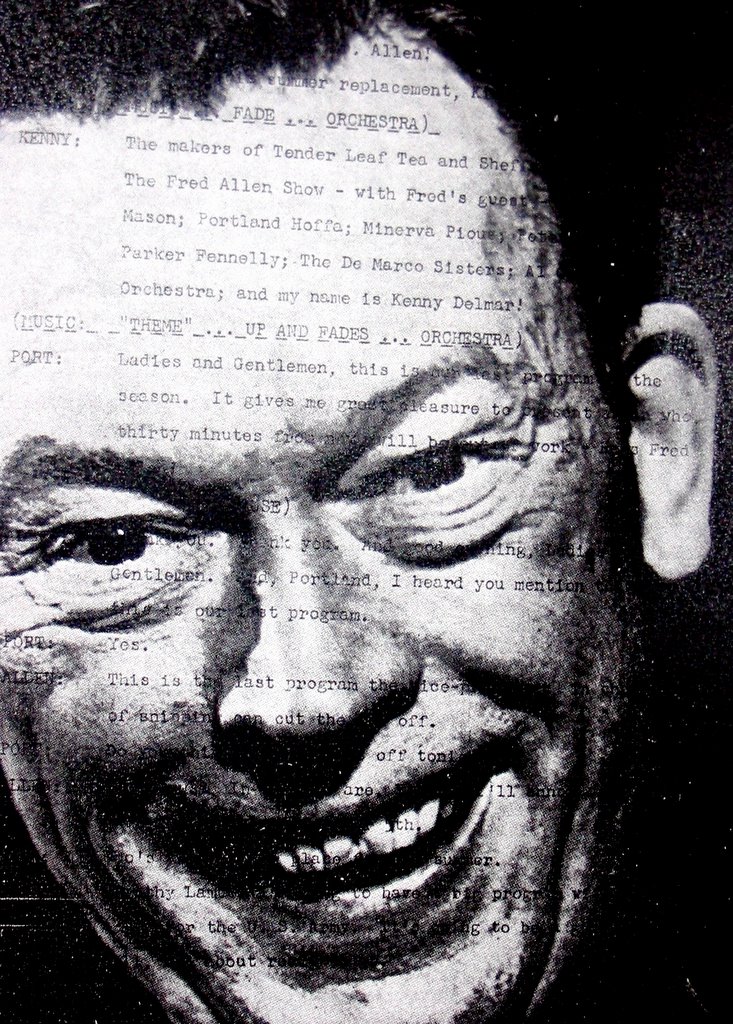
“Mr. Aaaaallen!” I can hear her none too dulcet voice now. Portland Hoffa, born on this day, 25 January, in 1905. Hoffa, of course, was the partner of radio comedian Fred Allen, on whose show she appeared as his Gracie-Allenish sidekick. Here is how Allen remembered their partnership in his autobiographical Treadmill to Oblivion (1954):

Portland and I started doing a vaudeville act together shortly after we were married.  In vaudeville, when a comedian married he immediately put his wife in the act.  The wife didn’t have to have any talent.  It was economical strategy.  With a double act the comedian could get a salary increase from the booking office.  The additional money would pay for his wife’s wardrobe, her railroad fares and the extra hotel expenses.  In vaudeville, the actor roams the country and the upkeep on the nonworking wife was an important item.  Having his wife in his act enabled the comedian to know where she was all the time.  This made it possible for him to concentrate on his comedy [. . .].

When radio became a challenge [to vaudeville] we accepted it.  We were married until death do us part and radio sure wasn’t going to interfere with this arrangement.  Radio might hasten it but not otherwise thwart the overall deal.  Our first concern was to create a character that the listener at home would associate with Portland’s voice.  That was our problem.  Over the microphone, Portland’s voice sounded like two slate pencils mating or a clarinet reed calling for help.  I still don’t know whether it was the microphone that distorted Portland’s natural voice or whether an element of nervousness was involved [. . .].

[With the exception of Jack Benny and Mary Livingstone, m]ost of the other radio couples [. . .]  used their marital status and their domestic experiences for comedy purposes. [ . . ].

Portland didn’t seem to fit into any of the accepted categories.  The more we heard her radio voice, the more we realized that a character, a small E-flat Frankenstein monster, would have to be custom-made for her.

And custom-made it they did, even though Frankenstein was more the métier of another important figure in radio drama, Les Crutchfield, born on the same day in 1916.  His work was frequently heard on the literary thriller anthology Escape, for which he adapted classics including Rudyard Kipling’s The Man Who Would Be King, Joseph Conrad’s Typhoon, and “The Fall of the House of Usher” by Edgar Allan Poe.

Crutchfield’s scripts were also featured on Suspense, as well as episodic thrillers like Yours Truly, Johnny Dollar and the short-lived Christopher London, an adventure series conceived by Earl Stanley Gardner and starring Glenn Ford. Throughout the 1950s, Crutchfield contributed scripts to memorable radio westerns like Ford Laramie, Have Gun, Will Travel, The Six Shooter, and the highly successful Gunsmoke, with the long-running television version of which his name is most closely associated today.

As a radio playwright, Crutchfield made his auspicious debut on 25 August 1946, when his work—unlike the works of many anonymous broadcast writers—was not only featured on but heralded by the Columbia Workshop:

Since it first went on the air ten years ago last month, the Columbia Workshop has constantly sought to introduce new talent to radio broadcasting and to persuade established artists in other fields to lend their creative talents to radio. Today, in presenting “The Path and the Door,” a psychological experiment, the Columbia Workshop achieves both aims.  “The Path and the Door” is the first radio play by Les Crutchfield, a young man who before the war was an explosives engineer and who, feeling that the world has seen enough of explosives in the last few years, now devotes his entire time to writing.  The musical score, which is such an integral part of the play [. . .], was written by George Antheil, who has been one of the most controversial figures in modern music for the past twenty years. Mr. Antheil has many other interests besides music, however, one of them being psychology. One reading of Mr. Crutchfield’s script persuaded him to write this, his first radio score.

Besides being in the same business, these two share their birthdays not only with modern novelist Virginia Woolf, but with Romantic poet Robert Burns, whose famous admonition is entirely appropriate for this occasion: “Should old acquaintance be forgot / And never brought to mind?”

On This Day in 1937: Dickens’s "Signal-Man" Is Interviewed on the Air

Well, my first review for the Internet Movie Database has gone online this weekend. I sincerely hope that no one will be led astray by my remarks about The Misleading Lady (previously discussed here). Unlike the rating, writing the short piece was a joy. As fascinated as I am by numbers (provided I don’t have to add them up), I have never been able to express myself satisfactorily in this supposedly succinct way. I also tend to be rather stingy with my stars or points or other such statistical thumbs, whether I share my opinions on the database or grade a student paper.

Five stars out of ten (as bestowed on aforementioned Lady) is meant to denote mediocrity; but to others it might spell “plain awful.” To me, two means “awful,” which is just what Charlie Chan and the Curse of the Dragon Queen merits, had I cast my vote. That insult to the memory of the famed detective, which aired on LivingTV in the UK this weekend, is so insufferable, however, that I could not sit through it. So, I willingly, gladly surrendered my right to vote, at least according to my own ethics of re-viewing. Luckily, I don’t have to deal with numerical expressions of (dis)approval in my ruminations about American radio drama.

On this day, 23 January, in 1937, the Columbia Workshop presented Charles Tazewell’s dramatization of Charles Dickens’s ghost story “The Signal-Man.” Too many American drama anthologies for radio tackled longer novels, rather than short stories, resulting in cut-rate digests and bloodless storytelling. In early radio drama, the narrator was the first to get the axe; gone with him or her were descriptive passages, character assessments, and an access to a speaker’s inner thoughts.

As I argue in Etherized Victorians, my doctoral study on the subject, the prejudice against narration in radio plays (a more inclusive term I prefer over radio drama), is related to the early failure in presenting stage plays straight from Broadway, a lack of adaptive skill that made it necessary to install a translator in the wings, a voice describing the gestures of the actors and the inaudible goings-on known as “business.” The challenge of proper radio form was to do without this awkward voice, to convey actions and thoughts in dialogue.

Another reason serious radio playwrights objected to—and producers did not encourage—the use of narration was the fact that the single voice on commercial radio was linked to the announcer, the peddler of a sponsor’s wares. The single voice stood out, disrupted the conversation—and thus drew attention to the business at hand: the business of selling things.

Over the years, radio plays and the techniques of broadcast hawkers became considerably more sophisticated; but the narrator was still frowned upon by many playwrights and listeners. Now, Charles Dickens’s “Signal-Man,” as reworked for the Columbia Workshop by actor-writer Charles Tazewell, is a fine example for the use of full dramatization.

In Dickens’s narrative, the plight of the titular character—a lonely railroad employee haunted by a death-foretelling “Thing in the Tunnel” (as the story was also called when adapted for radio)—is expressed by the man who observes him:

His pain of mind was most pitiable to see.  It was the mental torture of a conscientious man, oppressed beyond endurance by an unintelligible responsibility involving life.

Tazewell’s script called for the actor to convey this sense of dread and anxiety through changes in tone of voice as Braxton, the Signal-Man, responds to the questions of Darkin, a journalist interviewing him in hopes of a serviceable human interest story. Reading instructions include “almost hysterical,” “becoming hysterical,” or “with growing hysteria,” as Braxton relates his encounters with a specter warning him of impending disaster.

Generally known as a laboratory of sound effects techniques, the Workshop here relied on dialogue, rather than effects. The result is that the ghost story very nearly becomes a study of insanity; the ambiguities fade as the adaptor decides not to deal in noise. The warning bell, ringing in Braxton’s ears is not heard by the journalist or the play’s audience:

Darkin: It’s your imagination.  The bell is not ringing—and probably, it has never rung at any other time except when some station wishes to communicate with you. 

Braxton: Listen! 

Darkin: I tell you, the bell . . .

Braxton: Not the bell—outside—the ghost’s calling.

Darkin: I hear nothing—save the moan of the wind in the wires.

And so do we, the wireless audience. In Tazewell’s dramatization, the specter is all but explained away, drowned in the airwaves without as much as a ghost of a chance to rise before us. What haunts me now is the fact that, just after listening to this play, I came across the headlines about the deadly train crash in the Balkans. I’m sure Tazewell’s journalist would term it a coincidence, as dull and comfortless as such reasoning might be.