
On This Day in 1938: Broadcast “Air Raid” Assaults Like Sontag’s 9/11 Tirade

Sunlight and shadows across my
copy of MacLeish’s Air Raid

Well, only yesterday I wrote about the potentialities of broadcasting and blogging as means and modes of connecting with the world. Today I am going to mark the anniversary of an execrable “disconnect” by relating it to a disturbing episode in my life, a moment of outrage in a period of confusion and despair. Ready?

On this day, 27 October, in 1938, the Columbia Workshop laid an intellectual egg of such poor taste that I sometimes felt the only proper way of connecting to it would be to hurl it right back at its author, the American poet-pamphleteer Archibald MacLeish. The play produced by and broadcast over the US radio network CBS was “Air Raid,” an exercise in propagandist verse. Like “The War of the Worlds”, which aired a few days later over the same network, “Air Raid” entered the anti-fascist debate and commented on the political tensions then mounting in Europe by exploiting and fueling the anxieties of an American public divided between battle cries and isolationism. The nation’s enemies, such plays told in the abstract language to which pre-war radio playwrights were bound to adhere, were not quite so distant as to render their attacks futile.

In “Air Raid,” MacLeish went so far as to hold civilians whose lives were threatened or lost in fascist offensives responsible for their inaction. As in the previously discussed “Fall of the City,” the audience is taken to the scene of terror, listening in as carefree women, heedless of the warnings they receive, ar e going about their daily affairs until blown to bits by machine guns fired from above. The announcer, observing the raid from a secure post, reports and comments on the execution:

There’s the signal: the dip: they’ll
Dive: they’re ready to dive:
They’re steady: they’re heading down:
They’re dead on the town: they’re nosing:
They’re easing over: they’re over:
There they go: there they—

His coverage of the event is cut short by the stammering guns and the shrieking of women and ends in a boy’s calling of my name: “Harry! Harry! Harry!” I did not require such a prompt to feel personally offended.

MacLeish intellectualizing of terror and patronizing of the terrorized is the kind of disastrous argument that reminded me of Susan Sontag’s words shortly after the attacks on the World Trade Center. In an article published in the New Yorker, Sontag lamented the “disconnect” between the “monstrous dose of reality” that was 9/11 and the “self-righteous drivel and outright deceptions being peddled by public figures and TV commentators.”

Sontag opined that the “voices licensed to follow the event seem to have joined together in a campaign to infantilize the public,” a public lacking in “historical awareness” and subjected instead to the “psychotherapy” of “confidence-building and grief management.” Arguing the insistence on America’s strength to be not “entirely consoling,” Sontag concluded: “Who doubts that America is strong? But that’s not all America has to be.”

In retrospect, I find these words unremarkable; they have been uttered many times since. Living through the terror of those days in New York City, however, I was infuriated by such ill-timed chastising from afar (Sontag lived in Paris at the time). I sat down and cried and wrote a lengthy response to let out my anger, shared with the German friend who brought Sontag’s commentary to my attention:

Sie mag aus der Ferne spotten; sähe, fühlte, spürte sie die Stadt würde sie den New Yorkern kaum “Dummheit” vorwerfen.  Wenn ich ihr aus der Ferne auch weder Feigheit noch Dummheit unterstellen will, so muss ich doch feststellen, dass Abstand auch eine Freiheit von Anstand bedeuten kann.  Sontag schrieb einmal ein erfolgreiches, vielzitiertes, und feines Buch mit dem Titel Against Interpretation.  Sie täte gut daran, sich gegen ihre eigenen ‘Interpretationen’ zu sträuben.

In essence, I argued that Sontag should heed the words that formed the title of her book Against Interpretation, that she should have reserved her distant and distancing intellectualizing and her attacks on the supposedly infantile public and the media that pampered it for a period in which a bewildered public was more likely to stomach further humiliation and to respond with a kindness and dignity lacking in Sontag’s words to the unwise.

Attacking both the medium it employs and the masses it engages (that is, attempting to appeal to the latter by questioning the former), MacLeish’s “Air Raid,” like Sontag’s tirade, is a prime example of how not to connect.
On This Day in 1940: Arthur Miller Unleashes a Pussycat

As it turned out, I had been listening to Jeremy Vine’s “Climate Change Special” on BBC Radio 2, in which discussions about global warming and environmental crises were interspersed with a series of fictive news bulletin from the future—the year 2035. After such spurious time-traveling, I retreated into the world of fantasy, a bit of old-time radio whimsy from the pen of none other than the late American playwright Arthur Miller.

Pardon my credulity, but yesterday, listening to the radio, I experienced my own “War of the Worlds” encounter—you know, an act of airwave fakery during which hearing becomes believing. Going about my daily affairs, I picked up a few words of what I assumed to be a news broadcast, it being preceded by the customary jingle of the oft relied upon BBC. “Much of East Anglia remains under water today after the latest North Sea storm surge,” newsreader Adrian Finnegan informed me, and “nearly a million people” had been evacuated from an area large portions of which might never be reclaimed from the sea. Why hadn’t I heard about this before, I wondered, still under the influence of telecasts from hurricane-battered New Orleans.

Yes, Miller does have a radio past, even though it is a less than illustrious one. So it is frequently, politely, and foolishly ignored, as if a half-decade of dabbling in the theater of the mind could not possibly have had an influence on the career of a writer whose 1964 drama After the Fall “takes place in the mind, thought, and memory” of its protagonist.

“I despise radio,” Miller told an interviewer in 1947; with a successful play on Broadway and a well-received first novel to his credit, Miller was ready to get out of what he referred to as “a dark closet.” He meant the melodramatic excesses of radio drama, but also complained about the limitations imposed by network executives and the sponsors that fed them. Well, let’s open that closet now to commemorate the broadcast anniversary of Miller’s “The Pussycat and the Expert Plumber Who Was a Man,” a radio fantasy produced by the Columbia Workshop on 29 September 1940.

While not quite the man who had all the luck, Miller was rather fortunate to begin his career in radio, having his plays soundstaged by the sustaining (that is, commercial free) Workshop, a venue far more open to experimentation than the program he chose to recall in Timebends. His playful “Pussycat” is the story of an invisible trickster—a commentary on radio, therefore, and one that forced me to keep in mind the mind-game to which I had just been subjected.

The eponymous tomcat is a megalomaniac intent on going into politics and swaying the masses with his “lovely tenor voice.” Hidden from view behind a microphone, he convinces his audience of potential voters that he “must be a wonderful man,” until he is exposed as a fraud by an average Joe who threatens to drag him out into the open. “[I]f you want to know,” he sums up his tale, “a cat will do anything, the worst things, to fill his stomach, but a man . . . a man will actually prefer to stay poor because of an ideal.”

Clearly, Miller resented radio because he felt that it was making a pussycat of the manly expert he aspired to be. Yet he often overstated the strictures of network radio and eventually got too tired to resist them. Radio plays may not be the cat’s meow to narrow-minded intellectuals, but experts like Norman Corwin proved that they were hardly the litterbox of American culture.

On This Day in 1066 and 1939: Two Conquerors Take Language to War

Not being revisited by the nuisances of power failures and coughing fits I suffered recently, I find myself willing to rise to something amounting to a challenge. Tackling the ambiguities of Archibald MacLeish’s verse drama “The Fall of the City,” for instance. Originally broadcast on 11 April 1937, “The Fall” was again presented by the Columbia Workshop on this day, 28 September, in 1939. The world changed considerably during the time elapsed between those two productions, adding urgency to a play about . . . well, about what, really?

I’ve grappled at length with “The Fall” in my dissertation, describing the confusion and frustration of critics who sensed the play to be significant but could neither make sense of it nor find much consensus among each other. Some argued that it wasn’t even a play at all. Apparently anticipating this reception, MacLeish prefaced the published script with the following disclaimer:

“Any introduction is a confession of weakness. This one is no exception. It is written because I am anxious to persuade American poets to experiment with verse plays for radio and because I am quite certain the radio verse play I have written will not persuade them of itself.”

US poets were not too keen on having their precious wares compete with soap commercials. Others believed that their words were best spread among the few rather than being freely disseminated through channels of less-than-pure air. The horrors of WWII shook up a number of ivory towers, drawing out poets like Stephen Vincent Benét and Edna St. Vincent Millay in fighting form. In propagandist poetry, the ultimate test of language was not whether it could move listeners, but whether it could get them moving, whether it could motivate them to fight battles, buy bonds, or save kitchen fat.

While American broadcasters were training announcers (like the proud vocal-talent pictured above) to hawk the products of their corporate sponsors, Fascist Germany had been exploiting the power of the spoken word to turn open-minded individuals into a league of like-minded or mindless lemmings. “The Fall of the City” opened a debate about mass persuasion, about the media’s role in molding opinions and fabricating war. Its ambiguity is rooted in a distrust of the very medium it employed.

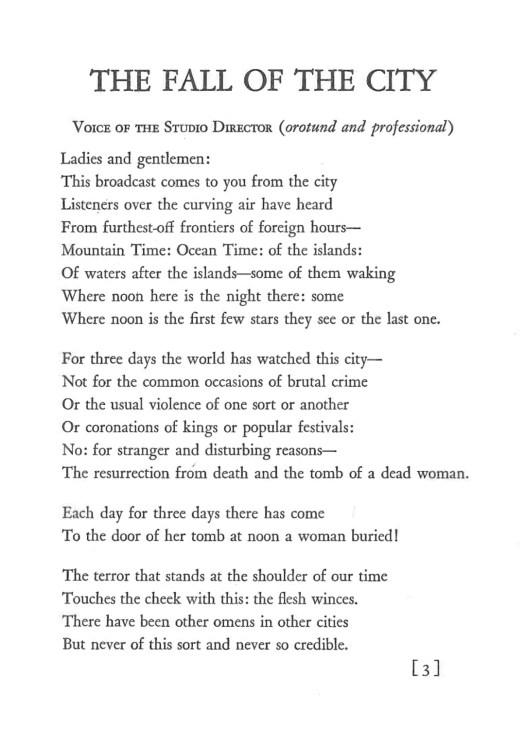
“Ladies and gentlemen,” the play begins, “This broadcast comes to you from the city,” a town whose downfall is first announced, then actualized. It is talked into being as the figure of a radio announcer stands by to document the unfolding event. MacLeish’s announcer takes listeners to the “central plaza” of this unspecified city to become ear-witnesses to the resurrection of a recently buried woman who, for three consecutive days, appeared before a crowd of spectators, and who now utters a baffling prophesy:

The city of masterless men
Will take a master
There will be shouting then:
Blood after!

Amid the bewildered throng (some 500 people participated in creating the sound of the crowd), reporters and politicians are heard trying to interpret the oracle and to fix upon a plan of action. Is the message to be ignored? Is the prophesied attack to be countered or endured? One orator, holds that “[r]eason and truth” are the weapon of choice:

Let this conqueror come!
Show him no hindrance!
Suffer his flag and his drum!
Words . . . win!

His words are powerful enough to have people dancing in the streets—until another speaker convinces them to go into battle. While this exchange of words and changing of minds is going on, the talked-of invader—a hollow suit of armor—takes over and the masses surrender. Unlike William the Conqueror—who, on this day in 1066, made Anglo-Saxon words bow to French langue—he does not have to utter a single syllable to make a message-mangled city fall, its “masterless men” happy to have “found a master.”

Summing up this war of words, the announcer remarks that the “people invent their oppressors: they wish to believe in them.” Are these words to be taken for the author’s? If oppressors are inventions—a notion not going over well with some of MacLeish’s contemporaries—then who is to be entrusted with the power to use or control the media capable of creating such alleged fictions?

It seems that MacLeish was apprehensive about the uniformity of thought produced by broadcast speech. It made his own attempt to invade the medium a troubling undertaking: how to convince your listeners not to take your word for it?

A Soundscape of Britain?

Princess Diana Memorial Fountain,
Hyde Park, London

A few days ago I went to the Tate Gallery in London to see A Picture of Britain. This exhibition of paintings, coinciding with a BBC television series, did not exactly get rave reviews. Critics complained that the real Britain was, for the most part, left out of the picture. The works on display mainly feature idyllic representations of what Britain could be or ought to be, according to followers of the Picturesque or romantically inclined artists. In short, plenty of nature, little naturalism. I wonder how A Soundscape of Britain would turn out, if ever there were such a showcase devoted to national noise. What would be the representative sounds of Britain?

In the US, during radio’s so-called golden age, the Columbia Workshop and the later CBS Radio Workshop offered listeners aural snapshots and panoramas of New York, London, and Paris. “A Portrait of London,” for instance, which aired over CBS on 20 July 1956, took listeners to Big Ben, the city zoo, and Buckingham Palace, with Sarah Churchill (daughter of the former Prime Minister) serving as tour guide.

A few weeks earlier (7 July 1956), the Workshop had taken tuners-in to Paris, while “The Sounds of a Nation” (18 November 1956) sonically evoked the history of the United States. Some twenty years earlier, the Columbia Workshop had presented a “Broadway Evening” (25 July 1936), a noisy report from the bustling Big Apple. Other such programs include “Crosstown Manhattan” (8 December 1938) and Norman Corwin’s “New York: A Tapestry for Radio” (14 May 1944).

While more concerned with the spoken word than with the creation of collages in sound, Corwin conducted frequent experiments in bringing faraway places home to the radio audience with travelogue series like An American in England (1942) and Passport for Adams (1943), as well as the ambitious documentary One World Flight (1947), which consisted of interviews and recorded sounds from actual locations in Italy, India, and Australia.

Corwin’s travelogues did not simply revel in sound qua spectacle; they were propagandistic or didactic in nature, designed to glean messages from or impose meaning on bits and bites of sound. As Alexander Pope once put it, the “sound must seem an echo to the sense.” How, then, could one make sense of Britain through sound? What, besides the tolling of Big Ben, or the water gurgling in the Diana, Princess of Wales Memorial Fountain (pictured above), or the chirping of robins, or the roaring North Sea, or raindrops falling on hedgerows, might be A Soundscape of Britain?

Many years ago, visiting New York City for the first time, I walked through the streets of Manhattan to capture the sounds of the sirens, the pedestrians on the pavement, the honking of cars and the hollering of cabbies during rush hour. It gave me immense pleasure listening to these recordings back in the misery that was my home across the Atlantic. I could drown out the silence and loneliness in ways that a few pictures in my photo album could not accomplish. I have always loved wrapping myself in sound’s cape, escaping in sound . . .