“The First Radio Play Printed in America”: “Sue ‘Em” (1925) and the Ensuing Question of Legitimacy

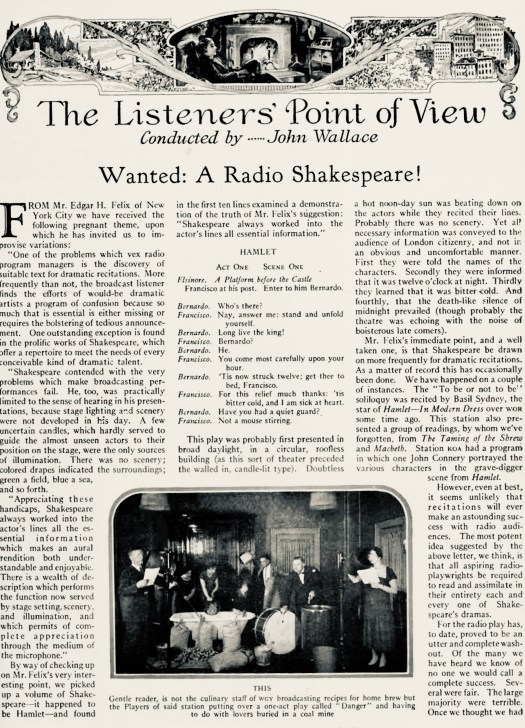
A photograph published in the April 1926 issue of Radio Broadcast
showing a young John Huston (left) and fellow members of the Provincetown Players

Here I go again.  Another broadcasting centenary, another radio “first.”  This “First,” mind, is wrapped in quotation marks, as the claim is not mine.  I am not going to dispute it, either, or challenge someone else to have the last word in the old “Who’s on First?” routine.  I have been there before.

Picture it: Early 2024.  I am commemorating the one-hundredth anniversary of radio “drama” at an event I staged with British playwright Lucy Gough at the National Library of Wales.  I set out by acknowledging the widely held assumption that Comedy of Danger by playwright-novelist Richard Hughes was the “first” original radio play to be broadcast … anywhere.

The claim served as a hook.  It was designed to underscore the international significance of the event.  At the same time, I tried to justify its happening in Wales by drawing attention to the play’s Welsh setting and the playwright’s affinity with the country.  More important to me than arriving at a definitive answer to the vexed question of whether Comedy of Danger should be regarded as the “first” of its kind are the shifting definitions of the term “radio play” on which, to my mind, hinges the answer to that question—or rather, its unanswerability and ultimate pointlessness.

After all, it is difficult to say what is “first” in any field if the field itself is not clearly delimited first, or if the field is so limitless that it defies delineation in the first place.  In the case of “radio play,” Hörspiel (play for listening) or radio drama—relatively arcane though this field of study may be—definitions not only vary greatly but are often not even attempted.

When is a play a radio play? That is a question I have been asking for a long time in my musings on the wireless, and it is a question I keep asking myself.  “When is a play a radio play” strikes me as a more useful way of framing the debate than the more obvious question “What is a radio play?” because the former encourages us to avoid the most perfunctory of answers: A radio play is a play written for and/or heard on the radio.  

Sure, on the surface it barely scratches, that statement sounds reasonable enough.  But are all plays written and produced for radio broadcasting radio plays by default? Is it the medium, then, that makes a play—any play—a radio play?

Not that “radio” as we understand or know it these days bears a close resemblance to “radio”—as a receiver set, a system, and a phenomenon—anno 1925, the year when Sue ‘Em, proclaimed by its publisher to be the “first radio play printed” in the USA, successfully made a play for first place in a radio playwrighting contest.

Continue reading ““The First Radio Play Printed in America”: “Sue ‘Em” (1925) and the Ensuing Question of Legitimacy”

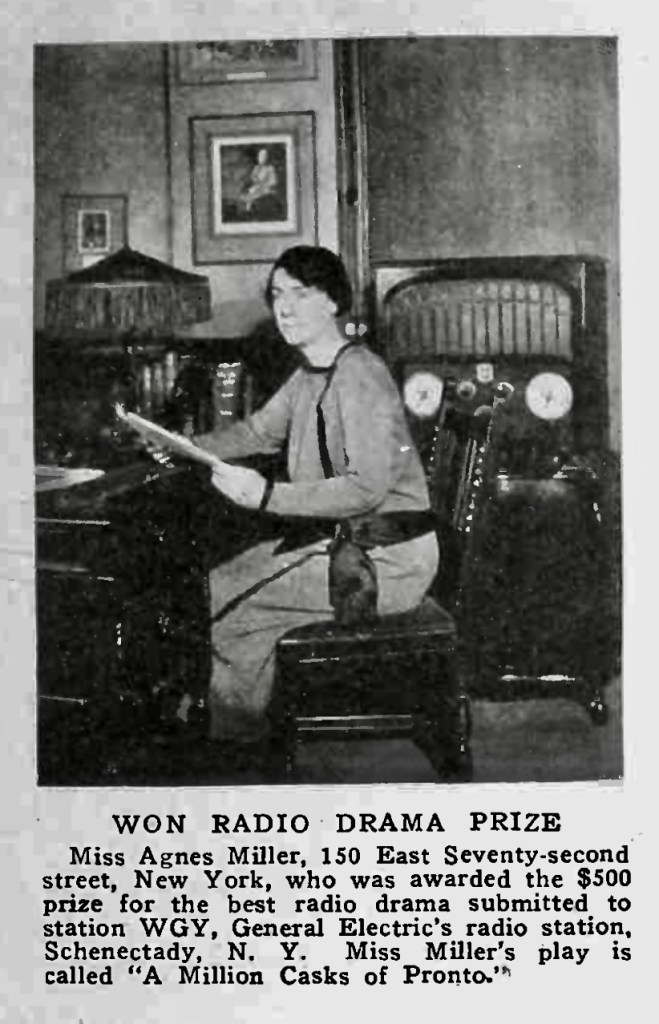
The Defined, the Definitive, and the Infinite: Thoughts Provoked by the Absence of “A Million Casks of Pronto”

Scoop up a tidbit, seemingly at random, however half-baked or nutritiously dubious.  Ask what made you stick your fork—or spork or chopstick—in it.  Reflect on why that morsel suits your palate, if indeed it does, at that particular moment in time.  Present your thoughts on a platter meant for sharing.  Hope for company, but don’t count on it.  That, in a coconut shell has been my approach to writing for the web since I commenced this journal back in the blogging heyday of 2005.  Eight hundred and forty-seven entries on, I am still at it, even though my diet, constitution and taste for potluck have changed considerably.

Not that I know exactly what those “Million Casks of Pronto” alluded to in the title of this blog entry contain; but more about that in as “pronto” as I can manage, especially since, as Wordsworth might have put it, these are lines composed a few minutes from Bronglais Hospital, where I went—and went under—for an endoscopy today.  Gallstones be damned, I am in a reflective mood, and those “Casks,” which were tossed onto the airwaves back in 1924, have been on my mind for quite some time now.

Continue reading “The Defined, the Definitive, and the Infinite: Thoughts Provoked by the Absence of “A Million Casks of Pronto””

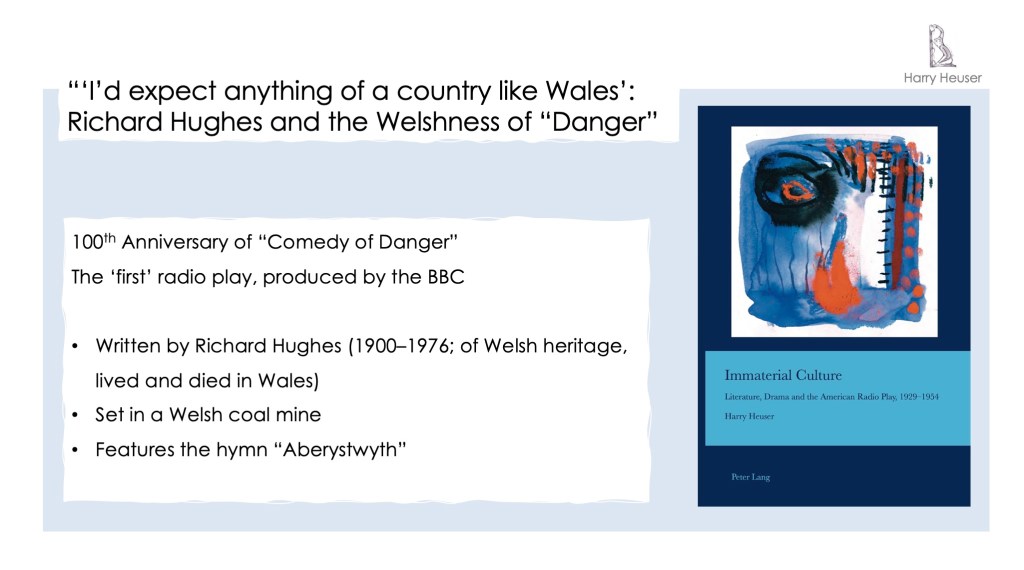
“The lights have gone out!”: Commemorating One Hundred Years of Plays for Radio

First slide of my presentation

Taking the radio play to the library has long been an ambition of mine, given that dramatic and literary works written for the medium of sound broadcasting occupy comparatively little space on the bookshelves.  Taking the first of its kind to a national librarythe National Library of Wales, no less—is a chance of a lifetime amounting to poetic justice.  Allow me to shed a modicum of light on that, and on my benightedness besides.

So that meaningful conclusions may be drawn from my peculiar challenge of commemorating one hundred years of radio dramatics in just a few minutes, it strikes me as essential that the centenary first be quartered, a fate I hope to escape on 22 February 2024, the date set for the event.

Continue reading ““The lights have gone out!”: Commemorating One Hundred Years of Plays for Radio”

Lance Sieveking, “The Man with the Flower in His Mouth”

Let me be the first to admit my ignorance. The world being largely ignorant of me, I simply cannot depend on anyone else to do so. That said, I might as well turn the keeping of this journal (complicated as it was today by internet-disrupting hailstorms) into occasions to pick up a little something rather than disperse whatever scraps of knowledge I may already lay claim to after years of study (or intellectual loafing).

One such occasion might be the birthday of British radio and television pioneer Lancelot Sieveking, born, as the Internet Movie Database informed me, on this day, 19 March, back in 1896. Sure, I had come across his name during my research for Etherized Victorians; but, concentrating my efforts on American radio dramatics, I had conveniently overlooked Sieveking’s accomplishments. Even the folks over at the Database have yet to catch up with this man of all media; at least, his death (back in 1972) has thus far escaped them.

It is no overstatement to say that the author of The Stuff of Radio (1934) is a neglected figure today; his name has most recently been dropped in connection to Disney’s first entry in the Chronicles of Narnia series. Narnia author C. S. Lewis had approved of Sieveking’s radio dramatization but dismissed the idea of a film adaptation. During the first season of BBC2 television’s Oxford English Dictionary challenge Balderdash and Piffle, there was some debate about the origin of the phrase “back to square one,” which was argued to lie in an eight-squared drawing meant to assist BBC radio’s football commentators back in 1927. That design, as it turns out, was Sieveking’s.

Fellow BBC radio drama producer Val Gielgud had this to say about the “not altogether fortunate” Sieveking: “He was perhaps over much influenced during his most impressionable years by G. K. Chesterton, and by the theory of that master of paradox that because some things were better looked at inside out or upside down such a viewpoint should invariably be adopted. Talented and imaginative beyond the ordinary, his eyes gazing towards distant horizons, he was liable to neglect what lay immediately before his feet.”

In other words, Sieveking was an audio-visionary, a trier of radiogenic techniques at whom actors and colleagues would “gaze with a certain dumb bewilderment” as he “exhorted them to play ‘in a deep-green mood,’ or spoke with fluent enthusiasm of ‘playing the dramatic-control panel, as one plays an organ.'” There was not much use for such an one in radio. As Gielgud put it, even British radio broadcasting, “provided him with no laboratory in which experiments could be carried out.”

In 1930, when radio drama was still in its protracted infancy (despite earlier trials-by-air like the aforementioned “Comedy of Danger”), Sieveking found a “laboratory” in the still newer medium of television. He collaborated with Gielgud in bringing to British television “The Man with the Flower in His Mouth.” An adaptation of Luigi Pirandello’s short play L’uomo dal fiore in bocca (1923), it aired on 14 July 1930.

Little remains today of Sieveking’s work in sound and images, aside from its blueprints—long-out-of-print scripts and theories. Now, I live in a town with a five-million-volume copyright library (which celebrated its 100th anniversary today); but for a snippet of sound, you might as well saunter over to tvdawn, where you may hear Sieveking’s spoken introduction to “The Man.”

Dark of Day: "Danger" and the Drama Invisible

Well, it was a scorcher of a day—the first I experienced here in temperate Wales. The unexpected heat brings back memories of my many summers in New York City and will prepare me for my return to the asphalt jungle this August. Moving to rural Wales from that bustling metropolis took more of an adjustment than adding a few layers of clothing; but anyone ready to weave life according to E. M. Forster’s motto “Only connect,” which is not a bad motto to live by, there is the comfort of that web of relations that, however remote or isolated you might believe yourself to be, will place you smack in the middle of the world, like a spider resting in the assurance that flies are bound to drop in, by and by.

Here is one such moment in the web in which I find myself. You might have to stretch your antennae a bit to get caught up in it.

Picture this: New York City, on this day, 18 July, in 1936. It’s the premiere of The Columbia Workshop, the most experimental and innovative of all the radio dramatic series produced during the so-called “golden age” of old-time radio. For that first broadcast, the Workshop revived what is generally considered to be the first original play for radio: The Comedy of Danger, by British playwright-novelist Richard Hughes, better known for A High Wind in Jamaica (1929), an adventure story that has been ranked among the hundred best novels of the twentieth century.

Danger is a sort of Poseidon Adventure staged in utter darkness; a spectacular melodrama of disaster involving three people about to drown in a collapsed coal mine. It is a scenario mined for the theater of the mind, evoked by sounds and silence alone. Danger was first produced by the BBC on 15 January 1924, but was still a novelty act when the Workshop chose it for its inaugural broadcast more than twelve years later. Back in 1924, US radio had no use for such theatricals, Hughes remarked in an article about “The Birth of Radio Drama”:

A few months [after the BBC production], finding myself in New York, I tried to interest American radio authorities in the newborn child.  Their response is curious when you consider how very popular radio plays were later to become in the States.  They stood me good luncheons; they listened politely; but then they rejected the whole idea.  That sort of thing might be possible in England, they explained, where broadcasting was a monopoly and a few crackpot highbrows in the racket could impose what they liked on a suffering public.  But the American setup was different: it was competitive, so it had to be popular, and it stood to reason that plays you couldn’t see could never be popular.  Yet it was not very long before these specially written “blind” plays (my own “Comedy of Danger” among them) began to be heard in America, and on the European continent as well.

Other than creating a situation in which the characters are as much bereft of sight as the audience, Danger has no artistic merit. It purports to be philosophical about death; but the fifteen minutes allotted for this piece of melodramatic hokum are hardly time enough to probe deeply, and much of the dialogue is ho-hum or altogether laughable.

What makes this seemingly generic if radiogenic play more personally meaningful to me is that it was written by a Brit of Welsh parentage, by a man who chose to live in a Welsh castle, and who chose, for this, his first dramatic piece for radio, a story set not far from the very hills where I found myself after these long years of writing in New York City about American radio drama. Is it a coincidence that I came home to the birthplace of radio drama?

“Goodness knows!” exclaims one of the trapped visitors,

I’d expect anything of a country likes Wales! They’ve got a climate like the flood and a language like the Tower of Babel, and then they go and lure us into the bowels of the earth and turn the lights off! Wretched, incompetent—their houses are full of cockroaches—Ugh!

In the background, Welsh miners face their fears by singing “Aberystwyth”—the name of the town near which I now reside. The Welsh, of course, are known for their oral tradition, for their singing and poetry recitals; their most famous poet is Dylan Thomas, author of the best know of all radio plays, “Under Milkwood.” It is here that American radio drama is still being thought of and written about: Rundfunk und Hörspiel in den USA 1930-1950 (1992), for instance, by fellow German Eckhard Breitinger, was written here, as was Terror on the Air, by Richard J. Hand, published in 2006. It is here, in Wales, that I started communicating with radio dramatist Norman Corwin; and it is here that, after a short break from my journal, I will continue my visits to the theater of the mind.

Yes, it is a web all right, even though I am not sure whether it was woven by or for me. I am merely discovering connections that, upon reflection, are plain to see and comforting to behold.