ASMR Jungle: Rambling Notes on NYC Composed Out of Earshot

Chalk drawing on the pavement at Union Square. Not that I need an invitation.

Inhale.  Exhale.  Inhale.  Exhale.  I must try that some time without using a brown paper bag.  Just kidding – but only just.  It’s been a breathless few weeks.  Now that I am coming up for air, I’d like to say, if it were not such a hackneyed phrase, that I have returned from my long and long-delayed New York trip with a suitcase full of memories.  Not that I care to be reminded about my luggage, given that, owing to an absent-mindedness brought on by physical exhaustion and an acute state of all-over-the-placeness, my carry-on case continued its journey by rail without me.

Argh.  Among other things, the valise gone astray contained a rare copy of Mr. Fortune Finds a Pig (1943), a curiosity of a mystery about which, had I not, through my negligence, forfeited the opportunity of its perusal, I would have liked to say considerably more here, especially given that its story is set in Wales, whereto its English author, H. C. Bailey (1878–1961) retired at the end of his career.

My copy of the novel, before it got lost in transit.

While in New York, I did a bit of research at the New York Public Library’s Billy Rose Theatre Division on lost recordings of Bailey’s “Mr. Fortune” stories, nineteen of which were adapted for US radio in the mid-1930s and are extant as scripts.  More about that, and the pig, some other time, the lost-and-found department of Transport for Wales permitting.  Never mind flying.  Pigs might travel by rail.

Pardon the rustling of mental notes; but as recounted here previously, fortune did not exactly smile on me during my stay in New York, entirely overshadowed as it was, at least initially, by my former partner’s heart attack and my bout of Covid, which barred me from the ICU and turned my legs to lead as I dragged myself from one testing site to another.

Rasp.  Not that my sojourns in the metropolis are ever an unalloyed joy, tinged as they invariably are with a sense of loss and estrangement.  Each year, the city I knew most closely when I lived there from 1990 to 2004, is becoming less familiar, less recognizable, and generally less worth revisiting, especially since what was particular and once characteristic is gradually being replaced by the generic and corporate.

The pandemic has speeded up this process, with many of the remaining one-of-a-kind sites going under in a sump of sameness.  A few years ago, when I researched the career of the English printmaker Stanley Anderson for a catalogue raisonné and a series of exhibitions, I was struck by the sense of dislocation some of his etchings communicate.  A kindred spirit, I am alive to Anderson’s visual commentaries on a world that was vanishing – or was made to disappear – before his very eyes.
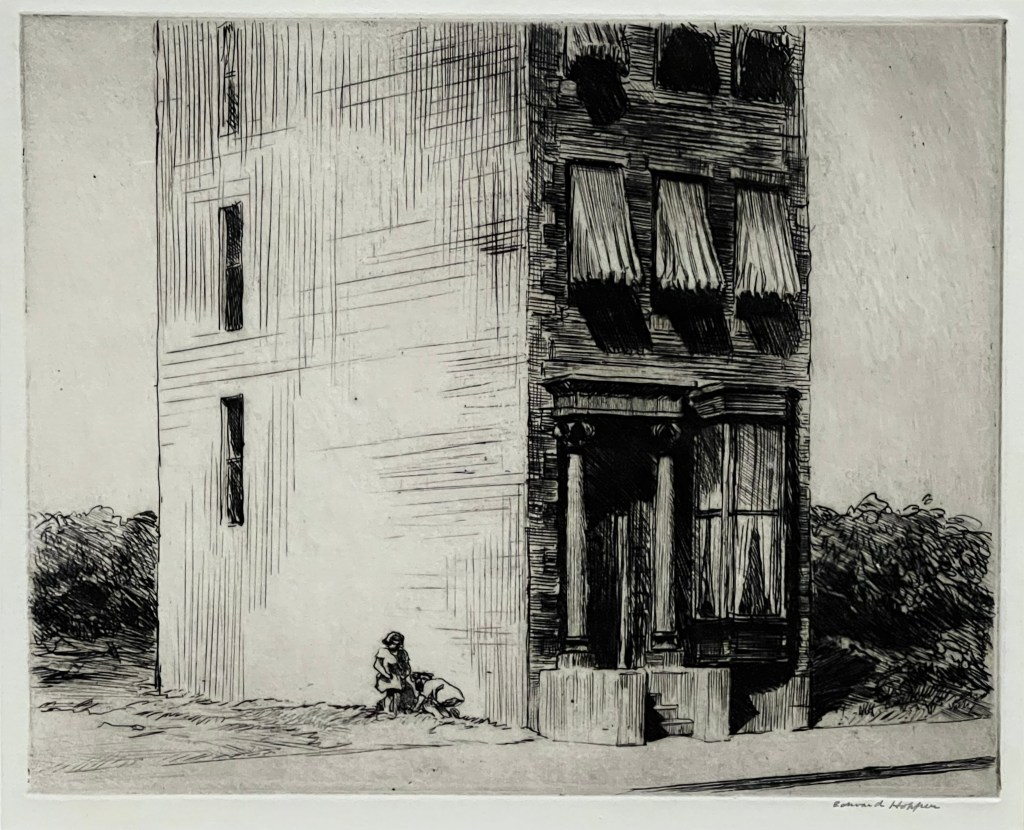
Edward Hopper, The Lonely House (1920)

I was reminded of Anderson’s alternative views of 1920s London – of construction sites and demolitions – when I came across the etching The Lonely House (1920) in the exhibition Edward Hopper’s New York at the Whitney.  New York City, as the show’s curators put it with platitudinous generality, “underwent tremendous development” during Hopper’s lifetime; and instead of focussing his attention on landmarks that are more likely to stay in place than the architecturally commonplace – an assumption proven false decades later by the pulverization of the World Trade Center, an act of religious fanaticism bringing home that iconoclasm on any scale demands the iconic – Hopper “turned his attention” to “unsung utilitarian structures” and was “drawn to the collisions of the new and old” that “captured the paradoxes of the changing city.”

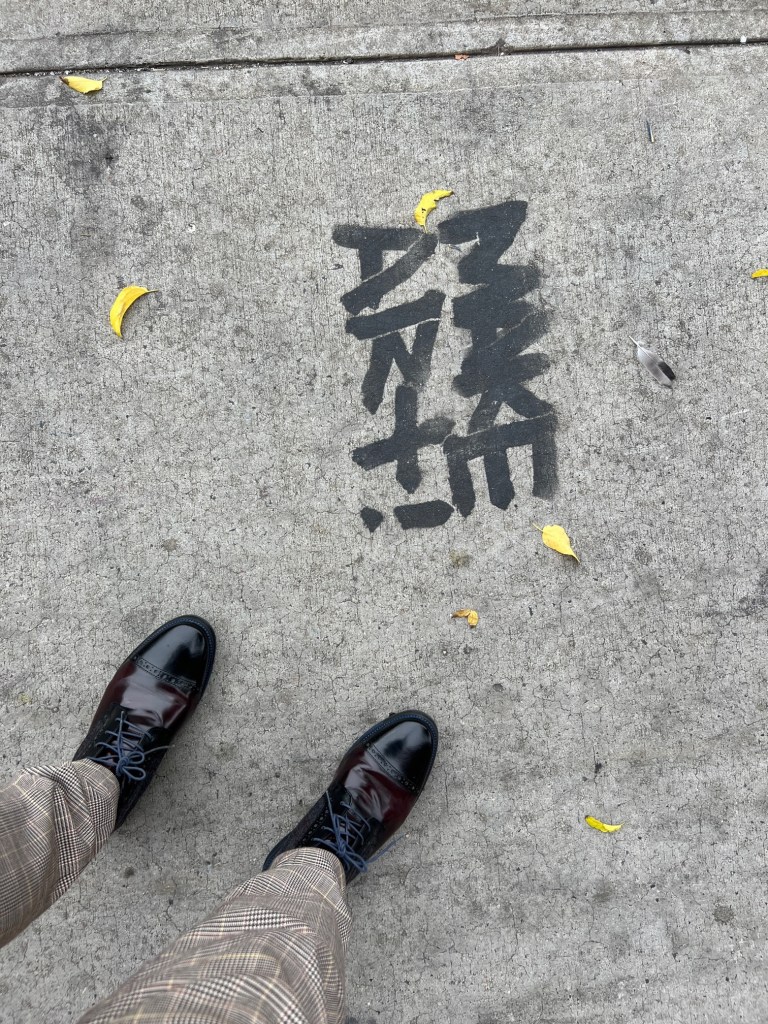
I am likewise eschewing the presumably picture-worthy sites in Asphalt Expressionism, my upcoming exhibition of large format, printed iPhone photographs of New York City sidewalks that, in a tourist’s pursuit of views or selfie backdrops, tend literally to fall by the wayside despite being in plain sight.

However, it is not visuals alone that vanish or material culture only that is subject to erasure.  Sounds, too, face neglect and extinction.  Unless they are voices or musical compositions, aural environments are largely unheard of in most records of our experiences, public or private.  Sounds may survive as a backing track to our home videos, but rarely do they become the main event, the real thing of our conscious engagement with sensed reality.

Continue reading “ASMR Jungle: Rambling Notes on NYC Composed Out of Earshot”
Down and Out in NYC: Movements, Pavements and Pandemics

Well, it ain’t over ‘til the proverbial — and stereotypically plus-sized — diva, binary or otherwise, puts down her lozenges to launch a final attack on the lorgnette-clutching, socially-distanced crowds. In as plain a variety of English as I can bring myself to adopt: we haven’t heard the last of COVID-19. Done as we might think we are with the pandemic the US President declared over, the virus continues to catch us unawares and mess with our lives.

It sure is messing with mine right now, in a number of ways. Almost immediately on arrival in New York City two weeks ago, I caught some resilient variant of the bug I had managed to steer clear of for so long. And it caught up with me despite all vaccinations and boosters, having taken advantage of the first opportunity to have my last antiviral top-up just two days before my departure.

Imperative mood

This is my first return visit to my old Manhattan neighborhood in three years … but clearly things did not go as planned or hoped for. What makes matters worse is that I had intended to be of some use to an old friend and former domestic partner, who, just days prior to my arrival, suffered a massive heart attack and has been in intensive care ever since. Here I am, stuck in his apartment, just a 20-minute walk away from the hospital that is now off limits. No doubt, millions of New Yorkers felt like that during lockdown — when everything and everyone close by was suddenly out of reach.

Continue reading “Down and Out in NYC: Movements, Pavements and Pandemics”

Little Lady Hee-Haw; or, A Temple Fit for Goebbels

On my only trip requiring an overnight bag during this stay-at-home summer, my husband and I drove from our patch on the west coast of Britain to the thoroughly overcrowded Cotswolds and, upon my urging, made a stop-over at the Welsh town of Hay-on-Wye, an internationally renowned haven for second-hand book lovers.  Now, musty old volumes and COVID-19 do not quite go together – or so I thought – considering that retail spaces generally set aside for them are rarely supermarket-sized.  However, Hay, which depends on the trade, managed to make it work; and, meeting the moment by donning a mask, I got to enjoy an afternoon of socially distanced and sanitized hands-on browsing.

Not that I walked away with any tomes of consequence.  While at the Cinema bookstore – a shop not limited to publications related to motion pictures – I discovered a nook stacked with a curious assortment of ephemera: German movie programs of the 1930s.  I am not sure how they ended up in a Welsh bookshop – but that dislocation may well have extended their shelf life … until a German such as I came along and took an Augenblick to sift through them.

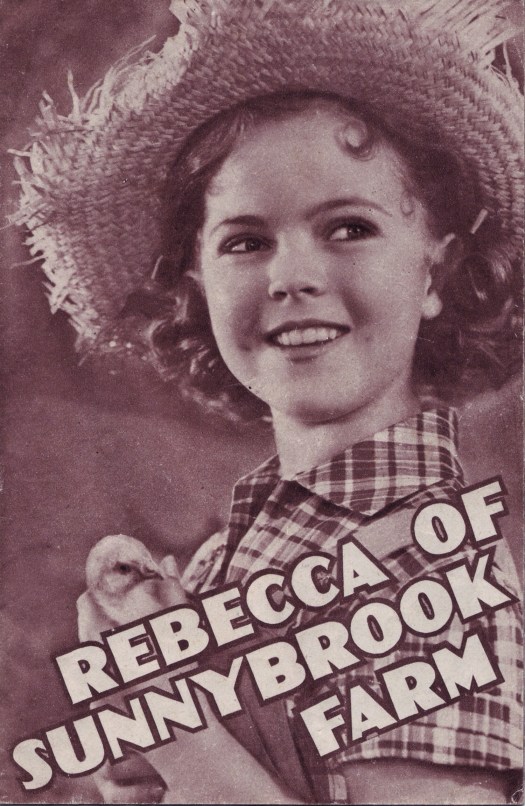
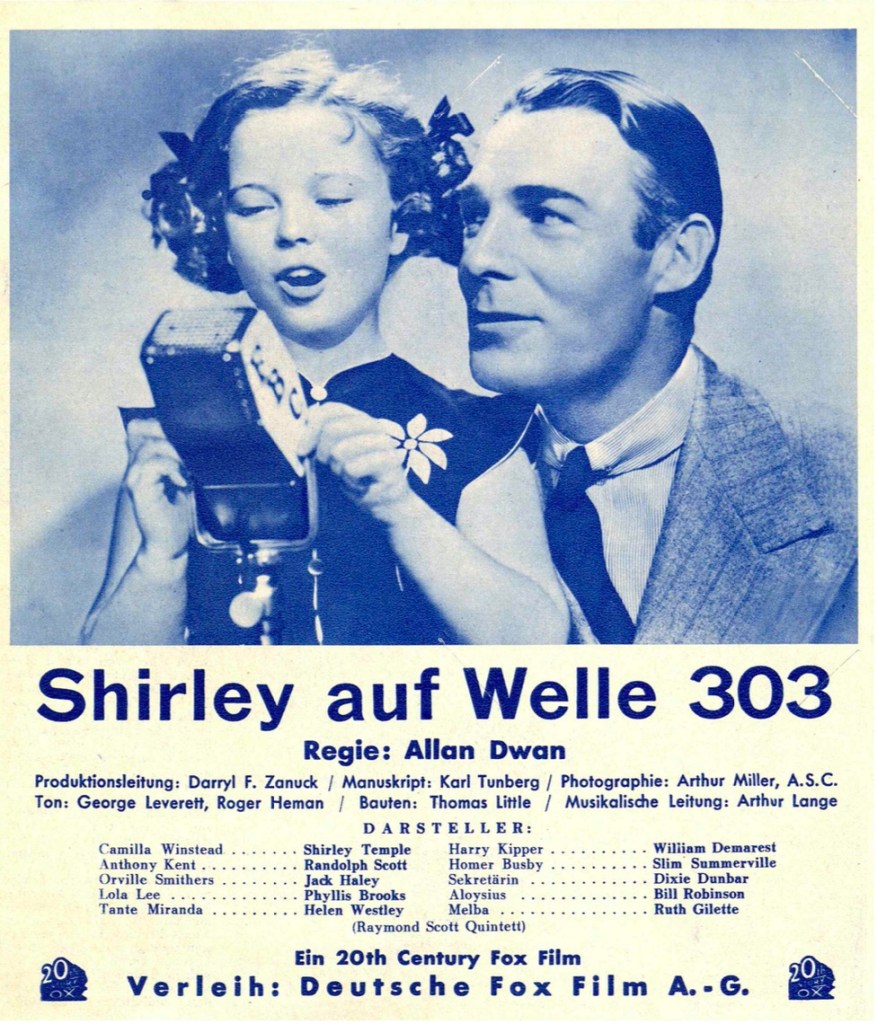
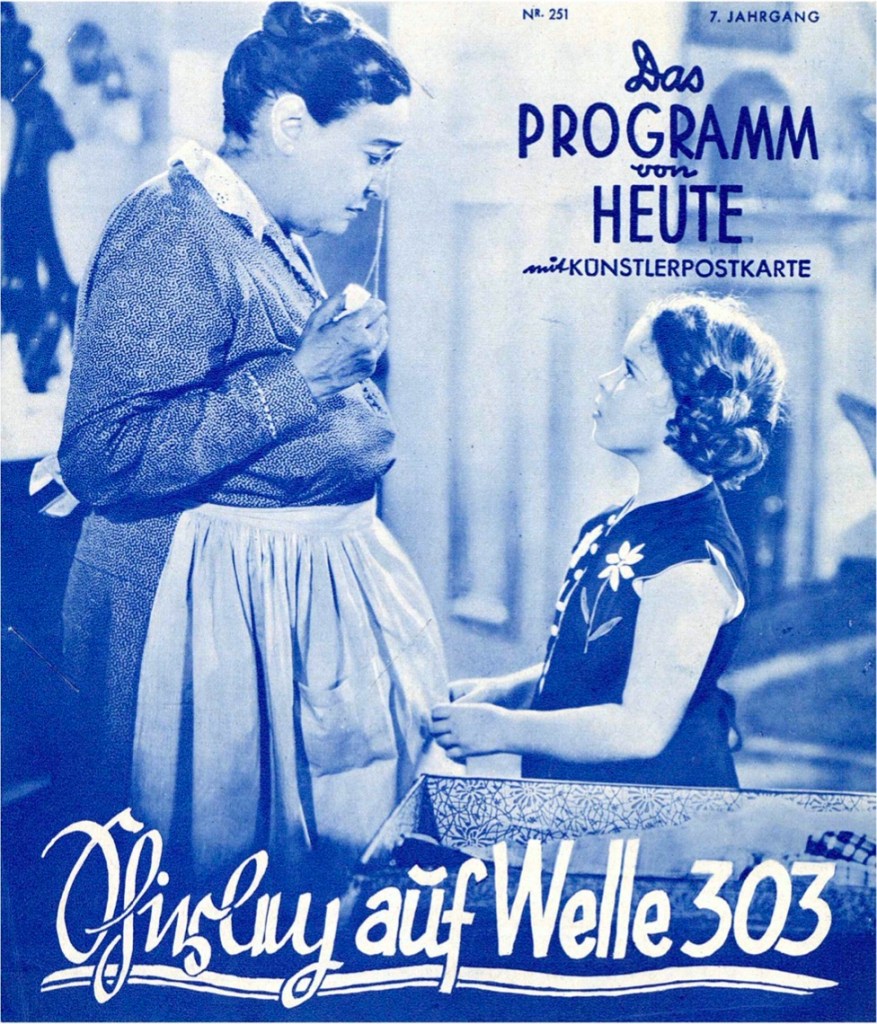
The program pictured above, dating from 1937, left me puzzled for a while.  I am familiar with many of Shirley Temple’s features – but I did not recall any among them bearing a title remotely like “Shirley auf Welle 303,” or “Shirley over Station 303.” So, I picked up this fragile brochure, and a few others besides, if mainly to tap their potential as pop cultural conversation pieces.

The film being deemed worthy of commemoration is Rebecca of Sunnybrook Farm, a DVD of which is gathering dust in my video library.  The title refers to an early twentieth-century children’s literature classic, although the movie version bears so little resemblance to it that it could hardly be considered an adaptation.  Not that the title of the novel would have resonated with German audiences. Meeting this challenge, the marketing people at Fox came up with a new one that might sound more relatable.

I suspect that the servants of the Nazi regime would have objected to the name of the titular character as well, being that Rebecca is Hebrew in origin, meaning “servant of God.” Shirley, on the other hand, was a household name, Ms. Temple having charmed audiences around the world since at least 1934. Like the titles of several other Shirley Temple vehicles released in 1930s Germany, the German version of Rebecca of Sunnybrook Farm therefore bears the first name of its star. Only Heidi stayed Heidi, rather than being translated into “Little Swiss Miss Shirley.”

A contemporary British program for the same film, also in my collection.

And yet, the effort to make the film seem more relatable to Nazi Germany’s picture-goers nonetheless resulted in a title that was out of touch with Fascist reality. In 1938, when the film was released in German cinemas, the idea of using radio transmitters for your purposes – or for the purpose of exploiting a child for your own purposes – was inimical to state-controlled broadcasting. On the air, it was always “Germany Calling,” a phrase famously used by the aforementioned Lord Haw-Haw beginning in 1939.

Germans would have struggled in vain to twist the dial and hit on a broadcast like Shirley’s, or they would have paid a price for such twisting.  Many of them listened via the Volksempfänger, a mass-produced receiver that was always tuned in to the Führer’s voice.  Imagine staying tuned to Fox News all day.  Then again, so many who do have the choice not to still do nonetheless, not unlike those who were complaisant during the rise of Fascism in Germany.

The change in title – and the recontextualization it achieves – is peculiar, and only a performer as innocuous as Shirley Temple could have gotten away with what otherwise would have been downright seditious: seizing the microphone and taking to the airwaves in a makeshift studio set up in a remote farmhouse.  Perhaps, the titular bandwidth – 303 – was to signal that Shirley’s broadcast had been sanctioned after all, 30 January 1933 being the date Hitler came to power. In the Third Reich, three was heralded as the charm.

For decades, the German film industry did wonders – or, rather, wilful damage – to international films with its dubbing of their soundtracks; voicing over and voiding the content of the source, there were many opportunities to ready a film more substantive than Rebecca for consumption in Nazi Germany.  I do not recall seeing this movie in my native language, although I do remember a festival of her films airing on West German television in the late 1970s.  Not that watching Rebecca of Sunnybrook Farm in the original is an experience I am eager to repeat, clobbered together a vehicle for an overhyped and overworked child star about to wear out her welcome that it is. Variety dismissed the film at the time as a “weak story,” “indifferently acted and directed,” while claiming its lead to be “at her best.”

The German program does little more than summarize the plot as well as state the principal actors and main players behind the scene of the production; I am sure someone checked whether producer Darryl F. Zanuck was Jewish, which he was not. What struck me about the program was that it mentions the word ‘propaganda’ twice in the first paragraph, where it was used as a substitute for advertising (in German, “Werbung” or “Reklame”).  Sending up the excesses of US consumerism while promoting the ostensible virtues of country living, this trifle of a film – distributed in Nazi Germany by the enterprising and accommodating “Deutsche” Fox – could serve as a vehicle for anti-American propaganda at a time when increasingly few US films were granted a release in Germany.

By making such trifles, and by marketing them for distribution in Nazi Germany, the US film industry contributed to the rise of Fascism, which, only after the attack on Pearl Harbor, Hollywood films began to confront with a suitably glossy vengeance. By that time, US films were banned in Germany, and Shirley Temple ceased to be a leading lady – at least in motion pictures.