
Cardboard Sentiment

I have yet to write a card this season; and considering that half of my greetings are to be flown overseas, I should really put pen to shiny paper any day now. In Germany, where I am from, it is tradition to wait until the last possible moment to post seasonal greetings, whatever the season. It is not customary there to display received mail for weeks on dusty end, certainly not prior to the event they are designed to commemorate. So, when is the right time to drop off those sentiments? The ever earlier reminders that are the shop windows can hardly be a guide in the matter.

“To save the postman a miserable Christmas, we follow the example of all unselfish people, and send out our cards early.” Thus noted the imaginary writer of The Diary of a Nobody (1892) in an entry dated . . . 22 December? The postal workers, no doubt, were less than pleased by the way in which the sentiment found implementation.

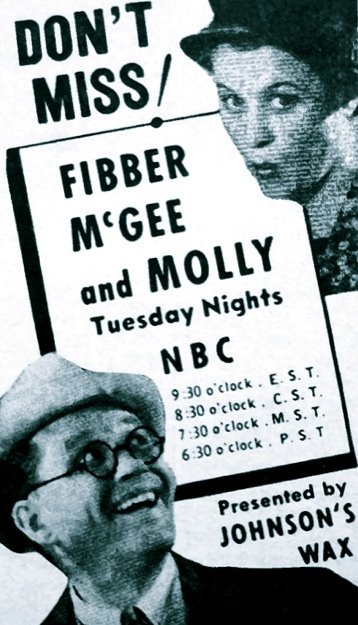
“Most of the cards had fingermarks, which I did not notice at night,” the same writer observed, a potential smudge on his reputation against which he resolved to guard henceforth by buying “all future cards in the daytime.” Another noted nobody determined not to purchase any cards at all. His name was Fibber McGee; and on this day 6 December, in 1949, he was found hard at work making his own holiday cards. To be sure, it was not his big idea to be creative or thoughtful that temporarily turned him into one-man Hallmark factory.

“Boy-o-boy,” Fibber told his wife, the doubtful Molly, “I sure wish I’d a-thought of this before. Look at the money I’d a-saved if I’d a-made my own Christmas cards every year.” Fibber did not merely paint the designs, including a beardless Santa Claus; he also dreamed up the accompanying sentiments. Among the rhymed excuses for his schlock art (words for which writer Don Quinn deserves and received some credit), are:

St. Nicholas had his beard cut off
as up on the roof his reindeers trample
because how can a guy with whiskers on
show little shavers a good example?

“I got a million ideas as good as this one,” Fibber boasted. “Well, I should hope so,” Molly replied.

For the Mayor of the town, Fibber paints the picture of a pork barrel with a hand in it; and for a friend who has been avoiding him for reasons soon to be apparent, he sketches a fish swimming through mistletoe, a symbolism explained in verse:

I hope the fish I hereby show
recalls the fin I loaned you last July.
And though he swims through mistletoe,
I ain’t gonna kiss that fin goodbye.

Ultimately, Fibber has to wash his hands of the whole Christmas card business, dirty as they are with paint and glue. Like the Nobody before him, and like millions of people everywhere, Fibber resorts to store-bought sentiments, even though the ones he has his hands on were pre-owned. The seller proved savvier than old Fibber. As Nobody’s experience with “fingermarks” suggests, even the purchase of new cards can be a challenge, especially when one has to face a shop

crowded with people, who seemed to take up the cards rather roughly, and, after a hurried glance at them, throw them down again. I remarked to one of the young persons serving, that carelessness appeared to be a disease with some purchasers. The observation was scarcely out of my mouth, when my thick coat-sleeve caught against a large pile of expensive cards in boxes one on top of the other, and threw them down. The manager came forward, looking very much annoyed, and picking up several cards from the ground, said to one of the assistants, with a palpable side-glance at me: ‘Put these amongst the sixpenny goods; they can’t be sold for a shilling now.’ The result was, I felt it my duty to buy some of these damaged cards.

I had to buy more and pay more than intended. Unfortunately I did not examine them all, and when I got home I discovered a vulgar card with a picture of a fat nurse with two babies, one black and the other white, and the words: ‘We wish Pa a Merry Christmas.’ I tore up the card and threw it away. Carrie said the great disadvantage of going out in Society and increasing the number of our friends was, that we should have to send out nearly two dozen cards this year.

May a joyous season be in your cards, fingermarks ‘n all!

Heavenly Days: What I Get to Watch When I’m Home Alone

Here I sit like a good egg given up for Lent. After having spent much of the week leading up to Ash Wednesday—a period celebrated as Karneval in my native Germany—entertaining two old (make that “longtime”) friends eager to get away from those festivities. The guests gone and my better half away in London, I now have the place pretty much to myself (the pleasant company of Montague excepting). Heavenly days? Not quite; but I did get to watch the movie. Heavenly Days, that is, a 1944 comedy based on the characters created by Don Quinn for his hugely popular US radio series Fibber McGee and Molly (many episodes of which are available online at the Internet Archive).

My web journal tells me that I recorded this film way back in November 2005, during a visit to New York City, my former home. So, it has taken me a while to catch up with Fibber McGee and Molly in their last major movie outing. It takes a day like this to do so without impunity, that is, without having to importune someone else who, despite having humored me by sitting through Look Who’s Laughing (1941) and much else besides, cannot be expected to share my enthusiasm for radio stars on celluloid. Who would?

That said, I have never been a friend of Fibber McGee and Molly; I much prefer the urbane wit of the aforementioned Halls of Ivy, a situation comedy conceived by the same writer, over the middle-America average-Joeness I have neither experienced nor longed for during my fifteen years in the United States. That did not stop me from picking up a copy of Charles Stumpf and Tim Price’s Heavenly Days at the Museum of Television and Radio while visiting Gotham in August 2006.

Messrs. Stumpf and Price point out that Heavenly Days, unlike the comedy team’s previous Look Who’s Laughing and its follow-up Here We Go Again, was not a commercial success. Yet whereas those earlier movies were rambling and largely inconsequential, Heavenly Days attempts to be earnest and socially relevant. Like the radio series, it is in the service of wartime propaganda, sending Fibber and his wife on an educational trip to Washington, from which they return with an awareness of their importance to the nation.

Heavenly Days is at once rebellious and (pardon the anachronism) politically correct. It seems determined to infuse the final months of the Second World War—a period in which fear and fervor made way for indifference and impatience—with the spirit of the New Deal, which, by 1944, was rather old hat. According to the peculiar logic of the sentimental comedy into which he is thrust, Fibber has to learn what it means to be “average,” a label all of the citizen he encounters vehemently reject; that it is neither a shame nor a statistical sham, but an honor and an obligation, considering that being average makes him a representative of the people who declare and elect him to be just that.

Of course, Fibber long had the vote of the people who, by tuning in to his weekly radio program, kept him in the office that was a prominent slot on the air—that realm of statistical averages and mediocrity. After the less than favorable reception of his Heavenly Capraescapades, that slot must have seemed a good place to come home to . . .

On This Day in 1951: A Radio Sitcom Is Cited by the Chamber of Commerce

Well, I can’t say that I have been, lately. Well, I mean. My digestive system is on the fritz, and my mood is verging on the dyspeptic. So, if I am to begin this entry in the broadcastellan journal with “Well”—as I have so often done these past six or seven months—it must be a brusque and slightly contentious one, for once. My jovial, welcoming “Well,” by the way, was inspired by Paul Rhymer’s Vic and Sade, a long-running radio series whose listeners were greeted by an announcer who, as if opening the door to the imaginary home of the Gook family, ushered in each of Rhymer’s dialogues with expositions like this one:

Well, sir, it’s a few minutes or so past eleven o’clock in the morning as our scene opens now, and here in the kitchen of the small house half-way up in the next block we discover Mrs. Victor Gook industriously bending over her ironing-board. Tuesday is the time usually given over to this task, but the holidays have more or less thrown Sade off schedule. And so she irons. But there’s a newcomer approaching apparently . . . because the back door is opening. Listen.

Writing my introductions, I chose to omit the gendered address; but I hope to have retained the friendly, casual tone of the interjection.

Now, Vic and Sade was one of those shows that did not successfully transition to the radio format that became such a staple of television entertainment: the situation comedy or sitcom. Rhymer was a raconteur, not a dramatist; he allowed his characters to reveal something about themselves through their words, rather than their actions. If you, like me, enjoy the Golden Girls, imagine Rose, Blanche, Dorothy and Sophia sitting around the kitchen table, telling stories about St. Olaf, the old South, Brooklyn and Sicily—without the dramatized flashbacks. The situation comedy became popular in the mid-1940s; and it did away with the old vaudeville routines, the minstrel shows, and the quietly funny Americana in which Rhymer excelled.

On this day, 2 May, in 1951, one of the finest American radio sitcoms was being honored in Washington, where the cast performed before members of the Chamber of Commerce. The program, which had just received the prestigious Peabody Award, was the aforementioned Halls of Ivy, and the cast was led by Ronald Colman (as William Todhunter Hall, the president of an imaginary American college) and his wife, Benita Hume (as the academic’s refreshingly non-academic spouse, a former stage actress). What made The Halls of Ivy worthy of such accolades was writer-creator Don Quinn’s ability—and the sponsor’s willingness—to tackle a number of social problems, whether topical or universal.

In the spring of 1951, that problem was the Korean War and the resentment with which the draft was greeted by college students who believed to have had their future mapped out for them and now found their careers derailed, their very lives in danger. On Halls of Ivy, the resulting campus unrests were dealt with in a rather tentative and sentimental manner; but Quinn’s sophisticated prose—peppered with smart puns, metaphors, and literary allusions no other radio or television sitcom can hope to rival—make this a worthwhile entry in the annals of Ivy.

Asked to speak before the members of the Chamber of Commerce, Colman had this to say about his radio role (which he later performed on television):

I want to thank you for being such an appreciative audience and for accepting me as a college professor. Come to think of it, I can’t be too bad at that because, I believe, I am probably the only college professor in the country that can take a difficult problem and solve it in exactly half an hour. More that this, I can do it every week.

Highlighting the strength of the program, Colman was also pointing out its weakness. Today, in the post-Seinfeldian era of social irresponsibility in entertainment, the problem sitcom strikes many as simplistic and hypocritical. Of course, most of us fail to express our cynicism and anti-social rants nearly as eloquently as any of the makeshift wisdom shared by The Halls of Ivy.

Realism may lie well beyond the scope of witticisms and sentiments—but the monosyllabic insult and the actions-speak-louder-than-words approach to problem solving contribute even less in the shaping of a better reality for us all.

On This Day in 1950: Ronald Colman Lectures on Bigotry and Schlitz Vows to Ship 600,000 Cans of Beer to Korea

I started writing this during a power outage; so, in commemoration of this event, I’ll try [and promptly failed] not to be quite so long-winded this time. I didn’t relish the experience of sitting alone in the dark without the comfort and convenience of electricity, especially since darkness is the very stuff of radio drama, the sound pictures that are stored on my computer or waiting to be snatched out of the world wide web.

For a while I tried to fill the void with my own voice, reading out loud by candlelight, enacting the parts in Jane Austen’s Persuasion, the book at hand. The flicker illuminating the pages began to irritate me; and when I caught a glimpse of the shiny surface of my laptop, I couldn’t resist to drain its precious battery power by popping in a CD and listening to one of my favorite situation comedies of old-time radio, Don Quinn’s witty and endearing Halls of Ivy. Besides, I had already decided to write about the 27 September 1950 broadcast of that show—an episode OTR enthusiast Jerry Haendiges argues to be “probably the best of the series.”

Among the smartest comedies of its day, the series had long escaped my notice, since “its day” was the early 1950s, a time when radio was already experiencing a decline in talent, audiences, and sponsorship. When setting up the research boundaries for my dissertation, I initially dismissed such late-comers, sound unheard, assuming them to be lacking in literary merit and production values, deficiencies owing to conservative—that is, money-starved—programming as a result of dwindling advertising accounts. The Peabody Award winning Halls of Ivy (1950-52) sure proved me wrong.

The program was greeted as a sign of radio’s maturity, not its senility and obsolescence. In the May 1952 issue of Theatre Arts critic Harriet Van Horne, who had previously lamented radio’s adolescent fare, recommended Halls of Ivy as a “literate” treat, arguing its writing to be “often much better than the dialogue you encounter in some Broadway shows.” Set in a liberal college, the series delicately addressed and eloquently expressed a number of social concerns, the fictional campus being a playground on which to act out matters of race, class, and gender. Sentimental without being saccharine, it was edifying without getting snooty about it. I mean, come on, the show was sponsored by the makers of Schlitz—the “beer that made Milwaukee famous.”

On this day in 1950, Halls of Ivy presented a study in prejudice. Penned by Don Quinn and Cameron Blake, the story for the evening involved a high-toned mother of a dead soldier who vows to make a $500,000 donation to Ivy College after finding a picture of her son in a newspaper announcing the award given to the student who painted his portrait. When college president Dr. Hall (Ronald Colman) hears about this proposed endowment, a “girdle” to bring the institution back into shape, he fears that “this girdle is the old-fashioned kind. You know, the kind with strings.” Sure enough, the benefactress stipulates that the money “must absolutely not be used to provide scholarships for . . . well, for certain races and creeds.”

The donation is refused. Adding to the irritation of the narrow-minded society lady who offered it, the Halls receive a visit from the student artist who captured the likeness of the son from whom she had been estranged. As it turns out, the painter is of a “certain race” himself. After this exposure—a confrontation with and a laying bare of her bigotry—the strings are removed and the money can change hands, a moral lesson delivered with such skill and grace that even the contrived ending does not come across as awkward or trite. Summing up the dramatized lecture, Dr. Hall remarks that “life itself is a little like a college. You don’t learn much by attending only one class.”

Not to be outdone my the fictional donation, Schlitz announced at the close of the program that, having been given the okay from the Eisenhower administration, it would ship 600,000 cans of beer to the American soldiers then fighting in Korea. It’s a rather tacky coda—but sponsors aren’t exactly classy when it comes to touting their wares.

Once the power was restored in my abode, I set out for another trip to Ivy College—because “you don’t learn much by attending only one class”—and watched a 1955 episode of the TV adaptation of Halls of Ivy, also starring Colman and his wife, Benita Hume (along with the wonderful Mary Wickes as their maid). Well, sometimes it is nice to let someone else do the picturing for you, particularly after having been forced to spend two hours in near darkness.

On This Day in 1939: The Folks at 79 Wistful Vista Channel Wimpole Street

Heavenly days! Thanks to modern-day technology (and, I suppose, a surplus of leisure) I have unearthed a spiritual bond that, thus far, has escaped literary scholars and old-time radio enthusiasts alike. Now it can be told: on this day, 12 September, the broadcast antics of Fibber McGee and Molly strangely intersect with the romance of Victorian poets Robert Browning and Elisabeth Barrett. Yes, on this day, both couples eloped—the Wimpole Street escapees in 1846 and the whimsical everybodies from Wistful Vista in 1924.

The latter celebrated their lucky breakout on their 15th wedding anniversary by attempting to restage the happy event—an elopement without the fuss of being detected and chased by opposing elders. Yet despite the blessings of their high-toned neighbor, society lady Abigail Uppington—who assured them that the “affair” would “never be criticized,” even though the couple was “unchased”—the folly of it all resulted in a series of outrageous and none too enchanting complications. Well, the whole thing was Fibber’s idea to begin with . . .

One of the earliest and most successful situation comedies on US radio, Fibber McGee and Molly (1935-59) sounds still remarkably fresh today, thanks to the witty scripts by Don Quinn (whose Halls of Ivy is the ne plus ultra in radio sitcom sophistication) and the winning performances of its leads. And while it’s no collection of “Dramatic Monologues” or “Sonnets from the Portuguese” (“How do I love thee” and all that), the aural comedy-romance Quinn whipped up each week is no mere escapist fluff. “Tain’t funny, McGee”—Molly exclaimed often enough, suggesting more serious undertones not picked up by those merely hoping for an amusing half-hour.

After all, both the Brownings and the McGees inspired great thinkers. As Garrison Keillor recalls in WLT: A Radio Romance), the Norwegian philosopher Søren Blak argued the “boastful Fibber” to be a “paradigm of western man”; his “famous loaded closet” (which first opened to listeners some six months after the McGee’s 15th wedding anniversary), “represented civilization and all its flotsam and loose baggage, while the childlike voice of Molly, bringing the man back to reality,” seemed to be “the voice of culture in its deepest and most profound incarnation, that of the adored Mother, the Goddess of Goodness, the great Herself.”

Alas, the McGees have been all but buried under the “flotsam and loose baggage” of popular culture, erstwhile idols hidden beneath the rubble that is the empire of the air.  No, “tain’t funny, McGee!” And yet, however muffled their voices, the heartbeats of Wistful Vista’s winsome twosome still reverberate among those ruins (as you can hear).

“Oh heart!” Robert Browning mused on an off day (in his own “Love Among the Ruins”),

oh blood that freezes, blood that burns!
Earth’s returns
For whole century of folly, noise, and sin!
Shut them in,
With their triumphs and their glories and the rest!
Love is best.

So, happy anniversary, Molly and Fibber!