
Clash by Day: A D-Day Reminder

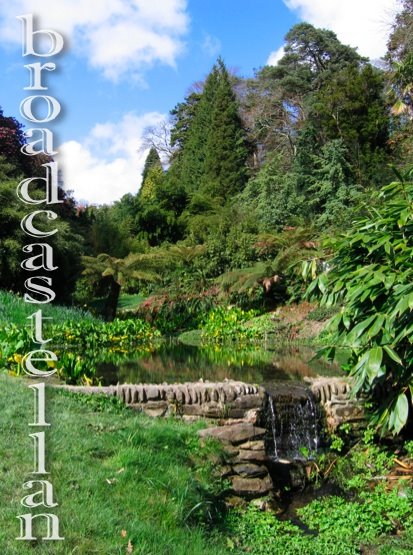
It was a crisp, bright afternoon in April when we visited Trebah Garden, one of the most beautiful spots in all of Cornwall. The sun had come out from behind a curtain of threatening clouds and the air was fragrant with a promissory note of summer that even the leafless, wintry trees in the distance were powerless to gainsay. As we walked down the sloping path, past the Rhododendron and Magnolias, beyond the dell of young Gunnera plants that, in time, would grow into a subtropical jungle, we reached a gate that led to a secluded beach. The sea was calm, peaceful the prospect; and even though the name of Trebah had been recorded in the Domesday Book, I felt far removed from the affairs of the world, present and past, as if sheltered in a reserve beyond the reach of history.
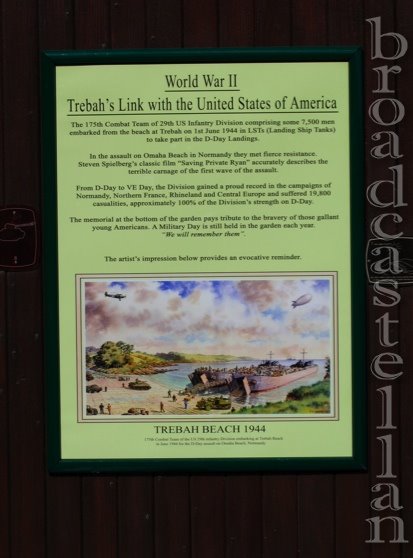
When I turned back toward the gate, that sense of detachment was shattered in an instant. I was reminded just how connected I was, even here, with the history of the world. I was yanked out of this perceived Eden by no uncertain notice of our fall: a sign telling me that, from it this secluded spot, thousands went into battle to secure the peace that I had enjoyed.

The memorial at Trebah tells of the 175th Combat Team of the 29th US Infantry Division, some 7,500 strong. On the 1st of June in 1944, those men embarked from that very beach to take part in the D-Day landings and, by carrying out their duty, face all but certain death.

“This is the hour,” Edna St. Vincent Millay wrote in her “Poem and Prayer for an Invading Army,” recited by Ronald Colman during a special radio broadcast on D-Day,

this is the appointed time.
The sound of the clock falls awful on our ears,
And the sound of the bells, their metal clang and chime,
Tolling, tolling,
For those about to die.
For we know well they will not all come home, to lie
In summer on the beaches.

And yet weep not, you mothers of young men, their wives,
Their sweethearts, all who love them well—
Fear not the tolling of the solemn bell:
It does not prophesy,
And it cannot foretell;
It only can record;
And it records today the passing of a most uncivil age,
Which had its elegance but lived too well,
And far, o, far too long;
And which, on History’s page,
Will be found guilty of injustice and grave wrong.

At Trebah Garden, where a Military Day is still being held each year, I was found guilty of the “grave wrong” it is to be walking in the splendor of oblivion. I shall not soon forget that sudden admonishment, that unsought clash by day.

Related recording
“Poem and Prayer for an Invading Army” (6 June 1944)
“A symmetry of unborn generations”: A Guernica for Radio

One of the many attractions of Madrid I will make sure not to miss is Picasso’s Guernica (1937), the most famous 20th-century painting in the Reina Sofía collection. A report from the commonplace-turned-combat zone, Guernica is a piece of anti-totalitarian propaganda commemorating the world’s first civilians-targeting air attack: the 26 April 1937 raid on the busy market town of Gernika-Lumo, masterminded by General Franco and carried out by the Condor Legion of Nazi Germany.

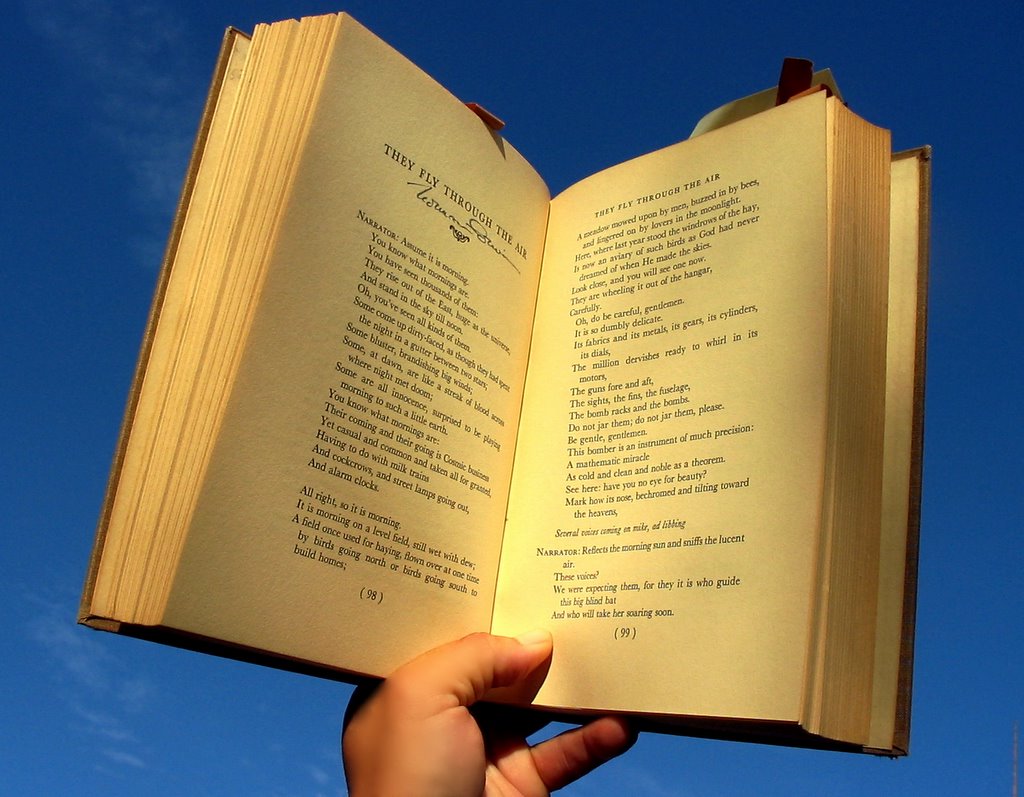
Holding up to the sky my copy of Corwin’s play “They Fly Through the Air,” signed by its author

For a long time, the painting was kept out of Spain and was mostly on display at the MoMA in New York City, where, during the Vietnam War, it became a site for vigils held by members of the peace movement, one of whom went so far as to deface it with red spray paint. It was Picasso’s wish that Guernica be returned to his homeland only after the reestablishment of democratic rule. A swiftly executed and brutally manipulative commentary on modern warfare, it invites comparisons to the three best-known American verse plays for radio, Archibald MacLeish’s “Air Raid,” Edna St. Vincent Millay’s “Murder of Lidice,” and Norman Corwin’s “They Fly Through the Air with the Greatest of Ease.”

MacLeish’s “Air Raid,” in contrast to Picasso’s painting, overtly implicates the civilian population, including his radio listeners, castigating them for their supposed ignorance and inertia. As in “The Fall of the City,” MacLeish attacks those falling rather than sentimentalizing their plight. His are bold performances, but his cruel warning turns listeners eager for news into silent partners of war who are asked to “stand by” as they tune in while women and children, refusing to heed warnings of an impending blitz, are being attacked and annihilated:

You who fish the fathoms of the night
With poles on roof-tops and long loops of wire
Those of you who driving from some visit
Finger the button on the dashboard dial
Until the metal trembles like a medium in a trance
And tells you what is happening in France
Or China or in Spain or some such country
You have one thought tonight and only one:
Will there be war? Has war come?
Is Europe burning from the Tiber to the Somme?
You think you hear the sudden double thudding of the drum
You don’t though . . .

Not now . . .

But what your ears will hear with in the hour
No one living in this world would try to tell you.
We take you there to wait it for yourselves.
Stand by: we’ll try to take you through. . . .

Millay’s “Murder of Lidice” recalls the innocent lives of those slain by Richard Heydrich, Deputy Reich Protector of Bohemia and Moravia, in Lidice. Artistically, the play is indefensible and shockingly inept in its bathos. In Millay’s Grand Guignol of Nazi terror, Heydrich the Hangman, whom the villagers have assassinated, is heard, from the beyond, planning his revenge:

He howls for a bucket of bubbly blood—
It may be man’s or it may be of woman,
But it has to be hot, and it must be human!
Oh, many’s the sweet warm throat he’ll suck.

In “They Fly Through the Air,” Corwin’s narrator goes in search of a language appropriate to the negotiation of art and propaganda. As I point out in Etherized Victorians, the play is a response to the perversion of poetic diction by the fascist cause. Viewed from above, Mussolini reportedly remarked, exploding bombs had the beauty of a “rose unfolding.” Throughout the play, metaphors are at war with plain speech, both in the service of motivating the masses:

What words can compass glories such as we have seen today?
Our language beats against its limitations [. . .].

Our rhythms jangle at the very start.
Our similes concede defeat,
For there is nothing that can be compared to that which lies beyond compare.
You see? We are reduced already to tautologies.
It’s awe does that.
The wonder of it all has set us stammering.

What is the language of war? How does it differ from the idiom of peace? And how shall war—often furious but not always futile—be rendered, recorded, and remembered in words or images? When I look at Guernica this week, I will ask myself these questions. Quite possibly, I will shiver when exposing it to the limitations of my shrinking lexicon.