
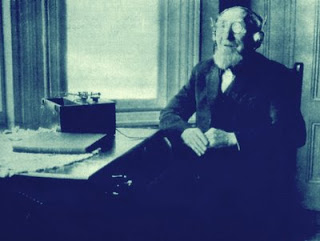
 Last night, I felt like an old queen. Granted, that is not an uncommon feeling for me; but the Queen in this case was none other than Victoria, who, in the last years of her reign, enjoyed partaking of live opera without actually having to leave for the theater at which it was presented. Her royal box was a contraption called the Electrophone, a special telephone service that connected subscribers with the theaters from which the sounds of music and drama could be appreciated while being seated in whichever armchair one designated as a listening post. Today, we may be accustomed to live—or, wardrobe malfunctions notwithstanding, very nearly live—broadcasts of sounds as well as images; but last night’s event felt as new and exciting to me as it must have been picking up the electrophone or dialing in to those experimental theater relays during the 1890s and 1920s, respectively.
The caption for the above photograph, taken from the 3rd volume of Radio Broadcast (May to October 1923) reads: “Christian Strohm traveled from Oldes Leben [wherever that might be] to Weimar, Germany, sixty-four years ago to hear the first presentation of an opera composed by Wagner. This year, he heard on a crystal set the same music, broadcasted from WIP, Philadelphia.” What, I wonder, was more thrilling to Herr Strohm or to Queen Victoria: the memory of past pleasures or the reality of present technology?
There we were, gathered at a movie house well over three thousand miles away from the Metropolitan Opera in New York City, taking in a live presentation of Rossini’s La Cenerentola (based on the fairy tale Cinderella or Aschenputtel, its meaner, dirtier, German ancestor, which renowned child psychologist Bruno Bettelheim rightly preferred over the dainty French and glossy American versions). Our local arts center cinema is the first independent movie theater in Wales to subscribe to those high definition broadcasts from the Met (or elsewhere); and, with the exception of the fact that the cameras fail to capture scenes set in near darkness, the transmission was received without a glitch.
True, I wasn’t seated in my favorite chair. I was in an auditorium, with a few dozen others who had come into town for the occasion, presumably undernourished stepchildren of the great cultural centers of the world. This far-fetched ball was a theatrical experience for which one dresses up (and I, for one, enjoys to do so), at which one meets and mingles at intermission.
The last time I saw a theatrical adaptation of Cinderella I was being squirted by a water gun. This time, I was sipping a glass of wine (included in the price of admission). I was very pleased to learn that, based upon the reception, the local cinema is going to book the entire season of opera broadcasts, beginning in October 2009 with Tosca, followed by Aida and Turandot. Tear your eyes out Clorinda and Tisbe. Every Cinderella has her day—and every dreaded midnight is over in a flash . . .
Related writings
My Evening with Queen Victoria
“Now on the Air: ‘Down the Wires’” (on the Electrophone)
“‘Oh no he isn’t’ (‘Oh yes he is’): Mickey Rooney in Bristol” (in Cinderella)
 Well, aren’t we rather quaint in our high-tech ways? Getting our entertainment via cable? Subscribing to so-called premium channels? Pshaw, old hat! Even Queen Victoria had a home entertainment center. Called the Electrophone, it was a service that allowed those who signed up to tune in to theatrical performances live—not time delayed—from the London Stage. No need to sit through commercials or settle for anything not worth your while. You simply selected a program, dialed in and an operator standing by connected you to the opera, the theater, or—who’s going to tell—a bawdy music hall.
 Harry Heuser