
Early in 2023, I participated in a workshop at Aberystwyth University exploring collectibles and the collection of ephemera. I was the only participant, among academics and museum staff, to talk about my private collection of ephemera. So as to give that fruit fly of a presentation an afterlife, I have gathered my notes for this entry in my journal, which, after all, was created for the purpose of ‘keeping up with the out-of-date.’
The presentation was titled “Making It Matter: Ephemerabilia, Queer Identity, and the Imperative of Being Out of Touch.”
I know, titles are like jokes. If you have to explain them, they don’t work. But, here goes:
“Ephemerabilia,” meaning, the love of the fugitive, the fragile, and perhaps even the futile. All of the above – which may apply to any of our lives and bodies. All of the above – but not ‘trivial.’ Nothing is trivial in itself. Just like nothing is memorable in itself. Someone has to make it matter.
For that reason, the word “minor” in Maurice Rickards’ definition of ephemera is problematic, as it devalues what it defines. To quote myself: “Trivia is knowledge we refuse the potential to matter,” whereas “Memorabilia is matter we grant the capacity to mean differently.”
The need to make something matter and mean something, something else, no matter what, is, to me, intimately bound up with queer identity, with my sense of being, thinking, feeling, and loving differently.
And that is where, to me, the compulsion of being out of touch comes in: being drawn to what has been relegated to the margins, to matter that has been disregarded and discarded as presumably nonessential or unrepresentative.
I could have put the last two words in parenthesis; because sharing my passion for the untouchable – or the “not touched much lately” – means coming out with what drives me. Making something neglected and presumably immaterial matter and mean something anew is an act of reification.
It means saying I matter. But the question I keep asking myself, in relation to my collection habits, is “What’s the matter with me?”
Let’s say I say “I am a collector.” Which question should I expect to follow? Is it “What are you collecting?” How about: “Why are you collecting?” “Why do you collect what you collect?”
What I collect is stated – and illustrated – on my website. I collect ephemera related to products of what once was popular entertainment – early-to-mid twentieth-century, mainly US American, film, theatre and radio – that are lesser-known now. I call it “unpopular culture.”
My collection is all fairly methodically put into actual and virtual drawers. Unlike in this scenario.
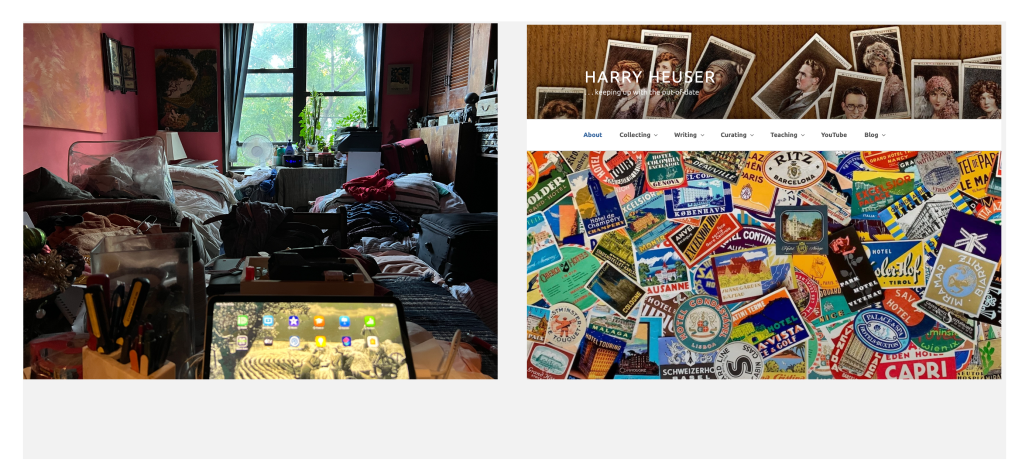
The image on the left shows my ex’s apartment on the Upper East Side of Manhattan. I once lived there, for about fifteen years, and, for over 33 years now I have stayed at that place whenever I am in the city.
Due to the pandemic, I hadn’t been back in three years. In the fall of 2022, my ex had a heart attack just days before I was set to arrive there. I looked after the apartment while visiting him at the hospital. Anyway, I was shocked when I saw the place in such disarray. My ex has always been a hoarder. But the place had become almost unnavigable in the intervening years.
Obviously, hoarding is not collecting. But is it so obvious? Is the distinction perhaps too obvious? Sure, hoarding is chaotic. It is indiscriminate, whereas collecting is orderly and discerning. Collections are curated. whereas the compulsion of the hoarder may strike us as an infliction, an illness that may or may not be curable.
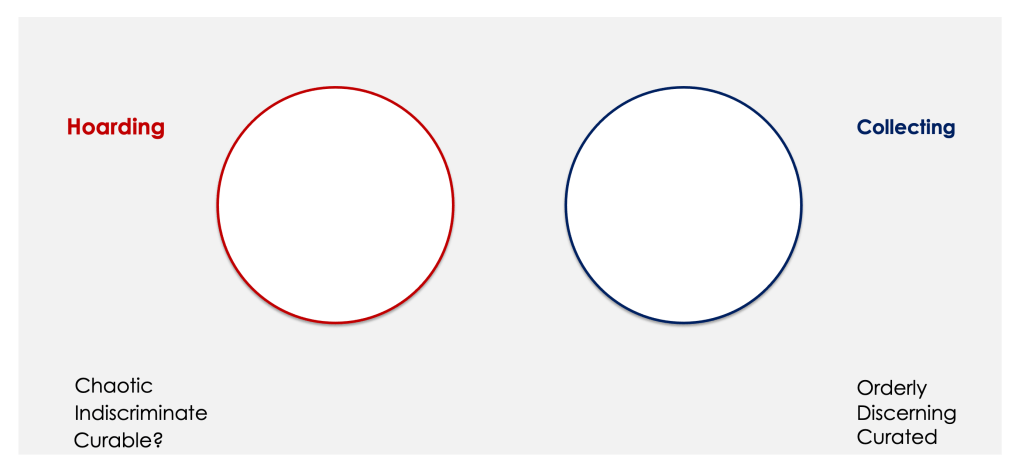
Curating is derived from the Latin word “curare,” meaning to care. Does it follow that the hoarder is careless? While staying in my ex’s apartment, I took it upon myself to discard of some items I deemed trash.
Given that chaos, I thought my ex would never notice. When my ex returned to the apartment after three months of intensive care, hospital care and aftercare, he emailed me and inquired about some of the objects I had discarded.
And he was so incensed about my attempt at tidying that he pretty much ended our 33-year-old friendship.
Seriously, to give up a friendship over a pile of cheap Chinese take-away containers, most of them without matching lids? That struck me as unreasonable, disproportionate.
But the fact that my ex remembered where what is in that chaos made me rethink the relationship between hoarding and collecting.

And it made me question whether collecting is not like hoarding in its illogical, perhaps even pathological clinging to matter that may not matter to most. Something that takes up so much time and space, it can threaten to diminish rather than enrich our experience of life.
Possessions can take possession of us. This is not vanity. It is not conspicuous consumption. For gay men born into decades of intolerance and legal discrimination, it may be a stab at making our existence more concrete and at leaving a trace or trail of it behind. I should have known better than to mess with the mess that I found.
I have had occasion – or made it one – to examine the collection of the queer Anglo-Welsh Victorian dilettante George Powell in an exhibition I staged with my curating students a few years ago. Powell bequeathed his collection to our museum. But you might say he was a poor curator of his collection. He did not collect methodically. And some of the objects in his collections are fakes or copies of dubious provenance.
Powell had no offspring, even though he married toward the end of his short life. Stating his intention to leave his collection to our museum, he referred to it as all he possessed of bigotry and virtue, meaning, bijouterie and vertu – trinket and treasure.
Powell left the lot to what is now Aberystwyth University. In his book collection, for instance, was a popular volume called Book of Wonderful Characters, which contains a short account of the life of Chevalier D’Eon, who lived as a crossdresser for half a century and to whom we owe the term “eonism.”
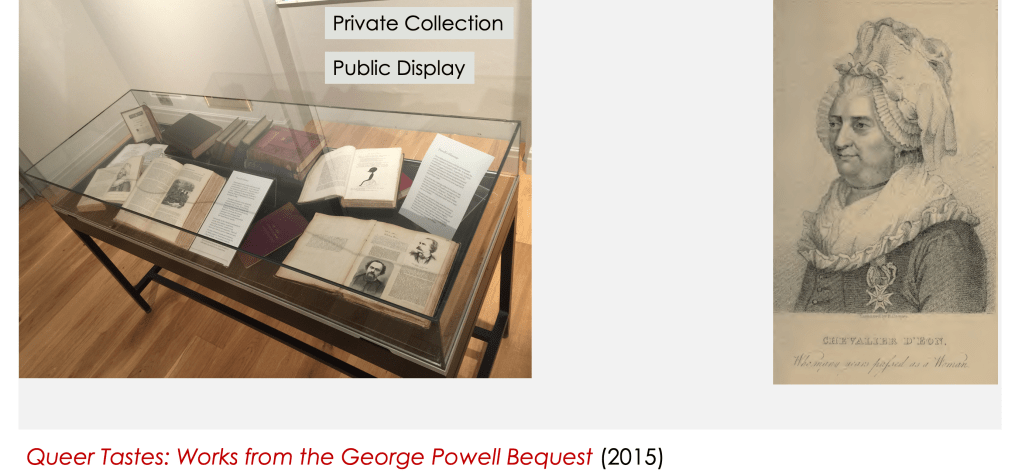
I sensed that Powell created through that bequest a diary of sorts – an invitation, by way of visual and material clues among the objects he once possessed, to go in search of him.
The “it” in “making it matter” refers less to the collection than it does to the collector. Powell did not curate his collection to take care that what might reflect poorly on his character or cause suspicion as to his tastes. To filter anything out would mean to erase what was at the core of his being, which is why Powell initially insisted that a museum be built to house it and that the collection be kept in one place, Aberystwyth, in its entirety.
He did not want to disappear behind his collection but reappear through it. He wanted to be become readable, to be understood. The Powell case made me more aware of the relationship between the private act of collecting and the public act of sharing a collection, of remaining visible through one’s collection.
Powell’s desire to remain visible, become readable and be understood becomes clearer to me in the contemporary periodicals he bequeathed to our University. Here, he did not give us the lot – the magazines, cover to cover – but he cut out which articles he wanted to preserve and bound them in leather. There is no telling whether he read the articles. But it is clear that he thought they mattered and should matter to others. And they are quite eclectic, ranging from articles on animal cruelty to drunkenness and insanity.
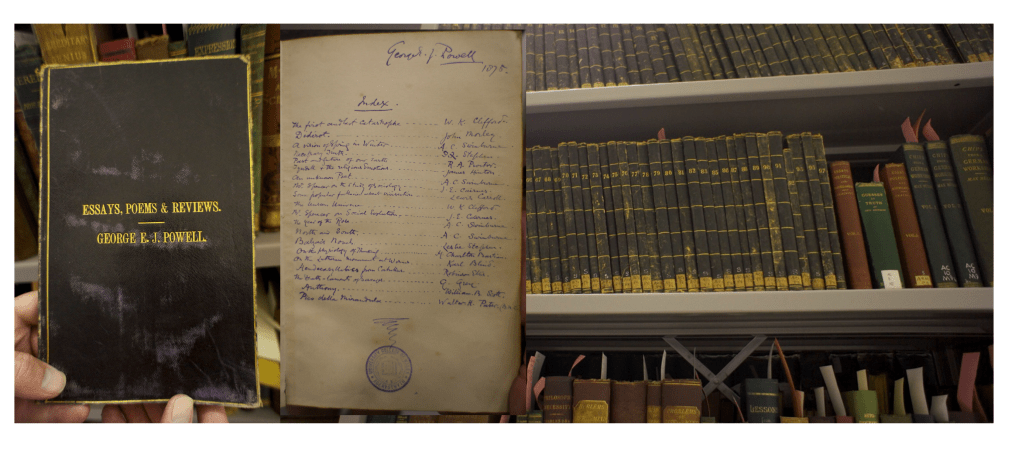
Articles on ‘Consanguinity in Marriage’ and ‘Marriages between First Cousins in England and Their Effects,’ which were no doubt of particular interest to him because his grandmothers were sisters and his parents first cousins.
Powell appeared to have been drawing attention to his struggle to figure out who he was and why he was the way he was.
Trying to understand what motivated Powell as a collector, I made a public display in the galleries of the School of Art Museum at Aberystywyth Univeristy of my own collection of cinema, theatre and radio-related ephemera. In my gallery texts, I asked:
‘Do we collect things simply to indulge our passion for them? If so, why make a display of that passion? Showcasing seems calculated to raise certain objects to the status of ‘collectibles’ so as to advance the collector as connoisseur. And yet, might not the urge to exhibit our personal belongings be rather more elemental?’
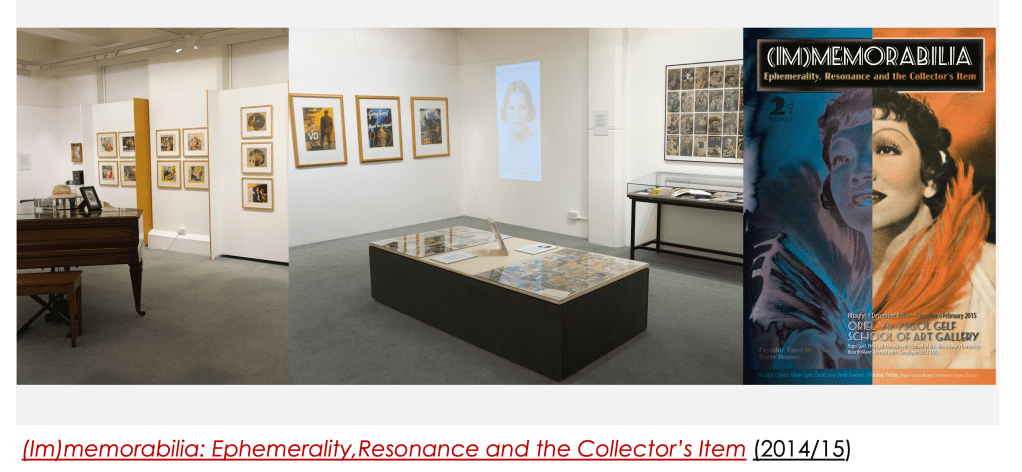
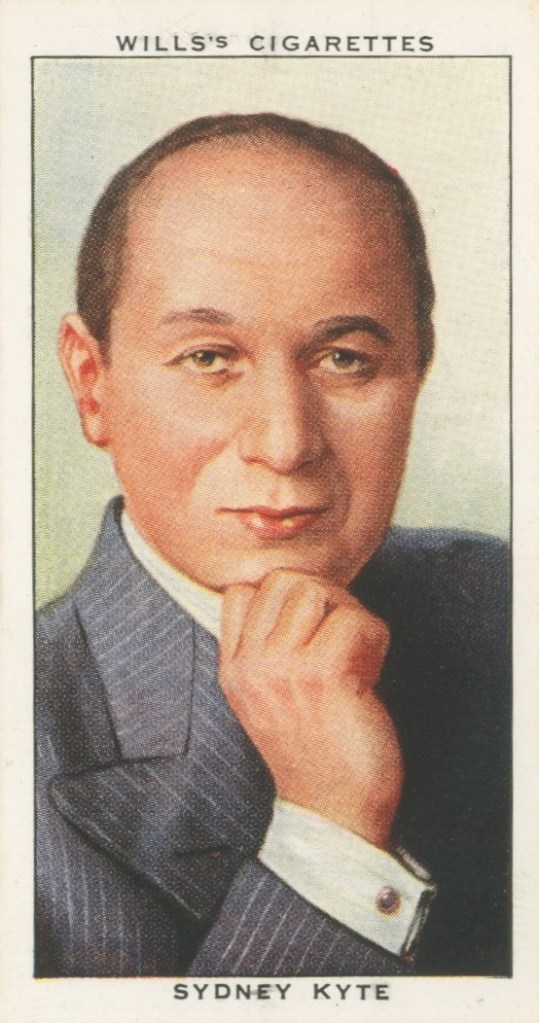
What are ‘collectibles’? What is collectible? Take, for instance, two different but related types of objects in my collection. Cigarette cards of once well-known but now mostly forgotten performers, in this case radio stars. As well as movie posters and lobby cards of films of roughly that same period.
Both feature performers from the world of popular – or now less popular – entertainment. Both are finite. Lobby cards were generally produced in sets of eight. Cigarette cards in sets of up to fifty.
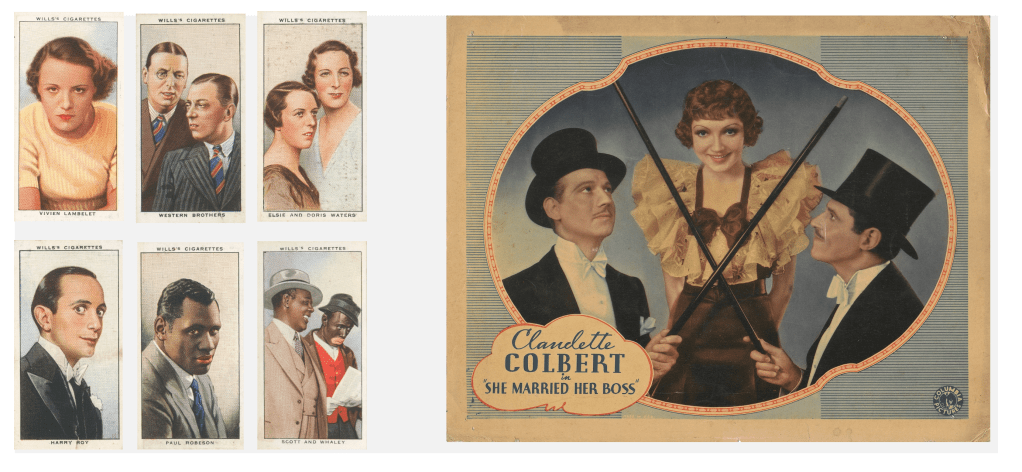
The main difference is that cigarette cards were designed to be collected. They were meant to be habit-forming, to encourage addiction.
Lobby cards on the other hand were not designed as collectibles. In fact, as the fine print states, collecting them was prohibited by the studios whose property they remained.
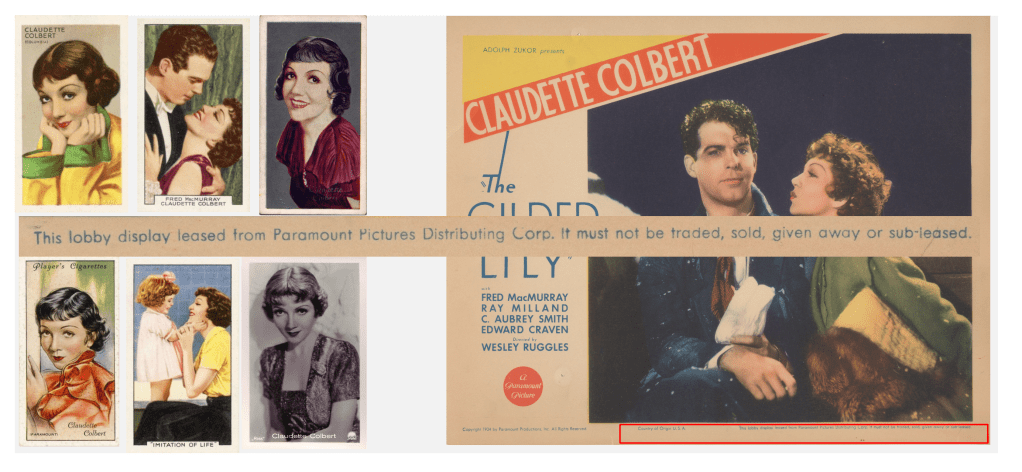
By now, the industry that cigarette cards once served has become detached from them. They no longer advertise and encourage addictive products, which makes them candidates for my belated affection, and which makes it possible for me to make them matter differently.
There are other intimate reasons why I mostly collect the likenesses of one particular actress: Claudette Colbert.
I became intrigued by the French-born US American actress watching a movie on television with my grandmother when I was 8 or 9. I didn’t start collecting until decades later. Nor did I know then that Colbert was rumoured to be queer.
My collection is also a catalogue of the love: more than 90% of my collection has been gifted to me by gay men, and almost all of which by my husband. Original film posters are now almost out of my league as a collector.
I do not collect objects because of their monetary value, of which, due to the fact that the items were given to me, I often have no knowledge. I have always been attracted to what is of little value to others.
A queer friend told me once that, as a child, he used to pick the crayon no other kid would pick up – the least popular colour. Embracing neglected objects to me is related to the feeling of having been unwanted and misunderstood as a child.
Exhibiting my collection, I realized just how intimate collecting is. I was very self-conscious about opening my drawers to display those objects – paper dolls, mass-produced pictures of performers few people today still relate to. When I tried to exhibit the cigarette cards, I also realized they were too small to be impactful or readable for display.
So I created a slideshow of them. There are objects in my collection that matter more once they are dematerialized. I scan many books and scripts so that I need no longer handle the physical artifact. It preserves the object. But it also makes the object less meaningful if what matters is the visual or written information it conveys. Not that I dispose of ephemera in my collection once I have scanned them.

The most ephemeral items in my collection are literally untouchable. They are digitized sound recordings. The cigarette cards of radio performers are, like scripts and contemporary books on radio, not the real thing. They are a means to materialise the immaterial culture they commemorate: the world of sound broadcasting.
My (Im)memorabilia exhibition contained a listening station and featured a soundtrack of clips on a loop. They are from my collection of audio recordings, now widely available online. The files contain recordings of radio broadcasts from the 1930s to 1950s, most of them plays, almost all of which were part of episodes of series or chapters of serials.
The vast majority of plays were also broadcast only a single time. Despite the recordings that gradually materialized from the vaults, they were as ephemeral as soundwaves. That they survive at all is owing to their commercial value.

The recordings are evidence for the sponsor that the programme they funded actually existed and could be inspected – or audited. As cultural products they were not valued. They still are not valued much. They certainly never received the scrutiny or status accorded to motion pictures or television programmes.
I organize the folders alphabetically by each series title.
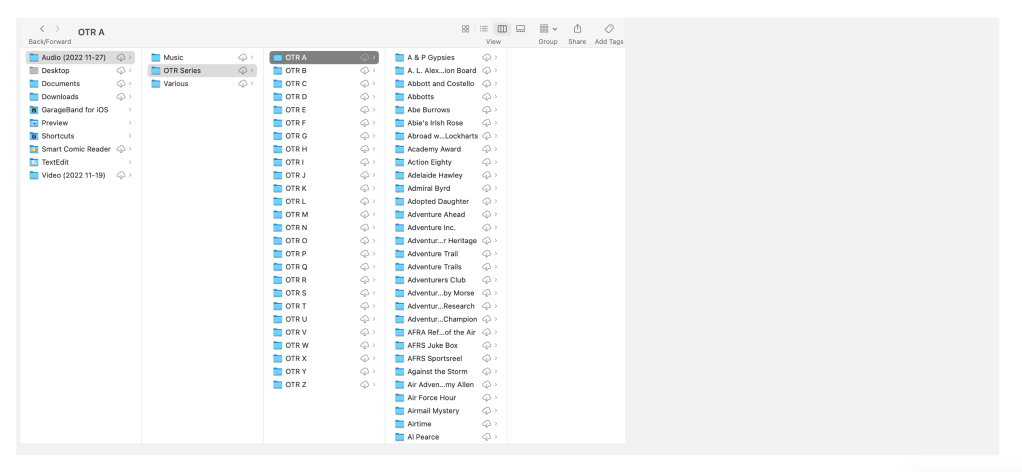
And each subfolder contains recordings of broadcasts from those series. Some subfolders contain close to one thousand recordings per series. Cataloguing these immaterial objects, which I have written about at some length in my study Immaterial Culture and on my blog broadcastellan, involves adding and correcting information about talents involved in a broadcast play; verifying air dates by referencing old newspapers and magazines; checking for sound quality and recording speed; and replacing files with newer, cleaner, more authentic recordings.
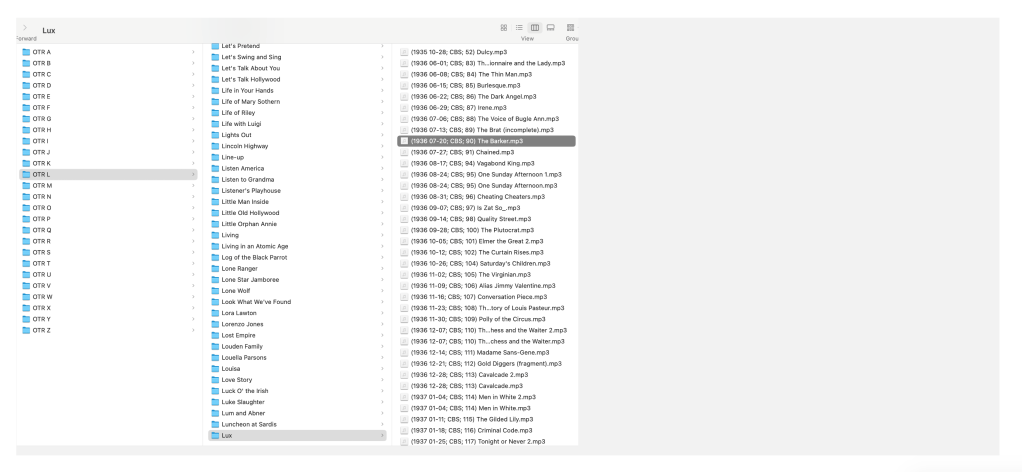
It is not possible to listen to all of those recordings in full. There are now over 30,000 of them. It is almost impossible to keep track of them.
Unlike my ex, I have forgotten about many of the items in my collection. But like my ex, I would be very upset if only a single item went missing. Most of these recordings are readily available on the internet, copyright being a murky issue. In my writing, I have argued for their cultural significance, their artistic merit. But I have not been successful in making a career out of my caring. I am wary of intellectualising my desire, and I am suspicious of such attempt by academics.
The difference between hoarding and collecting lies in the adding of value. Hoarding is an act of accumulation. Collecting is an act of accretion, of value added.

The ‘imperative’ in my title is the imperative of the matter – what drives us, what makes us who we are. The ‘it’ in “Making it Matter” refers both to the ephemeron and the life of its collector who deems it worth preserving. That my efforts have been futile only seems to fuel a desire that has been termed “The Queer Art of Failure.”

 Harry Heuser