
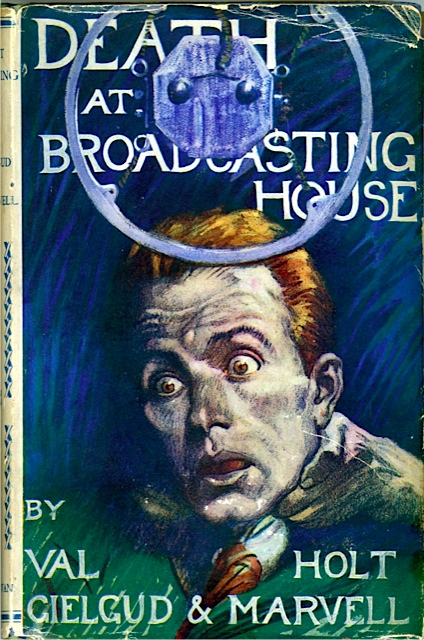
“Snobbish nonsense!” says one shabbily dressed young Londoner to another as they observe a man in a starched shirt and dinner jacket enter Broadcasting House. The man, they reckon, is an announcer about to go on the air, unseen yet meticulously groomed and attired. At the sight of which pointless and paradoxical propriety they sneer: “That whole place wants a dam’ good shake-up.” A “dam’ good shake-up.” That, in a coconut shell (to employ the most sound-effective nut in the business of radio dramatics), is what Val Gielgud and his collaborator Holt Marvell (the fanciful penname of fellow broadcaster Eric Maschwitz) set out to perform in Death at Broadcasting House (1934), a murder mystery set in and temporarily upsetting the reliable, predictable and frightfully proper BBC. Although I had know about it for quite some time, I just finished reading it; turns out, it’s a “dam’ good” page-turner, and a compelling commentary on the marginality, the relative obscurity of radio dramatics besides.
“There’s not a drop of good red blood about the whole place. Robots engaged in the retailing of tripe! That’s broadcasting!” one of the above sidewalk critics of the tried and generally trusted institution declares. It is clear, though, that Gielgud and Maschwitz did not side with the two self-styled “communists.” The authors were BBC employees and not about to stage a revolution. The “shake-up” was strictly a matter of maracas, a means of making some noise for their own undervalued accomplishments rather than spilling the beans without which those maracas would become utterly useless as instruments of ballyhoo.
Sure, broadcasting plays—minutely timed, meticulously rehearsed and intensely scrutinized—were far more mechanic than any other form of dramatic performance. Yet, as Gielgud insisted in one of his many articles on radio drama, “[i]n spite of [its] machine-like qualities” and “in spite of the lack of colour and applause, the work has a fascination of its own.” That the multitude for whom these performances were intended showed so little gratitude was frustrating to an actor-director like Gielgud, who sarcastically remarked a few years earlier that dismissive reviews in the press suggested, at least, that the broadcast play had “passed the first and most depressing stage of development—the stage of being entirely ignored.” By 1934, it had clearly not advanced to a stage that could be deemed legitimate.
What better way to gainsay those naysayers than to spill some of that “good red blood” or to stir it properly and to make it run hot and cold by turns. “A killing! In Broadcasting House, of all places! Good God!” is the response of General Sir Herbert Farquharson, the corporation’s fictional Controller. He has just been informed that an actor was done away with during the production of a live broadcast. “My god, sir,” the director of that play exclaims, “do you realize that everyone who heard that play must have heard him die? That makes it pretty unique in the annals of crime.”
That most folks tuning in thought little of it—that they believed it to be part of the drama—is owing to the fact that the murder was committed right at the moment when, according to the script, the character played by the victim was scheduled to breathe his last. A crime at once prominent and inconspicuous—like most radio dramas, performed as they were without a studio audience. After all, even the Controller, at the time of the murder, was attending a variety program staged in the specially designed Vaudeville Studio instead.
Death at Broadcasting House is the self-conscious performance of two radiomen, Gielgud and Maschwitz, fighting for the recognition that, for the most part, eludes those working behind the scenes—especially the folks behind the scenes of a largely invisible business. Their book, as they so slyly state, was “dedicated impertinently … to those critics who persistently deny that the radio pay exists, has existed, or ever can exist.” Radio plays existed, all right, but, for the most part, they died as soon as they were heard, if they were heard at all.
Unless, of course, they were blattnerphoned. “Blattnerphone?” the puzzled inspector exclaims. “Yes,” the BBC’s dramatic director, Julian Caird, explains:
“It’s a way of recording a programme on a steel tape so that it can be re-transmitted. We have to do a good deal of it for Empire work.” […]
“You mean we can hear that actual scene over again?”
“We can hear that scene,” said Caird, “not only over again, but over and over again. As often as you like. I wonder if the murderer thought of that?”
Probably not. Unless he numbers among the initiated few, folks like Caird—and Gielgud—who have their fingers at the controls, conjurers who don’t mind revealing some of their tricks to demonstrate just how powerful they are.
“The curious thing about the case what that it was both extremely simply and extremely complicated,” the inspector wraps up the business of detection. “It was extremely complicated only because it took place under very remarkable conditions—conditions which you wouldn’t find repeated anywhere else, and for which, of course, there was absolutely no precedent.” The same applies to Gielgud and Maschwitz’s fiction. However witty and engaging, the whodunit is entirely conventional. It is the setting, the broadcasting studio, that makes it unusual. The setting, thus, becomes the star of the production—a star without whose presence the show simply could not go on.
Indeed, the crime depends on the complexity of British radio production to be in need of detection. In American broadcasting, by comparison, all actors gathered in the same studio, a congregation that would render the unobserved strangling of one of them not only improbably but impossible. At the BBC, however, plays were produced using a multiple studios, a complex approach Gielgud’s stand-in explains thus:
[T]he chief reasons why we use several studios and not one, are two. The first is that by the use of separate studios, the producer can get different acoustic effects for his scenes…. Secondly, the modern radio play depends for its “continuity” … upon the ability to ‘fade’ one scene at its conclusion into the next. You can see at once that there must be at least two studios in use for these “fades” to be possible. In an elaborate play, therefore, the actors require as many studios as the varying acoustics of the different scenes require, while … sound effects have a studio of their own, gramophone effects one more, and the orchestra providing the incidental music yet another separate one.
Anyone who has ever listened to an American radio play of the 1930s, such as the ones produced by the Columbia Workshop, knows that no such complex arrangements are needed for the effective use of multiple fades and changes in acoustics. Death at Broadcasting House is a defense of the British system. It turns the multi-studio approach into something to be marveled at—an arcane system fit for a mystery, a puzzle whose solution requires the expertise of the initiated and thus vindicates the existence of the men masterminding the business with their hands firmly on that most complex of all pieces of broadcasting equipment: the dramatic control panel, which, Gielgud enthused elsewhere, enabled the director “to move at will, both in time and space, as simply as if he were travelling on the fabled magic carpet, and to take his audience with him.”
 I’ve been told to stay away from district eight; but I don’t suppose I’ll return home with impressions so graphic or lurid as to feel compelled to pen a thriller titled Murder in Budapest. BBC radio producer Val Gielgud did just that, back in 1937, after his return from the Hungarian capital. Val, brother of famed thespian Sir John Gielgud, was in town in the early fall of 1936 to accompany his colleague and friend Eric Maschwitz (both pictured above, on location) to “give a broadcasting impression of night-life in the Hungarian capital.”
 There are days when you are in desperate need of vicarious living. While the world marvels at the latest solar eclipse, you wonder whether there’ll be any sun at all his spring, the prospects for your upcoming trip to Cornwall looking decidedly grim. So, you grab a book from your shelves and, presto, you assume the identity of some personage whose existence strikes you as being rather more colorful than your own present self. I wouldn’t have minded trading places with a certain Val Gielgud, who, on this day, 29 March, in 1938, “as nearly as possible passed out over the soup!” I should add that the soup was served at the home of Isabel Jeans, Hollywood actress, and that Mr. Gielgud, brother of distinguished thespian John Gielgud (whom I heard only last night in a 1951 radio production of Hamlet) and a noted radio writer-director in his own right, was on a month-long tour of Tinseltown.
 Harry Heuser