
On This Day in 1943: Peter Lorre Gives Voice to "A Moment of Darkness"

Well, I am generally slow to catch up. As the broadcastellan maxim—”Keeping up with the out-of-date”—suggests, I am forever belated in my response to the news of the world, food for thought I tend to chew more slowly than the dinner on my plate. Having just learned from a fellow web-journalist that the mind of ousted American Idol finalist Mandisa might be considerably less broad than her frame, I thought of other occasions on which the message of a voice seems out of tune with the messenger, moments in which timbre and text, sound and image, appear to be at odds. One such occasion was “A Moment of Darkness,” a radio play by noted mystery writer John Dickson Carr that aired on this day, 20 April, in 1943.

“A Moment of Darkness” is one of Carr’s ambitious but far from satisfying attempts to make up for the inadequacies of the medium by complicating the kind of plots that radio is least successful in rendering: the “whodunit.” The murder mystery is a genre best suited to novels, page-turners that permit the confounded to do just that: turn the pages, forward and back. On the air, such puzzles are often marred by a lack of pieces, or red herrings, due to the limited number of suspects and clues a listener can be expected to tell apart and pick up within the short time allotted for the drama.

In the fall of 1942, when Carr became the head writer for a fledgling US radio program titled Suspense, he devised alternate ways of mystifying his audience, of casting doubt about the outcome of his thrillers.

As I discuss it in Etherized Victorians, my study on so-called old-time radio, Carr not only asked listeners “whodunit,” but “how done,” by presenting posers involving locked rooms, less-than-obvious weapons, as well ingenious acts of committing and concealing crime. Unlike the reader, the listening audience is rarely equal to this double challenge of guessing the “who” and “how,” considering that there is no chance to recap or retreat in order to evaluate the (mis)information provided. The likely response is that of utter dumbfoundedness, a puzzlement of the least intellectual sort that, in turn, may trigger feelings of exasperation or indifference.

Later Suspense dramatists well understood and expertly solved this problem by emphasizing the “most dangerous game” of the manhunt or exploring the mental state of criminal and victim. Determined to trick his audience with surprises rather than tease them with suspense, Carr decided to heighten the element of doubt and suspicion, to exploit the prejudices of the listener in ways that sounded entirely radiogenic: foreign accents suggesting fiendish acts. In “The Moment of Darkness,” as in Carr’s “Till Death Do Us Part,” such a foreign-tongue twist was delivered by the enigmatic Peter Lorre.

During World War II—and for many years thereafter—harsh Germanic tones often sufficed to taint or undermine a speaker’s message, to make listeners question the sincerity of the utterance or the motives behind it. His Teutonic tongue made Lorre a formidable wartime villain; and his voice, which could be disconcertingly oleaginous, sly, or sinister, inflected with hysteria and madness, only fueled the imagination of Americans prejudiced against foreign influences.

Given the diversity of US culture, however, the networks did not altogether endorse the exploitation of accents—particularly European accents—as reliable signposts of a certain, unmistakable nationality, a mother tongue bespeaking the fatherland of the enemy. Radio writers like Carr were advised not to use voices as a means of identifying—and disqualifying—a speaker as un-American. According to the logic of pre-Political Correctness, Lorre’s character, a sham shaman, is not at all what he sounds, a vocality/locality mismatch that not so much teaches the audience to question their prejudices but to distrust their ears altogether.

There is no such thing as accent-free speech, of course; but those, like me, whose first language is not the one in which they primarily speak are often self-conscious about the sound of their voice, or at least keenly aware of the doubt and derision it might provoke.

On This Day in 1944: A Dead Soldier Speaks Up to Stir the Living

I have often found comfort in the notion that the dead may survive in the minds of those who recall them. It is no mere vanity to desire such afterlives. Indeed, the concept of lingering in each other’s thoughts by virtue of some worthy deed or memorable word can be a significant motivational force in our lives. I am not sure, however, whether the self-images we try to instill in the minds of others as potential extensions of our corporeal existence are to be considered a noble attempt at rescuing our finite lives from triviality or whether these transferable or continuing selves are a construct that trivializes the finality of death. After all, does not the realization that we are perishable render each hour we have left so much more significant?

During times of war such as these, the possibility that those lost are never truly gone or might yet return has particular resonance. Radio, in the pre-television years, was often thought of or exploited as a spiritual medium. Gathering around the receiver to hear voices from the unreachable beyond—or the far away, at any rate—could assume all the magic of a conjuring act: a high-tech séance. As I have argued in Etherized Victorians, my doctoral study on so-called old-time radio in the US, broadcast propaganda often availed itself to addresses from the hereafter, words akin to the cries of “Remember me,” uttered by the Ghost in Hamlet, to stir and motivate the listener.

On this day, 18 April, in 1944, such a ghost voice was cast into the living rooms of America by radio playwright Norman Corwin (whose works I have frequently discussed in this journal). It is the voice of a soldier killed in action. “As for his life,” explains the narrator of “Untitled” (a recording of which you may find here),

there is no straightforward account available, but there are several people who could piece it together, although they cannot always be relied on to give you a true interpretation of the facts.

Through the various recollections of others, including those who thought little of him, the soldier’s unwritten biography comes to life. It is a conventional one, all told, if giving your life for an ideal may be justly labeled “conventional.”

Corwin’s soldier is not an action hero, but a man of doubts, a thinking fighter—or fighting thinker—who, in today’s parlance, chose to engage in a war on terror—and that terror, still very much alive today, was fascism. Rather than relying on others to give an account of his beliefs, the dead man picks up on and tears apart their words—some shallow, some insincere—like a radio commentator taking issue with so-called facts. The memories of those lined up to speak for him are proven to be too distorting or inadequate to capture the true self of the deceased who, according to the justice of the radio poet, is now given the opportunity to speak up for himself.

These lines, uttered toward the end of the play, are some of the finest written for radio—or any medium, for that matter. They are worthy of Shakespeare, and certainly worth quoting here and remembering thereafter: “I am dead of the mistakes of old men, / And I lie fermenting in the wisdom of the earth.”

It is not enough to live on in the minds of others from whose sundry impressions our existence might be retraced. Instead of becoming the mental playthings of our contemporaries or former associates, we must seize the chance to communicate our own minds while living. This journal may serve as a record of my thoughts.

On This Day in 1937: Dickens’s "Signal-Man" Is Interviewed on the Air

Well, my first review for the Internet Movie Database has gone online this weekend. I sincerely hope that no one will be led astray by my remarks about The Misleading Lady (previously discussed here). Unlike the rating, writing the short piece was a joy. As fascinated as I am by numbers (provided I don’t have to add them up), I have never been able to express myself satisfactorily in this supposedly succinct way. I also tend to be rather stingy with my stars or points or other such statistical thumbs, whether I share my opinions on the database or grade a student paper.

Five stars out of ten (as bestowed on aforementioned Lady) is meant to denote mediocrity; but to others it might spell “plain awful.” To me, two means “awful,” which is just what Charlie Chan and the Curse of the Dragon Queen merits, had I cast my vote. That insult to the memory of the famed detective, which aired on LivingTV in the UK this weekend, is so insufferable, however, that I could not sit through it. So, I willingly, gladly surrendered my right to vote, at least according to my own ethics of re-viewing. Luckily, I don’t have to deal with numerical expressions of (dis)approval in my ruminations about American radio drama.

On this day, 23 January, in 1937, the Columbia Workshop presented Charles Tazewell’s dramatization of Charles Dickens’s ghost story “The Signal-Man.” Too many American drama anthologies for radio tackled longer novels, rather than short stories, resulting in cut-rate digests and bloodless storytelling. In early radio drama, the narrator was the first to get the axe; gone with him or her were descriptive passages, character assessments, and an access to a speaker’s inner thoughts.

As I argue in Etherized Victorians, my doctoral study on the subject, the prejudice against narration in radio plays (a more inclusive term I prefer over radio drama), is related to the early failure in presenting stage plays straight from Broadway, a lack of adaptive skill that made it necessary to install a translator in the wings, a voice describing the gestures of the actors and the inaudible goings-on known as “business.” The challenge of proper radio form was to do without this awkward voice, to convey actions and thoughts in dialogue.

Another reason serious radio playwrights objected to—and producers did not encourage—the use of narration was the fact that the single voice on commercial radio was linked to the announcer, the peddler of a sponsor’s wares. The single voice stood out, disrupted the conversation—and thus drew attention to the business at hand: the business of selling things.

Over the years, radio plays and the techniques of broadcast hawkers became considerably more sophisticated; but the narrator was still frowned upon by many playwrights and listeners. Now, Charles Dickens’s “Signal-Man,” as reworked for the Columbia Workshop by actor-writer Charles Tazewell, is a fine example for the use of full dramatization.

In Dickens’s narrative, the plight of the titular character—a lonely railroad employee haunted by a death-foretelling “Thing in the Tunnel” (as the story was also called when adapted for radio)—is expressed by the man who observes him:

His pain of mind was most pitiable to see.  It was the mental torture of a conscientious man, oppressed beyond endurance by an unintelligible responsibility involving life.

Tazewell’s script called for the actor to convey this sense of dread and anxiety through changes in tone of voice as Braxton, the Signal-Man, responds to the questions of Darkin, a journalist interviewing him in hopes of a serviceable human interest story. Reading instructions include “almost hysterical,” “becoming hysterical,” or “with growing hysteria,” as Braxton relates his encounters with a specter warning him of impending disaster.

Generally known as a laboratory of sound effects techniques, the Workshop here relied on dialogue, rather than effects. The result is that the ghost story very nearly becomes a study of insanity; the ambiguities fade as the adaptor decides not to deal in noise. The warning bell, ringing in Braxton’s ears is not heard by the journalist or the play’s audience:

Darkin: It’s your imagination.  The bell is not ringing—and probably, it has never rung at any other time except when some station wishes to communicate with you. 

Braxton: Listen! 

Darkin: I tell you, the bell . . .

Braxton: Not the bell—outside—the ghost’s calling.

Darkin: I hear nothing—save the moan of the wind in the wires.

And so do we, the wireless audience. In Tazewell’s dramatization, the specter is all but explained away, drowned in the airwaves without as much as a ghost of a chance to rise before us. What haunts me now is the fact that, just after listening to this play, I came across the headlines about the deadly train crash in the Balkans. I’m sure Tazewell’s journalist would term it a coincidence, as dull and comfortless as such reasoning might be.

On This Day in 1940: As War Is Waged Overseas, Stephen Vincent Benét Romances an "Undefended Border"

Just a little while ago, I was following Jack Benny and Mary Livingstone into a Beverly Hills department store, where, on this day, 18 December, in 1949, they found themselves in a stampede of bargain hunters. As the doors of the emporium opened, the valued customers were greeted with a whip and shouts of “mule train, mule train”—a regular muletide treat.

Accounts of penny-pinching Mr. Benny as a latter-day Scrooge tasked with the challenge of Christmas shopping were a seasonal feature on US network radio. Having had a few chuckles, but not enough material for this online journal, I continued to raid my library of scripts and recordings and came across a play I hadn’t read or heard in a while. It’s a play for all seasons, but one conveying a message particularly well received toward the end of the year: the promise—and the reality—of peace.

The play is “The Undefended Border” by Pulitzer Prize winning poet Stephen Vincent Benét. Written especially for radio, it was first heard on the Cavalcade of America program on 18 December 1940—about a year before the US entered into war with Japan and Germany. As I discuss it in Etherized Victorians, my doctoral study on old-time radio, both networks and sponsors were squeamish about any overt commentary on the war then being waged in Europe. Broadcasters were not permitted to play “advocate,” to endorse an anti-isolationist position, or any other political position, for that matter.

Engaged in a comprehensive campaign to adjust its corporate image in the wake of a report about the company’s profiteering during World War I, the DuPont company commissioned an advertising agency to design a series of historical dramas dedicated to telling American stories of peace and progress. A well-respected writer of historical and patriotic verse, an author whose death in 1943 was argued by one contemporary critic to be “an even greater loss to radio than to poetry,” Benét was just the man to deliver such a message—but not without indirectly signalling his support for Britain in the war against fascism.

“The Undefended Border” celebrates the peace between the United States and Canada. Both countries were at war in 1812; but there existed friendships between those living along the border. Benét tells of such a friendship and how it encouraged an American citizen to go on mission to Washington to urge the Acting Secretary of State, Richard Rush, and the representative of the British crown, Sir Charles Bagot, to create a border that would foster rather than endanger friendly relations between the neighboring countries.

“All over the world, there are borders between countries,” Benét begins his play, narrated by character actor Raymond Massey:

They may be rivers or mountains—they may be nothing more than lines on a map.  But, in time of war, they are ravaged land—No Man’s Land.  And, in time of peace, the guns still look at each other. Between the wars, the grass grows back again, but sometimes it doesn’t grow for long.  And there are always soldiers.

But from New Brunswick to Puget Sound there runs a border between two great nations of proud people, individual people, people with their own customs and beliefs and ways, and that border has not one fort, not one ship of battle, not one hidden or usable gun.  There is a lone cannon.  And they point it out to tourists as a memory of the past.

The Rush-Bagot Agreement was signed in April 1817, and the two countries went on to create a “great house of freedom.” Was it the doing of that one farmer who travelled on foot to Washington to have his say?

Can the spirit of Benét’s play endure? Or will it be the doing of today’s anxious politicians to tear down our freedoms by putting up new fences? Love Thy Neighbor, I say. Just don’t ask for assistance from stubbornly feuding misers like Mr. Benny.

On This Day in 1942: Orson Welles Lures Fred Allen into the Sewers

Last night, watching BBC 4, I was in for a cinematic treat: Carol Reed’s Odd Man Out (1947). Cinematographically stunning and compellingly told, it is not unlike Reed’s best-known film, The Third Man, particularly in its investigation of that most dangerous game, the manhunt. Both films are 20th-century updates of novels like Caleb Williams or Les Miserables, stories of pursuit that challenge readers to distinguish between what is right and what is just, between law and ethics. The backdrops are often dark and seedy—the slums, dumps, the sewers. Contrasted with the dwellings of the elite, they serve as reminders that the dregs of society are not commoners but discarded ideals.

Welles found himself trapped in the sewers in both Les Miserables and The Third Man; and both stories were adapted for radio, starring Welles. On this day, 18 October, in 1942. Welles made another descent into the muck of humanity, this time to have his revenge on Fred Allen, the radio wit who had mocked him once too often.

The confrontation between Hugo’s Javert and Jean Valjean, that clash between ethics and law, was reduced to a mismatch of lowbrow and highbrow art as played out by two quintessential middlebrow artists, radio comedian Fred Allen and Shadow graduate-turned-thespian Wunderkind Orson Welles. Could radio and literature be reconciled? Could the airwaves be a fount of high culture?

Presumably, Welles had come to the realization that he was “getting along in years” and that he could “no longer carry on alone.” In search of a co-star “with a flair for the buskin,” he turned to Allen and offered him the role of Javert in Les Miserables.

As it turns out, however, Welles was not prepared to share the stage. He had to remain in charge of every aspect of the production and could not bring himself to letting Allen utter even a single line. Flattery soon turned into humiliation, and Allen began to protest:

ALLEN. Now look, Orson, I don’t want to hog the whole thing.  But in two acts all I’ve done so far is knock on a door and blow a whistle.  Now, after all, I’m an actor, not a soundman.  When do I get to read some lines?

WELLES.  The next scene is all yours, Fred. Your speech is the climax of the entire play.

ALLEN.  Well now we’re getting some place. What’s next?

WELLES.  In this final scene you trail me through the sewers of Paris.

ALLEN.  Oh, the sewers.

WELLES.  You finally corner me single-handed.  There we stand, face to face.  I have just a few words and then you speak.

ALLEN.  I speak.  Well, that sounds good.  Let’s go.

(Music: heavy, then fades.)

WELLES.  Mon Doo! Alone in this sewer! Trapped like a rat who nightly crawls through this hideous muck of the city.  The gloomy darkness, this narrow archway above my head, these two slimy corridor walls.  (Hysteric laugh.) Oh, but hark! That sloshing through the muck. Javert! At last you’ve cornered me, Javert! Don’t talk, Javert! Before you seal my doom, I would speak for the last time. You will never take Jean Valjean alive, Javert. (Laughs.)  The water in this sewer is rising, Javert.  I am six feet nine.  You, Javert, are five feet two.  The water rises, Javert.  There is no turning back.  The water! Higher, higher.  Now, Javert, you have Jean Valjean at your mercy.  Pronounce my doom.  Speak, Javert.  Speak.

ALLEN.  (Gargles.)

Thus, the wit of Fred Allen, radio’s smartest satirist, is drowned in a display of misguided aspirations. As I put it in Etherized Victorians, the promise of radio as a purveyor of great literature is “exposed as so much hogwash.” US radio artists were often called upon to ridicule that which neither sponsors nor network executives were willing to touch: so-called high art (including popular literature of the past that, like Hugo’s novel, had just enough patina to appear precious).

It was easier for producers and audiences alike to deride and dismiss as affected anything that might effectively challenge the status quo or the intellect. In the best games of pursuit, the lines between wrong and right become blurred; in the radio game, at its commercial best, the distinctions between what is wrong and right for the greater American public were always made with comforting clarity.

How the Blind Medium Immaterialized Coward’s Blithe Spirit

I guess I am still too wrapped up in US culture to have given British cinema its due. So, last weekend, while on a DVD shopping spree in Manchester, I made an attempt to rectify this cultural lopsidedness. Among my purchases was a copy of David Lean’s Blithe Spirit. Or is it more appropriate to call it Noel Coward’s Blithe Spirit, even after a noted director has . . . transubstantiated it? Generally, stage plays are treated like the brainchildren of their authors, while motion pictures are attributed to their directors. How many classic films could you trace back to their screenwriter parentage without resorting to the Internet Movie Database?

Anyway, it is an irksome inconsistency I grappled with when I needed to decide how to present and define radio plays for my dissertation (the aforementioned “Etherized Victorians”). Far from being a dead issue, the question arose anew when I followed up my screening of Blithe Spirit (1945) by taking in two radio disincarnations of Coward’s 1941 play.

The first one, soundstaged for Everything for the Boys on 16 May 1944, preceded the world premier of Lean’s feature by a year. Its adaptor was none other than Arch Oboler, probably the biggest name—and not the smallest ego—in US radio drama. Whether daring Americans to turn their Lights Out! or to put on a pair of 3D glasses, Oboler was hardly a subtle craftsman; he certainly was ill-suited to deliver the wit of Noel Coward.

Not surprisingly, Oboler’s rewrite of Blithe Spirit is a humorless affair, a tepid romance rather than a wicked romp. Presented to a live studio audience, the reconstituted comedy elicited only one laugh and a few mild chuckles; nor did it deserve more. The soundman was permitted to break a few dishes—flung by the two ghostly wives of the “hag-ridden” protagonist—but the damage was done largely by eraser, as hardly any of the play’s celebrated witticisms survived the adaptor’s indiscriminate airbrushing.

The challenge seems a formidable one when the play to be radio-readied involves ghosts visible and invisible, audible and inaudible, as well as the flesh and fancy of a decidedly material psychic. A filter microphone and a few hints from The Shadow will not suffice when wit is what is wanting.

Aside from a clipped and colorless script, the casting of Madame Arcati—the robust medium with a penchant for sandwiches, physical exercise, and dry Martinis—made matters worse: fluttery and frazzled, she lost much of her comic weight when portrayed by Edna Best. The Theatre Guild on the Air, at least, had access to the original New York cast. It also had the benefit of thirty-five extra minutes, and a script that retained much of the sparkle of Coward’s virtual sex comedy.

On 23 February 1947, nearly two years after Oboler’s inept dabbling in Coward’s froth, the Theater Guild revived Blithe Spirit with considerably greater success. It also broke a few dishes too many (to the audible delight of the studio audience to whom following the job of the soundmen had all the relish of an inside joke); but it kept both the spirit-flesh dynamics and civility-vulgarity dialectics relatively intact.

Sure, Mildred Natwick as Madame Arcati fudges a few good lines, and the attempt to explain the fact that Elvira, the irreverent revenant, is visible only to the tormented male and not to his second wife is almost as clumsy as my prose here. Still, having missed the recent London revival of the play , this was a more than tolerable substitute.

However much it tickled me to watch the redoubtable Margaret Rutherford (captured above in an ethereal fade) as she throws herself into the role of Madame Arcati, the Theater Guild adaptation brought the wit of Coward’s lines home to me like no coating of Technicolor ever could.

On This Day in 1933: An Old Pro(boscis) Turns to Radio

As the folks over at the History Channel reminded me, the Schnozz got his first whiff of the airwaves on 10 September 1933. A replacement for fellow vaudevillian Eddie Cantor, Jimmy Durante headlined the Chase and Sanborn Hour for several weeks, then returned as host the following spring. Having already appeared in about a dozen films (including The Phantom President, costarring Claudette Colbert and George M. Cohan, pictured right, with Durante center stage), the radio newcomer was further cross-promoted in MGM’s Meet the Baron, in which he stars opposite “Baron Munchhausen” (comedian Jack Pearl), one of the most popular radio personalities of the day. By the end of 1934, Durante was a household name; and when the musical Anything Goes opened that November, Cole Porter certified the comedian’s fame with these lines from “You’re the Top”:
You’re a rose,
You’re Inferno’s Dante,
You’re the nose
On the great Durante.

To be sure, “You’re the Top” proved more durable than the “great Durante.”  Still, at that time, the Schnozz was at the top of his game; and those with a proboscis for show business—Billy Rose and the Texas Oil Company—decided to take him to the Big Top. As I discuss in “Etherized Victorians,” my doctoral study on so-called old-time radio, the growing influence and commercial appeal of network radio led to the development of big-budgeted programs that, to encourage repeat listening, were becoming more tightly structured than the loosely formatted musical-variety programs.

After the success of NBC’s Maxwell House Coffee-sponsored Show Boat, a musical comedy-drama serial was believed to be the ticket. The Texaco financed Jumbo Fire Chief Program (1935-36) was one of the most extravagant serials to go on the air. It was broadcast live on Tuesday evenings from New York’s 4500-seat Hippodrome, the site of Billy Rose’s production of Jumbo, a star vehicle for the Broadway experienced Durante.

With a book by Charles MacArthur and Ben Hecht, a score by Richard Rodgers, lyrics by Lorenz Hart, and a large orchestra conducted by Adolph Deutsch—assets the radio announcer did not fail to point out—the nostalgic Jumbo romanticized the empires of show business that talent consuming Depression-era radio—including programs like Jumbo Fire Chief Program—raided and all but razed.

“However dark the clouds,” press agent “Brainy” Bowers (Durante) insists in the premier broadcast (29 October 1935), “people can always pay fifty cents for a peek at the pomp and glitter of old Roman days. The circus—what a spectacle, what a gold mine!” The series’ central story line (of a tax-burdened circus struggling to survive) suggested otherwise—and even though radio listeners did not have to pay as much as a nickel to take in the big show, the program fizzled and the whole venture failed to pay off for either Billy Rose or Texaco.

What struck me when I first listened to the program was that the audience inside the Hippodrome was asked not to applaud so as not to interfere with the broadcast. Soon, of course, such background noises of approval were understood to be an asset (they still reverberate today on the laugh tracks of sitcoms). But all that hadn’t quite been worked out yet when the Schnozz took to the soundstage. Imagine, there stood Durante before a crowd of thousands—and not one among them was to give him a hand . . .

“A symmetry of unborn generations”: A Guernica for Radio

One of the many attractions of Madrid I will make sure not to miss is Picasso’s Guernica (1937), the most famous 20th-century painting in the Reina Sofía collection. A report from the commonplace-turned-combat zone, Guernica is a piece of anti-totalitarian propaganda commemorating the world’s first civilians-targeting air attack: the 26 April 1937 raid on the busy market town of Gernika-Lumo, masterminded by General Franco and carried out by the Condor Legion of Nazi Germany.

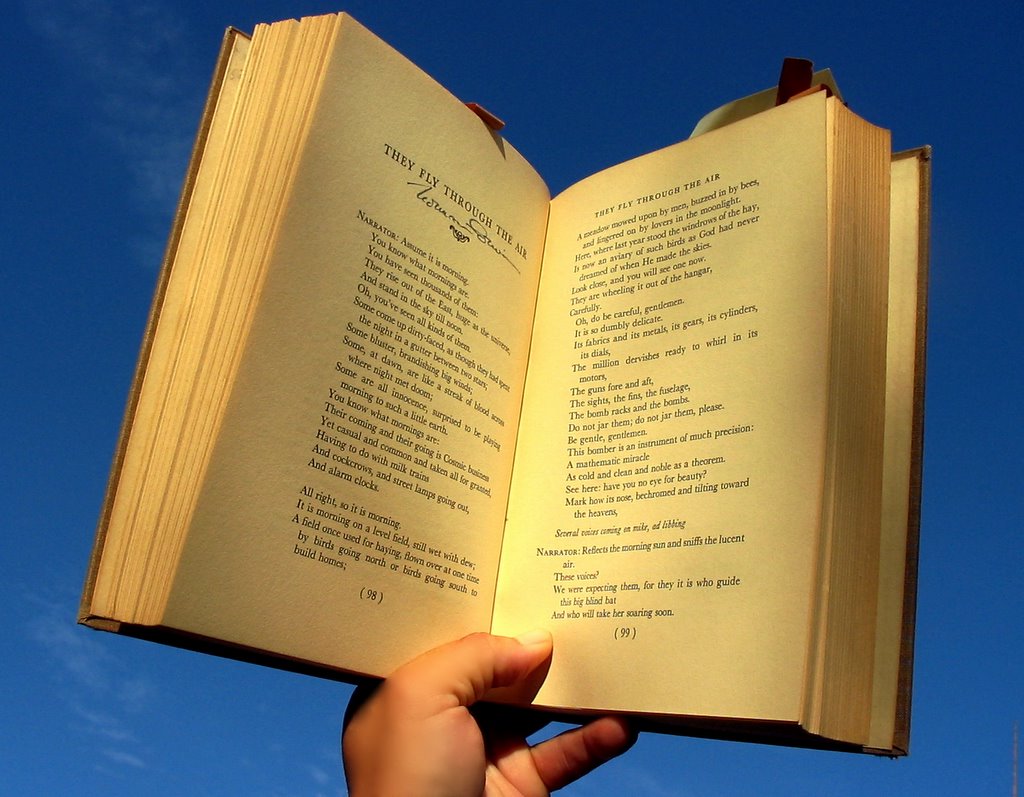
Holding up to the sky my copy of Corwin’s play “They Fly Through the Air,” signed by its author

For a long time, the painting was kept out of Spain and was mostly on display at the MoMA in New York City, where, during the Vietnam War, it became a site for vigils held by members of the peace movement, one of whom went so far as to deface it with red spray paint. It was Picasso’s wish that Guernica be returned to his homeland only after the reestablishment of democratic rule. A swiftly executed and brutally manipulative commentary on modern warfare, it invites comparisons to the three best-known American verse plays for radio, Archibald MacLeish’s “Air Raid,” Edna St. Vincent Millay’s “Murder of Lidice,” and Norman Corwin’s “They Fly Through the Air with the Greatest of Ease.”

MacLeish’s “Air Raid,” in contrast to Picasso’s painting, overtly implicates the civilian population, including his radio listeners, castigating them for their supposed ignorance and inertia. As in “The Fall of the City,” MacLeish attacks those falling rather than sentimentalizing their plight. His are bold performances, but his cruel warning turns listeners eager for news into silent partners of war who are asked to “stand by” as they tune in while women and children, refusing to heed warnings of an impending blitz, are being attacked and annihilated:

You who fish the fathoms of the night
With poles on roof-tops and long loops of wire
Those of you who driving from some visit
Finger the button on the dashboard dial
Until the metal trembles like a medium in a trance
And tells you what is happening in France
Or China or in Spain or some such country
You have one thought tonight and only one:
Will there be war? Has war come?
Is Europe burning from the Tiber to the Somme?
You think you hear the sudden double thudding of the drum
You don’t though . . .

Not now . . .

But what your ears will hear with in the hour
No one living in this world would try to tell you.
We take you there to wait it for yourselves.
Stand by: we’ll try to take you through. . . .

Millay’s “Murder of Lidice” recalls the innocent lives of those slain by Richard Heydrich, Deputy Reich Protector of Bohemia and Moravia, in Lidice. Artistically, the play is indefensible and shockingly inept in its bathos. In Millay’s Grand Guignol of Nazi terror, Heydrich the Hangman, whom the villagers have assassinated, is heard, from the beyond, planning his revenge:

He howls for a bucket of bubbly blood—
It may be man’s or it may be of woman,
But it has to be hot, and it must be human!
Oh, many’s the sweet warm throat he’ll suck.

In “They Fly Through the Air,” Corwin’s narrator goes in search of a language appropriate to the negotiation of art and propaganda. As I point out in Etherized Victorians, the play is a response to the perversion of poetic diction by the fascist cause. Viewed from above, Mussolini reportedly remarked, exploding bombs had the beauty of a “rose unfolding.” Throughout the play, metaphors are at war with plain speech, both in the service of motivating the masses:

What words can compass glories such as we have seen today?
Our language beats against its limitations [. . .].

Our rhythms jangle at the very start.
Our similes concede defeat,
For there is nothing that can be compared to that which lies beyond compare.
You see? We are reduced already to tautologies.
It’s awe does that.
The wonder of it all has set us stammering.

What is the language of war? How does it differ from the idiom of peace? And how shall war—often furious but not always futile—be rendered, recorded, and remembered in words or images? When I look at Guernica this week, I will ask myself these questions. Quite possibly, I will shiver when exposing it to the limitations of my shrinking lexicon.

Case Closed? The Piano Man, Olga Chekhova, and the Pleasures of Uncertainty

Well, the case of the “Piano Man” has been solved, it appears—and another mystery disappears. The denouement could hardly have been more disappointingly prosaic. It tends to be so with mysteries: unraveling them means to explain them away. “Mystery,” as I discovered when I looked up the word in my etymological dictionary, has its roots in muein, “to close the eyes,” as well as mu, a “slight sound with closed lips; of imitative origin.” Mystery is a condition, a state in which the people and things we perceive remain unclear; it is the temptation to discover and the pleasure of delaying the solution.

To “love a mystery,” as I put it in Etherized Victorians, suggests a delight in suspension rather than solution—a reveling in the act of unravelling in which what matters is a good yarn, not the clew one walks away with when it’s all done, or undone. It is a precarious and wondrous state of twilight and hushed voices, of bewilderment and speculation. That the biographical impulse to shed light on and make sense of things are at odds with the mysterious was conclusively demonstrated by a documentary I caught on BBC2 last night.

It was Antony Beevor’s account of his endeavor to tackle The Mystery of Olga Chekhova, a book I picked up a few months ago after having attended a screening of the silent movie Moulin Rouge, starring the alluring Ms. Chekhova. Niece of the playwright Anton Chekhov, major film star in Nazi Germany, and a spy for Russian intelligence, Chekhova sure is an intriguing personality; but little of that came across in the matter-of-fact sleuthing to which Beevor subjected her story.

In the documentary, we see him peeping through windows and rummaging through files in hopes of finding compelling evidence of her espionage activities; we hear him in conference with his translator, piecing together fragmentary data to forge causal relationships and force romance into patterns of logic. It was a dull display of diligence, only occasionally brightened by glimpses of his enigmatic subject.

The book itself, to be fair, is rather superior to the documentary, even though it nearly drowns the subject in heaps of historical detail surrounding her existence. As David Edgar remarked in his review, “somehow [Chekhova] seems smaller than her story, and it’s tempting to wonder what she would look like in the hands of a writer who could indulge in more speculation and extrapolation than the historian can allow.”

In search of truth, Beevor dismisses Chekhova’s brazen autobiographies as spurious. Factual lies, such embellished memoirs may tell so much more of the writer’s desire to be the author of her own life, to obfuscate and overwrite, to put pen to paper and eraser to past.

Over the years, “[r]umours about her mysterious life continued to grow,” Beevor writes in the concluding paragraph of his book. To me, the chief merit of his investigation is that it might give rise to further wonderings, that the rumors have not been quelled but quickened as a result. Grateful to the historian for having given me hooks on which to fasten my imaginings, I continue to dwell between the lines, where mystery lingers.

Right now, I am picturing Chekhova as a chameleonic adventuress, someone like the heroine of Top Secret, a radio series of spy thrillers starring “gorgeous Ilona Massey” (as she was tantalizingly announced). Here, as in Beevor’s documentary, mystery lies beyond tired phrases and contrived storylines; here, it is the allure of Ms. Massey’s voice that draws me in, just as Chekhova’s image captured my imagination when I saw her in the silent Moulin Rouge. Perhaps mystery is the willingness to take leave of at least one of your senses. Ahh, to be closing my eyes again . . .

Unpopular Culture; or, the Return of the Magnificent Montague

Popular culture is generally understood to be the mass-market consumer culture of the present.  As the culture of the everyday it is especially vulnerable to obliteration.  What happens to the popular of the past, to the dime novels, movies, television programs or radio entertainment no longer of interest to a larger public, no longer deemed marketable or relevant? Does it become fodder for historians? Is it fuel for nostalgia? I am going to investigate this heap of discarded objects, review products of a by now “unpopular culture,” and relate them to my here and now.

This attempt at a blog is an unacademic continuation of my doctoral study Etherized Victorians. It will chiefly concern movies, television and radio programs that may have fallen out of favor or are favored by the few only but are still available to anyone using contemporary means and media (television, radio, and the internet); or distributed as DVDs, mp3s or in plain old print.

Unlike my academic writing, this journal will allow me to broadcast my findings immediately upon discovery and to share my impressions with others who, like me, are passionate about presumably stale pop, whatever their cultural or educational background.  It also permits a more personal approach than did my dissertation, in which I never referred to myself in the first person singular.

My [initial] signature, “The Magnificent Montague,” [was] appropriated from a US radio sitcom (1950-51) of the same name. In it, a proud but hapless thespian (portrayed by Monty Woolley) finds himself stooping to radio work to make ends meet. This obscure reference was meant to express the confrontation of cultures high and low, of trends and traditions, of personal predilections and public personae—confrontations broadcastellan will bring about in the months to come.

[As I became more confident writing about myself and saw the need to lay claim to my own words, the “Montague” cloak became cumbersome and useless.  It was retired on 24 October 2005].