
 I have yet to write a card this season; and considering that half of my greetings are to be flown overseas, I should really put pen to shiny paper any day now. In Germany, where I am from, it is tradition to wait until the last possible moment to post seasonal greetings, whatever the season. It is not customary there to display received mail for weeks on dusty end, certainly not prior to the event they are designed to commemorate. So, when is the right time to drop off those sentiments? The ever earlier reminders that are the shop windows can hardly be a guide in the matter.
“To save the postman a miserable Christmas, we follow the example of all unselfish people, and send out our cards early.” Thus noted the imaginary writer of The Diary of a Nobody (1892) in an entry dated . . . 22 December? The postal workers, no doubt, were less than pleased by the way in which the sentiment found implementation.
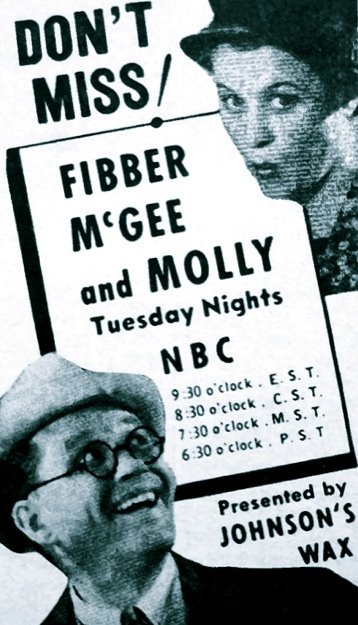
“Most of the cards had fingermarks, which I did not notice at night,” the same writer observed, a potential smudge on his reputation against which he resolved to guard henceforth by buying “all future cards in the daytime.” Another noted nobody determined not to purchase any cards at all. His name was Fibber McGee; and on this day 6 December, in 1949, he was found hard at work making his own holiday cards. To be sure, it was not his big idea to be creative or thoughtful that temporarily turned him into one-man Hallmark factory.
“Boy-o-boy,” Fibber told his wife, the doubtful Molly, “I sure wish I’d a-thought of this before. Look at the money I’d a-saved if I’d a-made my own Christmas cards every year.” Fibber did not merely paint the designs, including a beardless Santa Claus; he also dreamed up the accompanying sentiments. Among the rhymed excuses for his schlock art (words for which writer Don Quinn deserves and received some credit), are:
St. Nicholas had his beard cut off
as up on the roof his reindeers trample
because how can a guy with whiskers on
show little shavers a good example?
“I got a million ideas as good as this one,” Fibber boasted. “Well, I should hope so,” Molly replied.
For the Mayor of the town, Fibber paints the picture of a pork barrel with a hand in it; and for a friend who has been avoiding him for reasons soon to be apparent, he sketches a fish swimming through mistletoe, a symbolism explained in verse:
I hope the fish I hereby show
recalls the fin I loaned you last July.
And though he swims through mistletoe,
I ain’t gonna kiss that fin goodbye.
Ultimately, Fibber has to wash his hands of the whole Christmas card business, dirty as they are with paint and glue. Like the Nobody before him, and like millions of people everywhere, Fibber resorts to store-bought sentiments, even though the ones he has his hands on were pre-owned. The seller proved savvier than old Fibber. As Nobody’s experience with “fingermarks” suggests, even the purchase of new cards can be a challenge, especially when one has to face a shop
crowded with people, who seemed to take up the cards rather roughly, and, after a hurried glance at them, throw them down again. I remarked to one of the young persons serving, that carelessness appeared to be a disease with some purchasers. The observation was scarcely out of my mouth, when my thick coat-sleeve caught against a large pile of expensive cards in boxes one on top of the other, and threw them down. The manager came forward, looking very much annoyed, and picking up several cards from the ground, said to one of the assistants, with a palpable side-glance at me: ‘Put these amongst the sixpenny goods; they can’t be sold for a shilling now.’ The result was, I felt it my duty to buy some of these damaged cards.
I had to buy more and pay more than intended. Unfortunately I did not examine them all, and when I got home I discovered a vulgar card with a picture of a fat nurse with two babies, one black and the other white, and the words: ‘We wish Pa a Merry Christmas.’ I tore up the card and threw it away. Carrie said the great disadvantage of going out in Society and increasing the number of our friends was, that we should have to send out nearly two dozen cards this year.
May a joyous season be in your cards, fingermarks ‘n all!

 Here I sit like a good egg given up for Lent. After having spent much of the week leading up to Ash Wednesday—a period celebrated as Karneval in my native Germany—entertaining two old (make that “longtime”) friends eager to get away from those festivities. The guests gone and my better half away in London, I now have the place pretty much to myself (the pleasant company of
  Heavenly days! Thanks to modern-day technology (and, I suppose, a surplus of leisure) I have unearthed a spiritual bond that, thus far, has escaped literary scholars and old-time radio enthusiasts alike. Now it can be told: on this day, 12 September, the broadcast antics of Fibber McGee and Molly strangely intersect with the romance of Victorian poets Robert Browning and Elisabeth Barrett. Yes, on this day, both couples eloped—the Wimpole Street escapees in 1846 and the whimsical everybodies from Wistful Vista in 1924.
 Harry Heuser