
It seems I am going back to school. If I take Francis Bacon literally, that is. Considering that his stained-glass likeness greets me whenever I turn on the boiler or am induced by allergies to reach for the vacuum cleaner, it is high time I start quoting him now. According to the aforementioned essayist, “He that travelleth into a country before he hath some entrance into the language, goeth to school, and not to travel.” A timely reminder, as we are off tomorrow on a last-minute trip to Riga, Latvia.

Es nerunāju latviski. That is to say, I am a stranger to the native tongue (which is related to Sanskrit); and, having just gotten my hands on a couple of guidebooks, I realise that I am a stranger as well to much of the culture and history of the Baltic nation, even though German influences are pronounced—being that Riga was founded by Albrecht von Buxthoeven, a German bishop, and rarely enjoyed independence for long—and English, as is the case in most larger Western cities nowadays, is widely understood.
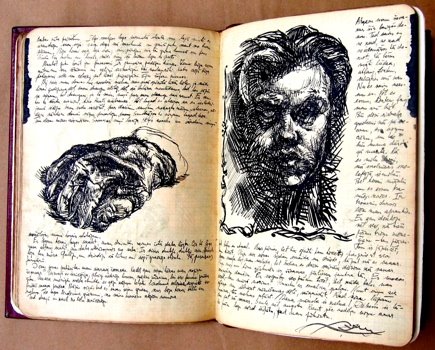
Much could be gleaned, no doubt, from the journal of a local, that is, a Latvian Francis, meaning the expatriate Renaissance man Francis Rudolf or Rudolph (1921-2005), some of whose paintings, drawings and diaries (shown here) were gifted a few years ago to a university here in Aberystwyth, the town where I currently reside.
“Expatriate” is too clinical a term: Rudolf was forced to migrate during his youth, when Latvia was being invaded by the Nazis and the Red Army. There he is, sticking out his tongue at us who are still largely ignorant of his world; yet it was he who put Latvia on the map for us and got me intrigued about Riga.

Richard Wagner and Sergei Eisenstein aside, there are few names in the Riga travel guides to which a journal devoted to US radio dramatics can readily relate. Determined not to stoop to the sharing of random snapshots, I shan’t continue broadcastellan until the conclusion of my “scholarly” outing, which is preceded and followed by sojourns in familiar destinations in Wales (Cardiff), England (Manchester), and the Netherlands (Amsterdam). Technology permitting, I might file the occasional report.
It rather irks me to be silenced by the marginal nature of my chosen subject. What a failure of self-expression, what a missed opportunity a journal like this is if it cannot accommodate whatever its keeper happens upon, sees and undergoes; yet such is the curse of the concept blog.
“Let him keep [. . . ] a diary,” Bacon rightly advises. I often regret my own strictures in this respect, as I imagine that my experiences may be rather more relatable to some than the dramatics of radio are to most. Besides, an online diary is ideally suited to the recording of everyday observations.
As has been demonstrated rather conclusively by the dead air I left behind on past travels, I seem incapable of reconciling the peripatetic with the armchair reflective. Still, I hope my experiences are going to enter into this journal somehow. As Bacon recommends,
[w]hen a traveller returneth home, let him not leave the countries, where he hath travelled, altogether behind him […]. And let his travel appear rather in his discourse, than his apparel or gesture; and in his discourse, let him be rather advised in his answers, than forward to tell stories; and let it appear that he doth not change his country manners, for those of foreign parts; but only prick in [that is, plant] some flowers, of that he hath learned abroad, into the customs of his own country.
Now, I have long been confused as to what “his own country” might mean, being that I have not lived in what is presumably and legally “home” to me for nearly two decades; but, in lieu of on-the-spot reports, I shall endeavor to gather and display such “flowers” as may withstand the airwaves or can be securely propped against a microphone . . .
 So, Carole Lombard and Clark Gable got married on this day, 29 March, back in 1939. Ginger Rogers tied the proverbial knot with someone or other in 1929; dear Molly Sugden, whom most folks today know as Mrs. Slocombe, a woman closest to her pussy, was Being Served, be it well or ill, with a license to wed in 1958; and the to me unspeakable ex-Prime Minister Tony Blair proved that he had popped the question fruitfully by walking down the aisle with someone named Cherie. It is a time-honored institution, no doubt; and one that has protected many a woman before her sex was granted the right to vote; but it is concept I find difficult to honor and impossible to obey nonetheless (which explains my love for the first three quarters of the average screwball comedy, the genre in which Lombard excelled).
 Harry Heuser