
“One excellent test of the civilization of a country,” Victorian poet and novelist George Meredith remarked, is the “flourishing of the Comic idea and Comedy; and the test of true Comedy is that it shall awaken thoughtful laughter.” To him, the “equality of the sexes” was, above all else, the requisite for “[g]ood comedies.” In this respect, the Germans were “rather monstrous—never a laugh of men and women in concert.”
While not entirely convinced by Meredith’s argument, I have often deplored the state of humor and wit in German film. The Germans are by no means a people of agelasts (non-laughers), let alone misogelasts (laugh-haters); but their comedy is generally crude or hostile. It tends to be discriminatory rather than discriminating. Those who displease us—and I have to include myself among the Germans, as much as I have distanced myself from Germany these past two decades—are being “ausgelacht,” that is, laughed out, as if banned from our midst, and stripped of their dignity.
German laughter is often elicited by the misfortune of others. And while such bemusement is not alien to Americans and the British, it is telling that English had no word for such a response to the world until it imported Schadenfreude. Laughing off the thought that what befalls others may happen to us may be an expression of fear; but I am not sure whether it is a fear of otherness or the fear that we might well find ourselves in the position of the ridiculed sufferer. What, to pick up Meredith’s idea, can a German movie produced in 1933 tell us about a civilization about to reach its darkest age?
Americans or the British might find it difficult to comment on the state German film comedy of the 1930s, considering how few of these films are known beyond Germany; far more familiar to them are earlier melodramas, ranging from gothic horror and dystopia to social realism. Even if the name of a highly regarded filmmaker like Max Ophüls is attached, German Lustspiele (comedies) are virtually uncharted territory for international audiences not in need of a regional map. Ophüls Lachende Erben (“Laughing Heirs”) is distinctly German; yet, to my surprise, it also has all the wit and charm of a 1930s Paramount comedy.
As a talkie, Lachende Erben makes full use of dialects, of which there are so many in German that it caused me great distress as a child to whom moving a mere fifteen miles or so meant being confronted to a language foreign to my ears and tongue. In Ophüls comedy, though, modern technology, from trains to telephones, is shown to bridge and unite the nation without obliterating regional differences. What keeps people apart, instead, is an obsession with the international language of finance.
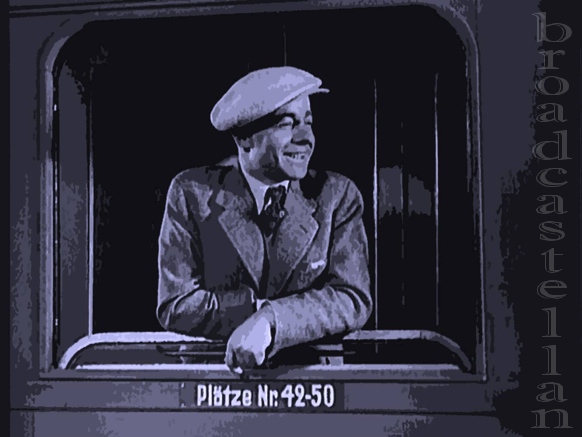
 The world depicted in Lachende Erben is a decidedly modern one; and the challenge is to master modernity without sacrificing humanity to it. It is the world of advertising, of commerce and industry. A train speeds through the German countryside in the opening scene; on board are Peter (Heinz Rühmann; pictured above) and Gina (Lien Deyers; seen right)—and, as far away from their destination, their destiny, they might be, the two are bound to come together at last. Along the way, in keeping with the by then already classic boy-meets-girl formula, there are numerous complications.
After all, Peter and Gina are in rivalling camps, representatives of competing wine merchants. Peter is an advertising man, but enough of a dreamer to brave the occupational hazard of falling in love with the competition. Gina has her own thoughts on the subject; impressed by Peter’s cockiness, she very nearly engages him as an adman; but when he loses his edge to please her, she gives him the brush-off.
Still more difficult is it for Peter to refrain from drinking the wine he is expected to peddle. Yet that is just what his uncle’s will stipulates. Reading, as it were, from the beyond and heard through a gramophone, the departed informs his unsmiling heirs that Peter is to inherit the Bockelmann fortune if he can manage to remain sober for an entire month. This becomes as much a test of Peter’s stamina as it is an opportunity for greedy relatives to deprive him of his inheritance. Resigned to throw away his fortune by reaching for his uncle’s wine, it is Peter who has the last laugh.
Lachende Erben nicely balances wit and humor, sentiment and satire. It is a comedy rooted in the belief that unity can be achieved through a respect for difference, that, while the world is getting smaller, there is room enough at the table for all—and wine, women and song besides. Perhaps it all looked a little more spacious since the women in this comedy were unencumbered by children, an independence at odds with Nazi dictum.
As a crowded nation on the verge of conquering new territory, Germany became preoccupied with Lebensraum (living space), and thoughts of cooperation made way for war and genocide, for a false harmony achieved through the suppression of diversity. The room was widened forcefully, but seats at the table were becoming exclusive. Max Ophüls (along with Ernst Lubitsch and the aforementioned Douglas Sirk) was one of the creative minds who chose to desert it, taking with them the hope of comedy that, in Meredith’s terms, might have prevented Germany from failing the test of civilization. The heirs who took his place had little to laugh at and gave the world less.
 “Good evening, ladies and gentlemen. The Lady Astor Screen Guild Players have a surprise for you tonight.” Such a promise may well have sounded hollow to many of those tuning in to the
  Harry Heuser