
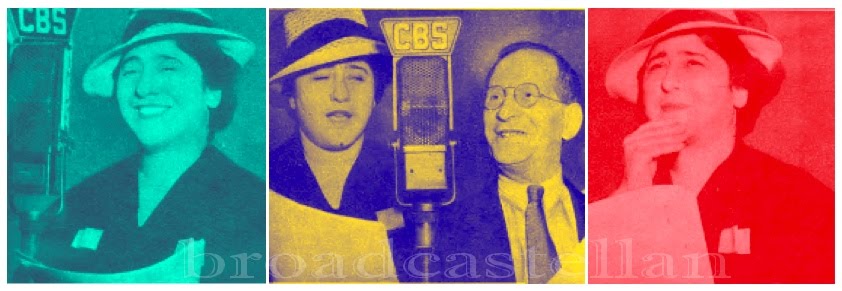
Yoo-hoo! Isn’t anybody anymore?

Remembering Gertrude Berg, that is. Having been to Fleischmanns last year (without spotting her tombstone there), I was thrilled to be catching Aviva Kempner’s much reviewed if ultimately unsatisfying documentary Yoo-Hoo, Mrs. Goldberg at the Quad Cinema in Manhattan last week. After all, it is not a film you are likely to see in Europe (or, for that matter, in any US multiplex); and I doubt whether it will ever be released in Wales, my present home. Who, after all, remembers (or ever had the opportunity of) tuning in to The Goldbergs, or The Rise of the Goldbergs, as Berg’s program was initially called in the days before television?

Kempner’s filmic memorial to Berg and her creation—heard on radio and seen on stage, television and the movies—aims at countering the oblivion to which the writer-producer-actress and her signature character have long been consigned; but, judging from the elderly, Jewish audience among which I found myself, aside from my good friend, Brian, Mrs. Goldberg is not likely to find new admirers through Kempner’s polite and downright reverent re-introduction, however deserving she may be of praise.

“Why, for all her popularity and apparent influence, is Gertrude Berg so little remembered today?” Paul Farhi of the Washington Post asked back in July 2009. It is a question Kempner does not trouble herself to answer, other than with a resounding “Why indeed?” Predating but overshadowed by I Love Lucy, The Goldbergs come across as little more than a noteworthy, ethnic curiosity, a historical footnote, the stuff of nostalgia. At least, Kempner’s documentary, which New York Post critic V. A. Musetto called “fawning and formulaic,” did little to convince me otherwise—and I don’t need convincing.

“Ulleright, ulleright!” For all its shortcomings, Yoo-Hoo, Mrs. Goldberg is still a welcome and overdue tribute to of a long overlooked icon of American popular culture—and an enterprising, emancipated woman at that; but it is also a rather perfunctory and historically questionable piece of bio-cinematography, replete with a poorly reenacted scene from Berg’s earliest radio script.
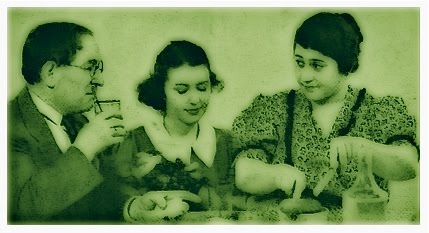
Except for a few tantalizing clips of Edward R. Murrow’s interview with Berg on Person to Person and those seemingly random excerpts from The Goldbergs kinescopes, the documentary, like most pieces of ocular proof, is at a loss to fill the screen, resorting to images only remotely related to the subject; or, else, to talking heads like Ed Asner’s and Ruth Bader Ginsburg (who recalls being addressed as Mrs. Goldberg). Meanwhile, the snippets from Berg’s radio and television broadcasts are often unintelligible, if it weren’t for the subtitles. The result is about as funny as a translated joke—and certainly not remotely as amusing or charming as Berg’s glossy autobiography Molly and Me (1961).

Here, for instance, is how autobiographer Berg made the connection between her parentage and her wireless offspring. Those watching Kempner’s documentary never get to hear about it. To them, Molly is a kindly woman leaning out of a window, chatting to her neighbors—and an audience long since dispersed—or praising the miracle of Sanka Coffee, instead of yelling “Yoo-hoo, is anybody?” into a telephonic darkness just beyond her Bronx apartment:

My father was a special fan of the dumbwaiter and when radio was invented, he gave up the shaftway only because of the better coverage. But until that time it was through the dumbwaiter that he got to know everybody, not by their names, but by their locations. He predicted divorce for Mr. and Mrs. 5-D because of their nightly arguments; he knew that Mrs. 3-A’s son was going to leave home before even Mrs. 3-A. It didn’t take second sight; all it took was a good ear and a comfortable chair near the dumbwaiter door.

Kempner’s film is so reverent and nostalgic, it sentimentalizes the already saccharine confection of Mother Goldberg, whose Jewish Amos ‘n’ Andyisms enliven the early scripts for her radio serial, extant only in print, before the series-turned-daytime serial settled for at times “soap-operaish” melodrama.

“[E]verything about The Goldbergs changed but the theme song, ‘Toselli’s Serenade,’” Berg explains in Molly and Me. Those encountering Molly in Kempner’s documentary are unlikely to see Molly as an early Lucy, or, come to think of it, as a prototype for linguistically challenged immigrant Ricky Ricardo.

“So come down a liddle after,” Mrs. Goldberg once yoo-hooed to her neighbor, Mrs. Bloom, “maybe ve’ll go to a mofie—is playing de Four Horsemen in de Apoplexies.” Well, you almost got it, Molly. Apoplexies are the kind of movie theaters that leave you angry at your lack of choices. Too bad that even the exceedingly rare art house simplexes are not likely to rescue you from the fate of being trampled to death by the pale horse of apathy.


Related writings
The House of [Broken] Glass
Wireless Women, Clueless Men: Gertrude Berg, Everybody’s Mama
On This Day in 1941: Molly Goldberg Nearly Chickens Out

The House of [Broken] Glass

Fleischmanns is a small town. There’s a sign on the road just before you get to it that says POPULATED AREA. Fleischmanns is populated with five hundred people, no more, no less. To a stranger it looks like any other little village in the Catskill Mountains. To a native it’s a special place and every town he doesn’t live in is a nice place to visit but he wouldn’t want to live there—he wants to live in Fleischmanns.

This is how the aforementioned actress-playwright Gertrude Berg begins her reminiscences about the town in which her father opened a summer resort more than a century ago in a spot once known as Griffins Corners. That, incidentally, is also the name of the local pub where we had lunch on our stopover at that once thriving, affluent community. Fleischmanns. Who ever heard of a place that sounds like a time slot reserved for the sponsor of Rudy Vallee! When I read the name, I thought for a moment that Mrs. Berg, who knew all about commercial radio, had made it up; but when I discovered it on a map of the Hudson Valley shortly before our 1,300-mile trip through upstate New York a few weeks ago, I was determined to pay a visit.

Now, I am not prone to bouts of nostalgia, the state of pining for what never has been anything else but an intense longing to the indulgence in which entire industries are devoted. I much rather aspire to something that is, delve in what has been, or simply make up whatever suits me without getting all melancholy about it. Still, if there is any place in the Catskills that could make me melancholy, it would have to be the town of Fleischmanns.

I don’t quite know what I expected after I read the lengthy, detailed description in Berg’s charming Molly and Me; I only knew that I really wanted to go. After all, Berg’s serial The House of Glass owes much to the town and the hotel run by Berg’s father. The House of Glass (a single instalment of which, dating from 13 November 1935 and featuring famed contralto Madame Schumann-Heink, has been shared on the to me invaluable Internet Archives) was “Fleischmanns all over again—through a ribbon microphone” Berg remarks in her biography:

Barney Glass was my father. The hotel was full of guests, all of whom I had known. I used what I could remember of their stories, and where there were unhappy endings I added happy ones. The radio hotel always solved its problem with a laugh, and as far as reality was concerned all I had to do was change the names of the guests and I had my story line.

Fleischmanns has a museum devoted to memory. It was closed on the day we passed through. The library has a copy of Molly and Me. I took it from the shelf, flicked through it until I got to the chapter on the town, and left it on a little table, as if to remind anyone stopping by of those better days. I know that the Borscht Belt went bust some decades ago; but I sensed that we caught Fleischmanns with its pants down. Not the kind of clowning around that makes you laugh; more like a sad, half-forgotten soul stuck in a retirement home with a suitcase of ill-fitting clothes and a yellowed scrapbook filled with mementoes of a past few active minds could be stirred into recalling . . .

"You Boig?"

“I don’t have much respect for biographers,” I once told John N. Hall, noted author of Trollope: A Biography and Max Beerbohm: A Kind of Life. I was being mischievous, knowing my professor to have a sense of humor that makes him just the man to examine the lives and fictions of the humorists who attract him. Indeed, I have rarely met an academic whose mentality was better suited to his subjects. I was not merely being facetious, though. I was also being honest. I don’t read biographies; not cover to cover, at least. I am too impatient to go through a series of incidents designed to trace the traits and career of a famous so-and-so to great-grandparents who were semi-literate peasants from Eastern Europe, to illustrate what impact the childhood agony of losing a balloon during a rainstorm had on an artist’s psyche, or explain what it really means to be a supposed nobody before becoming an alleged somebody.

You might say that I am not easily impressed by facts and downright doubtful of them; that I am unconvinced a life can be told by means of sundry scraps of evidence culled from contemporary sources or the recollections of contemporaries whose lost marbles are dutifully dredged from the gully of memory lane. It’s all that; but I would like to think that respect has something to do with it as well—respect for a creative mind expressing itself in a work of art by someone who might not be willing or able to open up otherwise. In other words, I take what an artist is willing to give, even if the limited supply of such works are dictated, to some extent, by market demands.

Nor do I believe that being told about traumas and toothaches ought to compel me to regard an artist’s works as the product of such ordeals. Nothing is more tedious than arguing that a character who slips on a banana peel was destined to break his neck because his creator was terrified of the tropical fruit a health-conscious aunt was trying to shove down his three-year-old throat. If I want a story or a picture to be a mirror, the reflection I find therein should be my own.

Autobiographies are a different kettle of fishiness altogether. They are the storied self, the persona an artist has decided to display in a public performance. (Hall, by the way, has since written his own memoir titled Belief [2007].) I accept them as such, which does not mean I am any more patient as I am being subjected to the courtship of an artist’s maternal grandparents, to Ellis Island flashbacks or dim impressions from the cradle. There is some of that in the aforementioned Molly and Me (1961), the autobiography of Gertrude Berg (pictured here in a photograph freely adapted from the March 1943 issue of Tune In).

Berg was the creator of the radio serial and subsequent television sitcom The Goldbergs, as well as the lesser known House of Glass, about which I got to read in Radio and the Jews by Siegel and Siegel, a volume I picked up at the Jewish Museum in New York during my last visit to my old Upper East Side neighborhood. Molly and Me may be short on the drama of radio, for which I initially picked it up, and lack the to researchers indispensable index, for which omission I immediately put it down again. I need not have been quite so prickly, though. Berg’s memoir, like her writings for the air, is alive with Dickensian characters, a conversational style, and challenges to literary theory that tickle the wayward scholar. Let me give you a for instance:

Well, I saw [New Orleans].  There were hot, wide streets, charming Old World houses—all hot—wonderful hot restaurants, and lovely, well-decorated, hot hotels. In the evening, when the sun goes down, the heat goes down also but the humidity goes up. It’s no wonder that Tennessee Williams and William Faulkner write such good tragedies.  With air conditioning maybe there’ll be a change in our Southern literature.

This passage, my favorite in the entire book, makes me wish Berg had been the ghost writer of Roland Barthes’s Mythologies:

The Lyceum [a New York restaurant her father managed] was a huge place that could take care of fifteen hundred people [. . .].  It was not only big, it was gemütlich, it was where people came to laugh, and it was before publicity men talked about atmosphere.  The ceilings were high and absolutely guaranteed not soundproofed. The whole idea was to have fun and not to be quiet. In those days silence was for funeral parlors, not restaurants.  There were chandeliers that were chandeliers—all cut glass with teardrops and draped strings of little glass balls, not straight pipes with blisters on the end or holes in the ceilings that drop light on you. I’m not saying that those were the good old days.  It’s just that there was something about bigness that was friendly.  Today if it’s big, it’s a bank or Grand Central or a cafeteria where you go in fast and come out fast.  There’s no place to relax any more except at home—and with the foam rubber they put into everything today, who can relax?

“You Boig?” an agent once addressed the writer at the beginning of her career. I can just see him there, facing her. I can hear him, too, thanks to Berg’s writerly gifts and a long exposure to actors like Allen Jenkins. She’s “Boig” all right. I feel that I got to know her as she wanted to be known, a woman who tells her audience not to expect the story of someone who “divorced three husbands, became a drug addict, and finally, after years of searching, found the real meaning of Life in a spoonful of mescalin.”

So what if there’s more Molly than “Me” in this production. I’m not going to tear up the cushions Berg arranged for me in hopes of finding a needle in what is too comfortable to be foam rubber . . .

The Big Brother Incident

Well, I did not tune in for it; but you would have to be dwelling under a boulder without broadband not to have become aware of the diplomatic incident and international protests caused by the treatment of Bollywood star Shilpa Shetty on the Channel 4’s Celebrity Big Brother program here in the UK. I generally shut off and down at the mere mention of the word “celebrity,” which to me signals the exhibition of some latter-day Zsa Zsa Gaborisms—the state of being prominently stupid for the sake of being stupendously prominent—that I can well do without.
Where is the humility that convinced notoriously competitive Rose Nylund (portrayed by birthday Girl Betty White, born on this day in 1922) to turn down the St. Olaf Woman of the Year award after discovering that the judges had been swayed by a spurious account of her achievements?

That said, confronting undereducated, overexposed, and self-absorbed have-beens or wannabes with someone who is someone somewhere else strikes me as an inspired premise for a potentially edifying spectacle. It might offer a cultural corrective to the culturing of fame, forcing those who fancy themselves somebodies—along with those who buy into or by way of mockery perpetuate the process of celebrification (the fabrication of celebrity)—to reevaluate the limits and merits of popularity. At any rate, it lends a culture clash edge to a program that is otherwise nothing but trash edging itself in on culture.

Now, Celebrity Big Brother has received some twenty-thousand viewer complaints citing the abuse of Ms. Shetty by other housemates, deploring the ethnic slurs and biasides (you know, those tossed in remarks revealing a speaker’s prejudices) that have translated into a ratings bonanza for the program. In a development worthy of satirist Johnathan Swift, these televised housecoolings have led to protests in India and protestations by the British Prime Minister (who, like the folks in the East, has never seen the show).

The public shaming of this guilty pleasure is a remarkable development indeed, considering that much of British entertainment is based on the principle of offending. Apparently, it is acceptable to caricature and be-Little Britain, but not to portray as reality the actual small-mindedness of some of its people who have been elevated to the status of representatives by virtue of their omnipresence.

It’s been good for business, this brouhaha; but might a muzzle put an end to the foul-mouthing? Could Big Brother live up to its Orwellian name by resulting in overzealous watchdoggedness, by causing a backlash more profound than the aftermath of Janet Jackson’s wardrobe malfunction, by pushing any kind of social controversy off the screen and by keeping prejudice private so that it may flourish, undetected and unchecked. Perhaps it is better to permit those in need of publicity to make fools of themselves (and each other) than to fool ourselves into believing such ignorance extinct.

The ongoing debate whether to aspire to cultural universals or favor the ethnically distinct predates the social climate change brought on by political correctness. Jewish writer-actress Gertrude Berg (previously mentioned here), whose sitcom The Goldbergs had its television premiere on this day in 1949, once remarked about the success of her series in the age of anti-Semitic Gentleman’s Agreements that “we all respond to human situations and human emotions—and that dividing people into rigid racial, economic, social, or religious groups is a lot of nonsense.” Worse than nonsense would be to deny that those divisions exist and that an assumed, unquestioned sameness is a healthy substitute for hard-fought equality.

Between You, Molly and Me: Should We Settle for Squirrels?

Well, it’s like looking for a park bench. Picking up a book, I mean. If I find one I like, I tend to stick around to enjoy the vistas it opens, willing to overlook its more or less obvious faults. Otherwise, I move on fairly quickly, knowing that there are seats out there that suit me better. Sometimes, however, I get stuck on something that I did not reckon with, something that remains long after I left, like a bit of chewing gum you sat on and struggle to remove. It makes you work, it irritates you as it forces you to deal with it, and you remember it (rather than the bench to which it was appended) for just this unexpected bit of friction and activity. Let me give you a “for instance.”

Last weekend, I picked up Molly and Me, an autobiography by actress-playwright-businesswoman Gertrude Berg. For several decades, Ms. Berg was best known as Molly (or Mollie) Goldberg, a character she created and kept pushing from medium to medium, from print to stage, from radio to television. Now, I haven’t gotten to the point in the book where Molly comes to life. I got stuck on her pre-history, which, in Berg’s 1961 memoir, begins with her grandfather, Mordecai, a tinsmith who opened a store on the Lower East Side of Manhattan (come to think of it, not all that far from the store where I bought the book last August).

The following piece of wisdom is that bit of gum I found myself struggling with. In an attempt to advertise his store, Mordecai carefully crafted a fine model of a steamship, five foot long and all made of tin. He placed it in the shop window in hopes of attracting customers. Sure, a few people stopped by and looked; but the time he spent on the display stood in no fair relation to the number of people he drew in. So, Mordecai decided on another way to dress his window: a cage with a wheel. In it, he placed a squirrel; and as it kept running in circles, people stopped by to look, far more than had been interested in the boat.

From that experience, Mordecai extracted a simple moral and applied it to all manner of situations, Berg explained:

Grandpa worked hard to make a boat that he was proud of. It was practically a masterpiece but what did people come to see? A squirrel running around in a cage! So what was the lesson? The lesson was, you can’t joint them, you can’t beat them, you can’t even understand them, so don’t bother. Hope for the best and maybe somebody’ll come in who’ll appreciate the boat. Meanwhile feed the squirrel, it’s not his fault.

Undoubtedly, this anecdote appealed to Ms. Goldberg, a popular wordsmith who found her niche by giving people—listeners and advertisers alike—what they wanted, even though what she came up with did not receive much respect as a craft, let alone as an art: the soap opera. Mordecai, you sure got me thinking. Keeping this journal, I wonder whether I should not tear apart the boat I put together and settle instead for a squirrel in a cage . . .

Wireless Women, Clueless Men: Gertrude Berg, Everybody’s Mama

Well, I am back from my three-day getaway to Manchester, my makeshift Manhattan. And what a poor substitute it has proven once again. The only bright spot of an otherwise less than scintillating weekend was the production of James M. Barrie’s comedy What Every Woman Knows at the Royal Exchange Theatre. While I prefer the traditional proscenium arch over an arena that to me suggests circus acrobatics or boxing matches rather than verbal sparring, I eventually got past the irritation of being dazzled by confronting stage lights, of having to watch the action through a fireplace or other obstructing props, and of looking into the faces of audience members opposite while the players turned their backs to me.

I was won over, tickled then touched by the excellent performances in this smart and sentimental piece, particularly by Jenny Ogilvie’s knowing portrayal of Maggie, whose “every woman” charm eludes the very man for whom she so devotedly works her magic: her clueless husband, that is. I will have more to say about Barrie’s play—and the hazards of adaptation—in a journal entry coinciding with its 2 March 1947 soundstaging by the Theatre Guild on the Air, on which occasion Helen Hayes was heard as Maggie.

Hayes is one of the leading ladies mentioned in the first broadcastellan quiz; and whether or not she ever had her own radio program is something for you to ponder should you choose to join in before the answer is revealed on 24 February. Until then, I could not possibly let Ms. Hayes or her interpretation of Maggie take center stage. That spot is reserved today for “every woman” Mollie (or Molly) Goldberg and her creator Gertrude Berg, who also portrayed the role for decades on radio, stage, big screen and small.

As vaudevillian-turned radio personality Eddie Cantor once remarked, Berg “captured the charm” of New York’s East Side, and “through her sketches runs the entire gamut of human emotions, from laughter to tears.” It was no charmed life on Pike Street those days, but surely one with whom many radio listeners could readily identify.

Jewish immigrants Mollie, her husband Jake, and her two children, Sam and Rosie, came to NBC radio on 20 November 1929, just a few weeks after Wall Street laid that proverbial egg. Recordings of those first broadcasts are not known to have survived, but the early struggle of the Goldberg family has been preserved in print, in a 1931 novelization of the scripts to accompany the popular series.

Mollie is introduced as a woman whose worries are largely domestic and sometimes imaginary. Anxious because her son, Sammy, is late from school, Mollie speculates that he might have gotten himself “runned over by a cabsitac”; after all, “[d]ey run around so fast like cackroachers.” Mollie, you see, lacked a formal education in American English—unlike her children, who were quick to correct her. “De chicks is loining de rooster!” Mollie exclaimed in exasperation.

Husband Jake, meanwhile, was clueless about Mollie’s desire to improve herself; he was too busy with his struggling business. “Oy, vat beezness!” Mollie sighed, “Saturday, Sonday, holledays. Plain talking all de time! Vy don’t you buy a bed and slip dere and finished! And dat’s beezness? It’s a slavery—jost like in Oncle Tom’s Cabinet!”

Sure, Mollie loved going to the pictures watching movies like “Oy, vot a fool I am,” by “Ruddy Kipland” or “de Four Horsemen in de Apoplexies.” She also marvelled at technological advances such as the newly installed telephone in her home (“Mr. Telephon Company, vhere do you put de nickels?”). Yet, like Barrie’s Maggie, Mollie was eager to learn even that which not every immigrant homemaker was expected to know. For that purpose, she enrolled in a reading and writing course at a neighboring night school. So, as much as listeners were invited to laugh at Mollie’s malapropisms, they were also taught to admire her courage and perseverance:

Ay, ay, Amerike, Amerike! Everybody vhat only vants, can become here a somebody. An education is like in de fairy story, “Open see-saw open.”  Vhen you got an education den everyting; all de doors from de vorld stands open far you.  You could even understand yourself, and vhat’s more important dan dat, ha? You’ll vouldn’t be ashamed from your mama, ha, Rosiely?

Years later, Berg commented on the significant contribution of the serial to American democracy. The “daytime serial,” she said, “can be a very effective force in bringing to the American people a deeper understanding of the democratic way of life” since it was capable of “revealing the meaning of democracy in people’s lives,” and of doing so far more effectively “than any speech.”

During the war, however, Berg agreed to address the radio audience in her own educated, if not nearly as charming, voice, imploring those listening to the Treasury Star Parade to be mindful of the fight for democracy, rather than wasteful of the material benefits deriving from it.

“Women like us fight with the bonds we buy, the rubber we save, the food prepare and the fat we save.” It’s what every woman needed to know back then. And who was more ideally suited to tell them than Gertrude Berg, the mother of radio’s surrogate mom?

On This Day in 1941: Molly Goldberg Nearly Chickens Out

Today, I spent so much time updating my homepage, surfing for internet television channels, and catching up with yesterday’s X Factor (rooting for Brenda, Andy, and Maria), that I neglected to commemorate the birthdays of Eugene O’Neill and Angela Lansbury (and discuss their respective radio connections). Instead, given the temporal restrictions, I decided to take in a 9-minute episode of one of radio’s earliest domestic serials, The Goldbergs.

I don’t mind listening to daytime radio serials. I certainly don’t condemn them outright; nor do I call them “soap operas,” for the same reason I don’t label crime dramas or variety shows “after shave thrillers” and “cigarette follies.” True, the so-called soaps (or washboard weepers) were largely manufactured by the makers of bubble baths and detergents. Still, it is wrong to single them out as being mere product placement opportunities, since promotional efforts also defined (or at least influence the content of) Jack Benny’s Lucky Strikes Program, The Lux Radio Theatre, and a great many other sponsored series.

The main problem I have with serials, as opposed to episodic or anthology dramas, is that I don’t give them enough time to grow on me or that too many installments are no longer extant to assist me in fostering an appreciation. In other words, I do not want to get engrossed and could not, anyway.

I do like Molly Goldberg; but she can—and occasionally does—get on my nerves. She is too frazzled, too neurotic, too much of a stereotype at times; whatever her accomplishments as a wife and mother, she too often fishes for sympathy, rather than compliments. Take the confession, for instance, that she was nearly too embarrassed to make on this day, 16 October, in 1941.

The entire episode could be summed up in one sentence: With considerable difficulty, Molly can be induced to admit that she has invested money in a friend’s possibly dubious poultry business. In this particular script, Gertrude Berg left out the story and depended solely on her portrayal of the kindhearted matriarch she created.

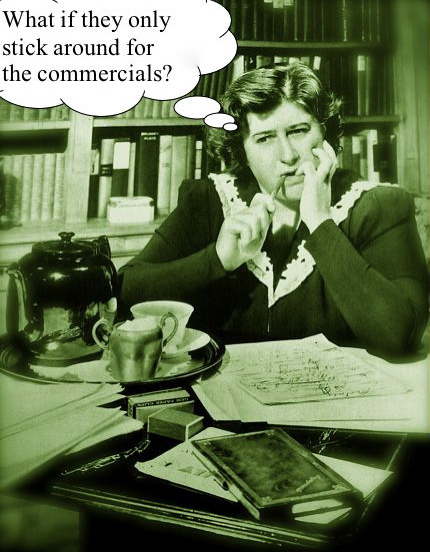
The stalling becomes a bit too obvious, and eventually desperate and tiresome. I’ve got nothing tonight, you can just hear Berg saying as she sits at her desk (pictured above), but I’ll pull it off because my public loves to hear Molly struggle.

Sure, I love you, Molly, and I appreciate the fact that you didn’t expect I’d be listening to your radio program today (with avian flu on my mind); still, parcel out a more generous piece of plot for me and I might stop by for another visit. After all, quite a few successive installments are available from October 1941, a period rife with war anxieties and home front preparations for inevitable shortages in food and consumer goods. Don’t count your chickens, Molly—there’s trouble ahead!