
In a Cornfield West of Denver, Calling Hogs

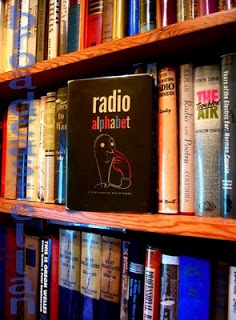
It is almost “like a bride’s outfit”; in it, there’s “something old, something new, something borrowed”—although rarely anything “blue.” That is how media critic Gilbert Seldes described the language of broadcasters, the jargon used by those behind the scenes of television, with which the American public was just getting acquainted (rather than walking down the aisle). Seldes’s remark can be found in Radio Alphabet (1946), a lexicon more concerned, at the title implies, with a poor relation of television. Let us say, a wealthy and powerful relation that was about to be abandoned by her suitors and cheated out of her fortunes.

Despite its inclusion of TV terminology, the Alphabet was compiled at a time when radio was at the height of its influence on American culture, shortly before it was reduced to playing the nation’s jukebox and serving as a source of patter. It not only spouted words—it begot them. Hence the publication of Radio Alphabet, the latest addition to my library of books on broadcasting (also available online). Before it, along with everything else, is being shoved into a box, awaiting a new home, I am going to pick it up and . . . have a word.

Radio Alphabet is prefaced by “an introductory program”—a foreword as broadcast script featuring the voices of many important figures in charge of operations at the Columbia Broadcasting System. Among them, Douglas Coulter, vice-president of the network; William B. Lodge, director of general engineering; William C. Gittinger, vice-president in charge of sales; William C. Ackerman, director of the network’s reference department; Elmo C. Wilson, director of the research department; Howard A. Chinn, chief audio engineer for CBS; and radio drama director Earle McGill. All of them are announced and quizzed by a “Voice”—a sort of mouthpiece for broadcasting (or CBS, at any rate).

Like any good announcer, the “Voice” knows how to sell:

Not since Gutenberg’s press has any instrument devised by man added more promise to the dimensions of man’s mind, or more altered the shape of his thinking.  The press enabled man to speak his mind to man through a code of letters on paper: radio enables man to speak his mind by living voice.  This expansion, under the somewhat imperative tempo of the radio art, has forced up a new, raw, essential working vocabulary which is steadily spilling over into wider understanding and usage.

Radio’s new operating tongue speaks now and then with fresh if familiar economy and color.  In the air a pilot on the beam is on his course; on the air an actor or director or conductor on the beam is making his most effective use of the microphone.  Bite off, bend the needle, west of Denver, soap opera, dead air, old sexton . . . these are new and useful and happy twists of the infinitely flexible mother tongue.

By now, the items in the Alphabet are largely useless; the unhappy twist is that radio’s tongue is tied, its jargon obsolete. However vivid the expressions in this glossary, consulting it makes you aware not only of the life of the medium but of the mortality of words. Although many of them linger in our vocabulary, they are figures of speech whose meanings have become arcane, whose uses are imprecise. These days, for instance, “soap opera” denotes melodrama, regardless of its financing or commercial purposes. It’s an expression on life support, a ghost of a word removed from the machine that created it.

Turning the pages of this handsome little volume is not unlike tuning in to those old programs and putting one’s impressions about them into words. There is that sense of being superannuated and abstruse; but there is also the thrill of rediscovery and the joy of being, in a word, conversant—at least with the subject.

So, what does it mean to have been in a “cornfield,” “west of Denver,” “calling hogs”? I’ll let the Radio Alphabet explain it all:

CORNFIELD: A studio setup employing a number of standing microphones.

WEST OF DENVER: Technical troubles which can’t be located.

HOG CALLING CONTEST: A strenuous commercial audition for announcers possessed of pear-shaped tones of voice.
On This Day in 1948: Radio Listeners Are Offered Free Delivery of "The Front Page"

Well, it sure was fodder for the tabloids. The case of the German cannibal, I mean, which resulted in a retrial and a life-sentence for the remaining party of one decidedly unconventional dinner date. Now, the so-called civilized world deems itself too far above bestiality to grant citizens the right to end their own lives as they see fit or to lose themselves completely in a consensual act of consuming passion. Widely exempt from the consequent criminalization of cruelty—which outlaws the animalistic it can never truly root out—remain the barbarism of capital punishment and the bane of the yellow press.

I don’t often quote journalist-turned-novelist Theodore Dreiser, mainly because his prose is among the most hideous ever to get past an editor; but this line, ripped from his Sister Carrie, is worth considering: “Our civilisation is still in a middle stage, scarcely beast, in that it is no longer wholly guided by instinct; scarcely human, in that it is not yet wholly guided by reason.”

It seems a perfectly reasonable attack on civilization; yet it is a line of attack defined by and conforming with the standards of the society it questions: a state of humanity based on the assumption that being human should mean being reasonable, the supposition that society should strive to rid individuals of their impulses and emotions—a project altogether unreasonable.

The paper logic of journalism—those well-formed, epigrammatic answers to monstrously complex questions—is as common and comforting as it is dangerous. Journalism itself is not the product of reason, but caters to the instinctual from which it derives: a curiosity at times so mean and perverse that it must be rationalized away by declaring the imagination-fertilizer being spread to constitute “news” or “information” in the public interest.

The famous American play The Front Page by Ben Hecht and Charles MacArthur, a comedy as poignant today as it was back in 1928, addresses this barbarism of the press, a force so powerful that it has been known to incite wars for the purpose of reporting them.

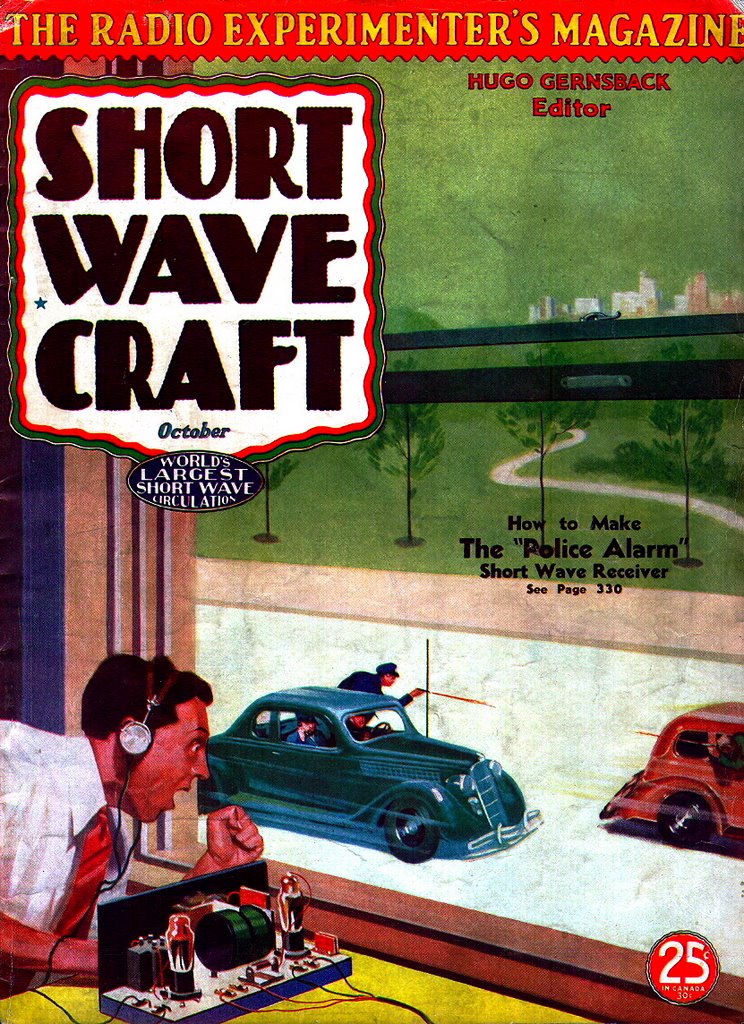
Adapted for the rival medium of radio by noted American critic, editor, and playwright Gilbert Seldes, “The Front Page” was spread out anew, if somewhat reduced in size, on this day, 9 May, in 1948, when it was reproduced by the Ford Theater, a venue named after its sponsor and not to be confused with Ford’s Theater, the center of cultural refinement that once was the site of a Presidential assassination.

Seldes’s edition of The Front Page makes good use of the aural medium by confronting listeners with the sound of the gallows being readied for an execution, a sound overheard in a newsroom whose occupants are paid to cash in on the event.

To those in public office, the timely execution of a cop killer is politically more advantageous than any probings into the mind of the convict. To a journalist like Hildy Johnson—a man torn between the mating instinct and the reasonable goal of making a name for himself—such a hanging not only spells good news, but excitement too great to be traded in for the state of matrimony.

The Front Page is an unflattering portrayal of the newspaper racket; but, unlike Dreiser’s brand of naturalism, it does not simplify what is complex by exposing societal corruptions only to subject them to the either-or morality of didactic fictions that aim at telling us how things are to teach us how they ought to but could not be.

Comedies and melodramas—especially plays that seem aesthetically flawed and morally ambiguous because they are as muddled as our everyday—can be instructive in their willful disorder or bewildering raggedness.

I was reminded of this last night while watching Are You Listening?, a 1932 MGM melodrama in which a young writer gets tangled up in the wireless game, the broadcast medium that offers him employment but that eventually contributes to his being hunted like a social menace and convicted of manslaughter. We, the spectators, are the only witnesses to his supposed crime—but we are sentenced, after promises of romance and gaiety, to follow the fall and disgrace of some latter-day Caleb Williams, an outcast hunted by media hounds interested in something less than justice, driven to the chase by nothing more than a desire to profit from—to feed rather than satisfy—our hunger for the sensational.