Flesh/Fur: “Significant Othering” in Island of Lost Souls (1932)

The index for volume 94 of Essays, Poems and Reviews, collected by George E. J. Powell. Aberystwyth University

Some years ago, researching the life of the Anglo-Welsh dilettante and collector George Powell of Nanteos (1842-1882), I set out to piece together whatever archival material I could get my hands on to gain access to the heart and mind of an eminently queer Victorian, a man who is now mainly known, if at all, as a friend of—and bad influence on—the poet Algernon Swinburne.

Powell bequeathed “all [he] possess[ed] of bigotry and virtue” to Aberystwyth University, where I teach art history and where, as part of my “Gothic Imagination” module, I screen films in the gothic mode on Wednesday afternoons.  For the third entry in “Significant Othering,” the current series, I chose Island of Lost Souls (1932), a pre-code Hollywood creature feature loosely based on The Island of Doctor Moreau (1896) by H. G. Wells.

Continue reading “Flesh/Fur: “Significant Othering” in Island of Lost Souls (1932)”

Brandishing the Pen: The War of “Seeing It Through”

Well, this is Guy Fawkes Day (or Bonfire Night) here in Britain. I am hearing the fireworks exploding as I write. Last year, I dragged Tallulah Bankhead into the Popish Plot; but it really seems an occasion to handle something explosive. To write about war and propaganda, or the war of propaganda, for instance. Bonfire Night coincides with the third anniversary of my move to Wales. So, I might as well write about something relating to the Welsh. And since this 5th of November is also the first day of the WGA (Writers Guild of America) strike that is intended to cripple the television and motion picture industry in the US, I might as well express my solidarity by turning a deaf ear to overseas media and lend a keen one to the voices of Britain.

Propaganda, a Welsh Prime Minister (pictured), and a group of famous authors including H. G. Wells, Thomas Hardy, and Arnold Bennett—“Seeing It Through” promises nothing less.

“Seeing” is the latest radio play by Neil Brand—last seen here in Wales accompanying The Life Story of David Lloyd George (1918). Dining with the writer, I remarked that, these days, the BBC seems most interested in airing biographical or historical drama. No exception is today’s Afternoon Play on BBC Radio 4, Tracy Spottiswoode’s “Solo Behind the Iron Curtain” (starring Robert Vaughn as himself, caught in revolutionary Prague anno 1968, and reviewed in my next entry into this journal). What sells these days are purportedly true stories, opportunities to eavesdrop on prominent, eminent or at any rate historical personages.

If it is to fly, the drama of the air is expected to have weight, especially now that such texts are generally being relegated to the footnotes of popular culture. Those in charge of allotting time for aural play try to salvage a dying art gasping for air by turning recorded sound into sound records and reducing storytelling into a substitute for oral history. A footnote-and-mouth disease is contaminating the airwaves, a corrupting influence in the theater of the mind for which there exists no talking cure. For the record, Brand has not so much caught the disease than braved it.

Cinematic in its architecture, in its designs on the mind’s eye, “Seeing It Through” opens like a house of worship, resounding with a hymn whose words are based on John Bunyan’s Pilgrim’s Progress, written in imprisonment: “He who would valiant be / ’gainst all disaster, / Let him in constancy / follow the Master.”

The music gives way to the sounds of a crowded auditorium and the words of one of the most famous British writers of the late 19th and early 20th century. None other than the man who invented The War of the Worlds: “You know me. My name is H. G. Wells,” the novelist addresses a conservative crowd and is very nearly booed off the stage, clearly not the master of his domain.

Wells was hoping to lend support to Charles Masterman, a liberal politician to whom we are introduced as he tries to promote welfare reforms. A gifted orator, Masterman disappears from the public stage to become the mastermind or mouthpiece of the newly established War Propaganda Bureau, Britain’s response to German duplicity. “There is no such thing as a clean war,” future Prime Minister David Lloyd George warns the radical idealist. “Then, Masterman replies, “we should create one.”

Rallied to aid him are the leading novelists of the time, including Arthur Conan Doyle, Chesterton, Hardy, Galsworthy and Bennett. As Wells is heard expressing it: “The ultimate purpose of this war is propaganda, the destruction of certain beliefs, and the creation of others.” Unlike the radio propaganda penned by US playwrights, poets, and novelists in the 1940s (as discussed here), their activities in publicizing an unpopular war was being kept a secret until well after armistice was declared.

As is revealed in a well-soundstaged scene symbolizing Masterman’s struggle to navigate the moral maze of a publicly invisible office, the alcoholic in charge gets lost in the structure he is meant to control. Trying to find his way, he relies on the guidance of a suffragette who once dared to toss pig’s blood in his face and whose brother is facing a breakdown on the front that she assisted in putting up: “I’ve learned,” she tells Masterman, that “there is no truth where war is concerned, except one: that the greatest cruelty is to let it go on when it could be stopped.”

She, too, operates under the influence, hers being Frances Stevenson, personal secretary, mistress, and future wife of Lloyd George, a woman Wells calls the “sphinx that guards the labyrinth of Whitehall.” It is in this nexus of oblique channels and hidden agenda that the lives of thousands are rewritten and expended.

That this is not merely a war of the words is demonstrated in noisy reports from the front and driven home in a sequence reminiscent of Howard Koch’s adaptation of Wells’s science fictional War: as London faces its first air raid, the weaponizers of words, Wells among them, look on and listen in the dark, Masterman speechless, his master’s voice overmastered: “If they’re smart, [the British public will] never trust any of us again.”

“Seeing” is a challenge to the audience. Instead of recounting an old if little known story, Brand puts listeners right a history in the making, thereby inviting us to draw parallels between the so-called Great War that was and the nominal anti-terrorism of the present, a war that some demand we see through while others struggle to see through it. Trying to make sense of the spin you will find yourself in, the acts of betrayal and false assurances you will overhear, you may feel yourself in need of another voice “Seeing [You] Through.” As in all history lessons that matter, this voice will have to be your own . . .

Morlock Guys and Eloi Dolls: The Domestic Battles of the Man Who Envisioned the War of the Worlds

I came across a peculiar piece of schlock science today. An evolutionary theorist has uttered the prediction that, within about 100,000 years from now, the human race may develop into two separate and unequal breeds, a scenario akin to the one H. G. Wells created in his sci-fi thriller The Time Machine over a century ago. Our descendants will either be nasty, brutish and short, or else graceful, fragile and overcultivated, enslaved by technology and a fear of Hobbsian life in the state of nature. In other words, a world of Morlock and Eloi.

Wells’s fictions strike me as rather more urgent and compelling than such a pseudo-scientific hypothesizing about the shape of things to come. As Orson Welles and his collaborators drove home when they brought The War of the Worlds to radio (as discussed here), they invite us to translate the grim visions of the future into a commentary on the none-too-bright world of today. If the time machine had not returned home, the ride would be pretty much wasted.

In some of his smartest if lesser-known novels, Wells dispensed with the creation of seemingly distant worlds as stand-ins for close and contemporary ones. Instead, he documented what was separate and unequal in his own society, examining the clash of classes and the battle of the sexes. One such Wellsian commentaries, which I am currently reading, is Ann Veronica (1909), an incisive comedy about women’s struggle for equality.

I owe this discovery, and quite a few others besides, to my daily excursions into the realm of —another trip not worth taking if you are not prepared to transport something back with you into your here and now. It was a remark made by Lost Horizon author James Hilton on the NBC University Theater that brought Ann Veronica to my attention.

On 3 April 1949, Hilton shared his thoughts on Jane Eyre with the listeners of the NBC University Theater, which presented a dramatization of the novel (as discussed here) with Deborah Kerr in the title role.

Considering how frothy the conclusion of the new four-part BBC television adaptation of Jane Eyre turned out to be last Sunday, Hilton’s lecture may serve as a reminder of the original’s “shocking” and groundbreaking qualities as the “first great novel that emancipated woman emotionally by portraying her not merely as the passive recipient of man’s favor, but as the possessor of rightful and independent passion of which she need not be ashamed.” This “battle” of Jane Eyre and her heirs, so Hilton, continued into the twentieth century, until Wells “fired the last shot” with Ann Veronica.

I just had to find out how that shot was going off, even though I could hardly agree that it was to be the last. I am grateful to Hilton for having brought Ann Veronica to my attention, happy to be following its rebellious heroine in her quest to grow up an equal to the men around her. “She wanted to live,” Wells’s narrator sums it up; but

all the world about her seemed to be—how can one put it?—in wrappers, like a house when people leave it in the summer. The blinds were all drawn, the sunlight kept out, one could not tell what colours these grey swathings hid.

Ann Veronica “wanted to know,” but was little helped by a father who held that women were creatures “either too bad for a modern vocabulary, and then frequently most undesirably desirable, or too pure and good for life.” Anxious to mingle with socialists and suffragettes, she very much resented being cast as an Eloi in a sheltered upper-middle class world apart from if beleaguered by the hoi polloi many of her class regarded as terrifyingly Morlockian.

To be sure, that feeling of being segregated, set aside or typecast, can hit you at any time in your life; nor are societal conventions oppressive to women only, as Wells demonstrated in another one of his remarkable comedies, The History of Mr. Polly. Like young Ann Veronica, the middle-aged Mr. Polly is eager to escape the strictures of a narrowly defined existence, a life of many divisions and few diversions.

On this day, 17 October, in 1948, the NBC University Theater presented Mr. Polly starring Boris Karloff, an actor whose career in film was similarly circumscribed by the (di)visions of men who profit from such classifications (as I remarked here exactly one year ago). It feels right to return to Wells now, whose gleefully staged domestic battles are often overlooked in favor of his more somber epic ones. I, for one, don’t require the thrills and frills of an elaborate Halloween party to appreciate an attempt to unmask human nature.

On This Day in 1948: Boris Karloff Gets Himself In and Out of a “Beastly Silly Wheeze of a hole!”

“Hole!” said Mr. Polly, and then for a change, and with greatly increased emphasis: “‘Ole!” He paused, and then broke out with one of his private and peculiar idioms: “Oh! Beastly Silly Wheeze of a hole!” —H. G. Wells, The History of Mr. Polly (1909)

Well, we’ve all been there, I guess; call it a rut, a depression, or down in the dumps. A hole by any other name is just as deep. To look on while someone you love is stuck in one can make you as miserable as dwelling there yourself; it seems difficult to find a way out either way. One could throw a book, I suppose, in lieu of a rope. Light enough to be hit by without sustaining injury, but profound enough to make what you might call an impact, The History of Mr. Polly is just the right volume to toss. While not exactly a guide to better living without chemistry, it sure is comforting—a friendly reminder to anyone who is deeply dissatisfied with the “hole” of life that it is possible to get out or on with it somehow.

In Mr. Polly’s case, getting out involves a botched suicide attempt, arson and insurance fraud, an unreliable pistol, a pair of stolen trousers, and the fortuitous departure of an abject scoundrel. I didn’t suggest there’s an easy way out, and neither does the author, H. G. Wells.

Middle-aged, mismatched, and miserable, Mr. Polly has very nearly gone crackers; but he learns, at last, that a change of luck or pace is not beyond his own powers. On this day, 17 October, in 1948, Boris Karloff assumed the role of the man in the proverbial ditch, seizing the rare opportunity to step onto the stage for a noteworthy stab at reinvention.

Karloff could probably identify with Wells’s antihero, considering that the actor had been in the beastly hole of typecasting for far too long and was, after a string of horror movies, in danger of becoming a mere caricature. The Grinch of box office calculations had absconded with his thespian options.

The NBC University Theater, a radio program that featured adaptations of literary works of fiction and provided brief lectures between the acts, gave the soft-spoken Londoner an opportunity to take off the Halloween costume he’d been dealt by Hollywood’s costume department and put on the mask of comedy instead.

Some three years later, when Anthony Pelissier’s motion picture adaptation of the novel opened in New York City, the audience was faced with a Mr. Polly who had the features and figure of John Mills; but on radio, it was Karloff who inhabited the role in a moving study of malady conquered and hope restored.

Let’s assume life is a broadcast studio. Consider the possibilities. Grab that microphone, my friend. I’ll be listening.

“War of the Worlds”: A Report from the Sensorial Battlefield

We know that in the early years of the twentieth century this world was being watched closely by intelligences greater than man’s and yet as mortal as his own.  We know now that as human beings busied themselves about their various concerns they were scrutinized and studied, perhaps almost as narrowly as a man with a microscope might scrutinize the transient creatures that swarm and multiply in a drop of water.  With infinite complacence people went to and fro over the earth about there little affairs, serene in the assurance of their dominion over this small spinning fragment of solar driftwood which by chance or design man has inherited out of the dark mystery of Time and Space.  Yet across an immense ethereal gulf, minds that are to our minds as ours to the beasts in the jungle, intellects vast, cool and unsympathetic, regarded this earth with envious eyes and slowly and surely drew their plans against us.  In the thirty-eighth year of the twentieth century came the great disillusionment. . . .

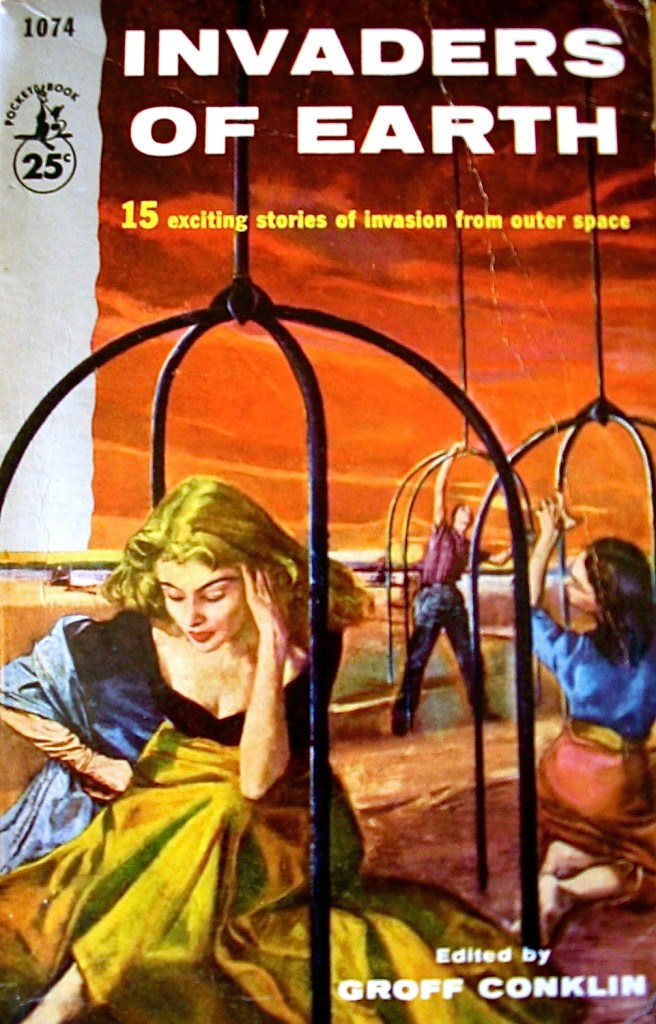
This 1950s paperback from my collection includes the script of the 1938 “War of the Worlds” broadcast.

With these ominous lines, read by Renaissance ham Orson Welles, opened what is now the best-remembered and most widely discussed of all US radio plays—Howard Koch’s adaptation of H. G. Wells’s “War of the Worlds” (30 October 1938).  Apart from this introduction, a slightly tweaked passage of Wells’s original narrative, the infamous Mercury Theater production took great liberties with its source.  It was an infidelity that proved most felicitous; for rarely has any story been transferred from one medium to another with greater ingenuity and with such sensational results.

Steven Spielberg’s cinematic update, which I experienced yesterday, pays homage to both Wells and Welles by quoting these words, by delivering them in a sonorous, Wellesian voice (Morgan Freeman’s), and by employing them as a literary bookend for an episodic melodrama that unfold as a series of more or less stupendous set pieces.  Freeman’s voice-over narration notwithstanding, Spielberg’s conventional sci-fi thriller—some kind of intergalactic Jurassic Park—has none of the qualities that made the radio play such an engaging and provocative experiment in adaptation.

Like all filmic reworkings, Spielberg’s spectacle struggles with and falters under the pressure of making terror visible, of equating the evocative with manifest dread.  The opening montage sums up the war to be fought by zooming in on the sources of threat and salvation, cosmos and microcosm.  Neither infinite outer space nor infinitesimal innerspace remains hidden from view.

The camera soon assumes the role of the terrorizing invader alluded to in Wells’s introductory remarks, as the menaced protagonists are being “watched closely,” “scrutinized and studied, perhaps almost as narrowly as a man with a microscope might scrutinize the transient creatures that swarm and multiply in a drop of water.”  As in our daily lives, captured by infiltrating webcams and ubiquitous close-circuit security equipment, vigilance and violence coincide; the act of surveillance has become the art of assailants.  And still, the demand for ocular proof has to be satisfied at all costs.

Throughout the movie, the hero’s daughter is cautioned not to look as camera and special effects expose the audience to the horrors of alien warfare and the consequences of human frailty.  In one scene, she is being blindfolded by her father in an attempt to shelter her from the murder he feels compelled to commit.  For one brief moment, the audience is spared a graphic scene.  As the crime is being perpetrated behind closed doors, a close-up of the girl’s face reveals that her mind’s eye creates an image no less terrifying than the atrocities she had witnessed before.  The father, like most western adults, has become too dependent on visuals to recall the power of suggestion and the thrills produced by the insinuating ear.  The movie thus manages to disclose his failings—and our sensorial loss—but cannot combat the empire of the eye to which it is beholden.

However futile, the radio artists of the 1930s and ‘40s were among the last dramatists to wage war against the dominion of the visual world.  Howard Koch’s adaptation proved to be one of the last victorious battles, dealing such a blow as to put censors on guard against the forgotten force of non-visual stimulation.  Then, “in the thirty-eighth year of the twentieth century came the great disillusionment. . . .”

Related writings

“Thousands Panic When Nelson Eddy Begins to Sing”
“‘War of the Worlds’: The Election Edition”