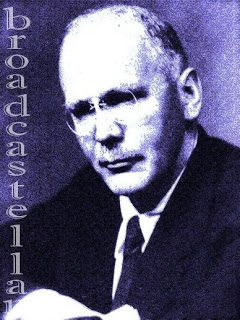
Forecasts in Hindsight: Wrongly Predicting the 1948 Presidential Election

As my motto ‘Keeping up with the out-of-date’ is meant to suggest, I tend to look toward the past; and yet, I resist retreat.  Retrospection is not retrogressive; nor need it be it a way of reverencing what is presumably lost or of gaining belated control over what back at a certain time of โ€˜thenโ€™ was the uncertainty of life in progress. I am interested in finding the ‘now’ โ€“ my ‘now’ โ€“ in the ‘then,’ or vice versa, and in wresting currency from recurrences.
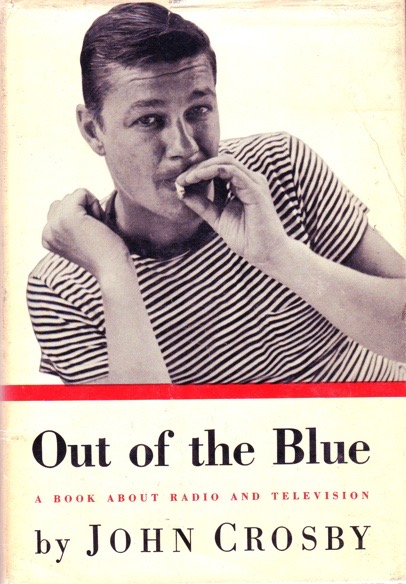
Many articles in Crosby’s column made it into this 1952 volume, which is on my bookshelf. The item discussed here did not.

I also tend to look at the ephemeral and everyday, the disposable objects or throwaway remarks we think or rather do not think of at all and dismiss as immaterial and obsolete, as too flimsy to carry any weight for any length of time.  Take an old syndicated newspaper column such as John Crosbyโ€™s โ€œRadio in Review,โ€ for instance.  Back in November 1948, Crosby, whose writing was generally concerned with programs and personalities then on the air, commented on a US presidential election that apparently no one, at least no one in the news media, had predicted accurately.  “Dewey Defeats Truman,” the headline of the Chicago Daily Tribune erroneously read on 3 November that year. Having listened to the words dispensed over the airwave on that day after โ€“ or, depending on your politics, in the aftermath of an election that paved the way for another term for President Harry S. Truman โ€“ Crosby noted:

โ€˜Perhaps never before have such handsome admissions of error reverb[e]rated from so many lips with such a degree of humility as they did on the air last week.โ€™  Truman had been in office since the death of Franklin D. Roosevelt in 1945; but in 1948, he had confirmation at last that the public โ€“ or the majority of those who made their views public and official โ€“ agreed that he belonged there.  As Crosby pointed out, even seasoned political commentators had predicted a Republican victory.

โ€˜[T]here probably never has been an election post-mortem in which the words โ€œI told you soโ€ were not heard at all,โ€™ the columnist remarked, adding that ‘if they were said, [he] didn’t hear them.โ€™  To his knowledge, โ€˜[n]o professional commentators โ€ฆ told anyone so.โ€™

Among those who, according to Crosby, got it more wrong than others was the ultra-conservative broadcaster Fulton Lewis Jr., an opportunist and influencer who, Crosby remarked, had gone โ€˜far beyondโ€™ his fellow commentators by predicting โ€˜Republican victories in states where most observers foresaw a seesaw battle.โ€™  

Speaking from the secular pulpit that was his radio program, Lewis โ€˜fully admitted his wrongnessโ€™ after the fact, Crosby noted, reading aloud the messages he received from listeners who โ€˜invited him to drop dead,โ€™ to โ€˜throw himselfโ€™ into Chesapeake Bay, or to โ€˜go soak his head in a vinegar barrel.โ€™ย ย Far from remorseful or self-deprecating, such revelling in controversy is representative of right-wing provocation as we experience it to this day.ย ย 

A question not posed by Crosby is whether future Barry Goldwater supporter Lewis simply got it wrong โ€“ or whether he predicted wrongly to demoralise Trumanโ€™s supporters by suggesting that a Republican landslide was a foregone conclusion. Given Lewis’s known bias, the miscalculation was obviously not calculated to rattle Truman supporters out of complacency. So, a question worth asking now not how commentators got it so wrong, but why.

Lowell Thomas, a conservative commentator courting an audience of both major parties, insisted that he had not predicted the election but that he had merely โ€˜passed along the opinions of others.โ€™  Thomas added, however, that, had he made a prediction, โ€˜heโ€™d have been as wrong as everyone else.โ€™  Unlike Lewis, this statement suggests, Thomas distinguished between reportage and commentary, the line between which was drawn no more clearly in 1948 broadcasting than it is in todayโ€™s mass media, discredited though they are as โ€˜legacyโ€™ and presumably obsolete by the social media weaponizing political right.

Reporter Elmer Davis who, also unlike Lewis, was critical of then on-the-rise Senator Joseph McCarthy, a Democrat who turned Republican and opposed the Truman presidency for being soft on Communism,  provided this statement to his listeners: โ€˜Any of us,โ€™ he said, โ€˜who analyze news on the radio or in the papers must hesitate to try to offer any explanation to a public which remembers too well the lucid and convicing explanations we all offered day before yesterday of why Dewey had it in the bag.โ€™  Commentators had โ€˜beatenโ€™ their โ€˜breastsโ€™ and โ€˜heaped ashesโ€™ on their heads since the election, Davis told his audience; but they still looked โ€˜pretty foolishโ€™ and should probably wait some time before sticking their โ€˜necksโ€™ out again.

โ€˜Cheer up, you losers,โ€™ veteran newscaster H. V. Kaltenborn declared on his radio program, โ€˜It isnโ€™t so bad as you think.โ€™  The peculiar mash-up of scoffing, commiserating, mind-reading and prognosticating did not escape Crosby, who wondered just what went on in the โ€˜mindโ€™ of someone who, more than having misjudged who lost, might himself have lost it.

The โ€˜explanations as to why President Truman won were almost as identical as the pre-election prediction that he wouldnโ€™t,โ€™ Crosby observed, namely that the nation โ€˜liked an underdog.โ€™  Just how much of an โ€˜underdogโ€™ can a presidential incumbent be? Playing one on TV would prove a winning formula for Donald Trump, at least, and the kind of doghouse he managed to furnish for himself, which is so unlike the residence some of us envision as rightfully his, provides support of that theory.

Summing up the state of desperation among commentators, Crosby stated that โ€˜manyโ€™ of them derived rather โ€˜odd comfortโ€™ from the fact that US ally turned adversary Josef Stalin, who likewise incorrectly predicted a win for Republican candidate Thomas E. Dewey, โ€˜had been just as wrong as they were.โ€™

Sure, there is momentary relief inย Schadenfreude, seeing those who got it wrong having to admit โ€“ or trying to avoid admitting โ€“ the fact that, in hindsight, they were demonstrably wrong, and, being wrong, on the wrong side of the future.ย ย And yet, getting it wrong may also be evidence of wrongdoing, of deceit and deviousness.ย ย As someone relegated to the sidelines, I can offer only one reasonable piece of advice to those who prefer a Truman over a Trump: pay attention to but do not trust folks who are determined to convince you that your vote does not matter much by declaring the game to be over when it is still afoot.
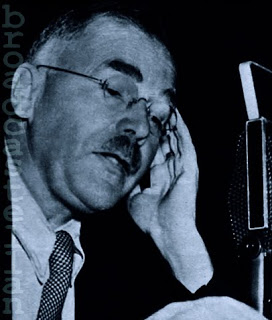
โ€œMore Easily,โ€ My Eye; or, Kaltenborn and the Dragon

โ€œEducation comes more easily through the ear than through the eye,โ€ H. V. Kaltenborn declared back in 1926. He had to believe that, or needed to convince others of it, at least. After all, the newspaper editor had embarked on a new career that was entirely dependent on the publicโ€™s ability to listen and learn when he, as early as 1921, first stepped behind a microphone to throw his disembodied voice onto the airwaves, eventually to become Americaโ€™s foremost radio commentator. Writing about โ€œRadioโ€™s Responsibility as a Molder of Public Opinion,โ€ Kaltenborn argued education to be the mediumโ€™s โ€œgreatest opportunity.โ€ And even though the opportunity seized most eagerly was advertising, some sixty American colleges and universities were broadcasting educational programs during those early, pre-network days of the โ€œFifth Estate.โ€

Kaltenborn reasoned that education by radio was superior to traditional correspondence courses since the aural medium could make up for the โ€œimperfect contact between student and teacherโ€ through โ€œthe appeal of voice and personality.โ€ Among the subjects particular suited to radio he numbered โ€œliterature, oral English, foreign languages, history, and music,โ€ but added that any class not requiring special โ€œapparatus or laboratory work [could] be taught on the air.โ€

Not that a polyglot like H(ans) V(on), whose father was born in Germany, had any use for such on-air instructions, but a number of local stations (KFAB, Nebraska, and WMBQ, Brooklyn, among them) broadcast introductory courses in German during the early to mid-1930s. According to Waldo Abbot, who, in the 1930s, directed the University of Michiganโ€™s educational broadcasts heard over WJR, Detroit, nearly four hundred stations in the US accepted foreign language programs, many of which were geared toward non-English communities, be they German, Albanian or Mesquakie. In 1942, as Variety radio editor Robert Landry pointed out, some two hundred local stations in the US were broadcasting in thirty languages other than English, at which time in history the efficacy of services in the public interest was being hotly debated.

Growing up in West Germany, I frequently tuned in to the English language Broadcasting Service of the British Forces (BFBS) and, lying in bed at night, twisted the dial in search of faraway international stations. Yet as much as the chatter of different, distant voices intrigued me, I was not so much enlightened as I was enchanted; and rather than translating what I heard, I was transported by it. I may have had an ear for language, but whatever came my way by way of the airwaves back then was mostly in one ear and out of the other.

Even when language poses no barrier to understanding, I do not assimilate spoken utterances as readily as written words. I was raised in the age of television and, to some degree, by that medium. So insurmountable was the visual bias that I have never been able entirely to rely on my ear when it comes to taking even the simplest instructions. I discovered early on, for instance, that it was difficult for me to write down a number taken from dictation; to this day, I struggle to piece together words that are being spelled out for me. My chirographic transcriptions of speech are often incomplete or frustratingly inaccurate.

Yes, I have long been keenly aware of the pigโ€™s ear that nature made of my senses. I learned that those cartilaginous funnels couldnโ€™t be relied upon to make, let alone fill, a purse, silken or otherwise. My head being thoroughly porcine, I nonetheless chose radio as the subject for my doctoral studyโ€”if only to give my eyes an earful.

If only education came โ€œmore easilyโ€ to me โ€œthrough the ear than through the eye,โ€ now that I am once again putting my ear for language to the test. Iโ€™ve been living in Wales for over five years now, but, insofar as I had occasion to mingle with the locals, I have communicated exclusively in English. Contrary to a travel guide one of my German friends showed me upon visiting, Welsh is by no means a language in extremis, even if its rejuvenescence is largely owing to the resuscitative measures of nationalist politics. Taking our recent move from a remote cottage in the country to a house in town as an incentive, I decided to grab the red dragon by its forked tongue at last. I started taking classes. โ€œDwi โ€˜n dysgu Cymraeg.โ€

To augment my weekly lessons, I am listening to recordings of the BBCโ€™s Catchphrase program, a late-20th-century radio series designed to introduce English speakers to the Welsh language. While it is a comfort to me that fleeting speech is reproducible at the touch of a button or key, I am still finding it difficult to take in and recall what I am hearing, particularly as I am being asked to learn โ€œparrot fashion,โ€ to play and replay by ear without being given a table or chart that would allow me to discern a grammatical pattern. Much of what I have heard still sounds to me what the Germans call Kauderwelschโ€”or plain gibberish.

Though I am not quite licked yet, the Welsh ddraig keeps sticking out its tongue to make a mockery of my efforts. Itโ€™s no use slaying it by ear. I simply wasnโ€™t bornโ€”nor am I Kaltenbornโ€”to do it.


Related writings
โ€œโ€˜. . . from hell to breakfastโ€™: H. V. Kaltenborn Reportingโ€
โ€œโ€˜Alone Togetherโ€™: A Portrait of the Artist as an Artistโ€™s Spouseโ€

” … from hell to breakfast”: H. V. Kaltenborn Reporting

Listening selectively to US broadcast recordings of the 1930s, โ€˜40s, and โ€˜50sโ€”the period often referred to as the radioโ€™s golden ageโ€”I often neglect the kind of program that, during the late 1930s was fast gaining in significance as millions of Americans, many of whom were immigrants from Europe and Russia, were following reports from the Old World they had left. On this day, 22 September, in 1939, news commentator H. V. Kaltenborn kept CBS listeners abreast of the situation in Europe, paying special attention to the politically unstable kingdom of Romania.

As I learned yesterday, reading My Eyes Are in My Heart by aforementioned radio announcer Ted Husing, the King and Queen of Romania were savvy people not averse to selling out or forging lucrative alliances. On a tour of the United States back in 1926, Queen Maria of Romania, made a splash in the advertising world, agreeing to appear on radio, promote products, and be seen shopping in certain stores, all for the right sum of money.

Romania had one particularly valuable commodity, and the country, still neutral in the fall of 1939 was keen on keeping good relations with the nation that was about to swallow the continent. On 21 September, premier Armand Cฤƒlinescu was assassinated by Romaniaโ€™s fascist Iron Guard and Gheorghe ArgeลŸanu, former Minister of War, was named as his successor. Here is how Kaltenborn (whose German title would have been Baron von Kaltenborn-Stachau, had he not been born and raised in Wisconsin) described the situation to American listeners:

That means that they are going to have a military government, as strong a government as King Carol [II] could possibly create, and it needs to be strong in view of the situation faced by imperiled Romania. Russian armies are menacing from the north. ย German armies are menacing from the west.

While Russia was anxious to regain territory lost to Romania after Germany needed Romanian oil, Kaltenborn explained; and in trying not to offend either giant, Romania was on the brink of becoming another Poland.

Speaking rapidly and with animation, Kaltenborn occasionally stumbled in his commentary; he generally used notes rather than a prepared script, a technique that lent urgency to his reportage.

By 1939, he was a veteran, his beginnings in broadcasting dating back to 1922 (as you will learn listening to this Recollections tribute from 3 April 1957). As early as 1926, he had remarked upon โ€œRadioโ€™s Responsibility as a Molder of Public Opinion,โ€ upon radioโ€™s role as the Fifth Estate. โ€œPublic opinion is the king of America, and radio must assume a more conscious responsibility as democracyโ€™s kingmaker,โ€ he had cautioned.

World War II had only just begun; but news analysts like Kaltenborn were preparing the ignorant, the indifferent, and the isolationists for the inevitable, however tentative and cautious they were in their warnings:

I spent a good part of yesterday in Washington, I interviewed members of the Cabinet, outstanding leaders of the Senate, some of the most outspoken leaders of the opposition to lifting the embargo [against sending military aid to European countries facing threats from Germany and Russia, an embargo maintained as part the US Neutrality Act that FDR had urged Congress to repeal on 21 September], and got a picture of the atmosphere of Washington. ย There is general apprehension in Washington that somehow, in some way, in spite of our not wanting it, that the country may be pushed towards war.

“Let those who seek to retain the present embargo position,” Kaltenborn insisted,

be wholly consistent and seek new legislation to cut off cloth and copper and meat and wheat and a thousand other articles from all the nations at war. ย I seek a greater consistency through the repeal of the embargo provisions and a return to international law.

Kaltenborn then read a bulletin from the United Press, which stated that the isolationists in the Senate intended to fight the President on the embargo repeal “from hell to breakfast.”

Recordings of broadcast news and commentaries like this (which you may find in this invaluable Old Time Radio Researchers Group compilation), bring to life a time of fear and uncertainty without an awareness of which classic radio plays like “The War of the Worlds” cannot be fully understood.