“Nance” Encounter: Herman Wouk’s Don’t Stop the Carnival (1965) as a Bad Date

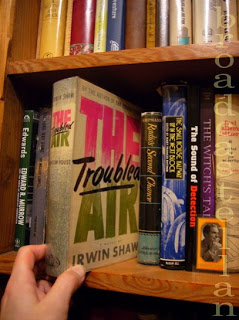
This curated window at the Oxfam Bookstore, Aberystwyth, drew me in.

The themed window of our local Oxfam bookshop here in Aberystwyth was something to behold on that bright July afternoon.  A row of handsome, second-hand but well-preserved copies of once popular fiction beckoned, reminding me of the tag I had chosen for this blog devoted to unpopular culture upon its inception back in 2005: “Keeping up with the out-of-date.”

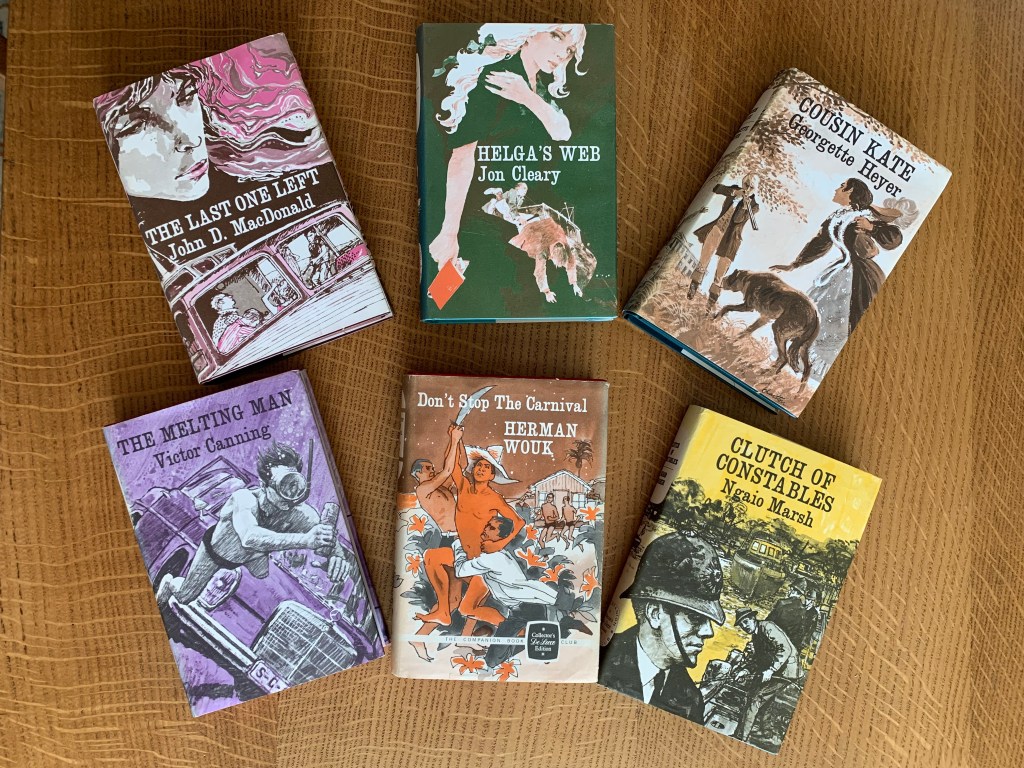
A novelist friend and avid reader, who had come from London for a visit, treated me to a volume of my choice.  Three of them, in fact, as the £5-for-three deal made it unnecessary to be quite so discriminating.  I passed up on erstwhile bestsellers by A. J. Cronin and Pearl S. Buck, both of whom had vanished from the display a day later, when I returned for another three titles (all six are pictured above).  My first choice, however, had been Herman Wouk’s Don’t Stop the Carnival (1965).

I remember picking up Wouk’s tome Youngblood Hawke (1962), in a German translation, from my parent’s sparse bookshelves.  My grandfather, likewise, was a Wouk reader, even though his chief interest lay in the writer’s Second World War subjects, to which Opa Heinrich, a former POW, could relate.  In my late teens, desultory though my readings were, I enjoyed Wouk’s earlier City Boy (1948) and Marjorie Morningstar (1955).
Volumes I recent additions to my bookshelf

My next encounter with Wouk’s writings dates from my years of graduate studies in New York.  I had decided to ditch Thomas Carlyle as a subject and instead write a PhD study on US radio plays.  Wouk, as I discussed here previously, had started as a radio writer or gagman.  He satirized the industry in Aurora Dawn (1947) and reflected on his experience it in his autobiographical novel Inside, Outside (1985).  From the latter I snatched the phrases “Hawkers of feces? Costermongers of shit?” – a reference to laxative commercials on the air – for the title of one of the chapters of Immaterial Culture to capture the dismissal of commercial radio as a legitimate literary forum by those who had written for broadcasting during the 1930s and 1940s but who gained prominence later as published writers and dramatists.

Long story short, I have a kind of casual relationship with Wouk as a writer, a relationship that at one point turned serious (or academic) due to my interest in radio.  So, when I spotted that copy of Don’t Stop the Carnival, an old book new to me, I felt inclined to get reacquainted.  It turned out to be a bad date.

Don’t Stop the Carnival is a story of middle age.  The action, of which there is plenty, is mainly set on an imaginary island in the Caribbean, anno 1959.  The novel relates the misadventures of a New Yorker – Norman Paperman – who falls in love with what strikes him as a tropical paradise and decides to take over a hotel, having had no prior experience either with the business or with life on a tropical island.  Complications abound, some less comical than others.

Paperman is a Mr. Blandings of sorts, a familiar figure in American fiction.  He’d rather lay an egg elsewhere than suffer his ‘disenchantment with Manhattan’ a day longer:

the climbing prices, the increasing crowds and dirt, the gloomy weather, the slow bad transportation, the growing hoodlumism, the political corruption, the mushrooming of office buildings that were rectilinear atrocities of glass, the hideous jams in the few good restaurants, the collapse of decent service even in the luxury hotels, the extortionist prices of tickets to hit shows and the staleness of those hits, and the unutterably narrow weary repetitiousness of the New York life in general, and above all the life of a minor parasite like a press agent.

Perhaps, as his name suggests, Norman is not to be looked at as man but as a page – scribbled on, rather than blank, over the course of nearly fifty years.  He may feel like turning over a new leaf – but his life is already scripted in ink that is indelible.  Don’t Stop the Carnival sets us up for its conservative moral: stick with what you know, stop kvetching, and don’t even think that the grass could be greener than in Central Park in May.

While it responds to the modernity of its day – to the threat of nuclear war and the growing doubt in the progress narrative of the 1950s – the novel nonetheless shelters in the makeshift of retrospection: it looks back at the end of the Eisenhower years from the vantage point of the violent end of the Kennedy presidency to reflect on the so-called modern liberalism of the early to mid-1960s.  

Was this choice of dating the action meant to suggest the datedness of the views expressed by the characters? What were the attitudes of the author toward race relations, civil rights and liberalism? In other words, what comments on the turmoil of the 1960s did Wouk make – or avoid making – by transporting back the readers of his day and dropping them off on an island that, for all its remoteness is nonetheless US territory, and that is about to be developed and exploited for its exoticism and natural resources?

The titular carnival is both figurative and metaphoric – an extended topsy-turvydom (or chaos) in which black mix and mate with white, queer live along straight folks, and Jews like Wouk’s protagonist Norman Paperman mingle with Catholics, Protestants, agnostics, pagans and atheists.  He encounters bad infrastructure, worse bureaucracy, and political corruption.  This island ain’t that different from Manhattan – which argues getting away from his former life to be futile and pointless.

The Carnival is not only shown to be a dead end but a deadly one.  In the final pages of the novel, two characters are killed in quick succession – one central to the narrative, the other – the decidedly other – being marginal.  The central one is Norman’s island fling, Iris Tramm, whom he knew as a celebrated actress two decades earlier and is surprised or reencounter, washed up but still alluring, as one of the guests in the hotel he decides to buy.  

The island carnival is exposed as a tropical fever that means either death or cure – a cure for an uncommon warmth of non-traditional bonds and realized desires.  Paperman recovers, and his understanding wife takes him “home.”  His lover, meanwhile, must first lose the companionship of her dog, and then, trashing Paperman’s car while trying to reunite with her wounded pet at a veterinarian’s, her life.  Was this the only out Wouk could conceive for a white woman who was the mistress of a black official who dared not to marry her?

It is the treatment of the marginal character of Hassim and his swift, unceremonious and unlamented disposal that lays bare Wouk’s fear of change: the antique dealer Hassim, introduced as a “rotund bald man” with a “bottom swaying like a woman’s,” who openly flirts with young men.  In fact, the island is awash with middle-class homosexuals of all ages.  Even Paperman’s hotel is pre-owned by a gay couple. And although he must have come across some of them in his former job as a Broadway press agent, Paperman is uneasy in their presence when he and Iris, his illicit love, visit an establishment frequented by gays:

Norman found the proprietor amusing, and he was enjoying the songs of his youth. But the Casa Encantada made him uneasy. Men were flirting with each other all around him; some were cuddling like teen-agers in a movie balcony. The boy in the pink shirt, biting his nails and constantly looking around in a scared way, sat at a small table with one of the rich pederasts from Signal Mountain, a pipe-smoking gray-haired man in tailored olive shirt and shorts, with young tan features carved by plastic surgery, and false teeth. Norman was glad when the proprietor finished a run of Noel Coward songs and left the piano, so that he and Iris could politely get out of the place.

Hassim is shot dead by a policeman, despite posing no risk and committing no crimes.  The killing, which occurs in Paperman’s hotel and bar, the Gull Reef, is described in few words and elicits less of a response than the stabbing of a dog a few pages before this incident near the close of the novel.

“As a matter of fact, […] I feel sorry for the poor bugger,” is the response to the death of  Hassim by one character, “munching on his thick-piled hamburger” not long after the killing.

“I’ve known thousands of those guys, and there’s no harm in ninety-nine out of a hundred of them. It’s just a sickness and it’s their own business.  Though gosh knows, when I was a kid working backstage, I sure got some surprises.  Yes ma’am, it was dam near worth my life to bend over and tie my shoelace, I tell you.” He laughed salaciously.  His once green face was burning to an odd bronze color like an American Indian’s, and he looked very relaxed and happy.  “Actually, Henny [who is Paperman’s wife], I almost hate to say this, but I think this thing’s going to prove a break for the Club.  I bet the nances stop coming to Gull Reef after this.”

Such views are unchallenged by the narrator and the main character, who decides to sell his business – to the man expressing those views, no less – and return to New York.  “People thought that this [his death] was a bit hard on Hassim,” the narrator sums, “but that the cop after all had only been doing his duty, and that one queer the less in the world was no grievous loss.”  Case closed. Business open as usual.

Clearly, queers like me were not considered by Wouk to be among his readers.  Targets, yes, but not target audiences.  Even the academic treatment of homosexuality – the suggestion that famous writers of the past, too, might have been homosexuals – is ridiculed in the novel, with one PhD student, the lover of Paperman’s teenage daughter, nearly drowning in the sea.  

Wouk, who died shortly before his 104th birthday in May 2019, lived beyond the middle age of Don’t Stop the Carnival for more than half a century.  I doubt that I shall make him a companion again on whatever is left of my journey.

“. . . that same young man in that same brown suit”: A "Jackass" Takes a Bow

For the life of me, I can’t turn a phrase. At least, not at a speed that would encourage anyone to keep up with me. I can’t seem to cut a line short enough to make it worthwhile anyone’s time or spin it fast enough to lasso in the crowds. By the time I’m done editing myself, everyone else has left the spot I failed to hit. As a matter of fact, I am still editing what you are reading now. I would have failed miserably in the days when radio demanded rapid-fire gags at a rate that prematurely aged funnymen like Lou Holtz, who had drawers full of them, and wrecked the nerves of his assistants (among them, the young Herman Wouk, aformentioned). “Take all the words in all the full-length pictures produced in Hollywood in a year,” Erik Barnouw calculated in 1939, “and you do not have enough words to keep radio in the United States going for twenty-four hours.”

Comedians and the largely anonymous writers who fed them their lines sure had to work fast; yet, energy aside, they also needed stamina to sustain an act through the seasons. Sure, you can get almost anyone to “Wanna buy a duck”; but to make it something other than a lame one and not to end up with egg on your face after a few weeks, let alone decades, requires some convincing.

That said, quite a number of comedians, most of them seasoned vaudevillians, enjoyed a long career on the air, a durability that, with a few exceptions, is foreign to today’s short-attention-spanned YouTubeans whose mental databases have been outsourced and replaced by all sorts of gadgetry (or re-call centers) designed to make us forget anything other than to heed those reminders of how to pay dearly, if conveniently, for our carefully nurtured deficiencies. Their mental faculties scattered along the hard drive, future generations may well be on too short a term with the world even to get a running gag. (As I was saying, my syntax just wouldn’t do for broadcasting.)

Celebrating his seventh year on the air, on this day, 30 April, in 1939, was Jack Benny, that perennial middle-age dodger from Waukegan. “Exactly seven years ago today a young man walked into a small New York broadcasting studio and spoke into a microphone for the first time,” announcer Don Wilson (pictured, above, to the right of comedian Jerry Colonna) told those tuning in to the Jell-O Program. There he stood, “that same young man in that same brown suit,” still shaking before every broadcast. “And that’s what worries me,” Benny confessed, “Now I shake and I’m not nervous.”

From the opening tune, “Man About Town”—the title of Benny’s latest film—the broadcast was to be a half-hour of . . . depreciation, an invitation for Benny’s writers to go to town at the man’s expense. That, in shorthand, is the Benny formula, an instantly recognizable persona that contemporary critics Jack Gaver and Dave Stanley termed the “whipping boy of the airwaves.” Benny’s first words on the air (uttered on 2 May rather than 30 April 1930) already signalled the fashion, but it also reminds us how successfully “that same young man in that same brown suit” retailored his act over the years:

Ladies and gentlemen, this is Jack Benny talking, and making my first appearance on the air professionally.  By that I mean I’m finally getting paid, which of course will be a great relief to my creditors.  I, uh, I think you don’t know why I’m here.  I’m supposed to be a sort of a master of ceremonies and tell you all the things will happen, which would happen anyway.  I must introduce the different artists who could easily introduce themselves, and also talk about the Canada Dry made-to-order by the glass, which is a waste of time as you know all about it.  You drink it, like it, and don’t want to hear about it.  So, ladies and gentlemen, a master of ceremonies is really a fellow who is unemployed and gets paid for it.

Gradually, such self-consciousness would become tempered with no uncertain vaingloriousness, and Benny (and his writers) left it to fellow cast members and rival comedians to make the fall guy trip. On the seventh anniversary program, even Fred Allen sent a wire, which Mary Livingstone somewhat less than dutifully read to Benny:

Livingstone.  Dear Jackass.

Benny.  Gimme that wire.  Mmm.  That’s “Dear Jack. As this is your seventh anniversary . . .”

The joke, however slight when quoted out of context, depends for its punch on a listener’s familiarity with the Benny-Allen feud. Audiences expected an acerbic note from a rival—but to be hearing it from those who worked with Benny, and on the occasion of his taking a bow to boot, gave the line a certain kick, one that was always directed at Benny’s posterior and conveniently administered by those nearest to him. Jackass? Benny was a regular piñata. The more direct the hit, the more likely the chances of hitting the jack(ass)pot.

Meanwhile, the anniversary of that celebratory broadcast is past . . . and I am still editing.

"A two-headed Zulu could do it": Irwin Shaw and the Radio

This being the birthday of novelist Irwin Shaw (1913-1984), I dusted off my copy of The Troubled Air (1951) to pay tribute to a radio writer who successfully channelled his anger and frustration by feeding it to the press, a rival medium that was only too pleased to get the dirt on broadcasting. Like his previously mentioned short story “Main Currents of American Thought,” published in 1939, The Troubled Air is a blistering commentary on the business to which Shaw was introduced by radio writer-producer Himan Brown, for whom he penned the aural comic strip The Gumps. For details on the novelist’s experience in radio, I refer you to Michael Shnayerson’s insightful 1989 biography; here, I am drawing on a few passages of The Troubled Air to document a hack-turned-published author’s urge to let off steam at a time (the McCarthy era) when the old radio mill seemed on the verge of blowing up.

Clement Archer, a former history teacher with hopes of becoming a playwright, enters radio after being persuaded by one of his students that a “ two-headed Zulu could do it. As long as you can type fast enough, you have nothing to worry about.” Archer has his doubts:

“My natural prose style,” he [tells his student], “is something of a cross between Macaulay and the editorial page of the New York Times, and my idea of how people should behave in fiction comes mostly from James Joyce and Proust. And I never had Bright’s disease and I never tried to seduce a twenty-year-old immigrant, and I actually believe that the innocent always suffer and the evil always prosper in real life. So I can’t say I feel boyishly confident about my equipment on a Monday morning when I sit down and know I have to write five fifteen-minute heart-breaking episodes before Friday. I have a lovely idea for next week. Little Catherine (the name of the program was Young Catherine Jorgenson, Visitor from Abroad) is going to California and she’s going to get caught in an earthquake and be arrested for looting when she goes into a burning building to rescue an old miser in a wheelchair. Ought to be good for ten programs, what with the arrest, the examination by the police, the meeting with the cynical newspaper reporter who is reformed by her, and the trial.

In fact, life in radio’s fiction factory turns out to be “murderously hard work.” After years of it, Archer gets a break at last when he becomes the producer-director of University Town, a series of anthology drama under the sponsorship of a drug company. When his actors and musicians are accused of Communist affiliations by Blueprint, a “belligerent” and “mysteriously” financed magazine “dedicated to exposing radical activities in the radio and movie industries,” the advertising agency in charge of the program gives Archer two weeks to find out from the five people involved—a Jewish immigrant composer, an aging actress, a gorgeous ingénue, a black comedian, as well as Archer’s best friend and former student—whether the accusations are false.

When asked by Archer why drastic measures such as the firing of his composer were deemed necessary, the agency representatives responds by arguing that radio

is not at the moment in a strong position. In fact, it is not putting it too vigorously to say that the medium is fighting for its life. A new form of entertainment, television, is gaining enormous momentum, capturing our clients and our audience; the economic situation of the country is uncertain and advertisers are retrenching everywhere—the old days when we could do anything and get away with every—are gone, perhaps forever.

Being supportive of his creative team, Archer is denounced as a Red sympathizer, even though the communists denounce him equally. His phone is tapped, his career is finished, his marriage in turmoil and a friendship exposed as a fraud.

Shaw was hardly alone in denouncing the industry in which he had worked; but, unlike former gag writer Herman Wouk (from whose satire Aurora Dawn I quoted here), he could not bring himself to make light of the experience.

Taking Them by Storm

Well, how is this for an odd piece of cross-promotion: Linda Darnell selling face powder and a Hurricane picture. Did they really release Slattery’s Hurricane at the height of the season known for the weather phenomenon from which the film takes its title (no, not Slattery, silly)? According to the Internet Movie Database, the movie starring radio actor turned big screen tough guy Richard Widmark was indeed blowing into theaters during the month of August, back in 1949. Perhaps, these days that would be considered bad timing, a move to bring on a storm of protest for its lack of sensitivity. Besides, you try keeping your powder dry during a torrential downpour.

The pictured advertisement, featuring the alluring Ms. Darnell (who had earlier starred in Summer Storm), can be found in the August 1949 issue of Radio and Television Weekly, through the tattered pages of which I am currently leafing. Now, I have not seen the motion picture, which was radio-readied for Lux (rather than Woodbury) on 6 March 1950, with Maureen O’Hara in the Darnell part. Never mind that now. More interesting to me is that Slattery’s Hurricane was written by none other than Herman Wouk, the aforementioned radio writer whose first novel, Aurora Dawn (1946), was a satire of the advertising game and commercial broadcasting in America:

Aurora Dawn! 

[. . .] was the name of a soap; a pink, pleasant-smelling article distributed throughout the land and modestly advertised as the “fastest-selling” soap in America. Whether this meant that sales were transacted more rapidly with Aurora Dawn soap than with any other, the customer snatching it out of the druggist’s hand with impolite haste, flinging down a coin and dashing from the store, or whether the slogan was trying to say that its sales were increasing more quickly than the sales of any other cleansing bar; this is not known. Advertising has restored an Elizabethan elasticity to our drying English prose, often sacrificing explicitness for rich color. 

[The hero’s] purpose was [ . . .] to make the fastest-selling soap sell even faster. [He, one Andrew Reale,] was [. . .] employed [. . .] by the Republic Broadcasting Company, a vast free enterprise rivaled only by the United States Broadcasting System, another private property. These two huge corporations monopolized the radio facilities of the land in a state of healthy competition with each other, and drew their lifeblood from rich advertising fees which assured the public an uninterrupted flow of entertainment by the highest priced comedians, jazz singers, musicians, news analysts, and vaudeville novelties in the land—a gratifying contrast to the dreary round of classical music and educational programs which gave government-owned radio chains such a dowdy reputation in other countries.

Meanwhile, no cross-promotion could save Arctic Manhunt (1949) from obscurity. Announced in the same issue of Radio and Television Mirror, it was meant to convince both the “man-hunting brunette” and the “girl whose man needs—a little encouragement” that lipstick was indispensable to the survival of the species. As yet, no five people of either sex could be found who saw and care to cast their vote for Arctic Manhunt on the Internet Movie Database. Whether or not the advertised product “lasts—and LASTS and L-A-S-T-S,” especially under the conditions endured in the forecast melodrama, I am in no position to say; but memories of those promised “pulse-quickening” scenes certainly faded fast. It takes more than corporate windbags to take them by storm.

On This Day in 1947: Fred Allen Drops a Name

Well, it has been over five months now since I launched broadcastellan and began to broadcast my assorted musings to a potentially vast if largely abstract public. I am still doing what I set out to do, which is to dig up discarded pieces of western popular culture and return what has been drowned in or washed away by the busy mainstream of commerce to the multitude that owns and defines the popular.

The first principle of popularity, after all, is presence; and even though universal accessibility alone is no guarantor of prominence (a fact to which my humble efforts are mute testimony), there’s nothing like a blog to keep alive what might otherwise rot in some cranial nook or linger in the obscurity of a private library.

My awareness of the promotional opportunities within the web notwithstanding, I have had to learn—and am learning still—that a blog is not merely a medium but a mode of communicating, a way of writing and sharing that has qualities distinct from other forms of publishing and follows different sets of conventions. So, like radio comedian Fred Allen, I would like to acknowledge a few of the individuals who have influenced the evolution of broadcastellan.

Where does Fred Allen fit into all this? Not that I need any particular reason or pretext to drop his name. Namedropping! That’s it. On this day, October 26, in 1947, Allen mentioned one of his former writers, one of those nameless if rather well remunerated gagmen of radio. That man was novelist Herman Wouk, who had just given up writing for Allen.

With his first novel in print (a Book-of-the-Month Club recommendation, no less), Wouk was ready to announce his retirement from broadcasting. He did just that in an article that appeared in the November issue of the magazine ’47, as Allen and partner Portland Hoffa told their audience in their joke routine at the beginning of the Fred Allen Show.

When I heard this remark, I went in search of the article, found it, and found it quite interesting, too. This is what bloggers do, I realized at last. They not only post and recycle material, but share and comment by linking and tagging, by renting their blogs and surfing for credits, thereby contributing to the dissemination of thought while all along promoting themselves and others. Like today’s blogger, the pioneers of radio had to learn that the medium is not just a distribution apparatus but a distributive art.

So, I am no longer posting a series of essays. I have begun to open up the discourse, to make my blog more interactive. I no longer hide behind “The Magnificent Montague,” and, having quietly dropped my nominal cloak now feel at ease writing and mingling in the forum without donning such disguises. I am more comfortable now leaving comments on other sites, always, I hope in the spirit of sharing rather than blatant self-promotion.

I have edited my writing after receiving comments from Jim Widner, the host of Radio Days, for instance. I have added a reader poll (an idea I got from Brent McKee’s site) and have made attempts to encourage participation (something I noticed being done with some success by Cavan Terrill). Like Gertrude Stein, “I am writing for myself and strangers.” I am also writing with strangers and am being rewritten by them.

So, the initial confusion about blogging is pretty much gone and I continue this interactivity with greater confidence and considerable joy. Say, how interactive are you?