
“There [still] ain’t no sense to nothin’”: A Wayward Text Comes Home

“Home at last,” I could almost hear myself sigh as, out of the narrow slit in our front door, I yanked the packet arriving today.  Bearing my name, as few pieces of mail of any consequence or sustenance do nowadays, it contained the volume Audionarratology: Lessons from Radio Drama, to which I had been invited a few years ago to contribute a chapter.  The book was published in July 2021 by Ohio State University, a press renowned for its contribution to the evolving discourse on narratology.  
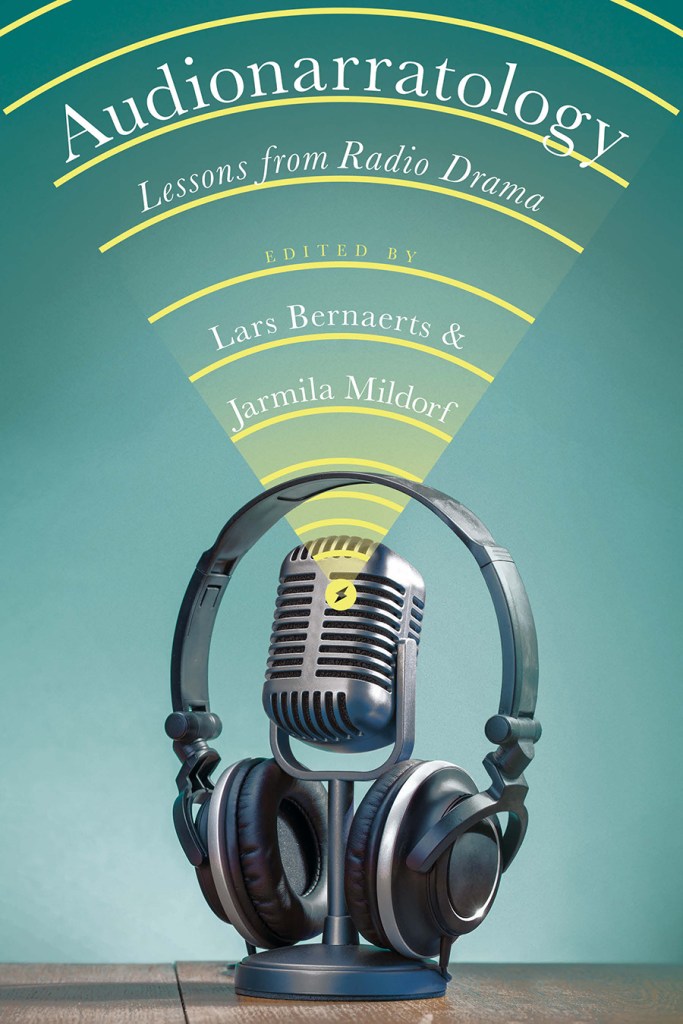
The titular neologism suggests that an engagement with aural storytelling is proposed as one way of broadening a field that has enriched the interpretation not only of literature but also of visual culture.  Whether such aural storytelling should be subsumed under the rubric ‘radio drama’ is something I debated in my study Immaterial Culture, for which I settled on the term ‘radio play,’ as, I argued, the fictions written for radio production and transmission are hybrids whose potentialities remained underexplored and whose contribution to the arts underappreciated in part due to the alignment of such plays with works for stage and screen.  Nor am I sure that, by adding the prefix, “audionarratology” will be regarded as a subgroup of narratology – which would defeat the purpose of broadening said field.

To the question what “Lessons” may be learned from plays for radio, or from our playing with them, the quotation that serves as title of my essay provides a serviceable response: “There ain’t no sense to nothin.”  The line is uttered by one of the characters in I Love a Mystery, the thriller serial I discuss – and it is expressive of the bewilderment I felt when first I entered the world created in the 1930s and 1940s by the US American playwright-producer Carlton E. Morse.  My cumbersome subtitle is meant to suggest how I responded to the task of making sense not only of the play but also of the field in which I was asked to position it: “Serial Storytelling, Radio-Consciousness and the Gothic of Audition.”

By labelling ‘gothic’ not simply the play but my experience of it, I aim to bring to academic discourse my feeling of unease, a sense of misgivings about explaining away what drew me in to begin with, the lack of vocabulary with which adequately to describe my experience of listening, the anxiety of having to theorise within the uncertain boundaries of a discourse that I sought to broaden instead of delimiting.

Throughout my experience with radio plays of the so-called golden age, I felt that, playing recording or streaming play, I had to audition belatedly for a position of listener but that I could never hear the plays as they were intended to be taken in – serially, via radio – during those days before the supremacy of television, the medium that shaped my childhood.

In the essay, I try to communicate what it feels like not knowing – not knowing the solution to a mystery, not quite knowing my place vis-à-vis the culture in which the play was produced or the research culture in which thriller programs such as I Love a Mystery are subjected to some theory and much neglect.  Instead of analysing a play, I ended up examining myself as a queer, English-as-second-language listener estranged from radio and alien to the everyday of my grandparent’s generation – never mind that my German grandfather fought on the Axis side while the US home front stayed tuned to news from the frontlines as much as it tuned in to thrillers and comedies that were hardly considered worthy of being paraded as the so-called forefront of modernism.  So, a measure of guilt enters into the mix of emotions with which I struggle to approach or sell such cultural products academically.

The resulting chapter is proposed as a muddle, not as a model – although its self-consciousness may be an encouragement to some who are struggling to straddle the line between their searching, uncertain selves and the construct of a scholarly identity.  Its failings and idiosyncrasies are no strategic efforts to fit in by playing the misfit or refitting the scene – they are proposed as candid reflection of my mystification.  

They also bespeak the fact that the essay, unfinished or not fully realised though it may seem, was a quarter century in the making.  It started out by twisting the dial of my stereo receiver and happening on Max Schmid’s ear-opening program The Golden Age of Radio on WBAI, New York, agonising whether to turn my newly discovered hobby into the subject of academic study, enrolling in David H. Richter’s course “The Rise of the Gothic” at CUNY, and by responding to the essay brief by exploring gothic radio plays and radio adaptations of Gothic literature.

Once I had decided to abandon my Victorian studies in favor of old-time radio, the essay was revised to become a chapter of my PhD study Etherized Victorians.  It was revisited but removed from Immaterial Culture as an outlier – the only longer reading of a play not based on a published script – during the process of negotiating the space allotted by the publisher.  It had a lingering if non-too-visible presence on my online journal broadcastellan as an experiment in interactive blogging, and it now appears in a volume devoted to a subject of which I had no concept when I started out all those years ago.

The draft, too, has gone through a long process of negotiation — of editing, cutting and rewriting – at some point of which the frankness of declaring myself to be among the “outsiders” of the discourse did not make the editors’ cut.

So, home the essay has come; but the home has changed, as has its dweller, a student of literature who transmogrified into an art historian with a sideline of aurality, and who now has to contend with tinnitus and hearing loss when listening out for clues to non-visual mysteries and, ever self-conscious, waits for his cue to account for the latest of his botches, or, worse still, to be met with silence.  Estrangement, uncertainty, and the misery of having to account for the state of being mesmerised by mysteries unsolved – such is the gothic of audition.

The Next Voice You Hear; or, Blogging Away

The next voice you hear will still be mine; but it will come to you from the metropolis. Tomorrow morning, I am leaving Wales (my man and Montague, the latter, being more compact, pictured in my arm). After a stopover in Manchester, England, it’s off to New York City, my former home of fifteen years. Last time I was there, I found myself in the middle of an old-time radio serial (I Love a Mystery), the keeping up with which turned out to be somewhat of a chore, appreciated by too few. I also did not enjoy wireless access and was piggybacking wherever I could, a haphazard signal chasing that complicated the webjournalistic experience.

This time around I will suspend all regular programming and write instead about popular culture in relation to Gotham. I am planning to visit and report from various New York City locations where radio drama was produced, is being presented these days, or has been set. I’ll also conduct tours of second-hand bookstores, cultural sites that are fast becoming extinct in the corporately co-opted rental space for advertising opportunities that is today’s cityscape. In short, it will be an old-time radio travelogue.

I might also write about any play or movie I get to see while in town. Unfortunately, the Film Forum has decided upon a retrospective of swashbucklers, as well as a series of Buster Keaton features. Since I don’t care much about either (and went to see Keaton’s The General only a few weeks ago, with silent film music composer Neil Brand at the piano), I don’t think I’ll spend much time at the local movie houses, most of which play the fare that you get to see anywhere else in the western world or the non-hostile elsewhere. I’ll stack up on a few good DVDs while there, snatching whatever bargain I can get my hands on.

I might also flick through the US channels I miss here in the UK, such as the Independent Film Channel, Sundance, and Turner Classic Movies, which has scheduled a Carole Lombard day on August 17, and catch up on some of the television series I’ve read about on the web journals I regularly peruse. I might also take in a few Broadway or Off-Broadway shows. Whatever comes my way or catches my eye, you’ll read about it here.

So, to borrow from Archibald MacLeish’s “The Fall of the City” (previously discussed here), the next “broadcast comes to you from the city,” technology and the general vagaries of life permitting. I hope you’ll tune in.

Old-time Radio Primer: H Stands for Hiatus

Well, how are you feeling today? According to one British study, 23 June is the happiest day of the year. Montague and I were perfectly content, playing and dozing in the garden and going for walks along the lane. Perhaps, the folks down in the nearby town of Aberystwyth were even happier last Tuesday, when they had several thousand pounds thrown at them on the street by a stranger who just wanted to “spread a little sunshine.”  Apparently, this local story had already travelled around the world (both my sister and my best friend in Germany had heard of it) before it came to my ears, which, no doubt, were too busy picking up the sounds of .

As grateful as I am for ready access and instant replay, recording technology can render our present-day listening quite unlike the experience of tuning in back then. It is difficult to get a sense of a weekly broadcasting schedule, of certain parts of the day being associated with particular programs, of the anticipation of their airing and the space such periodically scheduled events occupied in the minds of the audience in the interim.

To be sure, the middle of June would have been meant a rather prolonged wait for the next tune-in opportunity. It was during this month (rather than May, as on US television nowadays) that most of the crowd-pleasing drama series and comedy-variety shows went on their summer hiatus. Hiatus, from the Latin hiare, meaning “to yawn.”

As I suggested a while ago, the off-season in radio had initially been a response to technical difficulties of broadcasting during the long, bright days of the year. Now, a hiatus can be a precarious wait, which is why I’d never attempt one for broadcastellan. The question is: will the audience greet the news of your return with excitement, or a resounding yawn? That is, will your show go on even in its absence, circulating in the minds of the multitude? Not, perhaps, if your season finale is as disastrous as the second one of Desperate Housewives.

To be sure, broadcasters did not shut down the microphones and close the studios for the duration. Before resorting to reruns, which became customary in the 1950s, they scheduled replacement programs, some of which, like the Forecast series, were designed to test the potential of untried fare. It wasn’t all filler during those summer months. The Mercury Theater, for instance, was first heard in July 1938. Besides, a prestigious timeslot, one occupied by the Lux Radio Theatre demanded high-profile or at least adequate replacements. One of the most highly regarded programs to have its premiere during the summer was the thriller anthology Escape.

On this day, 23 June, in 1950, Escape offered the western melodrama “Sundown,” the “story of a boy who never owned anything . . . but a gun.” The cast was headed by Barton Yarborough, best remembered today for his portrayal of Texan daredevil Doc Long in Carlton E. Morse’s I Love a Mystery serial. Doc and his pals did not break for the summer; they kept audiences suspended, from one cliffhanger to the next. On the very day Yarborough was heard in “Sundown,” another Doc Long (played by Jim Boles) set out for a new adventure in “The Snake with the Diamond Eyes.”

There was time as well for summer schooling. On this day in 1957, Edward R. Murrow introduced the listeners of the CBS Radio Workshop to a word far more ominous than “hiatus,” precisely because it denotes a lingering presence:

A new word has been added to our ever increasing vocabulary.  It’s a small word, dressed in fear.  To pronounce, not very difficult.  To envision, staggering.  This scientific word may well become the most important in all languages and to all peoples. It is pronounced “fallout.” “Fallout.”  Rather a simple word to describe so much.  “Fallout.”  Radiation withheld by quantities of atmosphere that may eventually descend to pillage, burn, kill not only you and me, but the scores of generations unborn.  Quite a word, “fallout.”

Countering the politics of terror, Murrow suggested that this lexical novelty could also denote the harvest of knowledge, as “words, thoughts, ideas,” withheld in an “atmosphere of ignorance,” eventually descend on future generations. Perhaps, this intellectual fallout is rather too gradual and the radiation too slight. With atomic energy once again on the political agenda in Britain, and threats of nuclear warfare not quite a thing of the past, little seems to have been learned from past horrors.

I wish political leaders could be forced to go on hiatus to make room for summer replacements—especially since some of them seem as perverse as that ill-treated teenager in Escape, seeking retribution beyond reason in an atmosphere of fear and its inevitable fallout. To the restless mind, “hiatus” can mean “pause for thought.”

Wireless Women, Clueless Men: Mercedes McCambridge, Airwaves Advocate

Last night, I watched The Damned Don’t Cry (1950), a seedy but glamorous rags-to-riches-to-rags melodrama starring Joan Crawford. Crawford was a perfectionist on screen, even though producers like Jerry Wald determined that, by the mid-1940s, her physiognomy was less than ideal and called for that extra layer of gauze in front of the lens to soften her mature looks (because most leading roles in Hollywood are, to this date, a little too young for anyone over forty). No doubt, Crawford’s need for control contributed to what those in the radio business called mike fright.  When Crawford went on the air, starring in dramatic programs like Suspense, she insisted on being recorded for later broadcast rather than going on the air live. Apparently, to someone as protective of her persona as Crawford, any screw-up in radio insinuated something tantamount to crow’s feet on screen. Not to Crawford’s Johnny Guitar (1954) co-star and rival, though, the radio-trained and true Mercedes McCambridge.

Her career in film and on stage notwithstanding, McCambridge was a genuine radio actress; and unlike many aspiring thespians, she would not have objected to the term. Sure, her voice was so distinct that even the hearing impaired could not fail to spot her in any of her many notable radio roles; but, however obvious her vocal disguises, McCambridge, whether performing in night-time thrillers, daytime soap operas, or wartime propaganda plays, rarely did less than throwing herself, larynx and soul, into each and every part she accepted to play.

On this day, 8 February, in 1950, for instance, McCambridge was “Jack Dempsey,” the rambunctious teenage daughter of a prize-fighting crazed rancher. Determined to get married to a man of whom her father does not approve, she convinces a trio of adventurers to defend her rights in what was billed as “The Battle of the Century.” That was just one of the adventures in which McCambridge played a part in 1939—and again a decade later—in a thriller serial called I Love a Mystery. The program, and McCambridge’s role as the maniacal Charity in “The Thing That Cries in the Night,” has been discussed at some length previously in this journal.

She was also heard in many other Chicago-originating drama broadcasts, including episodes of the legendary horror program Lights Out!. My favorite among those is an episode in which McCambridge plays a spoiled teenager on a school trip to Paris. Abducted by a man who claims to know her family, she is dragged into the sewers, where she is forced to make necklaces out of the bones of those killed by her capturer. It’s Grand Guignol, all right—ghastly melodramatics that don’t require images to conjure up unimaginable horrors.

To moviegoers, McCambridge is best known as the demon voice in the The Exorcist, a performance she attributed to a fortuitous bout with childhood bronchitis. McCambridge thought of this role, in which she is never seen, as a radio performance. Until the 1970s, when radio enjoyed a renaissance, she returned to the airwaves with former colleagues, enjoying the freedom that radio afforded the performer, notwithstanding the limitations imposed by producers and sponsors.

“In radio you had to be a tiger or you didn’t last,” McCambridge wrote in her autobiography, The Quality of Mercy, “If you didn’t keep your toes curled under, you would fall of the edge of that marvelous world. For me, nothing in films, or theater, or certainly TV as ever touched the magical kaleidoscope of radio.” Most television and film producers may have been clueless about radio; but you sure got us, tiger! I consider myself mauled.

Listening to “The Thing That Cries in the Night”; (Chapter Fifteen): Radio Is a Deserted Home

Well, Heavenly Days! This morning, I caught a glimpse of the Great Gildersleeve and the McGees (Fibber and Molly, that is), who were featured in a triple bill of radio-takes-the-pictures comedies on Turner Classic Movies. Of course, radio always takes the pictures, provided the audience has a mind’s eye keen enough to develop them. Soon I’ll head out to pay a visit to the Museum of Television and Radio. As I noticed yesterday, the bookstores, second-hand or otherwise, are not exactly well stocked with radio-related publications; the late-1990s resurgence of interest in radio dramatics and pre-TV broadcasting here in the US seems to have died before it could mature as an independent, sustained, and regenerative field of study.

My own study on the subject of old-time radio, Etherized Victorians, doesn’t have much of a chance in a market that caters to people with short memories or nostalgic longings, instead to those who, like me, think of audio drama as alive if largely abandoned.

Today, my rather unsuccessful attempt at creating enthusiasm about Carlton E. Morse’s I Love a Mystery must come to an end. On this day, 18 November, in 1949, “The Thing That Cries in the Night” stopped bawling at last.

In his fifteenth and final chapter of “The Thing,” Morse keeps on postponing the prosaic business of making sense, until he eventually explains away the mystery of the voice without a body and solving the case of the name without a face.  Not that Jack Packard, one of Morse’s trio of adventurers, finds pleasure in lifting the veil.

“The House of Martin has fallen,” he concludes, soberly; the collapse has proven too devastating and deadly to call for celebration.  The story of a house under the corrupting influences of Hearst and Hollywood, “The Thing That Cries in the Night” is also a chapter in the history of radio, the medium for which Morse chose to write. Exposing the double life of the not-so-sweet Charity, the secret career and inglorious demise of a radio voice and its bodied double, Morse turns ventriloquism into a metaphor for the depersonalizing business of commercial broadcasting and its body of tongue-tied artists and scribes who, generally barred from speaking their mind and forced to mind their speech, stomached ignominy while devising various modes of indirection.

The dark art of casting voices, narrowly or broadly, is exposed as a duplicitous act, an impersonation in whose impersonal nature we can descry the corruption of communication and the unwholesome fragmentations of modern life.

Thus concludes my adventure in radio listening. Had it met with a more favorable reception—or just more of a reception, for that matter—I might have fixed my mind’s eye on a longer serial, such as Chandu the Magician. Instead, I will listen to the sounds of the city for a while as I mingle with the more tangible multitude. Perhaps you’ll be here when I return.

Listening to “The Thing That Cries in the Night”; (Chapter Fourteen): Desperation Is a Clash by Night

Well, if prices had plummeted as rapidly as city temperatures, I’d be enjoying some terrific bargains today. Yesterday, I went downtown to my favorite electronics store and went hunting for a few old movies. I am not prepared to pay $25 or more for a copy of, say, Queen Kelly; nor am I eager to get my hands on $5 DVDs that turn Hollywood entertainment into headache-inducing eyestrainers. I always keep abreast of what’s in the stores by reading the notes and reviews posted by fellow bloggers like Brent McKee and Ivan Shreve; so I pretty much knew what to look our for while in town.

I had my eye on The Doris Day Show and the Ann Sothern sitcom Private Secretary, both of which I turned down for the reasons just stated. This time, I walked away with The Harold Lloyd Comedy Collection, a set of seven DVDs containing most of Lloyd’s best films, some shorts, stills, as well as episodes from his Old Gold radio program. With prices for this anthology as high as $100, I was pleased to have snatched it up for the relative bargain of $63. Today I will head downtown again to have a browse at the best second-hand bookstore in town (you know, the one featured in Absolutely Fabulous). Now, on with the show . . . I Love a Mystery that is.

On this day, 17 November, in 1949, creator-writer-director Carlton E. Morse opened the penultimate chapter of “The Thing That Cries in the Night,” the fifteen-part radio thriller I have been following for nearly three weeks now. Compared to the previous installment, today’s 10-minute segment is a decidedly noisy affair. It is the equivalent of a car chase sequence in an otherwise not uninspired detective story. For all its excitement, it is something of a cop-out.

Only yesterday, Morse was demonstrating how terrifying and mysterious a voiceless presence can be when the ambiguities of silence are introduced to challenge the sound-equals-life dynamics of radio drama. Silence, however, was dreaded by none more than the broadcasters, who filled the air with words, noise, and music to prevent listeners from twisting the dial or questioning the soundness of their receivers.

In Jack’s dialogue with death, Morse had found an ingenious way of giving silence a voice. Now, in a desperate attempt to crank up the thrills, his storytelling is in danger of being reduced to a frantic mess of juvenile tumult and shouting, a nocturnal free-for-all during which the stuffy air of the Martin mansion is filled with much mindless clamor and sense-numbing chloroform (the weapon of choice for Morse’s unseen and supposedly ethereal adversaries).

I Love a Mystery was always introduced as an “adventure-thriller”; and in episode fourteen, it is adventure that prevails. If silence is the stuff of mystery, adventure plays itself out in loud noise and boisterous speech. Will “The Thing” shut up when the mystery concludes tomorrow? Time for me to take a break from blogging and signal-hunting. The town beckons.

Listening to “The Thing That Cries in the Night”; (Chapter Thirteen): Terror Is an Intangible Presence

Well, it is a mild, sunny afternoon here in the asphalt jungle (even though the trees on the block I used to call my neighborhood suggest another kind of jungle altogether). I’ll be off on a shopping spree in a moment, hunting for movies, books, and a few clothing essentials I just can’t seem to get in the UK. I will report on my tour of local second-hand book shops and video stores before long; but before I venture out, I must first pay another visit to a certain LA mansion that has been in my mind’s eye these past two and a half weeks.

I mean, of course, the dark house featured in Carlton E. Morse’s I Love a Mystery serial “The Thing That Cries in the Night.” In the thirteenth installment, heard on this day, 16 November, in 1949, Morse’s mystery exposes listeners to what is as rare on the streets of Manhattan as it is in radio drama: the disconcerting din of silence.

In the previous chapter, private investigator Jack Packard claimed to have untangled the mysteries of the Martin mansion, but refuses to share his thoughts with anyone, including his two partners. Doc Long and Reggie York. Staying put, despite Grandmother Martin’s attempt to dismiss her inquisitive retainers, Jack provides his bewildered friends with a list of cryptic instructions (such as peeling off the three top layers of the wallpaper in the bedroom of Charity Martin), to be carried out in the case of his demise.

Having sent all to their rooms, Jack remains behind in the sepulchral stillness of the deserted library to confront the “Thing.” Knowing less than our guide—who, for the first time, is keeping a secret from the audience—we cannot but cling to his every words as we try to determine whether Jack is facing a deathly adversary or dead air, whether the verbal sparring in the library, the repository of words, spells reasonable maneuvering or hapless fumbling.  Is the “Thing”?

Delivering his speech, Jack is interrupted by Doc, who staggers into the room, stammers that he has been hit over the head, and then collapses. The “Thing” makes itself heard once again, and Jack cries out for Reggie.  Things are getting frantic again; but it is that confrontation with nothingness in the library that, to me, is the most disturbing moment in “The Thing That Cries in the Night.”

And now, from the Martin library to Manhattan’s bookstores.  Perhaps I’ll find a used copy of Martin Grams’s I Love a Mystery companion.

Listening to “The Thing That Cries in the Night” (Chapter Twelve): Pride Is a Fierce Old Lady

We are experiencing technical difficulties. I arrived in New York City yesterday after what seemed a well-nigh interminable journey by train and plane, prolonged rather than relieved by a sleepless stopover in Manchester, England. Now I can’t seem to get wireless access long enough to update and edit this journal. So far, I resisted having to consume cups of overpriced coffee for the privilege of keeping the silent few abreast of my adventures in living and listening.

Right now, this means resting my laptop under a scaffold while waiting for the rain to ease. Not quite the walk in the park I enjoyed yesterday (as pictured above). I am determined, though, to continue my three-week mission to explore strange goings-on, seek out new death and old civilization, to boldly venture deeper into the house of Martin, whence I’ll be reporting back as regularly as technology, weather, and footwear permit. Today’s installment, the twelfth in the fifteen-part radio thriller “The Thing That Cries in the Night,” was first broadcast during the East Coast revival of Carlton E. Morse’s I Love a Mystery program on this day, 15 November, in 1949.

Jack Packard, one of the three investigators hired to rid the formidable Mrs. Randolph Martin of her “granddaughter trouble,” makes a startling statement. He claims to know the identity of the mysterious “thing,” the menacing no-show that bawls like a baby, supposedly to warn the Martin’s of death and destruction.

It is unclear whether we are to regard the “thing” as a neo-gothic alarm system or as the destructive force that has already caused the death of two people and the injuries of other members of the Martin clan. So, Jack is in a position not only to put an end to the mystery but to prevent further crimes. Yet instead of sharing his knowledge, he keeps his two fellow adventurers, Doc Long and Reggie York as mystified as most of Morse’s listeners are likely to be at this point.

The rules of the game have changed: we are no longer Jack’s secret sharer. A compact has been broken. The police are on the scene of the crime; they, too are being left in darkness. Morse does not as much as give them a voice. They are figures of no consequence; and since they are not given a voice, we cannot expect any assistance from such muffled authorities.

Mrs. Martin is about to go back on another agreement. Just when the case shows promises of being solved, the old woman dismisses the men whose services she had been anxious to secure. So eager to protect whatever secrets are cloistered in her less-than-happy home, she even expresses herself pleased at the prospect that cracking this nut of a case might be the death of Jack.

Is Jack willing to pay so dearly for his supposedly superior position, a fiercely contested vantage point from which he is now able to threaten Mrs. Martin with the disclosure of her deadly secrets? Will the price of knowledge prove higher than the cost of ignorance? And will I manage to post again tomorrow? Please stay tuned.

Listening to “The Thing That Cries in the Night”; (Chapter Eleven): Promise Is a Name Remembered

Well, I am on my way to New York City, the town I once called home. It has been a year since I left, and I am looking forward to catching up with friends, revisiting old haunts, and walking through streets that are so much part of the landscape of my soul that I never thought I would be able to find myself elsewhere. I did, eventually; but I would not be the man I am today, for better or worse, were it not for my New York education—and I don’t just mean earning my PhD. Technology permitting, I will continue my blog from there; it is the first time I am travelling with my laptop and I wonder whether or to what extent being back in town is going to influence the way I am writing here, even though my mind’s eye will remain fixed, for a few days longer, on a certain mansion in Los Angeles—the house of the doomed Martin family.

For two weeks now I have been listening to the old-time radio thriller “The Thing That Cries in the Night,” a serial in fifteen chapters that aired as part of Carlton E. Morse’s I Love a Mystery program back in 1939 and (in its New York revival) in 1949. The eleventh chapter was broadcast in the US on this day, 14 November, in 1949.

So, what’s been going on? The troubled Charity Martin has been carried to her quarters, a room she claims to have “always hated.” During her childhood, it was wallpapered with less-than comforting nursery rhyme figures, creatures that seemed to spring to life in the darkness. When asked to return to the events of the night—a night during which the young woman was found bound and gagged next to the basement furnace, Charity tremulously relates being abducted by a faceless figure in a blood-red hood carrying out the horrors which, she insists, have “got to go on and on and on until there isn’t any of [her family] left.”

Having encouraged this outburst, Jack surprises Charity, his partners, and us listeners with a seemingly unrelated question: “Do you know a girl named Pauline West?” Charity (or Cherry, as she prefers to be called) hesitates, acknowledging little more than a vague recollection. Jack explains that he read the name on a casting sheet he found next to Cherry’s body, and that Pauline West appears to be a radio actress.

What else is down there in that basement: transcription disks? The 1949 transcribed run of Morse’s serial was produced during the early days of tape recording; but the script for “The Thing” is a decade older and dates from the time when radio was live.  Is the titular “Thing” live? Or is it a recording, like Morse’s remake?

Before the chapter closes, another shot is fired—right in our presence. Charity and her sister Hope are struggling for the possession of the gun that killed the family chauffeur. Hope is shot. For once, the “thing” has not cried. Was the shooting accidental? Or did one sister try to do away with the other? And was it all part of the scheme to bring about the fall of the house of Martin?

Now you’ll have to excuse me. I’ve got a plane to catch . . .

Listening to “The Thing That Cries in the Night”; (Chapter Ten): Opportunity Is an Unguarded Furnace

Well, before I continue packing my suitcase for a trip back to New York City, I am going to take a moment to consider the journey proposed in my second broadcastellan poll, now closed. Venturing to shed temporal fetters, I asked the following question: “If you could travel in time, when would you stop?” Here are the results (30 votes):

In the distant past (3% / 1 vote); One to three centuries into the past (10% / 3 votes); A few decades into the past (23% / 7 votes); I’ll stay put, thank you very much (17% / 5 votes); A few decades into the future (3% / 1); One to three centuries into the future (10% / 3); In the distant future (20% / 6). Since I always insist on the reader’s right to question a question, rather than accepting it outright, I added the to me valid response “I think it’s a waste of time to think this through” (13% / 4 votes).

Given the subject of this blog, I am not surprised that a chance to return to the recent past would be more welcome by those who care to read these words than any of the other time travel opportunities. I must confess to having expressed my preference for staying right when I am, even though I half regret my lack of daring. I am not sure whether I would be able to resist an offer to walk among the Victorians I have read and studied for so long.

My steadfast refusal to see myself as nostalgic got the better of me, I guess. Besides, I neglected to clarify whether this exploration into the fourth dimension would mean a return trip. The problematics of polling questions did not prevent me from creating a new and considerably less esoteric survey, which will run until my return from the US in early December. What might it yield? Time will tell.

The clinging to a supposedly happier past and the relentlessness of time’s onward march are very much at the heart of Emlyn Williams’s Night Must Fall, the theatrical thriller I saw yesterday in a production by Clwyd Theatr Cymru. The play opened with the amplified and hence ominous sound of a ticking clock in the home of the superannuated Mrs. Bramson, a self-righteous, imaginary invalid who derives pleasure ordering others about while seeking refuge in the orderly morality of Victorian melodrama. Her time has run out as surely as night must fall.

In Williams’s drama, the retreat into the past is exposed as a false comforter. It offers a superior vantage point, a chance to assign meaning, catalogue and judge; as such, it leaves us unprepared both for the daily negotiations the present in its contingencies demand and for the future that looms dauntingly vague, unfathomable to all who lack a sense of vision. Williams kills off the past as symbolized by the tyrannical Mrs. Bramson; but he offers no future to Dan, her killer, or to Olivia, the old woman’s deeply dissatisfied niece and companion who eventually strips her inhibitions to take his side. The past is not to be conquered by breaking with it violently, Williams suggests; instead, it is the responsibility of the living to dwell and progress in the present with the full understanding that night must fall on us all.

The formidable matriarch of Carlton E. Morse’s radio thriller “The Thing That Cries in the Night” has much in common with Mrs. Bramson; and her grandchildren are all as eager to escape her clutches as Williams’s miserable Olivia, even if it means having to resort to violence or side with their violators.

In the tenth chapter, as heard on this day, 11 November, in 1949, the unconscious Charity Martin is found naked, bound and gagged in front of the furnace down in the basement of the Martin mansion. Who brought her there—and why?

Reggie, one of the three investigators hired to deal with old Mrs. Martin’s “granddaughter trouble,” fears that the young woman was about to be tossed into the flames. Are the violent deeds committed in the house of Martin to be read as an attempt to bury a less than joyful or healthy past—a past whose rotten secrets are fiercely guarded by old Mrs. Martin? Who is playing Atropos? And who might benefit from robbing the Martin children of their future?

Playing by the rules of Morse’s radio serial, I shall have to wait until Monday to find out just what the future will hold. In the meantime, I am living in the now, packing my bags and taking off for New York City, my former home. Catching up with my past while making decisions about the future . . . it’s the adventure I call my present.