The "Hat" Is Familiar

Well, I don’t drive. Sitting in the car for a few hours, as I have been on two separate trips to the south of Wales these last few days, and failing to make scintillating company for my partner at the wheel, I pass the time that always seems longer when the body is at rest while in motion by listening to comedy and quiz programs on BBC 4. Quick, witty, and thoroughly radiogenic, shows like I’m Sorry I Haven’t a Clue and Just a Minute continue to provide the kind of smart broadcast entertainment introduced in America back in 1938, when Information, Please! premiered on the CBS radio network.

Like those present day BBC offerings, the Information, Please! program relied in part on well-known guest panelists, mainly writers and entertainers, publicly to make fools of themselves for our private amusement. Now, Information, Please! is still a darn good quiz program; but I tend to listen to it for information other than that requested by host Clifton Fadiman. The program sure tests the memory. It also attests to the transitory nature of what constitutes the memorable and the retrievable, trivia and common knowledge.

To me, the most intriguing questions of Information, Please! are raised by the very voices and names of those who answer. On this day, 18 July, in 1939, Information, Please! featured the voice of one Clarence Budington Kelland. Apparently, the speaker was deemed popular enough to become a celebrity guest guesser. Not only did he join a long list of Information Pleasers including Lilian Gish, Gracie Allen, Rex Stout, and Alfred Hitchcock, he was invited to return and second guess.

On an earlier edition of Information, Please! (the transcript of which was included in an anthology of Best Broadcasts), Kelland was introduced as an “ever popular” author “whose stories and novels have delighted millions” (23 May 1939). While it is clear that those millions did not bother to pass on their delights to future generations, it remains open to speculation just when the “ever popular” made way for “whatever,” the yawn of indifference.

Lillian Gish Does Not Recall My Name

Mine is not an illustrious one. There are a few others who fared well enough with it; but none among them are my relations. It is uncommon enough to catch my eye or ear whenever it is mentioned, even though my own is frequently misspelled or mispronounced. My surname, I mean. As I shared a while ago in this journal, names hold a special fascination for me. Imagine my surprise when, in search of a broadcast event worth recalling today, I came across the modest proper noun attached to my existence while listening to a recording of an American radio program that aired on this day, 4 July, in 1939.

The program in question is Information, Please!, a quiz show that, as discussed here, invited radio listeners to send in brain teasers and memory testers to “stump” a panel of so-called experts and notable personalities. The guest guesser featured on this day in 1939 was silent screen actress Lillian Gish.

He “wouldn’t be surprised,” host Clifton Fadiman remarked, if Ms. Gish could not answer the first question of the evening, a comment suggesting that the venerable actress was too far removed from the everyday to tune in like regular folk (despite the fact that she had been a panelist on previous occasions).

Whether unable to supply the expected response or unwilling to utter it, Ms. Gish had the smartest reply anyone thus confronted could have given. In keeping with her glorious past and altogether more dignified than the prompted line, her response was silence. You see, the panel was called upon to “give the exact wording” used by announcer Milton Cross in the opening of the program, which, at that time, was sponsored by the makers of Canada Dry. To provide the correct piece of trivia would have meant to parrot a commercial message.

It was a clever game of naming nonetheless. The ostensible poser of said puzzler was awarded a small prize, and the solution, revealed by Fadiman, was rendered even more prominent as a result of it having supposedly managed to elude the experts, much to the amusement of the crowd in the studio.

This introductory bit of product placement was followed by another nominal challenge. The panelists were asked to “name four literary works whose titles consist entirely of initials.” Columnist Franklin P. Adams came up with R.U.R. (short for “Rossum’s Universal Robots”), the science fiction drama by Karel Capek to which we owe the word “robot.” Ms. Gish advanced R.F.D. (for “Rural Free Delivery”), a now obscure volume on farm living in 1930s Ohio by one Charles Allen Smart.

Getting into the spirit of things, Gish then allowed herself to suggest “The Life of the Bee.” She didn’t get away with the pun, but garnered some chuckles, following it up with “Abie’s Irish Rose.” Prepared for such levity with a pun of his own, Fadiman suggested X.L.C.R. as the title of a poem by Longfellow. Controlling herself—and asked not to make another joke—Gish think of R.V.R., a book on Rembrandt by Hendrik Willem van Loon, an essayist whose work (compiled as Air-storming) was regularly heard on US radio back then.

Now, I had to look most of these names up—and quite forgot my own in the process. That name, however, was brought up shortly thereafter on the broadcast, Ms. Gish having been given an opportunity to be anecdotal about silent movies by claiming that she had to smooch a bedpost in Birth of a Nation since no actress was “allowed to kiss the men” in front of camera in those days. The question that followed transported listeners back into the reality of the present day; it concerned names of people in the news. Apparently, one of those names was A. Heuser—H E U S E R.

So, who was this A. Heuser? Ms. Gish left it to fellow panelist John Kiernan, the noted sports columnist who would later host the television version of Information, Please, to answer that question. Turns out, said Herr Heuser was a German prizefighter. Also known as the “Bulldog,” Heuser had been soundly defeated by Max Schmeling two days prior to the broadcast. His first name may have made that defeat sound particularly pleasing to those among the American listeners who kept a watchful eye on Nazi Germany: the initial A. stands for Adolf. That, at least, is an ignominy I do not have to live down.

On This Day in 1938: Americans Are Invited to "Stump the Experts"

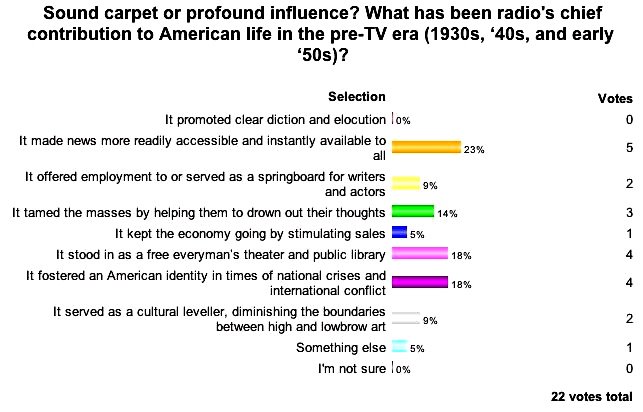
Well, it was time to close the sixth broadcastellan poll, if only to devise another in which you are herewith invited to participate. So, what, in my view, has been radio’s chief contribution to American life in the pre-TV era? There is some validity to all of the proposed replies (which I would not have bothered to list otherwise); and even though the statement that the medium “promoted clear diction and elocution” was endorsed by none, it was not meant to be facetious. Depending so much on the spoken word, radio producers certainly had more respect for it than today’s entertainers, artists whose mumblings are the Brad Pitt-falls of visual storytelling. And “Something else”? It might very well be broadcasting’s influence on the nation’s musical tastes, radio having served not only as an “everyman’s theater and public library,” but as a virtual concert hall.

Polls are nearly as fascinating to me as they are frustrating. I, for one, prefer not to give straight answers; I much rather respond or challenge, preferably after some reflection. The kind of question that can be answered decisively—the kind that requires one particular, supposedly right reply—is either unnecessary or suspect.

Nor can I rely upon my memory as a fail-safe system for the ready retrieval of data, pieces of trivia with which I’d rather not clutter up my mind. So, it is with some trepidation that I note a significant anniversary in American broadcasting: the quiz program Information, Please!, which had its radio premiere on this day, 17 May, in 1938 (and not, as the History Channel website will have you know, back in 1930).

Information, Please! was billed as a celebrity quiz program on which everyday citizens asked the questions that experts from the fields of literature, science, motion pictures or politics were called upon to answer. Noted guest panelists to appear on the show during its first two seasons (along with regulars like the aforementioned Oscar Levant) include movie director Alfred Hitchcock, playwright Moss Hart, as well as authors Ben Hecht, Rex Stout, Louis Bromfield, and Christopher Morley.

Here are some of the questions raised during the first program:

“Correct the following line and name its author. And the line is: ‘In the spring a young man’s fancy always turns to thoughts of love.'”

“In what well-known symphony did the composer include a chord in order to awaken a sleeping audience?”

“How is immigration to the United States from the following nations restricted: England, Brazil, China?”

“Kyosti Kallio is a Greek Island, a dictator of Peru, President of Finland, or the name of a Japanese political party?”

Unlike the quiz and giveaway programs of late 1940s—which had an even more devastating effect on the production of dramatic entertainment than the reality show format has on today’s television storytelling—Information, Please did not depend for its success on shrewdly engendered greed and promises of instant gratification, whether experienced by the participant or felt by the listener. This does not mean, however, that the instincts worked upon by the comparatively sophisticated Information, Please were any less basic.

“Now, folks,” moderator Clifton Fadiman greeted the audience, “any education that you and I may pick up for the next half hour or so is all to the good; but beyond that we’re out simply to play this as a game and have some fun at it.” And the “fun” of Information, Please! was not so much the thrill of getting it right, but of witnessing others of supposedly “towering intellect” (as Fadiman put it, mockingly) struggle and fail to meet the public’s challenge. To “stump the expert” was the objective, which was nothing less than an exercise in ridiculing the artist and the intellectual in a joyous vindication of mediocrity.