
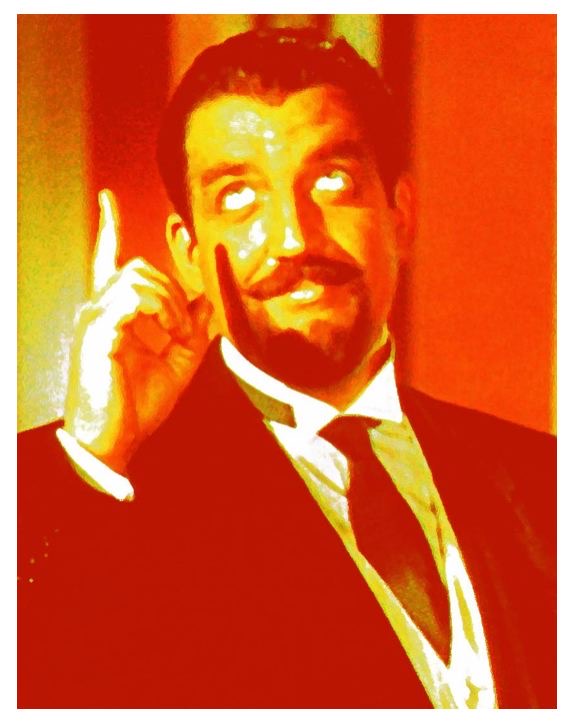
The Man Who Went on a Diet and Didn’t Come Back

Laird Cregar in Heaven Can’t Wait

Well, I did not bother to make any.   New Year’s resolutions, I mean. Once again I let slip by the chance of this calendrical construct—a moment in which our attempts to impose the order of the chronologic on the so-called fourth dimension whose measurable expanse is being commorated with renditions of “Auld Lang Syne”—to bring about changes in the race against time that is my life. Perhaps you made up your mind (or had it made up for you) to put an end to something and start something new, an exchange of habits or a switch in attitude intended to improve life or merely to prolong it. I did resolve nothing more than to account for my everyday, aside from continuing with this journal, by counting the movies I take in this year (so far, Night at the Museum, Pan’s Labyrinth, The Gay Falcon, Gentleman’s Agreement, Gilda and The Man in the White Suit), thereby to get a clearer picture of my actual rate of consumption and to ponder, at year’s end, how much these fictions have informed or impeded my journey.

Though far from being a life-as-artist like Walter Pater, I try to think of my existence in all its failures and shortcomings as an unfinished essay, a half-published and oft edited text of which broadcastellan is both a digest and an extension. A man’s success, comedian Fred Allen remarked, “depends on which wears out first—his pencil or his eraser.” That, like most epigrams, sounds smart enough; but the real trick is to avoid getting those two writerly tools confused. Believe me, it’s not that easy to tell them apart. Here’s a for instance and how I arrived at it.

As I was thinking about a subject for another one of my “On This Day” features, I came across “The Death Laugh,” an episode of the radio thriller anthology Inner Sanctum Mysteries broadcast on this day, 8 January, in 1944. Rummaging through my library, I failed to lay my ears on the play I assumed to be there; many of the Inner Sanctum episodes available online have been mislabeled, their dates and titles inaccurately recorded. Rather than putting an eraser to this futile search and moving on to another subject, my mind lingered instead on Hollywood heavy Laird Cregar, the star of said thriller. It was as if the man demanded to be called to mind today, not content to wait even until tomorrow (which marks Cregar’s anniversary in a 1943 broadcast of the Radio Hall of Fame) or the day after that (in which he played Montezuma in Orson Welles’s propaganda series Hello Americans).  

There was no need for him to get pushy. I have always thought Mr. Cregar a fascinating and devilishly handsome fellow—ever since he first made an impression on me in This Gun for Hire (1942); so much so that I quite forgot—or was only too ready to neglect the by no means negligible performances of Alan Ladd and Veronica Lake. Playing Satan, Cregar brought wit to Lubitsch’s Heaven Can Wait, an otherwise disappointingly well-mannered and overly sentimental portrait of a scoundrel. Why hadn’t I seen more of Cregar over the years, considering my love for classic Hollywood movies?

Now, I am not in the habit of turning to an artist’s biography to assess his or her performances. Instead, I focus on the works that show people and storytellers are in the business of sharing with us. For that reason, the fact that Cregar practically starved himself to death in order to become a leading man was news to me. It seems that neither heaven nor Hollywood could wait for Mr. Cregar.

According to some sources, Cregar was born in 1913; others claim he came into this world in 1914; others still state 1916 as his date of birth. Certain, however, is that he died in 1944 of an uncommonly early heart attack, apparently brought on by a crash diet, the resulting 100 pound weightloss of which was intended to convince Hollywood to give top billing to a man considered too fat to play the dashing lead.

Even on the air, where he could have gone invisible, Cregar played the fat man when he filled in for Sidney Greenstreet in the Lux Radio Theater adaptation of The Maltese Falcon. Mr. Cregar got his wish eventually, yet only posthumously, in Hangover Square (1945)—a belated nod to a man who conformed to an image and was reduced to one in the process.

After I thought about all this, I flicked through the current issue of the Radio Times and noticed that, just as I was fiddling with computer and camera to capture Cregar’s likeness from hell, the British cable channel Film Four had been screening The Black Swan, in which the actor impersonated Henry Morgan, a Welsh pirate born in the windswept parts I now call home.

Yes, Mr. Cregar seemed adamant to turn me into his medium today. Perhaps he was out to warn anyone with the New Year’s wish of shedding pounds this year to take it easy or, better still, to reconsider whether the eraser we take to our lives is chosen by ourselves or handed to us by those who dictate just how our being ought to be shaped.

January 4, 1942: What’s On?

I am one of those forward-looking folks who peruse the television and radio listings as if they were stock market reports or racing forms. Determined not to miss a winner of a program, I prepare myself by wielding the ever ready text marker as I wend my way through the weekly offerings. Today, though, I am seriously late in my planning. Before me is the US broadcast schedule from 4 January 1942 as it appeared in an issue of the Radio-Movie Mirror.

Having just watched “Static,” a 1961 episode of The Twilight Zone—shared with me by a fellow web journalist and consummate teller of fantastic tales—I am in a time-warped frame of mind. It is not for the sake of self-indulgent nostalgia, mind you, that I am revisiting the past, but in order to reconsider the boundaries of escapism. If the present does not turn us on, how can we, in this multimediated world of ours, expect to switch off entirely?

“Static” does not look kindly on television and the getaways it promises; it suggests that there is no escaping the challenges we dare not face as we stare at that small screen on which Westerns, quiz shows, and commercials flicker while life flashes by. Instead, it romances what, by 1961, was nearly a forgotten or at any rate woefully neglected medium in America; it gives two middle-aged people a second chance at realizing their dreams by transporting them, as if on radio waves, to the early 1940s, when first they met. The radio entertainments of that period—Fred Allen, Major Bowes, and the music of Tommy Dorsey—stand ins for what was presumably a time at once rich in possibilities and free from the mindnumbing influences of that set to which Americans had gotten so attached over the years.

All this romancing aside, the early 1940s were hardly an innocent period in modern history; and rather than coming true, many a dream had to be deferred or abandoned altogether. In this moment of uncertainty, at least one business comforted consumers by attempting to keep business running as usual. Worried or bewildered about the war, wondering what changes it would impose on their everyday existence—from blackouts to rationings, from irritating inconveniences to the loss of lives—those sitting at home could still depend on radio for escapist entertainment.

On 4 January 1942, an “Appointment for Murder” was kept by Raymond, host of The Inner Sanctum, Humphrey Bogart and Claire Trevor were heard in Screen Guild reconstitution of High Sierra, and Sherlock Holmes embarked on the virtually spotless “Adventure of the Second Stain,” first related by Conan Doyle some four decades earlier. Meanwhile, Jack Benny was overhead in a flashback episode recounting his botched New Year’s Eve celebrations, a belatedness indicative of the radio industry’s reluctance to catch up with the times.

Beholden to the sponsors who footed the bills, commercial radio was slow to adjust; and none of the programs broadcast during the weeks immediately following the attack on Pearl Harbor appear to have any relation to the realities of war. By comparison, even undemanding and apolitical publications like the Movie-Radio Guide, from which the above schedule was ripped, were quick to recontextualize the entertainments they were designed to bring to the attention of prospective listeners.

“A little over three weeks ago,” the Editors of the Guide commented, “a third-rate power with autocratic, imperialist ambitions and no scruples, attacked the United States as was to be expected—by hitting below the belt.” The propaganda still wanting on the air was already being provided by publications catering to the radio industry.

Responding to the demand for information, the Movie-Radio Guide promised to keep “pace with the nation’s war effort” and the “needs” of its readers by “inaugurated” an “enlarged short-wave department.” To the reader’s inquiry “What’s on?” the Guide replied in no uncertain terms: A war, that’s what was on.

How much does your entertainment guide of choice remind you of the fact that 2007 is by no means shaping up to be a time of peace?

Playing, Dead and Alive: Tennyson, the Internet, and the Radio Racket

Well, the afternoon is about as lively as a cancelled séance whose medium walked out due to death in the family. For the past few days, picking up where I left off a long time ago, I’ve been flicking through two sets of an English literature anthology. Rather than tossing out the old for the new, something I’d be happy to do with a pair of shoes, I’ve been comparing the volumes, pondering the expulsion or demotion of canonical authors whose once prominent works have been removed from subsequent editions. One such author now represented by fewer works is Victorian poet laureate Alfred, Lord Tennyson.

Now, reading Tennyson on a gloomy day does little to brighten the mood; but the following lines, from “In the Valley of Cauteretz” (1864), seem worth reviving, if only to remind me of my present state of mind.

The speaker of the poem, whom we may or may not take to be Tennyson himself, returns to a stream he once visited with a friend, now dead:

Thy living voice to me was as the voice of the dead,
And all along the valley, by rock and cave and tree,
The voice of the dead was a living voice to me.

Tennyson may have been revisited by the memories of his dead friend Arthur Hallam; but to me these lines somehow echo my own noisy yet quiet present, conjuring up my life among the voices of the past, my dwelling and revelling in recorded speech. Why do many of the radio voices I replay each day, transcribed sounds of live broadcasts featuring people now living no longer, sound so much more alive or closer to me than the voices of the present day?

Radio, back in the 1940s, when thousands of men were dying in battle far from home, was complicit in this sense of being visited by those gone or lost, a conjuring act achieved by a mere twist of the dial. Radio often presented itself as a spiritual medium, a modern device capable of annihilating space as well as time. On this day, 2 October, in 1944, for instance, Walter Huston introduced a play about the life of Thomas Paine by remarking that the words of this man called “Common Sense” still speak the

thoughts of many of us even today, in the year of 1944. And because of many other thoughts that this man put into words, we, in these troubled times, reach across the years to shake hands with him, to shake hands with Thomas Paine.

Sure, Thomas Paine sounds an awful lot like Edward G. Robinson, in whose hands lay Robert L. Richards’s script for that broadcast of “The Voice on the Stairs,” produced by the Cavalcade of America. Still, the phonic handshake was neither phoney nor merely symbolic; it was an act symptomatic of radio’s exploitation of our sense of revenance when we hear a voice from the past.

I am reminded of a friend of mine (the one with whom I went to the mystery book store a while back) who threw out her answering machine after playing back the voice of her dead father, still calling for her from the sonic loop of an old tape recording. When we look at pictures of dead people, the subject does not spring to life in the process of beholding; instead, pictures of the past or dead tend to serve as memento mori. They are a representation that does not quite render present, a reminder that is merely an aid to the act of calling to mind, whereas a recorded voice—sound being alive for the duration of its occurrence—streams through the ear canal into the now of our presence before fading into memory. Emanating from the living or the dead, it comes to life anew with each listening.

Dead, alive? The living dead? Or, speaking Tennyson, “Death in Life”? Perhaps I have dwelled among these sonic revenants for too long, becoming in turn, like Widmark’s character in the Inner Sanctum thriller “The Shadow of Death” (also cast on this day, back in 1945), dead to the world. Being engaged in this kind of séance, in the retrieval and re-presentation of past voices, I at times sense being shut out from and slipping out of touch with the living. Just like being caught in the internet, living in a world of sound is, after all, only the exposure to an echo of life—a reverberation produced by the clashing bones of a life stripped of flesh.

Have Script, Will Listen: "Death Across the Board"

After a May that had all the cheer of a pea-souper, summer is approaching at last. Great or small, the outdoors beckons. In light of this momentary brightening, it seems wrong somehow, or at any rate incongruous, to turn away from my scenic surroundings here in Wales to contemplate the largely generic fare that is popular culture. The challenge is always to make it matter; but sometimes it appears too much of an effort, a tiresome exercise in digging up what might have lain justly buried. Entirely worthy of excavation this weekend was A Cottage on Dartmoor, a gloomy love-gone-wrong melodrama that was shown by the BBC as part of a series of British silent films and documentaries on the subject.

A Cottage was filmed as the silent era drew to a close in the late 1920s. Like The Jazz Singer, it was conceived as a partial talkie, even though its soundtrack is no longer extant. Like the groundbreaking Al Jolson vehicle, A Cottage comments on the filmmaking tradition from which it departs even as it partakes of it; but unlike the former, it does not look forward to the dawn of the talkie with anything amounting to “You ain’t heard nothing yet” enthusiasm.

One scene of A Cottage is set in a movie theater transitioning from silents to sound pictures. The camera shows us an audience thrilling to the non-verbal slapstick of Harold Lloyd, presented with orchestral accompaniment. When the main feature, a talkie, is shown, the musicians abandon their instruments and turn to their sandwiches instead. The spectators are getting quiet as the people on the screen begin to talk; there is less interaction in the crowd as attention is being paid to the spoken word.

The once animated crowd becomes as static as the actors on the screen, huddling around their appointed microphones. An elderly woman with an ear trumpet struggles to follow the action, frequently turning to her less-than-pleased neighbor for voice-over narration and some instant dubbing. The talkies, Anthony Asquith’s stunningly photographed A Cottage on Dartmoor suggests, are threatening to fossilize the fluid medium of the moving image, rather than serving as its revitalizing force.

In this sense, talkies are to silent movies what television is to radio—a death warrant. Who, besides Charles Chaplin or Norman Corwin, managed to defy technology with any success or integrity? Yet whereas silent moviemaking had about a quarter of a century to develop into an art, radio’s golden age, which also lasted about a quarter of a century, was relatively short on artistic highlights. Broadcasting demanded such a mass of mass entertainment and imposed such massive restrictions on its creators that radio drama was on the verge of extinction before ever getting much of a chance to come into its own.

On the other hand, the crudity of radio drama is often being exaggerated, used as a justification for its demise. No movie critic would mistake a screenplay for the experience of the play unfolding on the screen; and even though radio drama depends more heavily on the spoken word than the visual storytelling medium of film, they do not—and should not—rely exclusively on words to convey moods, set scenes, or create dramatic tension. To reduce an aural art to the merely oral is nearly as misguided as looking upon silent films as a series of close-ups and title cards.

On this day, 5 June, in 1945, the thriller anthology Inner Sanctum Mysteries presented “Death Across the Board,” a drama of pursuit starring acclaimed stage and screen actor Raymond Massey as a madman who regards his fellow man as so many pawns on a chessboard. When the script, written by Robert Newman, appeared in a handbook for the instruction of writers in radio and television, it was accompanied by the following remarks:

The reader’s first impression, if he is a person of any taste at all, is one of surprise at the actual crudeness of much of the writing, and the seeming clumsiness of construction.  Furthermore, everything seems preposterously convenient for the writer, doesn’t it? He whirls from one improbability to another in a way that would earn any student the censure of his teacher—and quite properly—were he to do the same thing in any other form of writing.

Radio plays, however, are quite apart from “any other form of writing.” They are best appreciated—and most satisfying—when their limitations are understood to be creative opportunities rather than shortcomings. Like silent movie melodramas, radio thrillers are more than mere precursors to an ostensibly superior form of entertainment. And to give them a chance to work upon our imagination, it helps to listen to the medium for which they are created.

Anodyne Thrills, Abject Thraldom: Broadcasting “fear itself”

“The only thing we have to fear is fear itself,” US president Franklin Delano Roosevelt insisted in his 1933 inaugural speech. These days, as bombs are going off again in London (and, for that matter, in many other places east and west) and as people are being victimized both by terrorism and the measures taken to control it, this famous aphorism seems particularly poignant. What is to be feared, certainly, is the abject thraldom of fear, the suspicion it breeds, and the potential it has to quell the spirit of humanity, to diminish our ability to act within reason and with understanding. As is the case with all epigrams, however, FDR’s becomes shorter on wisdom the longer it is pondered.

What might this be, “fear itself”? Is fear not always a reaction, whether reasonable or not? As a response to stimuli or surroundings, it is neither to be feared in “itself” nor as part of our being. The avoidance of conditions potentially harmful to us is an instinct it would hardly behoove us to conquer in our efforts to become more civilized, less primal. I lived in New York City when the World Trade Center towers crumbled in a cloud of asbestos-filled dust. What impressed me most during the immediate aftermath was that those living in fear and trembling were reminded of their mortality, encouraged to examine their everyday lives in order to find ways of making themselves useful to others. Even heroes were publicly shedding tears.

While often admired, warriors who prefer fight over flight are often less civilized than the worriers who respond to threats by trying to avoid them or void them with circumspection. In any case, fear is hardly the “only thing” to be dreaded, no matter how dire the situation. Recklessness and heedless indifference of dangerous consequences beget more horrors than caution, awe, or diffidence. What is to be feared most, perhaps, is fearmongering—the deliberate provocation of fear, the manufacturing of fear for profit or political gain. The media are open, the masses vulnerable to such designs. Yet when the fears are real and not sensed keenly enough, imagined terror may assist in making true horrors apparent.

The 7 December 1941 broadcast of Inner Sanctum Mysteries‘s “Island of Death” suggests just slow the radio industry was to react to the terror that had finally hit home. The show, however inappropriate, had to go on, for the sake of the sponsors. The titular island is not, of course, Hawaii; but it is doubtful that either this “strange and terrible tale” of black magic or the sponsor’s product, “Carter’s Little Liver Pills” (the “best friend to your sunny disposition”) could do much to get people’s minds off the topic of the day or alleviate the anxieties the news—or lack thereof—must have produced.

The government could not afford radio drama to remain escapist. Within a few weeks after the attack on Pearl Harbor, fear became a weapon aimed at mobilizing the homefront. In Arch Oboler’s “Chicago, Germany,” for instance, listeners were confronted with the dystopia of an America annexed and governed by the Nazis. With nightmarish fantasies like these, the Treasury hoped to raise millions for defense.

It is too simplistic to argue that audiences then were more gullible or less sophisticated than today’s consumers of popular culture. Certainly, the 1940s, when millions of civilians perished or faced irreparable losses as the result of global warfare, were not “innocent” times, as those pining for nostalgia might opine. They were times of uncertainty like any “now” any time, times of suffering, hardship, and frustration—times during which those tired of threats or numbed by pain needed to be reminded that a present free from fear might bring about a future without freedom, that to stop fearing might well mean to stop living.

The weekly blood-and-thunder anthologies were deemed particularly suitable to the awakening of real terror through imaginary thrills. Underlying the tension of such melodramas, wrapped up neatly within less than 30 minutes, were the anxieties of war, which were often driven home with a final curtain call appeal. Even shortly before the end of the war in Europe, when those listening to the tales of The Mysterious Traveler were invited to rejoice as ”Death Comes for Adolf Hitler” (24 March 1945), a mere month prematurely, they were cautioned that the dangers of Nazism were still very much alive. So, rather than being purely escapist, the terror of the airwaves provided anodyne thrills to impede abject thraldom.

Today, the uses of fear are well understood by the terrorists, that new breed of indiscriminals holding the world hostage; but the weapon that once was the thriller is too rarely being honed to prepare us for them.