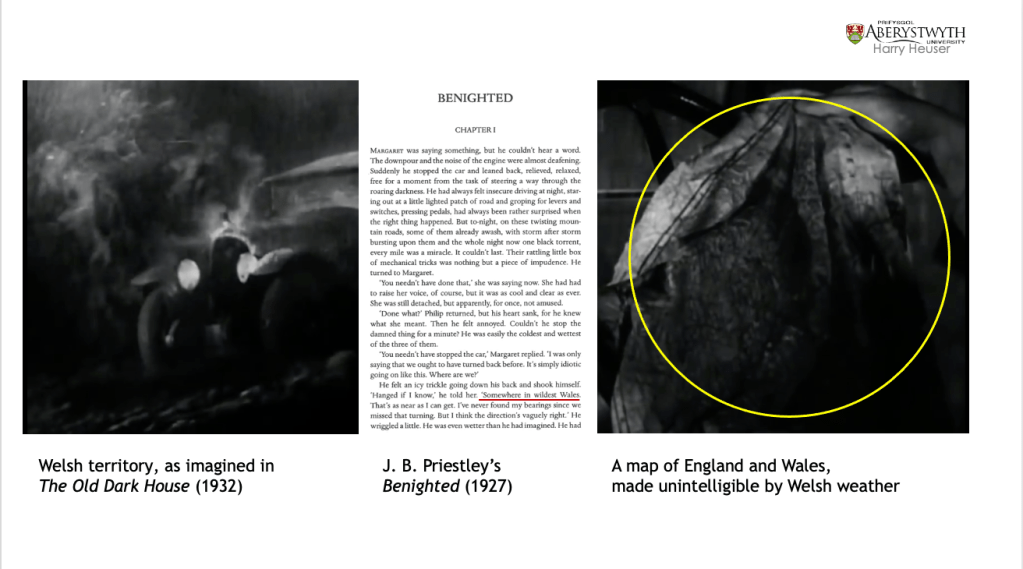
The last time I approached that Old Dark House – the titular edifice of a 1932 Hollywood thriller directed by the queer English filmmaker James Whale and founded on a novel by the English social critic J. B. Priestley—my eyes were not focussed on any particular visual detail. I was remarking generally on the house as a concretization of Priestley’s views on the condition of Britain after the so-called Great War, as the film and its source, Priestley’s Benighted (1927), are often understood: Interwar Britain as an empire haunted by its past and a kingdom lacking a vision as unifying as the largely unchallenged rule of its alleged heyday.
Never mind the map. Now entering gothic territory
Not that British moviegoers, let alone US American audiences, would have considered this perspective, partially obscured by the retitling of the property, as being essential to the experience of the fun house-ghost train atmosphere the film conjures. Sure, the house, with its shadowy corridors, massive oaken doors and branching staircases, is as ill-lit as any old Gothic-fictional castle; but the unenlightened ones at the heart of this picture are its denizens, the backward, dim-witted and intractable Femms in whose midst we, along with a small group of unfortunate travelers, find ourselves.
Much has been said about the titular edifice of Universal Studio’s 1932 melodrama The Old Dark House, the third in the series of films I am screening as part of my Gothic Imagination module at Aberystwyth University. Directed by the queer English Great War veteran James Whale, and adapted from J. B. Priestley’s 1927 novel Benighted, The Old Dark House is often argued to be a commentary on Imperial Britain during the so-called interwar years (that is, the period between the two World Wars, Britain having been involved in plenty of other international conflicts besides): an ancient but crumbling family home – run by aging and morally corrupt imbeciles and cut off from the world by water. It has been called, more than once, a “metaphor for … England.”
And yet, the story is not set England but in Wales, and the novel and film alike exploit and perpetuate the stereotypes of what, presumably, constitutes Wales and sets it apart from neighboring England: the wild, the uncivilised, the superstitious and unenlightened. Wales, according to Priestley and Whale, is gothic territory. It is the stuff of romance – or the English definition of romance – meaning that when the English want to go primitive, they think Wales.
Here is what the dreamer Penderel, himself a war veteran, says about Wales as he is being driven around in his friend’s motorcar one dark and dismal night:
I don’t want to go to Shrewsbury. I don’t particularly want to go anywhere. Something might happen here, and nothing ever happens in Shrewsbury, and nothing much on the other side of Shrewsbury. But here there’s always a chance.
The Hollywood ending aside, the film is remarkably faithful to the novel, retaining much of Priestley’s dialogue. While I am not sure just how many US American viewers back then would have understood the reference to the border that Shrewsbury represents, both Priestley and Whale would have known that, when the name “Shrewsbury” is dropped, the meaning “borderline” is implied. Arriving at Shrewsbury – and this is the party’s intention – means traversing the Welsh Bridge over the Severn and arriving back in England.
The party in question – Penderel and his friends, the married and bickering couple Margaret and Philip – has lost its way in what Priestley lets Philip describe as “wildest Wales.” The colonial attitudes toward Wales as both enchanted and benighted – as a place where there is ‘always a chance’ – the chance of an improvement in infrastructure excepting – are at the heart of this modally gothic narrative.
When the drunkard Welsh butler Morgan opens the door upon their unannounced arrival, he “produce[s] from somewhere at the back of his throat, a queer gurgling sound” that Penderel cannot translate. Priestley tells us that “Penderel knew no Welsh.” And yet, he says with confidence, in the book and film version alike, that “Even Welsh out not to sound like that; it was as if a lump of earth had tried to make a remark.”
Wales, to be sure, was just that to England, or many in England, a mute lump of Earth to be exploited for its resources. It is not Wales that is gothic – or Gothic – but the perspective of the English that, fascinating as they may be with the wildness of Wales – impose their views on the nation they invade like “travellers in a foreign country,” as Priestley has Penderel see it.
Morgan, as we soon learn, cannot communicate in any spoken language. He is a personification of Wales infantilised, gesturing like “some prehistoric monster.” Wales, the source of mined ore – of coal and slate and lead, silver and gold – as well as Water, was often seen as little more than potential to be unearthed and funnelled for the benefit of England. The tradition was deemed to be expendable.
In The Old Dark House, as in Benighted, the nightmare vision makes way for daylight. What we experienced was a Phantasmagoria staged by the visiting English. The travelers depart, whether enlightened by what they experienced or just glad to have survived it. The perspective of the hosts is not considered.
Hollywood would return to a fairy-tale Wales in The Wolf Man a decade later, in which Welsh landscape and culture, rendered unrecognisable, become the other when England was seen as the real, the upholder of values, in its fight against fascism. To this day, visitors prefer to be enchanted by Wales, an old dark house whose perceived darkness is to a large extent a product of an English or Anglo-American imagination.
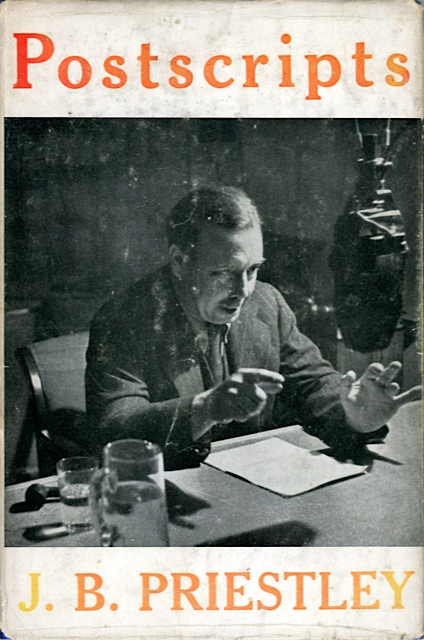
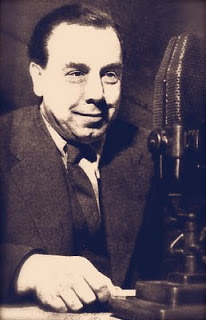
I have never heard J. B. Priestley deliver his famous Postscripts, a series of morale-boosting talks broadcast to the British public during those early, uncertain and hence no doubt most terrifying days of the Second World War. Many decades later, actor Patrick Stewart returned Priestley’s lines to the airwaves that had once carried them into the homes of millions; but somehow I could not get excited about those recreations. For, no matter how delayed an originally live broadcast, its recording yet retains the immediacy of a first-hand experience that no re-enactment can approach.
Recently, I came across the published Postscripts (1940). Unlike Stewart’s voiceovers, the printed speeches are unabridged and, their author insists, “exactly as they were, without a speck of retouching.” These are “wireless talks and not essays,” Priestley cautions the reader:
If I had my way they would never have re-appeared in this form, to be examined at leisure instead of being caught on the wing every Sunday at nine-fifteen, but the requests for a volume of them have come in so thick and fast during these last three months, that I felt it would be churlish to refuse. So here they are, and please don’t blame them now, for they have already done the work they were intended to do.
Indeed, reading those scripts aloud now, I can, even in my own indifferent, untrained voice, hear them doing their work. Priestley indulges in none of the hysterics and hyperboles that so often render alienating what is meant to be persuasive speech. They are sentimental, these talks, and they are sane.
As Priestley puts it in the Preface, the
tricks of the writing trade and some fortunate accidents of voice and manner are all very well, but what really holds the attention of most decent folk is a genuine sharing of feelings and views on the part of the broadcaster. He must talk as if he were among serious friends….
Priestley’s Postscripts are simply words of encouragement, gentle reminders that much of our seemingly inconsequential everyday is worth holding on to as it defines who we are, that the loss of even the slightest thing may be keenly felt as a threat to our identity. Take a piece of pie, for instance—and make it a fake one.
That is just what Priestley did, on this day, 29 September, in 1940, when he talked about returning home to Bradford, the “solid real place” of his childhood. The seemingly random devastation caused by a recent air raid, though far less grand in scale than the attacks on London, “made a far deeper impression” on Priestley “because it somehow brought together two entirely different worlds; the safe and shining world of my childhood, and this insecure and lunatic world of to-day.”
The local bakery, too, had suffered during the raid; but there, in the broken, half boarded up window, could still be glimpsed at the giant pie that had fascinated Priestley when, as a child, he saw emanating from it a steady flow of “fine rich appetising steam.” A wondrous, awe-inspiring sight it was to Priestley, the boy—and a wonder it was now to Priestley, the man, that, after all those years and after all those hours of bombing, the pie was still in its place, still in one piece, and still steaming away.
Mindful of the prosaic souls who needed to have their lessons spelled out for them, and who may well have resented as this “yapping about . . . pies and nonsense” at a time of acute crisis, Priestley added the reminder to “keep burnished the bright little thread of our common humanity,” a world in which that particular pie had “its own proper place.”
If only we had heard a voice like that during the dark days after 9/11, an opportunity seized by warmongers and profiteers. If only there had been that sane and gentle voice, the raising of which in a time of terror is as difficult as pie.
Both BBC Radio 4 and 7 are in the thick of a J. B. Priestley festival, a spate of programs ranging from serial dramatizations of early novels (The Good Companions and Bright Day) and adaptations of key plays (Time and the Conways and An Inspector Calls), to readings from his travelogue English Journey and a documentary about the writer’s troubled radio days. Now, I don’t know just what might be the occasion for such a retrospective, since nothing on the calendar coincides with the dates of Priestley’s birth or death. Perhaps, it is the connection with the 70th anniversary of the evacuation of Dunkirk, an event on which Priestley embroidered in June 1941 for one of his Postscript broadcasts, that recalled him to the minds of those in charge of BBC radio programming.
Never mind the wherefores and whys. Any chance of catching up with Priestley is welcome, especially when the invitation is extended by way of the wireless, the means and medium by which his voice and words reached vast audiences during the 1930s and early 1940s, both in the United Kingdom and the United States.
For all his experience as a broadcaster, though, Priestley, who was not so highbrow as to high-hat the mass market of motion pictures, never explored radio as a playwright’s medium, as a potential everyman’s theater on whose boards to try his combined radiogenic skills of novelist, dramatist, and essayist for the purpose of constructing the kind of aural plays that are radio’s most significant contribution to twentieth-century literature—the plays of ideas.
Priestley prominently installed a wireless set in Dangerous Corner, a stage thriller whose characters gather to listen to a thriller broadcast. Later, he read his controversial wartime commentaries (titled Postscripts) to a vast radio audience. He even went on one of Rudy Vallee’s variety programs to discuss the fourth dimension. Yet the medium that relied entirely on that dimension, to the contemplation of which he devoted many of his stage plays—Time and the Conways and I Have Been Here Before among them—did not intrigue Priestley to make time and create plays especially for the air.
To be sure, his falling out with the BBC in 1941 (as outlined in Martin Wainwright’s radio documentary about the Postscript broadcasts) did little to foster Priestley’s appreciation of the radiodramatic arts. Yet the indifference is apparent long before his relationship with Auntie soured. When interviewed for the 1 September 1939 issue of the Radio Times about his novel Let the People Sing, which was to be read serially on the BBC before it appeared in print, Priestley dismissed the idea that he had written it with broadcasting in mind:
“I realised, of course, that the theme must appeal to the big majority. But apart from that, I thought it better to let myself go and leave the BBC to make it into twelve radio episodes. It would otherwise have cramped my style.”
To Priestley, the “experiment” of broadcasting his novel lay in the marketing “gamble” of making it publicly available prior to publication, a challenge of turning publishing conventions upside down by effectively turning the printed book into a sort of postscript. Clearly, he looked upon radio a means of distribution rather than a medium of artistic expression.
Reading I Have Been Here Before and listening to the radio adaptation of Time and the Conways, I realized now little either is suited to the time art of aural play. Whereas the Hörspiel or audio play invites the utter disregard for the dramatic unities of time and space, Priestley relied on the latter to make time visible or apparent for us on the stage.
The Conways, like the characters of Dangerous Corner before them, are brought before us in two temporal versions, a contrast designed to explore how destinies depend on single moments in time—moments in which an utterance or an action brings about change—and how such moments might be recaptured or rewritten to prevent time from being, in Hamlet’s words, “out of joint.”
“Time’s only a dream,” Alan Conway insists. “Time doesn’t destroy anything. It merely moves us on—in this life—from one peep-hole to the next.” Our past selves are “real and existing. We’re seeing another bit of the view—a bad bit, if you like—but the whole landscape’s still there.”
In Priestley’s plays, it is the scenery, the landscape of stagecraft, that remains there, “whole” and virtually unchanged. The unity of space is adhered to so as to show up changes in attitudes and relationships and to maintain cohesion in the absence or disruption of continuity.
In radio’s lyrical time plays, by comparison, neither time nor place need be of any moment. It is the moment alone that matters on the air, an urgency that Priestley, the essayist and wartime commentator, must surely have sensed. Priestley, the novelist and playwright did or could not. Too few ever did. To this day, a whole aural landscape is biding its time . . .
As I was saying: what is wanting here is continuity, some sort of story on the go, a sense of goings-on ongoing, of the so on and so on and so on. It would be laziest to claim, as I have done, that what prevents me from turning a seemingly random clipbook into the attraction that is the yet-to-come is largely owing to the kind of clippings for which this (mis)nominal journal is reserved.
Instead of looking ahead, I keep on hearkening back. As I recall, which is what my kind of introspective retrospection calls for, my life always seemed to unfold in hindsight, not so much enveloped as developing. I know better than to regard history as a series of acts perpetrated rather than ideas perpetuated—but that knowledge does not prevent me from living ahistorically. According to J. B. Priestley, I am bound to regret this.
For the most part, mine has been a life apart; many are the instances, momentous events even, in which I just was not in the moment. What was I feeling when the Berlin Wall fell? My diary won’t tell you. It only refers to the event in passing—and with detachment—as something that would have been “noch vor kurzem undenkbar” (unthinkable even a short time ago). “Undenkbar,” perhaps, since I had never given it much Gedanke.
I recall being revolted by David Hasselhoff’s “Looking for Freedom,” a 1989 chart topper all over Europe, but was not aware that the song’s popularity was owing to political events then in the making, let alone that Hasselhoff was part of the revolution (as claimed, with tongue firmly in cheek, in a current BBC Radio 2 retrospective). I never made the connection. Nothing seemed to connect, least of all with me. My existence, as I saw it, was coincidental and inconsequential.
It is not for nothing that my generation was known as the “no future” generation. Life in the Western middle of Europe was, to many, solely dependent on the whim or disposition of two world leaders, on a red telephone, and a scientist’s finger on a long-range missile switch.
I came briefly into contact with my past self when, on a recent weekend in London, I looked into the fresh faces of my nieces, whom I had not seen in over twelve years since I steadfastly refuse to set foot again on German soil. I never did make peace with my native country, and, as much as I enjoy a good Schlachtplatte (literally, a battle or slaughter platter, which is a dish of assorted meats), I’d much rather rely on German exports than return to the scene of inner turmoil.
The belated realization that, growing up in the Rhineland, I had never witnessed a celebration of Armistice Day, seen a World War I memorial (of which there is one in nearly every village here in Britain) or witnessed the annual spectacle of lapels sprouting poppies, only deepened my suspicion that it was the shame of defeat that rendered causality ineffective in a post-1918 German construct of history, and that what was being commemorated elsewhere was victory rather than the failure to insure it.
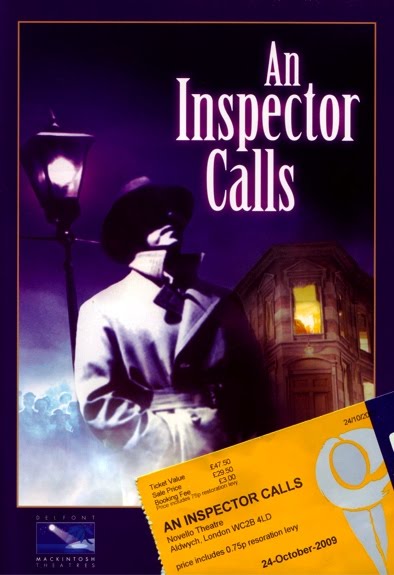
As the fatalism expressed in the grating conclusion of the most recent installment in The Final Destination series of disaster horror suggested to me, causality without social or moral responsibility is a mere exercise in predictability. “We are responsible for each other. And I tell you that the time will soon come when, if men will not learn that lesson, then they will be taught it in fire and glood and anguish.” J. B. Priestley keeps saying as much in An Inspector Calls, the previously maligned 1990s production of which I caught again on said trip to London a few weeks ago.
“You’ve a lot to learn yet,” pragmatic and presumably self-made Mr. Birling advises the younger generation, anno 1912.
And I’m talking as a hard-headed, practical man of business. And I say there isn’t a chance of war. The world’s developing so fast that it’ll make war impossible. Look at the progress we’re making [. . .]. Why, a friend of mine went over this new liner last week—the Titanic—she sails next week—forty-six thousand eight hundred tons—and every luxury—and unsinkable, absolutely unsinkable. That what you’ve got to keep your eye on, facts like that, progress like that—and not a few German officers talking nonsense and a few scaremongers here making a fuss about nothing. Now you three young people, just listen to this—and remember what I’m telling you now. In twenty or thirty years’ time—let’s say in 1940, you mighty be giving a little party like this—your son or daughter might be getting engaged—and I tell you by that time you’ll be living in a world that’ll have forgotten all these Capital versus Labour agitations and all these silly little war scares. There’ll be peace and prosperity and rapid progress everywhere—except of course in Russia, which will always be behindhand, naturally.
Mr. Birling is blind not only to the signs of the time but also to his responsibilities in designing the future while consigning the present to waste and ruin. Even when given the chance in Priestley’s fantastic setup, he is incapable of turning hindsight into insight. Knowledge, after all, is not synonymous with understanding. As much as I keep rejoicing in Mr. Birling’s fall—a delight dimmed by the knowledge that his is our downfall by proxy—logic dictates that I fall well short of understanding the consequences of my own ahistorical ways.
I’ve had quite a few “silent nights” here at broadcastellan lately (to use an old broadcasting term); and yet, I have been preparing all along for the weeks and months to come, those dark and cheerless days of mid-winter when keeping up with the out-of-date can be a real comfort. Not that the conditions here in our cottage have been altogether favorable to such pursuits, given that we had to deal with a number of blackouts and five days without heating oil, during which the “room temperature” (a phrase stricken from my active vocabulary henceforth) dropped below 40F. Not even a swig of brandy to warm me. I have given up swigging for whatever duration I deem fit after imbibing rather too copiously during the New Year’s Eve celebrations down in Bristol.
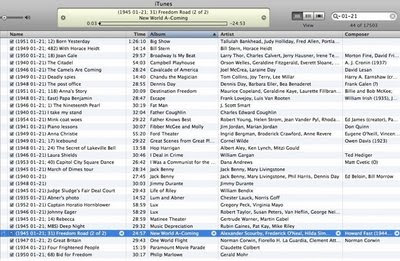
Those are not the blanks (let alone the ones in my short-term memory) that I intend to fill here. The gaps in question are in my iTunes library, which currently contains some 17500 files ranging from the recent BBC adaptation of Anthony Trollope’s Orley Farm to World War I recordings. The vast majority of these files are American radio programs. They are readily gathered these days; but the work involved in cataloguing them for ready retrieval can be problematic and time consuming. For now, I am not lacking time; at least not until our long planned and much delayed move into town, real estate crisis be damned. Anyway . . .
For the past few weeks, I have been filling in each of the fields as shown above, verifying dates, checking the names of performers, comparing the sound quality of duplicate files, and researching the source materials for adaptations. It took a while to arrive at a convenient system. When I started the project anew (after the crash of an earlier Mac), I made the mistake of entering the date after the title of the broadcast (entries in lower case denoting descriptive ones).
As a result, I could not readily listen to a serial in the order in which its chapters were presented. I would have been at a loss to follow and follow up today’s installment of Chandu the Magician (1949), as if having missing out on the chance of getting my hands on Chandu’s “Assyrian money-changer” by sending in a White King toilet soap box top sixty years ago were not difficult enough to bear.
Listing, though, is to me almost always less satisfying than listening; it is also far less difficult and engaging. Listening often results in research, in comparing adaptation to source, in reading up on the performers, or in finding contemporary reviews. About the 21 January 1946 premiere of I Deal in Crime, for instance, broadcast critic Jack Gould complained that it “creeps along at a snail’s pace” and that Ted Hediger’s monologue-crowded narrative style was “not helped” by William Gargan’s “rather lackadaisical” delivery.
While he did not have instant access to thousands of such programs, Gould nevertheless noted the sameness of such nominal thrillers and their “stock situations.” To him, Paul Whiteman’s Forever Tops was the “real lift” of the evening’s new offerings on ABC, a reference that compels me to find a recording of that broadcast . . . .
In this way I spend many an hour before once again sending another missive into the niche of space I, as keeper of past broadcasts, have grandiloquently styled broadcastellan.
Yesterday’s gloomy afternoon gave way to a splendidly sinister evening at the theater. The play was J. B. Priestley’s An Inspector Calls, which I had previously seen back in 1995, with 80’s heartthrob Maxwell Caulfield in his Broadway debut. In that production, the set pretty much upset the text—a huge, dark house confronting the audience from behind a curtain of rain. It was an impressive spectacle calculated, it seemed, to veil or countermand Priestley’s directives, the stark simplicity and artifice of his didactic play. Yet, as I realized last night, watching a touring Clwyd Theatr Cymru production directed by Barry Kyle, An Inspector Calls loudest when the lines are clear and the stage bare.
I had prepared for the evening by reviewing the 1934 film adaptation of Priestley’s Dangerous Corner, starring Virginia Bruce and Melvyn Douglas. The movie struggles to open Priestley’s play to the demands of a dynamic camera. The cinema audience wants, or is at any rate accustomed to, something other talking heads and sedentary bodies. Even Martyn Bainbridge’s design, while effectively sparse compared to the melodramatic Broadway treatment of An Inspector Calls, at times displayed a doubt in the sufficiency of Priestley’s script by underscoring his words with visuals, turning walls into movie screens and tilting the stage to demonstrate the downfall of a supercilious and self-centered family.
Do we need images to get the picture? The theater of ideas is best accommodated by radio, a non-visual medium that forces our mind to focus on the spoken word and telling silences. Back in the early 1930s, Priestley may not have been convinced of this. After all, Dangerous Corner is a rather scathing commentary on the wireless as a soundcarpet under which the unspoken and unspeakable can be swept: the receiver has to break down to crack the surface of idle chatter among the civilized yet rotten.
In An Inspector Calls, which reworks the central idea of the earlier play, the part of the radio is performed by a telephone that rings to shut up a group of culpable and contemptible individuals talking themselves back into a state of calm. Unreliable or intrusive, both means of telecommunication are called upon to penetrate the walls of bourgeois conventions, obliging those standing apart to connect and disclose what has been carefully concealed from others.
Priestley could and did rely upon the wireless to spread the word and to popularize his ideas. His novels and plays were often heard on American and British radio during the 1930s and ‘40s, among them adaptations of Angel Pavement and Laburnum Grove, as well as the two works discussed here. The author-dramatist even made an appearance on Rudy Vallee’s show, as I read in a September 1939 issue of the Radio Times, and agreed to let the BBC serialize one of his novels prior to publication, with its author reading the first installment.
While expressing his reservations about the experiment and its effect on book sales, Priestley nonetheless decided to reach out to the populace he was eager to unite. Perhaps, some six years prior to the completion of An Inspector Calls, he had already gotten the call from his inquisitive messenger. It is a call that still resonates strongly today, not so much as socialist propaganda, but as an appeal to think beyond economics, beyond present self-interest, for the sake of turning a Dangerous Corner in the path of the planet we share.



 Both BBC Radio 4 and 7 are in the thick of a J. B. Priestley festival, a spate of programs ranging from serial dramatizations of early novels (The Good Companions and Bright Day) and adaptations of key plays (Time and the Conways and An Inspector Calls), to readings from his travelogue English Journey and a documentary about the writer’s troubled radio days. Now, I don’t know just what might be the occasion for such a retrospective, since nothing on the calendar coincides with the dates of Priestley’s birth or death. Perhaps, it is the connection with the 70th anniversary of the evacuation of Dunkirk,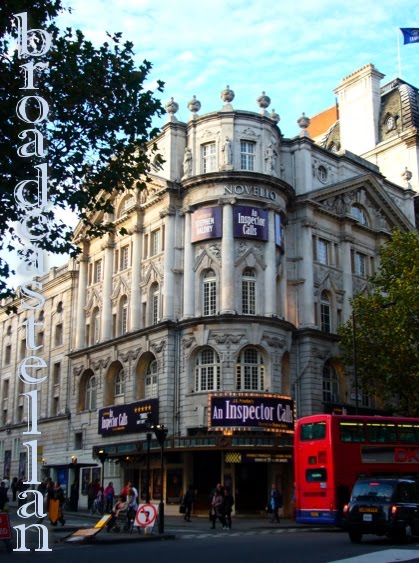
 I’ve had quite a few “silent nights” here at broadcastellan lately (to use an old broadcasting term); and yet, I have been preparing all along for the weeks and months to come, those dark and cheerless days of mid-winter when keeping up with the out-of-date can be a real comfort. Not that the conditions here in our cottage have been altogether favorable to such pursuits, given that we had to deal with a number of blackouts and five days without heating oil, during which the “room temperature” (a phrase stricken from my active vocabulary henceforth) dropped below 40F. Not even a swig of brandy to warm me. I have given up swigging for whatever duration I deem fit after imbibing rather too copiously during
  Yesterday’s gloomy afternoon gave way to a splendidly sinister evening at the theater. The play was J. B. Priestley’s An Inspector Calls, which I had previously seen back in 1995, with 80’s heartthrob Maxwell Caulfield in his Broadway debut. In that production, the set pretty much upset the text—a huge, dark house confronting the audience from behind a curtain of rain. It was an impressive spectacle calculated, it seemed, to veil or countermand Priestley’s directives, the stark simplicity and artifice of his didactic play. Yet, as I realized last night, watching a touring
  Harry Heuser