
Perhaps I should call her. We have not talked in over a year. Could I have telephoned tonight, though? Not simply to exchange a few kind words, mind. From her, I would like to learn about the past that shaped our world; and who would not seize the opportunity to grasp that past firsthand? That said, I have never quizzed my German grandmother about life in the Third Reich, never attempted anything amounting to probing inquiry. I am more distressed by my failure to ask than by any responses I might get. Not that any number of answers could make me stop wondering.
Tonight marks the 70th anniversary of Kristallnacht, and I am more keenly aware than usual that the past is not done with, that many of those who threw stones into shop windows or looked on as Jews were hauled off to the concentration camps are still among us. Their ideologies, their hypocrisies, and their indifference are alive as well.
My grandparents were not among those who resisted the Reich and its reign of terror. “Of course, we knew they were being shipped to the camps,” my paternal grandmother once told me. Frank about knowing, she was open rather than open-minded. Third Reich propaganda remained at work throughout her life, even some forty, fifty years after the defeat of the Nazi regime. Once she heard I was schwul (German for gay), she ceased to acknowledge me; not as much as a reply to my Christmas cards. My maternal grandmother, now in her nineties, continued to correspond, though, sending greetings and wishes to me and mine. Is she more open? Or is she, like so many of us, merely permitting her personal feelings for her own kind to gainsay thoughts that would otherwise dominate her mind?
My maternal grandmother worked for one of the leading Nazi families and remained loyal to them decades after the war, introducing me to the heirs when I was a child. My memories are vague. I remember being told about the guilt that made outcasts of the obviously well-to-do family for which grandmother worked as a seamstress. There was a boy, roughly my age, with whom I played while grandmother worked. As much as I would like to fill in the blanks, I cannot bring myself to ask about the past, about grandmother’s connection to the Von Ribbentrops.
On this Remembrance Sunday, as Britain commemorates the 90th anniversary of the 1918 armistice and those killed in war, I drift in and out of consciousness, sick with the commonest of colds. Swirling in the thick of my head are thoughts that just the right word cannot put into any conclusive or satisfying order. I continue to question myself rather than demanding answers from those who might help me to resolve matters.
Instead of proving that actions speak louder than words, Kristallnacht demonstrated that actions are louder than the silence of unvoiced dissent. A stone, in this respect, is like a resounding “no” to the potentialities of change latent in the troubled mind. Words can set nothing aright if they merely create the illusion of control, if they obscure the chaos within us rather than dispel it. I let my words bespeak confusion rather than answer conclusively, thus falsely. I let them run riot rather than underwrite what amounts to the hollow triumph of paper solutions.
A quandary is at the heart of “Von Ribbentrop’s Watch,” a radio play by Laurence Marks and Maurice Gran, which premiered 8 November 2008 on BBC Radio 4. It is the story of a Jewish shop owner in contemporary Britain who learns that the less-than-reliable watch he inherited from his father once belonged to Nazi Germany’s Foreign Minister Joachim Von Ribbentrop. What to do? Keep the watch and ignore the Swastikas to which a watchmaker alerted him? Sell it to collectors of Nazi memorabilia in order to keep alive his own struggling business? Would that be retribution or profiteering?
The fascinating premise is undermined by the language in which the conflict is couched. It seems that the playwrights are rather too enamored of their at times desperate wordplay, too eager to elicit awkward chuckles from assorted squabbles at a Passover table when restraint might have served them better. Perhaps, the broadcast date for this dreadful piece of imitation Goldbergs was as unfortunate a choice as the playwrights’ mockery—a Jewish defense of Nazi crimes, the sounds of broken glass after a family quarrel, followed by an otherworldly visit from Von Ribbentrop—as it gave me reason to believe that “Von Ribbentrop’s Watch” was meant to coincide with and somehow commemorate the horrors of Kristallnacht. Armistice Day, by comparison, is given a solemn treatment on BBC Radio 3, with an adaptation of All Quiet on the Western Front.
At least, the titular chronometer of “Von Ribbentrop’s Watch” seems to suggest that even belated justice is preferable to terminal ignorance; time catches up with timepiece in question, however exasperating and offensive the ninety minutes that it takes us to hear about it. Not that the conclusion is rewarding: in its tacky irony, the play insists that the Jews end up confessing their guilt by association.
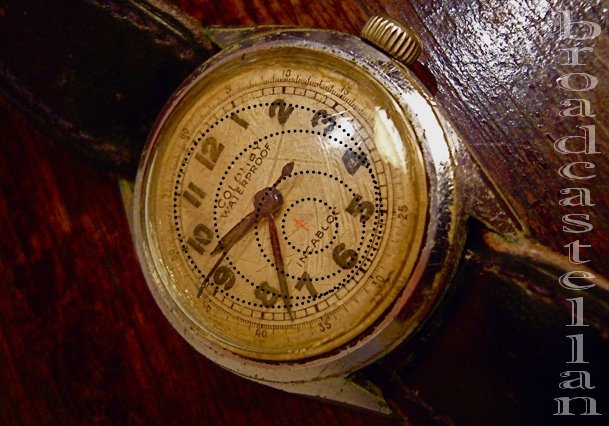
In response to this appalling piece of misjudged comedy, which is supposedly based on a true story, I retrieved the watch shown above. Like so many stories of so many objects around me, the story of this watch cannot be recovered, the one who could have helped to pieced it together having died many years ago. It was given to my partner, whose father brought it back from the Second World War. My camera failed to capture it, but the face bears the Cross of Lorraine, the symbol of the Resistance.
What we need to resist, always, is the convenient answer, the conclusive remark, the word to extinguish the doubt that is the life of thought, the hope for change; and the doubt we should all permit ourselves to voice on this day is whether the past is truly over or whether we are still victims of the same prejudices, susceptible to the same talk, capable of the same actions. Those are the questions we cannot expect anyone to answer on our behalf.

 Harry Heuser