“… an America that must never happen—that will never happen!”: Revisiting US American Anti-Third Reich Propaganda in the Second Age of MAGA

The script for “Chicago, Germany” as it appeared in the June 7-13 issue of Radio Life

Delving into the “Draft and Ideas” folder set aside for this blog, I came across a fragment titled “‘Chicago, Germany’: A 1940s Radio Play for Our Parallel Universe.”  It was intended for posting on 10 November 2016 as a response to a “Trump administration having become a reality.”  The draft was abandoned, but no other piece of writing was published in its place.  

In fact, the next entry in this journal did not appear until 15 May 2017, and it coincided with the opening of Alternative Facts, an exhibition I staged with students at the School of Art, Aberystwyth University, in Wales.

As the abandoned fragment and the ensuing hiatus suggest, the “reality” of the Trump presidency had so rattled me that I could not bring myself to continue a blog devoted to the popular culture of yesteryear, as much as I had always tried to de-trivialize bygone trifles not only by examining them in the context of their time but also by relating them to the realities of the present day.

The exhibition project that kept me busy in the interim, had similar aims.  Alternative Facts provided me, as a curator and educator, with an opportunity creatively to engage with the outrage of MAGA by appropriating a phrase that encapsulated the duplicity and travesty of those early days of spurious swamp-draining.

Fast forward to 20 January 2025, the day that Trump returned to office, by the popular demand that is a product of his populist brand, with the singular and single-minded vengeance of a MAGA-loomaniac.  Pardon the execrable pun, but I find no words other than that crass neologism adequately to describe a US President who pardons rioters storming the Capitol and defecating on democratic principles, much to the Nazi-salute inspiring enthusiasm of enabling, super-empowered and quite literally high-handed oligarchs who, I suspect, will, rather than Elon-gate this reign, eventually assume the gilded let’s-lay-democracy-to-rest-room that, in the interim, is the seat of Trump’s throne,

It struck me that the time was ripe for—and indeed rotten enough—to pick up pieces of that draft in light or dimness of the current and perhaps irrevocably changed political climate, which, far from incidentally, is the only human-made climate change we are likely to hear about from the US government for the duration, as dramatically shortened for our species and for most lifeforms on our planet as that time may have become in the process.

As a melodramatist who staged the end of the earth both on radio and for the movies (in the 1951 nuclear holocaust thriller Five), Arch Oboler would have much to say about all this—except that what Albert Wertheim has called his “penchant for altered reality” was being “married to his anti-fascist zeal” in propaganda plays sponsored by or at least aligned with the objectives of the US government during the FDR years.

Continue reading ““… an America that must never happen—that will never happen!”: Revisiting US American Anti-Third Reich Propaganda in the Second Age of MAGA”
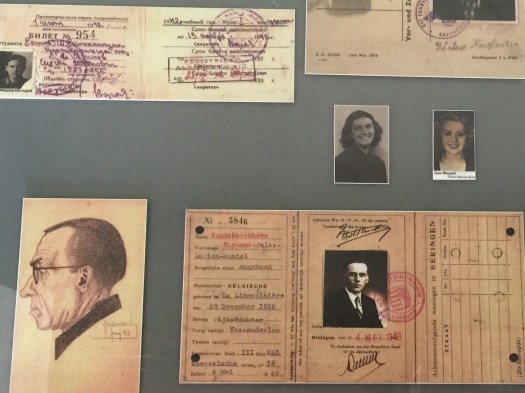
Joan Blondell in Dachau

I am no historian. At least not in a traditional facts-and-figures sense. Early in life, I became doubtful of efforts to account for the present by recounting the past of a place or a people. Growing up – and growing up queer – in Germany during the 1970s and 80s, I was not encouraged to find myself in such accounts.  After all, how could I have developed a sense of being part of a national history? The present did not make me feel representative even of my own generation, while the then still recent past was presented to me as the past of a different country. A different people, even. A people whose history was not only done but dusted to the point of decontamination.

Visiting Dachau, June 2015

That many of those people – those old or former Nazis – were all around me and that the beliefs they held did not get discarded like some tarnished badge was apparently too dangerous a fact to instill. Pupils would have turned against their teachers.  Children would have come to distrust their parents. They might even have joined the left-wing activists who were terrorizing Germans for reasons about which we, endangered innocents and latent dangers both, were kept in the dark.

As I have shared here before – though never yet managed adequately to convey – I left Germany in early adulthood because I felt uneasy about my relationship with a country I could not bring myself to embrace as mine. It’s been a quarter of a century since I moved away, first to the US and then to Wales.  For over two decades, I could not even conceive of paying the dreaded fatherland a visit. 

Eventually, or rather suddenly, that changed. In recent years, I have found myself accepting offers to teach German language, history and visual culture, assignments that made me feel like a fraud for being second-hand when imparting knowledge about my birthplace.  I realized that I needed to confront the realities from which I had been anxious to dissociate myself.

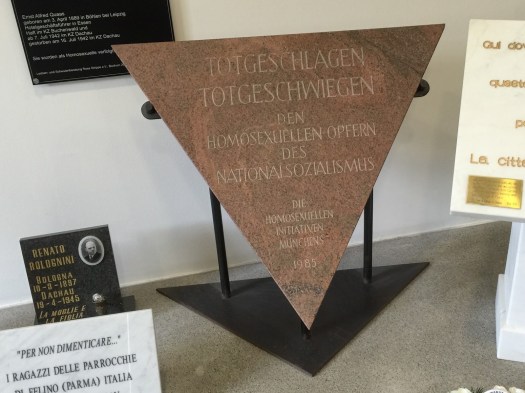
Beaten to death, silenced to death”:
A memorial to the homosexuals killed during
the Nazi regime, made in the year I came out.

This summer, I visited the Dachau concentration camp for the first time.  There, in the face of monumental horrors, I was drawn to one of the smallest and seemingly most inconsequential object on display: a cigarette card featuring the likeness of 1930s Hollywood actress Joan Blondell.

Dates and figures are no match for such a fragile piece of ephemera. To be sure, the macabre absurdity of finding a mass-manufactured collectible—purchased, no less, at the expense of its collector’s health—preserved at a site that was dedicated to the physical torture of real people and the eradication of individuality could hardly escape me.

But it was not this calculated bathos alone that worked on me.  It was the thought that I, too, would have collected such a card back then, as indeed I do now. Investing such a throwaway object with meaning beyond its value as a temporary keepsake, I can imagine myself holding on to it as a remnant of a world under threat.

Lives taken, identities recovered at Dachau.
Unexpectedly, a picture of Joan Blondell

Looking at that photograph of Joan Blondell at Dachau, it was not difficult for me to conceive that, had I been born some forty years earlier, I might have been sent there, or to any one of the camps where queers like me were held, tortured and killed.  That minor relic, left behind in the oppressive vastness of the Dachau memorial site, speaks to me of the need to take history personal and of the importance of discarding any notion of triviality. For me, it drives history where it needs to hit: home—home, not as a retreat from the world but as a sense of being inextricably enmeshed in it.

Joan Blondell, meanwhile, played her part fighting escapism by starring in “Chicago, Germany,” an early 1940s radio play by Arch Oboler that invited US Americans to imagine what it would be like if the Nazis were to win the war.