
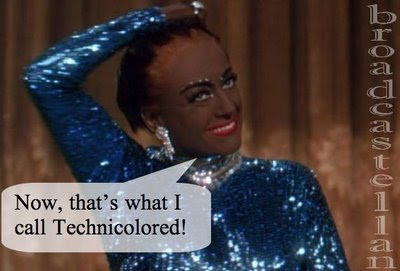
Why Carry a Torch for Joan When She Puts Her Career to It?

I have always been fortunate in having what is now conveniently termed a gaydar. Long before I knew what I could long for, long before I even dared longing, I simply knew or sensed what what was. What was what I was, that is. I looked into Raymond Burr’s eyes or listened to disco divas like Hazell Dean and, somehow, I could relate. Not to whatever their lines or notes were, not to the label that may nor may not become attached to their names, but to the individual behind or beneath, to the one who agreed to perform what was deemed suitable for mass reproduction. Ours was, is—and, I suppose, has to be—a society of re-producers, a society that accepts those who do not reproduce only as long as they churn out plenty of product and generate heaps of dough.

For all my queer gifts, which somewhat fail me here in Britain, where every other male seems somehow gay to me (gay, I say, not desirable), I never developed a sense of camp. I resent camp. To me, it is an act of wilful misreading, and that is empowerment at too great an expense—somebody else’s. You need to read the lines first before you can sneak between them, let alone get palimpsestic. After all, it is not that there has never been anything other to read, hear or see than the conventional, the traditional that then is mercilessly turned into—or, if you will, exposed as—travesty. There is always some code that permits you to identify—and identify with—a designated misfit or underdog, a guise for what you might feel yourself to be. Perhaps I am old-fashioned that way; but I do not insist on breaking something to pieces if it does not bend toward me.

I welcome melodramatic manipulation. I let it happen. It is an openness I bring to the popular arts, however cloaked in conventions and coded accordingly. How irritated was I when, during a screening of Douglas Sirk’s Imitation of Life at New York’s Public Theater, the audience started to snicker and swoon at the sight of Lana Turner’s admittedly fabulous sunglasses. I was absorbed in the to me already familiar action. I recall my father, a Hemingway-gone stoic who would rather die an alcoholic (which he did) than admit to being vulnerable, reduced to tears at the conclusion of the movie. And I respected him for that. If you cannot get drawn in at least once, just withdraw. I see no use in intellectual exercises removed from any felt engagement with the arts.

Sometimes, though, no involvement can be forced, no manipulation willed. You are being pushed or taken aback too far to venture an approach. Last night, for instance, I caught up with Torch Song (1953) and could only gape in disbelief at the misfireworks before me. I very nearly felt guilty watching the carnage as Joan Crawford goes into her blackface “Two-Faced Woman” routine as if this wreck of a vehicle were another Band Wagon. It is the self-destructive act of a perfectionist too delusional to notice the damage this would mean to what was left of her career.

However removed from any sense of reality, the story is remarkably close to the star’s own Hollywood history, reflective of her state and status then, of her demise as a leading lady which this film, in turn, accelerated. All the while, though, Crawford failed to elicit my compassion; her earnest and joyless quest for perfection turns Torch Song into a stilted, lifeless performance.

Torch Song is not quite Trog; but for all its glossy production values, it is monstrously inept. Crawford’s humorless performance is as uncomfortable to watch as the carefully choreographed moves of a dancer too focused on getting the steps right to notice the misstep of it all, too fixed on the floor to see where it is going.

Torch Song is, at best, a rehearsal—a rehearsal of a swan song recorded in the act of drowning. If only there had been room for a tongue in Crawford’s cheek, the dire melodrama leading up to the supposed triumph of “Two-Faced Woman” would not have been quite so jaw-droppingly awful. Even the film’s reflexivity does not improve matters, since the entire production is self-delusional rather than self-conscious. Torch Song is all about Crawford, not All About Eve. It may be concerned with the staging of a show and the dropping of masks; but even what is going on behind the scenes is all cardboard and paste.

It seems to me that Torch Song came about twenty years too late for Crawford. I don’t mean that she was too old for the part. Like Madonna, who turns fifty today, Crawford had an amazing figure on which rested the head of a business-hardened professional. To bowdlerize Sheridan, the trunk’s modern, ‘tho the head’s antique. No, it isn’t a question of Crawford’s fitness, but of the datedness of the material, a grab bag of hand-me-downs it would be generous to describe as contrived.

The only genuine article in the entire production is Marjorie Rambeau, who was both old and bold enough to play Crawford’s mother, imbuing her few moments on the screen with a wit and restrained sentimentality reminiscent of parts that often went to Thelma Ritter.

Today, Torch Song is considered classic camp, a status not reflected in the tepid reception from Internet Movie Database voters. Being among them, and having rated some 160-odd pictures so far, I am puzzled as to how to judge this unspectacular if spectacularly misjudged production. I am almost beginning to envy Michael Wilding’s character, a blind man to whom Crawford’s Gypsy Madonna appeared as the remembered image of her promising and glorious past; but then I keep thinking: Joan, as flattered as you might have been by the invitation to work once more at the studio that made you a star, you should not have taken those steps like a blissfully oblivious Norma Desmond. You were never away from Hollywood long enough not to know your place there. If only you had slipped and cracked a smile for all those people out there, in the dark, I would have been happy to carry the torch.

A Doctor in Spite of His Shelf

They are gone. I’ve finally done away with them all. My compact disks, I mean. As of last night, I placed all twelve thousand or so audio files in the iTunes library of my new MacBook (which I only dropped once thus far). Not that past experiences have made this an easy decision for me, given how vulnerable such digital memory is to erasure.

This time around, I backed up everything onto an external hard drive. Sure enough, just after completing this weeklong task (which, the exceptionally fine spring weather here in mid-Wales aside, accounts for my now broken silence), nearly two thousand of those imported files could not be played. Last night, I had to retrieve them, very nearly one by one, from some hidden folder and return them to the library so as to have them at my fingertips once more.

Such ready access is making it easier for me to get my ears on notable broadcasts and celebrate the anniversary of certain radio plays and players. “Train Ride,” for instance, a melodrama “written especially for Joan Crawford” (by Charles Martin, then producer of the aforementioned Silver Theater) and broadcast on this day, 7 May, in 1939. Crawford’s mike fright (already remarked upon here) made such live dramatics rare events indeed. In “Train Ride,” Crawford gets to play a role with which many a radio listener can readily identify: an unhappily married woman who falls in love with a voice other than her husband’s. It is a fantasy fit for a wife who is told to “go to bed with a book of love stories and a box of chocolates.”

Indeed, the two wire-crossed lovers vow never to meet unless the other is about to die. “Each of us has an illusion,” the voice tells her. “Why destroy it for the other?” So, when the two finally get together, the meeting is hardly a moment of unadulterated bliss. After all, her platonic lover, who turns out to be the speech writer for her politically ambitious husband, tells Mary that he working on a “more humane method of electrocution,” the kind of hot love seat he seems certain to take one day.

BIZ. Telephone rings. Receiver is picked up.

Voice. Hello Mrs. Crane.

Mary. Hello.

Voice. Why, you’re crying. What’s the matter?

Mary. Nothing.

Voice. Haven’t you got anybody to talk to? Your husband?

Mary. He hasn’t the time.

Voice. Talking is a medicine for sick souls. I’ll listen.

Mary. I can’t talk to someone I don’t know.

Voice. Why not try getting acquainted? I still promise never to see you.

However unsound the vehicle, Crawford’s flawless script reading and suitably emotive voice make this a smooth “Ride,” one that runs as scheduled without betraying the actress’s much talked of microphobia. “I loved your voice, and I wanted to hear it again” her soon-to-be soul-only mate tells her. “You see, it’s been . . . well, it’s been like a lost chord vibrating in my memory.”

Memory. Lost chords. Vibrations. That brings to mind my own uneasy radio romance. When I set out to research so-called old-time radio for my doctoral study (Etherized Victorians), I was apprehensive about writing on non-print matter. I was torn between the concrete and the intangible, the alleged permanence of script and the inconstancy of the spoken. It felt like an adulterous relationship whose boundaries I could not get in writing.

I was, after all, a student of literature, not performance; and compared to the activity of reading, listening sounded like cheating. Having studied the Victorians for so long, I found it difficult to conceive not having my nose stuck in a three-decker.

These days, my shelves are largely virtual. The plays and narratives, while scripted, exist only in sound. Let’s hope my library won’t deny me access and yield plenty of immaterial matter to go on about . . .

Dancing with Franchot Tone: Tenth Avenue Girl Gets to Be “Lady for a Day”

Fancy that, Florence Farley! You were one lucky teenager, when, early in March 1939, a photographer from the ever enterprising Hearst paper New York Journal American came to see a fashion show planned by you and the kids in your neighborhood—the none too fashionable Tenth Avenue in Manhattan. Subsequently, you were chosen to go to Hollywood and become a “Lady for a Day.” What’s more, on this day, 1 May, you got to tell millions of Americans about your experience, dutifully marvelling at the “simply swell” Lux toilet soap in return. After all, you were talking to Cecil B. DeMille, nominal producer of the Lux Radio Theater, and there had to be something in it for those who made you over, young lady, and made your day.

Mr. DeMille was in New York City for the premiere of his Union Pacific, while Leslie Howard took over as narrator and host in Hollywood; so, C. B. didn’t really have to go out of his way (or send you back, all expenses paid, to Tinseltown) to meet up with you. You had returned by then from your West Coast adventure, the title of “Lady” being bestowed upon you “with the understanding” that you would return to your “own workaday world.”

“I was just another girl,” you told the famous director, just as the script had it. “Gee,” you exclaimed, as anyone should, having had a break like yours. When prompted to do so, you told listeners of going to your “first nightclub,” where you met Dorothy Lamour and “danced with Franchot Tone.” He probably felt like dancing, too, considering that he was single again, his marriage with Joan Crawford having recently ended in divorce, which might not be as bad as going back to the tenements. By the way, I’m watching Harriet Craig tonight and wonder what it must have been like, living with Crawford. But never mind that now.

While in Hollywood, you also got to make a screentest, go for a “bicycle ride with Bob Hope,” and appear in a Paramount picture. Not that I could find your name anywhere on the Internet Movie Database. Who knows just how much of your dream come true is true, Florence Farley. Tell me, were you really glad to return to the tenements to live with your grandma and go out with boys who only dream of being Errol Flynn? Did you get to keep those “Cinderella slippers,” never having “paid more than $2 for shoes” before?

Yours was another thin slice of Hollywood baloney, a West Coast diversion from the butchery about to commence in the east to the east of you. It’s no coincidence, either, that the Lux Radio Theater presented an adaptation of Damon Runyon’s ”Madame La Gimp” (later aired under original title on the Damon Runyon Theater program and remade as Pocketful of Miracles starring Glenn Ford, who would have celebrated his 91st birthday today, had he not died last August). Nor is it surprising that your fairy tale fits so well into the scheme of selling things, of carving the mess of life into neat bars of soap.

You know, Flo, listening to your voice (more real than the hooey you were asked to repeat) and wondering about the life behind those lines of yours—the life behind the “human interest” story and the publicity act you were that spring—sure beats following the sentimental play on offer that night. Now let’s wash our hands of the whole affair, without so much as thinking about lathering with the sponsor’s product . . .

Acid Tongues in Wilted Cheeks: Hollywood and the "Older" Woman

Well, she’s being teased quite a bit this season about her obsolescence, about being too old for her former job, too old to start dating again after her marriage fell apart, too old for any excitement greater than awaiting the arrival of the latest issue of Cat Fancy. The superannuated one is Gabrielle Solis, one of those supposedly Desperate Housewives. She’s a mere 31, mind you; but that’s just about a quarter to finished on the watch of a supermodel. It’s Hollywood poking fun at its obsession with youth, an obsession I never shared even while I stilled possessed it. It is pointless to shout “Grow up!” these days, since that is exactly what is feared most.

If fifty is the new thirty, does it follow that thirty is the new pre-pubescence? Perhaps that is why Gabrielle is asked to prep hideous little Miss Sunshines for a short career of runway sashaying or paired with an even more hideous Ritchie Rich of a teenager who seriously undermines her chances of landing a man. Gabrielle is not so much robbing the cradle than sinking back into it.

Men like birthday boy William Shatner (born on this day in 1931) never had it quite as tough to stay employed, even though they might experience their own aging anxieties, drowned sorrows untraceable in their bloated or botoxed visages. If Desperate Housewives can be claimed to succeed in making mature women appear desirable it is only by making them look and act less than mature. At least they are spared for a while longer from the fate of being assigned nothing more glamorous or challenging than a low budget sequel to Trog.

Joan Crawford, who did exit with that movie on her resume, made a career out of playing formidable women past forty just until she passed fifty, at which untender moment the formidable was twisted into the berserk. According to Hollywood, the line between fierce and frantic is as thin as a wrinkle behind a layer of gauze; and even in the make-believe of radio, where no gauze is required to assist those incapable of suspending their disbelief at the sight of crow’s feet, Crawford was asked to walk and cross it.

In “Three Lethal Words”, a tongue in less-than-rosy cheek Suspense thriller that aired on this day, 22 March, back in 1951, Crawford is heard as Jane Winters (read: well past spring or about to enter the second childhood of a Jane Withers), a woman who confesses to being, gasp, 43! You know the old gal has a problem (according to Hollywood logic, that is) when she also confesses to having been “ill” and walks into a film studio with a bottle of nitric acid in her pocket.

“It’s amazingly powerful,” she tells her former colleague, now head of the studio’s story department, to whom she is trying to pitch a story of a woman not unlike herself. As it turns out, that is an understatement, considering that the parallels are melodramatically overstated by Ms. Winters choice of character: Sally Summers, a screenwriter who tries to make herself believe that “43 isn’t very old,” but who is constantly reminded of her relative antiquity by her marriage to an actor 19 years her junior, especially when that young man leaves her after being told to send his wife Mother’s Day cards and is teased about not only having seen Sunset Boulevard, but “living it”!

“Three Lethal Words” throws acid into the wrinkle-free face of Hollywood; but the woman who gets to do the throwing is not looking any better for having dreamed up the deed.

Of “Past and Paste”: Rereading (Myself on) Mildred Pierce

The generally reliable and greatly appreciated Blogger has been given me quite a headache these past twenty-four hours. I was unable to upload any images; and although this journal is primarily concerned with the spoken word, I was irritated to the point of name-calling it a day. In the meantime, I dug up one of my undergraduate essays on Mildred Pierce, one of the movies (listed, right) I screened again recently. Say, how many motion pictures do you consume over a twelve-month period? That is the question I am posing in my current poll (a feature I resurrect herewith).

As if to account for time spent, whether well or otherwise, I try to keep track of what I experience, see or do. Sometimes, only the title of a movie remains; I remembered very little about Prick Up Your Ears, for instance, a copy of which I picked up a few weeks ago, some two decades after watching it during its initial release (in Germany, mind you). Back then, the fact that playwright Joe Orton, whose life is the subject of Frears’s biopic, began his short career by submitting a radio play to the BBC would not have meant much to me. About what the film did mean to me my diary is disappointingly mum, aside from the rather astonishing remark that I deemed it enjoyable. While I tend to summon up feelings far better than facts, my initial impressions were beyond recall.

Not so with Michael Curtiz’s crowd-pleasing gem, about which I once penned a trifle titled “The Loathsome Scent of Low Descent: Of Past and Paste in Mildred Pierce.” In it, I comment, without much originality, on the role of the “past, its influence and irrevocability,” in this shadow play of “a mother’s struggle to shed her past in order to secure the happiness of her daughter.” The opening credits, “washed ashore and wiped away by the surf,” suggest that the “past, though carefully concealed, may suddenly resurface, and that time itself, like the tides of the sea, is an element beyond our control.”

Since I require something more stimulating to enter into an argument with anyone, including myself, I pricked up my ears instead and took on the 24 June 1954 Lux Radio Theater adaptation starring Claire Trevor, in the title role originated by Joan Crawford, and Crawford’s co-star Zachary Scott as Monte. In an earlier Lux broadcast, Rosalind Russell had impersonated the fierce Mrs. Pierce, Academy Award-winning Ms. Crawford having been (as Louella Parsons reminded me) a less-than-confident radio performer (her notorious Christmas special notwithstanding).

The final screenplay for Mildred Pierce was written by one of radio’s better writers, Ranald MacDougall (previously mentioned here). Yet little of Curtiz’s noirish vision, James M. Cain’s rags-to-wretchedness design, or MacDougall’s smart revision remains in Sandy Barnett’s audio version, which not only cleans up Veda’s act (by refraining from mentioning her feigned pregnancy) but sidelines the central figure of her mother by opening with a dramatization of Wally’s arrest at the beach house rather than Monte’s call of “Mildred,” the dying word of a murder victim that implicates the named one from the get-go.

Since we are not encouraged to think of her as a suspect (her suicide attempt is not even mentioned), Mildred’s subsequent storytelling loses much of its ambiguity. From her reaction to the police inspector, the listener senses that she is uneasy about the fact that her first husband is the prime suspect; but it is unclear whether her narrative is designed to shelter him (or anyone else). Without those scenes at the beach house and the pier, there is little reason to distrust Mildred, who comes across here as a hard-working, suffering parent abandoned by her husband and stuck with an ungrateful child.

The radio adaptation seems determined to take literally the famous tagline of the movie—”don’t tell anyone what she did”—by keeping quiet about what Mildred might have done and suggesting that she didn’t do much at all aside from baking pies to do well by ne’er-do-well Veda. Lux sure got the stains out of Mildred’s past.

"Chained" to the Mike: Joan Crawford Goes Live Reluctantly

Well, they come to the remotest of spots, spreading their words—or the word—undaunted by the indifference or hostility with which they are greeted. Jehovah’s Witnesses, I mean. This morning, I’ve been listening for about an hour to two of these travelling preachers, one of whom likened our lack of receptiveness and knowledge to sitting in front of a broken television set. Actually, the two reminded me of radio announcers: hawkers with a mission who come into your home (or as near as you let them) to sell you ideas and convince you to tune in tomorrow—a tomorrow so protracted it might have been conceived by a soap opera writer if it weren’t quite so blissful.
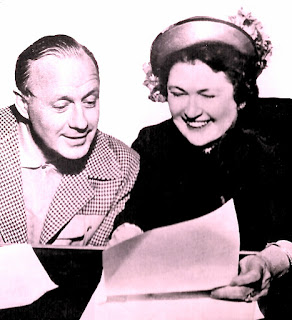
Radio announcers, of course, were being paid for delivering promotional messages they did not compose; and it sufficed for them to feign conviction and enthusiasm in their pushing of ideas, services and products. Rather than turning the dial or twisting the doorknob on those Witnesses and their ill-concealed prejudices, I kept listening to their mythological broadcastings, even though my life at present is so serene that I do not long for another or any hereafter.

We are being sold so many mass-marketed keys to happiness that, when one of them finally fits into the lock, the confounded peddlers and their less-than-satisfied customers importune us to question whether we’ve got the right door. Once achieved, happiness is reduced to a token of stupor or proof of lacking ambition, a mark missed rather than hit. After all, there is business in creating desire and none in realized contentment.

Now, the elusive happily ever after is an illusion often smashed to great effect. The creators of melodrama, the theater of the contested status quo, turned the struggle for a joyous or secure future into a chief generatrix of storylines. The characters of melodrama often seek happiness by looking for something not belonging to them and find it by discovering that what they want is close by, however obscured by conventions or removed from their everyday by the chains of society. In all this strife, melodrama often insists on destiny, on a path chosen not by us, but for us, a path to be discovered instead of forged.

On this day, 27 July, in 1936, Joan Crawford stepped behind the microphone she dreaded to struggle against such conventions—and succumb to others—by recreating her role of Diana (or Dinah) Lovering in Chained, which was adapted for a production of the Lux Radio Theater.

Diane is a secretary of a well-to-do, “middle-aged, but attractive steamship magnate.” She vows to marry him—once his wife consents to set him free. In the meantime, she falls in love with a younger man, played by Crawford’s husband, Franchot Tone, a man who poses a challenge, rather than showering her with affections. There is little excitement in the triangle, a routine love affair in which Crawford is blandly smooth, rather than edgy. Perhaps the greatest achievement of Crawford’s performance is that the actress, reputedly uneasy about speaking live before an invisible audience of millions (as previously mentioned here), displays no audible signs of mike fright.

Setting the scene with an apposite if contrived Hollywood legend, Lux Radio Theater host Cecil B. DeMille explains that Crawford and Tone, whom he had never before met professionally, were meant for each other by virtue of their ancestry. “Their romance, which began in 1933, was more than a courtship,” he suggests. “It was a coincidence which had its beginnings in 1798, when an undecided Corsican named Bonaparte was lighting the fuse that was to explode all Europe and an Irish patriot named Wolfe Tone was enlisting French aide in a revolt against England.” Sure, Ms. Crawford, who married the descendant of said Wolfe Tone, was born Lucille LeSueur; but the “little French girl” was born closer to Paris, Texas, than to the French capital.

Aided by the continuity writers of the Lux Radio Theater, DeMille was able to craft a compelling theme out of such historic strains, even if it meant to strain historic facts in the crafting. For all his vision, though, DeMille was no seer. Between the second and final acts of “Chained,” the famed director introduces Helen Burgess, one of his recent discoveries for the screen. She might have been groomed for stardom, but, as Billips and Pierce remind us in Lux Presents Hollywood, the on-air promotion was futile. The promising starlet died on 7 April 1937, shortly before her twenty-first birthday.

Crawford, meanwhile, kept returning to the microphone, relieved, no doubt, when the era of live radio drama came to an end in the late 1940s.

Wireless Women, Clueless Men: Louella Parsons, Dirt Dispenser

Today, I am closing my series of tributes to women in American radio by devoting this final edition to one of the biggest names in Tinseltown hearsay: Hearstian columnist Louella Parsons. I leave it to Ms. Parsons to dish a little dirt about her on-air scandalmongering, even though that dirt is no more messy than a dusting of confectionary sugar on a well turned cuff. “Well,” Parsons told readers of Radio and Television Mirror Magazine (from an issue of which this picture has been taken), “I can safely say that no one else in the business can boast that her program was almost a radio casualty because of a toothache, a can of soup, and Audie Murphy’s cold! Likewise, I’m the only woman in these parts who’d had the dubious distinction of being almost ‘stood-up’ by Clark Gable. . . .”

Now, she does say “almost.” As it turns out, Gable was scheduled to appear on Parsons’s Hollywood Hotel when he got “snarled up” in a traffic accident. Shortly before the broadcast, he showed up with assorted bruises, welts, and a torn coat; but, according to Parsons, he insisted on going ahead with the live broadcast as scheduled, since, as the enterprising secret sharer put it, “he knew the program was very important to me, and didn’t want to disappoint me.”

He also knew better than to stand up this formidable career ender. So, Parsons’s wounded pride was mended—and Gable’s stardom secure. “Since that day,” Parsons added, “he has had a very special place in my book of friends.” Merely pencilled in, no doubt. This lady dealt in muck, after all, which in her profession is more precious than friendship.

I’ve mentioned Joan Crawford’s mike fright before in this journal. It was a well-known fact the first lady of gossip enjoyed repeating, claiming that the star “ran like a startled faun” every time a microphone was as much as “mentioned” to her. Eventually, the actress’s fear of bad press must have been more pronounced than her microphonophobia, as Parsons got her to go on the air talking about “what an advantage it was to be born on the wrong side of the tracks.”

Carole Lombard, on the other hand, was “completely unruffled when she lost two whole pages of her script. She merely ad libbed her way through, without a pause, and you’d never have known the difference.” Abbott and Costello, in turn, “turned the tables” on Parsons by reading her lines instead of their own. So, the chat hostess obliged by reading theirs, and, “as mad as it may sound,” she discovered that “the program had some semblance of sense to it.” These recollections are not exactly an endorsement of Parsons’s writing; but, by her own admission, “lack of talent has never dimmed [her] enthusiasm.”

Her first program, Hollywood Hotel, was off to a shaky start back in 1934: “My show was probably the worst in existence—I wrote, produced, and directed it all by myself.” Perhaps, it was not so much the writing and directing that were most amiss. Unlike rival columnist Hedda Hopper, Parsons did not have a trained voice, let alone a pleasing one; but she “knew too that is wasn’t how [she] said anything that mattered, because people were interested in what [she] was talking about.”

Sure, she couldn’t “close [her] eyes to television indefinitely,” she concluded. “But until better make-up and lighting are developed,” she vowed to “stick with [her] Hooper” (Hollywood jargon for radio audience).  And stick she did, for better and worse.

Wireless Women, Clueless Men: Mercedes McCambridge, Airwaves Advocate

Last night, I watched The Damned Don’t Cry (1950), a seedy but glamorous rags-to-riches-to-rags melodrama starring Joan Crawford. Crawford was a perfectionist on screen, even though producers like Jerry Wald determined that, by the mid-1940s, her physiognomy was less than ideal and called for that extra layer of gauze in front of the lens to soften her mature looks (because most leading roles in Hollywood are, to this date, a little too young for anyone over forty). No doubt, Crawford’s need for control contributed to what those in the radio business called mike fright.  When Crawford went on the air, starring in dramatic programs like Suspense, she insisted on being recorded for later broadcast rather than going on the air live. Apparently, to someone as protective of her persona as Crawford, any screw-up in radio insinuated something tantamount to crow’s feet on screen. Not to Crawford’s Johnny Guitar (1954) co-star and rival, though, the radio-trained and true Mercedes McCambridge.

Her career in film and on stage notwithstanding, McCambridge was a genuine radio actress; and unlike many aspiring thespians, she would not have objected to the term. Sure, her voice was so distinct that even the hearing impaired could not fail to spot her in any of her many notable radio roles; but, however obvious her vocal disguises, McCambridge, whether performing in night-time thrillers, daytime soap operas, or wartime propaganda plays, rarely did less than throwing herself, larynx and soul, into each and every part she accepted to play.

On this day, 8 February, in 1950, for instance, McCambridge was “Jack Dempsey,” the rambunctious teenage daughter of a prize-fighting crazed rancher. Determined to get married to a man of whom her father does not approve, she convinces a trio of adventurers to defend her rights in what was billed as “The Battle of the Century.” That was just one of the adventures in which McCambridge played a part in 1939—and again a decade later—in a thriller serial called I Love a Mystery. The program, and McCambridge’s role as the maniacal Charity in “The Thing That Cries in the Night,” has been discussed at some length previously in this journal.

She was also heard in many other Chicago-originating drama broadcasts, including episodes of the legendary horror program Lights Out!. My favorite among those is an episode in which McCambridge plays a spoiled teenager on a school trip to Paris. Abducted by a man who claims to know her family, she is dragged into the sewers, where she is forced to make necklaces out of the bones of those killed by her capturer. It’s Grand Guignol, all right—ghastly melodramatics that don’t require images to conjure up unimaginable horrors.

To moviegoers, McCambridge is best known as the demon voice in the The Exorcist, a performance she attributed to a fortuitous bout with childhood bronchitis. McCambridge thought of this role, in which she is never seen, as a radio performance. Until the 1970s, when radio enjoyed a renaissance, she returned to the airwaves with former colleagues, enjoying the freedom that radio afforded the performer, notwithstanding the limitations imposed by producers and sponsors.

“In radio you had to be a tiger or you didn’t last,” McCambridge wrote in her autobiography, The Quality of Mercy, “If you didn’t keep your toes curled under, you would fall of the edge of that marvelous world. For me, nothing in films, or theater, or certainly TV as ever touched the magical kaleidoscope of radio.” Most television and film producers may have been clueless about radio; but you sure got us, tiger! I consider myself mauled.

On a Note of “Relevance”; or, What I Learn from Fellow Bloggers

Well, I had this particular spot reserved for two; but, as you will see, it got considerably more crowded here. Watching the Joan Crawford melodrama Possessed (1947) last night, I noticed in the opening credits that the screenplay was an adaptation written by playwrights once well known for their work in radio: Ranald McDougall and Silvia Richards.  I had come across McDougall’s name only yesterday, when his propaganda piece “The Boise” reached me by mail (between the covers of Erik Barnouw’s 1945 radio play anthology Radio Drama in Action).

McDougall’s plays for the series The Man Behind the Gun are notable for their effective use of second-person narration, an addressing of the listener as a character in the drama to follow:

You’re a chief bosun’s mate aboard the “Boise”—a gun pointer—the guy that points and fires the fifteen big guns of the cruiser.  Right now you’re standing by for action [. . .].  You’ve sighted the enemy, and your eye is jammed into the telescopic gun sight, searching for a target.  [And] now, very dimly, you see a light-gray spot on the lens . . . then another . . . and another—five of them. It’s them! You can see them plainly.

As those listening to old-time radio shows know, the technique was later used to announce each upcoming episode of Escape). McDougall’s collaborator writing the screenplay for Possessed was Silvia Richards. I assume that is the Sylvia Richards who wrote scripts for the thriller anthology Suspense. At any rate, I was going to discuss the influence of radio writing and technique on the structure of Possessed, a film noir that also makes use of radio’s voice-altering Sonovox, readers interested in which Google occasionally refers to broadcastellan.

The second topic on my mind was the narrative genre of soap opera, which occurred to me after misreading the date marking the demise of four long-running radio serials back in 1959, the anniversary of their silencing having been 2 January, not 1 February. I occasionally contribute a definition to Waking Ambrose and was interested in redefining “soap opera” for myself. It is a word that has become rather too loosely used, but might actually fit certain commercial blogs.

So, this is what I had planned to write about today; but technorati made me reconsider all that. After posting my essays here, I often go in search of other online journals discussing subjects similar to mine. Not infrequently, this leads to some follow up on my part. The other day, for instance, having written about the radio promotion for Cecil B. DeMille’s Four Frightened People, I searched for recent mentions of that title elsewhere. And what did I learn? That the film is going to be released as part of a DeMille DVD anthology. Both the Alternative Film Guide and Trouble in Paradise will tell you as much. That’s another product of popular culture recalled from obscurity. Unfortunately, my similarly obscure journal had little to do with it; but bloggers are doing their share by spreading the word and signalling interest in or demand for such films.

Yesterday, having just mocked the “relevance” of the Academy Awards, I came across an entry in the Popsurfing blog, shared by someone who, unlike me, took time to look at the entire list of nominees. And what is nominated in the documentary (short subject) category? A Note of Triumph: The Golden Age of Norman Corwin, a film honoring the foremost exponent of American radio dramatics. How relevant (to me, the broadcastellan blog, and readers in popular culture) can an Oscar nomination get? The next question on my mind was not a rhetorical one: how can I get my hands on a copy of this film?

By sharing all this I meant to comment on the enriching interactivity of the blogosphere, on the flow of information (correct, false, relevant or not) that can sweep past, engulf, or uplift you, if only you bother to keep surfing. “There will be time later” (to quote a line from Corwin) to retreat into that world between my ears. Right now, I’m eager to look around and partake . . .