
"Samson, made captive, blind": Milton on the Wireless

BBC Radio 3 is in the middle of a Milton season, designed to commemorate the 400th anniversary of the poet’s birth. This week, John Milton’s works are the subject of The Essay; his views, their significance and influence, are discussed on this week’s Sunday Feature, while excerpts from his poetry are recited on Words and Music. On 14 December, a new production of Milton’s Samson Agonistes will be presented by Drama on 3.

The wireless gave birth to the career of many a Milton, from announcers Milton Cross and John Milton Kennedy to comic Milton Berle. Among its writers numbers Milton Geiger, a playwright whom Best Broadcasts anthologist Max Wylie singled out for his ability to bring “reality and movement to a property that is in every sense an allegory.” More than any of those Miltons on the air, John, the poet and essayist, is truly in his element in the so-called blind medium of radio. His struggle to combat metaphorical blindness while being afflicted with physical sightlessness—a challenge that became the subject of a radio play (previously discussed here) was frequently the theme of his poetry, from “To Mr. Cyriack Skinner Upon His Blindness” to Paradise Lost and, finally, Samson Agonistes:

“O loss of sight, of thee I most complain!” the captured Samson, blinded and bereft of his powers, laments:

Blind among enemies! O worse than chains,
Dungeon, or beggary, or decrepit age!
Light, the prime work of God, to me is extinct,
And all her various objects of delight
Annulled, which might in part my grief have eased.
Inferior to the vilest now become
Of man or worm, the vilest here excel me:
They creep, yet see; I, dark in light, exposed
To daily fraud, contempt, abuse and wrong,
Within doors, or without, still as a fool,
In power of others, never in my own—
Scarce half I seem to live, dead more than half.

As a political writer eager to get his word out, Milton might have embraced the swift spreading of ideas that wireless technology makes possible. He would have seen in broadcasting the dissemination of so much good mingled “almost inseparably” with so much evil, from which the good is “hardly to be discerned.” To him, though, discernment was not the result of a shutting out of anything potentially harmful or ostensibly bad, but of a taking in of it all and an informed judging of its qualities. He would have welcomed the chance to have his words reach the ears of the multitude in a single broadcast, and of hearing the voices of others in an open forum.

Yet was there ever such a forum on the air? As he did in his Areopagitica, Milton would have objected to the licensing and censorship that threaten and curtail the freedom of speech. Commercial broadcasting, he might have argued, is not unlike Samson, betrayed, imprisoned and abused: “in power of others, never in [its] own,” a “moving grave” awaiting death by television. Even when it was still capable of bringing down the house, radio, like Samson, went down in the process before ever entirely convincing anyone of the power and virtue of sightless vision.

So, if Samson is Radio, who is his Delilah? Would it be television, the sponsors, radio executives, or, perhaps, the Philistine public at large?

The Great Dictation: Milton, Munkácsy and the Blind Medium

I did not know what to expect when I stepped inside the Hungarian National Gallery, a war-battered royal palace turned into a public museum during the days of Communist rule in Budapest. Somehow, Hungarian culture has remained a closed book—or rather, a neglected volume—to me; and looking at rooms filled with art depicting scenes from Magyar history made me come face to face again with my own ignorance.

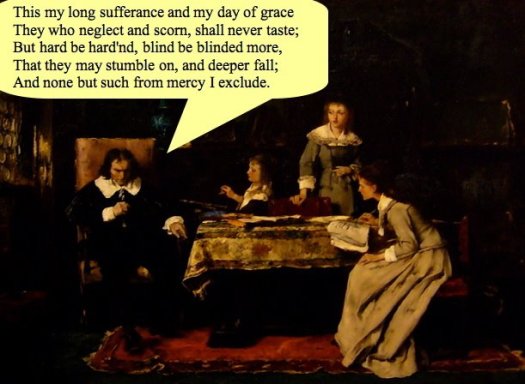
How welcome a sight was “The Blind Milton Dictating ‘Paradise Lost’ to His Daughters.” Yes, that face was familiar, as was the composition, even though I had never troubled myself to note, let alone pronounce, the name of its artist: Mihály Munkácsy. I was surprised to reencounter “Blind Milton” there, knowing it to be on permanent display at New York Public Library on 42nd Street (where it is currently the centerpiece of an exhibition celebrating Milton’s life and works). As it turns out, there are two version of Munkácsy’s painting, the one in New York City being the larger of the two.

This year marks the quatercentenary of Milton’s birth, so we are likely to come across “Blind Milton” in the arts and literature sections of our newspapers or the pages of magazines on history and culture. Even in the 19th-century, the image was frequently reproduced on paper. Indeed, we happened upon such a reproduction at a second-hand bookstore in the Hungarian capital not long after our gallery visit, on the very day it was featured in The New York Times arts section online.

The image became so familiar that, by the twentieth century, the

usual conception of John Milton in the imagination of America’s school children has been a misty mezzotint of a blind man sitting in a dark room dictating Paradise Lost to his bored but dutiful daughters.  That Milton was one of the most fearless and most revolutionary thinkers of his century few youngsters have ever been permitted to know.

.This is how, in 1939, Max Wylie prefaced “The Story of John Milton,” a script from the radio series Adventure in Reading (NBC; 1938-40). The play (by Helen Walpole and Margaret Leaf) tells of blindness, vision, and the specter of persecution as the monumental struggle of the beleaguered poet is being recalled by the voices he called forth in his art.

For twelve years, Milton’s ideas had been in the service of the Commonwealth, until the Restoration threatened to obliterate his words and legacy. Awaiting news from his friend Sir Harry Vane, Milton tries to dictate Paradise Lost to his daughter Mary:

Milton.  You aren’t writing, Mary, you aren’t writing!

Mary.  How can I father? How can I do anything … while we’re waiting for the coming of Sir Harry!

Milton.  Write.  Take down what I say.  “Wolves shall succeed for teachers, grievous Wolves, / Who all the sacred mysteries of Heav’n / To their own vile advantage shall turn. . . .”

Mary.  I cannot.  I cannot.  Paradise Lost may never be finished.

Milton.  Paradise Lost shall be finished.  I’m not a human being any longer, Mary.  I’m an instrument … a vessel … you don’t understand that … but no matter … I may seem hard to you and your sister … but that’s not important either. . . .

Mary.  I shall try to write.  Dictate it again, father.

Milton.  “Wolves shall succeed for teachers, …”

The war of ideas and the fight for their expression—a challenge as urgent in 1660 and 1939 as it is today—is a fitting subject for the so-called blind medium, a medium capable of conjuring images before the mind’s eye not grown dim from lack of exercise.

Milton is accused of treason. The burning of his books, to be executed by “a common hangman,” have been ordered. “Blind among my enemies…. How can I fight?” the poet cries in near despair, until, roused by his visions, he declares:

If, by my own toil, I have fanned the flame that burned out my eyes … then from that darkness will be born new eyes. All natural objects shut away … I can see clearer into life itself….  My vision will not be blurred or turned aside! And so, O, Highest Wisdom, I submit.  I am John Milton, whose sight was taken away that he might be given new eyes.

It is in the opening lines of the third book of Paradise Lost that Milton comments on his condition:

I sung of chaos and eternal night,
Taught by the heav’nly muse to venture down
The dark descent, and up to re-ascend,
Though hard and rare: thee I revisit safe,
And feel thy sovran vital lamp; but thou
Revisit’st not these eyes, that roll in vain
To find thy piercing ray, and find no dawn;
So thick a drop serene hath quenched their orbs,
Or dim suffusion veiled […].
Seasons return, but not to me returns
Day, or the sweet approach of ev’n or morn,
Or sight of vernal bloom, or summer’s rose,
Or flocks, or herds, or human face divine;
But cloud instead, and ever-during dark
Surrounds me, from the cheerful ways of men
Cut off, and for the book of knowledge fair
Presented with a universal blank
Of nature’s works to me expunged and razed,
And wisdom at one entrance quite shut out.
So much the rather thou celestial light
Shine inward, and the mind through all her powers
Irradiate, there plant eyes, all mist from thence
Purge and disperse, that I may see and tell
Of things invisible to mortal sight.

It seems that, in the scene depicted by Munkácsy, Milton is dictating these very lines, at the moment dramatized for Adventure in Reading. His three dutiful daughters look anything but bored. Entrusted with a solemn responsibility and not altogether ignorant of their father’s perilous position, they are rapt and apprehensive as they listen to the dictation, encoded in which is the speaker’s intimate story, a few telling lines in an epic on the fallibility of humankind.