
Pitch-Hitting; or, When Dietrich’s Not Herself

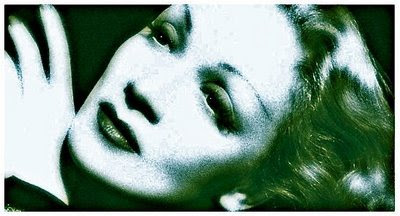
My grandmother refused to listen. She would walk out of the room whenever Marlene Dietrich appeared on the small screen. “She betrayed our country,” Oma would say, referring to Dietrich’s departure for Hollywood about the time the fascists came into power. Actually, Dietrich left a few years earlier; but the Nazis sure failed to lure her back. What a loss it is to turn a deaf ear to what aforementioned radio actor Joe Julian called “an exotic accent” and a “strong voice-presence.” Working with her in Dietrich’s lost radio series Café Istanbul (1952), Julian got a “glimpse behind the public image” and discovered

a woman of strength, warmth, and intelligence, yet so spontaneous that when, during a rehearsal, she overheard one of the actors express doubt that the rest of her body [she was in her early fifties by then] was as youthful as her famous legs, she ripped open her blouse to prove him wrong.

On this day, 8 October, in 1939, Dietrich could provide no such proof of her health and vitality. Scheduled to appear on the Screen Guild program that night, she was forced to call in sick due to a severe cold that, according to Roger Prior, host of the show, had halted the shooting of Dietrich’s comeback feature Destry Rides Again. The star had tried to honor her commitment, but had lost her voice entirely during rehearsals. In what must be one of the most inept voice-overs in Hollywood history, the Screen Guild producers replaced her with . . . Zasu Pitts.

It was all for laughs, of course. After all, Pitts’s voice had about as much sex appeal as fingernails being painstakingly filed . . . with a blackboard. And by casting Pitts opposite the less-than-expressive Gary Cooper, the Guild made the most of this emergency situation. “Is that Marlene Dietrich?” Cooper inquired. The affirmative only produced a terse “Well, so long.” Trying to explain the situation, Prior informed Cooper that “Zasu has Marlene Dietrich’s lines.” “Not from where I’m standing,” Cooper retorted. Together with Bob Hope and the actress billed as “Marlene Zasu Dietrich Pitts”, he nonetheless condescended to co-star in the sketch “The Girl of the Woolly West; or, She Was Wearing Slacks, So She Died Like a Man.” It sure made audience’s anxious for Dietrich’s return.

Nine years later to the day, on 8 October 1948, Dietrich was once again sick—and scheduled to appear on the air. This time, though, she was able to perform her role, cast as she was as the ailing Madame Bovary in the Ford Theater presentation of the novel as adapted by NBC staff writers Emerson Crocker and Brainerd Duffield . Sure, you’ve got to take Madame Bovary with “a pinch of power”; but you won’t be sorry to hear Dietrich breathe her last on the occasion. Besides, who could expect fidelity in the case of Emma Bovary?

“If some of Flaubert’s delicate delineation of character was missing from ‘Bovary’-on-the-air,” critic Saul Carson remarked, “Marlene Dietrich more than made up for this loss in literary flavor by her superb acting in the lead role.” Hardly carrying the chief burden, Dietrich was supported that night by Van Heflin and Claude Rains. “Too often, film stars rely on their screen reputations to cover slipshod work in radio,” Carson conceded; “but these people performed as artists who respected the medium as well as the vehicle.”

If Dietrich’s in it, just about any vehicle will do for me. Unfortunately, the extant recording does about as much justice to her timbre as Zasu Pitts. As for you, grandma, who saw trains depart for the concentration camps without making a noise, I’m just sorry that fascist propaganda robbed you of your senses . . .
He Calls Them As He Hears Them: Joseph Julian Remembers

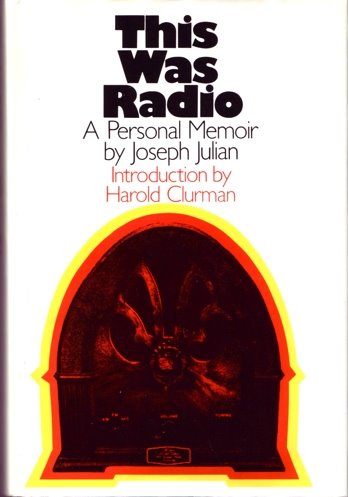
“The small but rich body of radio literature, which [Norman Corwin] brought so lovingly to life, lies languishing in a few libraries and second-hand book shops, under the titles Thirteen by Corwin and More by Corwin—a great shame and deprivation for the present generation!” My sentiments, entirely. Not my words, though, which is why I had to slap quotation marks on them. The man who said so was Joseph Julian, a once highly acclaimed and sought-after radio actor who starred in a number of plays written and directed by Corwin during the early-to-mid 1940s. Today, Julian’s memoir, a copy of which I recently added to my own library of out-of-print books on broadcasting, is one among those “languishing” volumes, a forgotten voice from a medium whose dramatic potentialities have remained largely unsounded since the late 1950s.

This Was Radio came out in the mid-1970s, a time widely deemed ripe for a reassessment of the aural medium and its derelict theater of the mind. Rather than waxing nostalgic—thereby squeezing the last few bucks out of a defunct business which, back then, most American adults still recalled experiencing first-ear, and fondly at that—Julian takes readers on a trip down memory lane that leads into neighbourhoods they would not get to hear about on an official tour.

His Corwinian class acts aside, Julian appeared on thriller programs like The Falcon, The Shadow, Inner Sanctum, Mr. Keen, Broadway Is My Beat, and The Mysterious Traveler. He was first heard on The March of Time, but as an also-ran-off-the-mouth, in re-enactments that called for crowd scenes. Briefly, he served as a sound man, during which stint he learned what noise a human body produces when it is turned inside out.

I can imagine just what kind of sounds emanated from Julian when he learned that the same thing was happening to his career. An established actor by the early 1940s, Julian remained highly successful throughout the decade, until, in 1950, his name appeared in Red Channels. His career as a radio actor declined rapidly; by 1953, his annual income had dwindled to a mere $1630.

Barred from work at CBS, Julian fired back by filing a lawsuit for libel. Character witnesses during Julian’s 1954 trial were Edward R. Morrow (last talked of here) and the aforementioned Morton Wishengrad. It was “an ugly period in American life and in mine,” Julian comments. His “urge” was “to skip over it”; but he felt a

responsibility as a victim to record some of what [he] went through. A whole new generation hardly knows that such a thing ever happened. But the fact is it could easily happen again if we relax our vigilance in defending our freedoms. Control of broadcasting is one of the first major objectives of those who would take them away.

His lawsuit was dismissed; thereafter, Julian virtually unemployed until William Fitelson, a theatrical lawyer and executive producer of the Theater Guild’s US Steel Hour television series staged one of the actor’s own plays in December 1954. Julian’s fortunes changed as quickly as they had declined; and he once again “getting calls for radio acting jobs.”

Without bitterness, Julian tells it as it is. About Myrna Loy, for instance, he remarks that, “if she had to win [her radio] role in a competitive audition with radio actresses, she wouldn’t have been there. Her voice, isolated from her other attributes, was dull and flat. She was selling her name, not her art.” More problematic still was it to perform a dramatic scene with Veronica Lake, who had such a weak, wispy voice” that the sound engineer could not get her and Julian “in proper balance.”

Lake was handed a “separate microphone across the stage” so that the engineer could “could mechanically raise her voice level to mine.” However effective for listeners at home, her faraway whispers had Julian straining to hear his cues. “Especially since they had her facing front so the audience could see her famous peek-a-boo hairdo. Hardly the way to play an intimate love scene with a lady!”

Of the notorious Hummerts, who “grimly dominated their empire” of soap operas, Julian remarks:

There was something darkly foreboding about [them].  Their stiff presence always evoked a sense of insecurity.  And with good reason.  They had a reputation for firing actors who incurred their slightest displeasure.  And authors.  When Mrs. Hummert once told a writer that she wanted “God” on every page of a script, and his answer was “Who will we get to play Him?” he was fired on the spot.  And whey you were fired from one of their shows it was a catastrophe.  It meant being banned from all their nine or ten others that might be on the air at any given time.

Call him fortunate or not, Julian continued to act on the air well into the medium’s decline. On this day, 4 October, in 1959, he was heard on Suspense, one of radio’s last remaining drama anthologies, in the routine thriller “Room 203.” It is a far cry from Julian’s greatest work; but these days, almost any cry uttered on radio seems distant.