
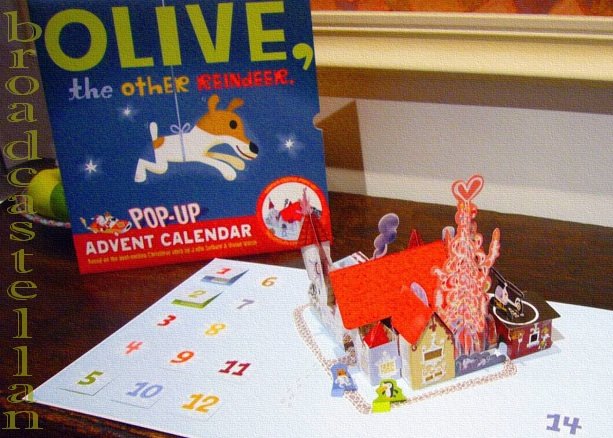
 Four weeks and a day! As the exclamation mark suggests, being that I use it so sparingly, I am not counting down the days to New Year’s Eve here or marvel at the seemingly accelerated passing of time. It is the time my cold has been taking thus far to run its collision course and me crazy into the not so welcome bargain. It could be, though, that today’s headache has been exacerbated by Mickey Rooney.
My attempt to book tickets to his latest show, that is. I tried to get in touch with a sales representative to make sure that the tickets I ordered online won’t be sent to our home, as requested, given that, as it dawned on me only after I had finalized the booking, we are elsewhere during the latter part of December.
The apparently unstoppable octogenarian, Judy Garland’s co-star in a series of musical-comedies, is going to be in one of those pantomimes so popular in Britain during the holiday season; this time, some eighty-two years after his acting debut in motion pictures, he appears at the Hippodrome in Bristol, England, where we had planned to spend the final forty-eight hours of 2008.
The busy Mr. Rooney, slated to appear in four films in the upcoming months, stars opposite British stage and television actress Michelle Collins, whom last we saw backstage at the Shaftesbury Theatre in London (and whose autograph I displayed here). Anyway, I eventually sorted out the mailing situation and can only hope that the constitution of the man formerly known as Andy Hardy will prove sturdier than mine.
I am in the mood for a seasonal tale, tall or otherwise, but would much rather close my eyes than read Christmas Stories with its selection of fiction by Conan Doyle, Damon Runyon, Evelyn Waugh, and, a personal favorite, Anthony Trollope. So, once again, I rely on the radio, or recordings of plays once produced for the medium. On this day, 2 December, in 1945, The Philco Radio Hall of Fame presented a new story, which it predicted to “become a Christmas classic.”
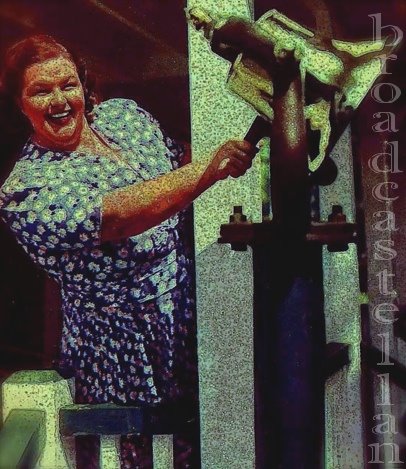 Never mind that this prediction did not quite come true. After all, the woman who made it was not chiefly known as a clairvoyant, even though she had a voice that could induce millions to spend millions on war bonds and forge stars in the smithy of her own radio shows. Announcer Glenn Riggs somewhat needlessly reminded the public that, “as commentator, singer, forceful personality and discoverer of stars,” she had “no equal on the air.” Yes, it was Kate Smith who ventured that guess, no doubt boosting the sales of the volume. When Smith sings, you can count on sales as well as volume.
On the Hall of Fame, Smith not only belts out a number of tunes, including “If I Loved You” from the latest Rodgers and Hammerstein musical Carousel and her celebrated rendition of “God Bless America”; as story lady, Smith narrates a dramatized version of Roger Duvoisin’s “The Christmas Whale,” a whimsical paean to ingenuity involving the breakout of a flu epidemic at Santa’s toyshop and the reindeer that flew not because they all came down with it. Perhaps, such susceptibility explains why this year’s advent calendar featuring Olive, the Other Reindeer, arrived a day late in the mail.
The title of Duvoisin’s story leaves no doubt as to the creature lending a helping fin. Perhaps, the sudden substitution was a metaphor for the death of FDR just at the time when things were beginning to look up and the theaters of war were closing, not merely for the duration of the holidays. There is no mention of Harry Truman; but, when asked what Christmas gift she would make General Eisenhower, Smith remarks: “Well, I’d give him a future as great as his past.” Perhaps, she was prophetic after all . . .
 Harry Heuser