
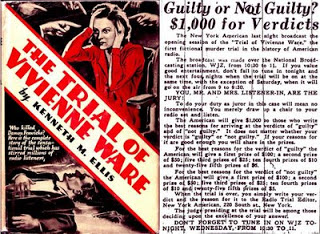
Blind Justice; or, ‘1000 for Verdicts’

“It does not matter whether your verdict is ‘guilty’ or ‘not guilty.’ If your reasons for it are good enough you will share in the prizes.” With this peculiar invitation, millions of US Americans were lured to their radios, tuned in to WJZ, for a trial in which they, the listening public, were called upon to act as jurors. As previously mentioned here, it all began on this day, 25 November, in 1930.

The judge in the case was none other than New York Senator Robert F. Wagner, lending gravitas to a spectacle that was, in more sense than one, a trial broadcast. Would listeners find fictional society beauty Vivienne Ware guilty of the murder of millionaire architect Damon Fenwicke, a crime for which she could be sentenced to the electric chair? And would they leap out of their armchairs to boost not only their own circulation but that of their local paper by rereading what they just heard on the air?

“It is no part of your duty to decide whether or not she shall die,” Senator Wagner insisted. That, he told the listeners,

is the function of the Court and the Law.  But you must remember that in endeavoring to secure a conviction of this young and beautiful defendant the District Attorney is but pursuing the business to which you, the people of this State, have set him.  You will consider carefully all the evidence as it is presented for you from the witness stand.

Whether or not their voices could kill, those tuning in nevertheless derived their thrills from the importance of the interactive role granted to them. Tune in, have your say, all for a chance to win a substantial amount of dough—what’s not to love!

Leave it to a Hearst paper to conceive of a reality show like The Trial of Vivienne Ware—a trial that sold papers and bought the jury. Those who caught up with the daily broadcasts from the courtroom and read transcripts and analyses in their daily Hearst paper were rewarded for being informed enough to arrive at the verdict they were invited to mail in. No attendance, no deliberations with fellow jurors required. All that was needed, aside from a radio set and a few cents for daily tabloids, was curiosity, rhetoric, and greed.

You might say it was just fiction, this fictitious call for justice; but the Hearst press, known to have started a war with mere words, was doing its utmost to make the trial seem as real as the joined media of radio and the press could make it, all with the aim of a very real boost in sales through a cleverly manipulative marketing campaign.

More than a radio serial, The Trial of Vivienne Ware is one of the most elaborate and dubious media events ever staged. All that remains of it now are a number of newspaper articles and a book touted as “an innovation in both the radio and publishing worlds”—the “first radio novel.”

To be sure, Kenneth M. Ellis’s “novel”—a combination of faux news reportage and courtroom dialogue—has none of the thrills of the original experience. Its failure to excite and convince convincingly argues the power of the media to create a sense of reality through the realities we glean from sensation.

On This Day in 1930: ‘”Mystery Gun” Disappears As Lights Go Out’ in Invisible Courtroom

I don’t suppose I shall ever get used to it. The Welsh weather, I mean, the nocturnal roars and howlings of which I often drown out by listening to the familiar voices of old-time radio, reassuring and comforting voices like those of Harry Bartell or Elliot Lewis, both of whom were born on this day, 28 November, in 1913 and 1917, respectively. Storms are part of the Welsh soundscape, much like the bleating of sheep on the hills. If such climate conditions were faced by the people of New York, among whom I numbered for some fifteen years of my life, I wager that the local television newscasts would report little else. To be sure, last night’s storm did make headlines, being that a tornado wreaked havoc in a village just a few miles from my present home.

Thanks to some well-chosen radio thriller, I managed to sleep through it all, losing myself in dreams that, once radioactivated, tend to become particularly vivid. I often wonder just how much my mind, conscious or not, is influenced by the popular culture I consume by listening in. Sometimes, though, it is what we hear about, and not what we perceive, that stirs our imagination. There are a few listening experiences I can only dream of, plays I have only read or read about and consequently fascinate me no end. One such unheard soundplay is the serial The Trial of Vivienne Ware (previously mentioned here and discussed at some length in Etherized, my study of American radio dramatics). Pulled by the Hearst press and propagated on the air by station WJZ, New York, it was a spectacular publicity stunt designed to promote Hearst’s less than reputable papers.

Those tuning in did not only get to hear the proceedings, but were cast as jurors. They stood a chance of being awarded $1000 for coming up with the most convincing verdict (be it “guilty” or “innocent”), thus making it unnecessary for the author of the story—one Kenneth M. Ellis—to determine upon a reasonable conclusion and the fate of his titular character.

From the 25th to the last day of November, the fictional trial was broadcast live, with eminent figures of law and politics, New York Senator Robert F. Wagner and prominent attorney Ferdinand Pecora, heading a cast that included noted stage actress Rosamund Pinchot. Here is how the New York American, the Hearst paper sponsoring the series, described the session of 28 November 1930:

It was almost at the close of the session that the lights suddenly were extinguished and the court plunged into total darkness. Women’s screams, the shouts and bustle of court attaches, and the hammering of the gavel filled five or six black seconds with sound. Then the lights came on again—but the .38 caliber revolver which George Gordon Battle, chief counsel for Vivienne Ware, had just introduced as evidence had disappeared from the table where it lay.

Now, that’s a melodramatic conjuring act fit for the airwaves. It probably wouldn’t do much good during a stormy night, though, since such interactive thrills—let alone the pondering of the verdict, and what to do with the prize money—are, unlike much else that was presented on American radio with comforting predictability, anything but soporific.

On This Day in 1930: Murder Trial Broadcast Summons Millions to Court

Well, it is Black Friday here in New York—the stores are opening at preposterously early hours and shoppers are lured away from their leftover turkey with promises of early bird specials and nest egg busting savings. Too lazy after a sumptuous Thanksgiving meal, I am not partaking of any 5 AM bargain debasements. Instead, I am going to celebrate yet another milestone in radio drama history—The Trial of Vivienne Ware, which opened on this day, 25 November, in 1930 and ushered in a new age of cross-promotional multimediacy.

“There’s murder in the air,” the New York Times had announced in its Sunday radio section, predicting that The Trial of Vivienne Ware would “occupy the attention of listeners over WJZ’s network for six consecutive nights beginning Tuesday.” Considerably more enthusiastic was the New York American, which declared the six-part serial to be “one of the most stirring mystery radiodramas ever presented,” quoting NBC president M. H. Aylesworth as saying that its script “established a new standard in the creation of radio plays. The simplicity and fidelity of the theme, together with the colorful word and character pictures, stand out in this new field of adaptive writing.”

The New York American—the Hearst “paper for people who think”—had good reason to eulogize the as yet unaired serial as “one of the best radio dramas ever written,” given that the program had been conceived by one of its own feature writers.

Every effort was made to prevent the program from appearing like a cheap marketing ploy and to convince WJZ, New York—the flagship station of NBC’s Blue network—to produce the series in its glass-curtained Times Square studio atop the New Amsterdam Theatre and to broadcast the event locally instead of making the required six half-hour spots available to national advertisers.

Certain to impress NBC executives was the fact that—along with Ferdinand Pecora, Assistant District Attorney of New York, and prominent New York attorney George Gordon Battle—none other than US Senator and Supreme Court Justice Robert F. Wagner had agreed to participate in the mock trial by assuming the role of the presiding judge. The titular heroine was played by Rosamund Pinchot, a stage actress who had appeared in Max Reinhardt’s celebrated staging of The Miracle, and the entire spectacular was supervised by well-known Broadway producer John Golden.

“Ladies and Gentlemen of the Radio Jury,” Wagner addressed the audience during the inaugural broadcast:

You have been called to one of the most trying tasks which befalls the lot of a citizen. You are to try a fellow being on a charge of first degree murder.  It is the more difficult for you in that this defendant has everything which would make life for any young woman most desirable.  Yet it may become your solemn duty to deprive her of her enjoyment of that life.

Standing to gain cash prizes for the most convincing verdict, readers of the New York American were advised to prepare themselves by taking in the published “information” daily, since they might miss “important loop-holes” if they did not “carefully follow the testimony and the evidence” as presented on the radio. “By reading the New York American every morning” throughout the trial and by “tuning in on WJZ each night at the specified time,” readers should be able to form their verdict as to Miss Ware’s guilt or innocence—“just like any other juror.”

According to Radio Digest, verdicts, letters of congratulations, and demands for a sequel were received from places as remote as Canada and Virginia, as well as from ships at sea; an estimated 14,000 listeners eventually acquitted the fictional heroine on trial, with about 2000 arguing the “society girl” to be guilty. More significant for the publisher was that the serial had increased the circulation of the New York American “far in excess of expectations,” as a result of which Hearst papers in San Francisco, Chicago, Los Angeles, Washington, and Omaha sponsored the trial with different casts of local luminaries.

A follow-up trial involving the murder victim’s less privileged “friend,” nightclub singer Dolores Divine, was staged a few weeks after the acquittal of the first defendant. A generic version of the radio scripts for both serials, prefaced by excepts from the printed reports and concluding with the audience verdict, was subsequently published by Grosset and Dunlap, which marketed Kenneth M. Ellis’s The Trial of Vivienne Ware as the “first radio novel, an innovation in both the radio and publishing worlds.”

Unfortunately, no recordings of this interactive multi-media event seem to have survived. I sure would have enjoyed tuning in . . .