
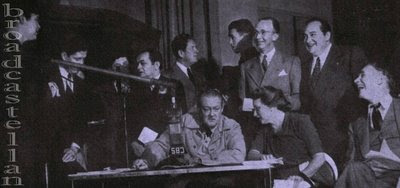
 I might as well end this year’s regular programming here at broadcastellan with a bang. This one was sure made an impact, heard by as many as sixty million Americans—at once. Subtitled “A Dramatic Celebration of the American Bill of Rights, Including an Address by Franklin D. Roosevelt,” We Hold These Truths made radio history on this day, 15 December, in 1942. It also made the most of history in the making.
“No other single dramatic performance [. . . ] ever enjoyed so large an audience,” author Norman Corwin remarked in his notes on the published script. The program was “[w]ritten at the invitation of the US Office of Facts and Figures” to commemorate the 150th anniversary of the United States Bill of Rights, which came into effect on 15 December 1791,; but it was already in the works when the attack on Pearl Harbor took place.
“In fact,” Corwin later recalled (in Years of the Electric Ear), “I was on a train travelling from New York to Hollywood, still working on the script when the attack on Pearl Harbor took place.” Now that the United States had entered the war, the broadcast became a rallying cry, a reminder of the rights it is the duty of all those who possess them to protect.
“To many listening Americans,” Movie-Radio Guide summed up in its 3-9 January 1942 issue,
the big “Bill of Rights” program broadcast over the Nation’s networks Monday, Dec. 15, was an utterly unforgettable event. To the many personalities who joined their talents to produce the program it was likewise a memorable privilege. Coming as it did at a time when it could not have meant mere to the nation, the broadcast brought America figuratively to its feet. A transcription of the superb dramatic production [. . .] will be preserved in the archives at Washington.
The cast, as shown above, included Orson Welles, Rudy Vallee, Edward G. Robinson, Bob Burns, James Stewart, Walter Brennan, Edward Arnold, as well as (seated) Lionel Barrymore, Marjorie Main, and Walter Huston.
According to the Movie-Radio Guide, “[o]ne of the highlights of the presentation was the performance of James “Jimmy” Stewart.” So moved was he by the reading that, at the close of the broadcast, he “pulled off his earphones” and “let down his emotions, excusing himself from the studio and reportedly breaking into tears in private.” No wonder, Stewart was called upon to introduce President Roosevelt, who addressed the public from Washington, DC. Upon this experience, the humble actor remarked: “Imagine a corporal introducing a Commander in Chief of the armed forces!”
 Yes, it’s been a good day. Yes, sir, a good day. Started out that way. When I woke up, the warm, friendly smell of breakfast was drifting upstairs, and the blossoms of my cherry tree were tapping against the windows. Mmm. Lying there, I felt seventeen. Until Marilly’s voice bolted upstairs . . .
  Well, it isn’t C. B. DeMille, folks. Those tuning in to the Lux Radio Theater on this day, 30 November, back in 1936, were in for a surprise. DeMille, host and nominal producer of the program, briefly addressed the audience from New York, rather than uttering his customary “Greetings from Hollywood.” For the “first time” since taking on his role, he was going to “join the Lux Radio Theater‘s legion of listeners” instead. There was just enough time for him to mention his latest picture, The Plainsman, which he was currently previewing coast to coast, and to announce his substitute: “The show you and I are about to hear has been prepared by one who is certainly on speaking terms with our microphone: Lionel Barrymore. To one so familiar, and so beloved, the mention of his name is the most glowing introduction I could give.”
 Harry Heuser