
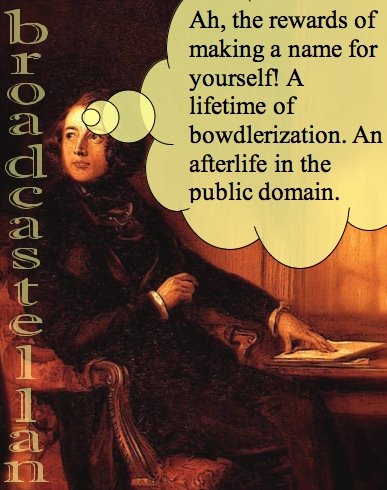
They are still after him, those producers of television drama. And they know that many of us are eager to follow. In a way, we cannot help being After Dickens, to borrow the title of a study on “Reading, Adaptation and Performance” by John Glavin. It is a sly title, that. After all, we are belated in our pursuit; we do more than simply try to catch up. We are bringing something to the game that is the act of reading. We are making sense, and we remake it, too.
Andrew Davies, the writer responsible for the award-winning dramatization of Bleak House, subsequently tackled Little Dorrit (1855-57), one of the lesser-known works in the Dickens canon. Having greatly enjoyed Bleak House when it first aired back in 2005, I was again drawn away from the wireless, to which most of the posts in this blog are dedicated, to go after what is being shared out—in installments, not unlike in Dickens’ day—by radio’s distant and rich relation.
Now, it has been some time since I read Little Dorrit. During my graduate studies, the novel tantalized me with its perplexing nomenclature, an uncrackable code of names and monikers that inspired me to dabble in the dark art of onomastic speculation. The result of my academic labors, “Nominal Control: Dickens’s Little Dorrit and the Challenges of Onomancy,” is available online.
While many of the names heard in the adaptation of Little Dorrit still ring the proverbial bell for me, some of the faces, as made up for us by the adaptor, seem less familiar. Never mind Arthur Clennam, who is rather younger than the middle-aged man Dickens was so bold to place at the center of his novelistic commentary on the manners, mores, and money matters of Victorian Britain. The character of Tattycoram is the one to watch out for and puzzle over: a foundling turned changeling.
In the original story, Tattycoram (alias Harriet Beadle, alias Hattey—the act of naming is that complicated in Little Dorrit) is introduced as a “handsome girl with lustrous dark hair and eyes, and very neatly dressed.” As portrayed by Freema Agyeman, the televisualized Tatty certainly fits the bill: a young woman with dark hair and eyes, and, my metaphorical hat off to the costume department, handsomely outfitted.
Hang on, though. The color of her skin, to which no reference is made in the novel, appears to have been adjusted; and, in a crowd of pale faces, it is a change that really makes a difference. Has Tattycoram just “growed” that way?
It surely is not simply a case of equal opportunity for television actors like Agyeman, if such cases are ever simple. A black Tattycoram transforms the very fabric of Little Dorrit. It imposes an historical subtext on our reading of the story and the young woman’s part in it.
Adaptors, like translators, frequently engage in such updates, if that is the word for what can amount not only to anachronisms but to presentism, the latter being the imposition of a viewpoint contemporary with the audience of the new version. I was not bothered by the lesbian characters the BBC insisted on sneaking into the staid and psychologically none too complex mysteries of Agatha Christie, even though such reorientations seem gratuitous. The determination adaptors made regarding Tattycoram’s ethnicity is altogether more problematic.
While slavery was abolished in Britain prior to its publication, Little Dorrit is set some thirty years in the past, the possible implications of which present-day television audiences are not given sufficient context to ponder and may not even notice. I had certainly forgotten about the dating of the action prior to the coronation of Queen Victoria. Little Dorrit, unlike Dickens’ A Tale of Two Cities and Barnaby Rudge, is not an historical novel, however; nor is it a commentary on the slave trade.
Concerned with prison reform, and the injustices of the debtor’s prison in particular, the novel refers to slavery only metaphorically to signify systems of oppression and forms of thraldom, perceived or actual. At one point, the orphan Harriet is taken in as a companion by the fiercely independent Miss Wade who, in readings of the novel, has been outed as a lesbian. In a first-person narrative, Miss Wade reflects on her earlier experience as a governess: “I was not bought, body and soul. She [Miss Wade’s employer] seemed to think that her distinguished nephew had gone into a slave-market and purchased a wife.” Clearly, in this questionable equation of servitude and slavery, no comment on the reality of the slave trade was intended by Dickens in this expression of a character’s anger regarding her station and the transgression of which she believes herself to have been accused.
In the Victorian novel, the black or “mulatto” figure remained largely invisible, or else was the brunt of derision. One such laughing-stock character is Thackeray’s Miss Swartz, the “rich woolly-haired mulatto from St. Kitt’s” who parades through Vanity Fair being “about as elegantly decorated as a she chimney-sweep on May-day.” In Dickens’ Bleak House, concerns about black lives in the colonies are dismissed as the folly of “educating the natives of Borrioboola-Gha, on the left bank of the Niger.”
Of the nearly one hundred, mostly flat characters that flit in and out of Little Dorrit—which, according to the Radio Times, were reduced to around seventy-five in the process of compression—it is Tattycoram, an orphan named after the notorious Coram hospital in London, who now stands out as an individual struggling to emerge from a socially imposed conspicuous invisibility that, the adaptation insists, is owing to her ethnicity. Thus, a marginal character takes center stage by an imposed discourse on the nature of her marginalization. In other words, the attention paid to her, belatedly, is justified mainly by the postcolonial narrative grafted on the novel in which the Harriet in question is treated as if she were the brainchild of Beecher Stowe.
Showing a little skin, and revealing it to be black, Davies’ retailoring may strike some audiences who are acquainted with the genuine article as a bold new cut. And yet, in the process of giving the old Empire new clothes, the Dickensian fabric is suggested to be more than a little Tatty. Perhaps, instead of such alterations, the assumption that, with strategic trimming, Dickens can still meet our aspirations needs adjusting.
They are still after Dickens, all right. The question is: are they even trying to get him or, riding on his coat-tails, are they out get at something he just hasn’t got?
 Harry Heuser
