
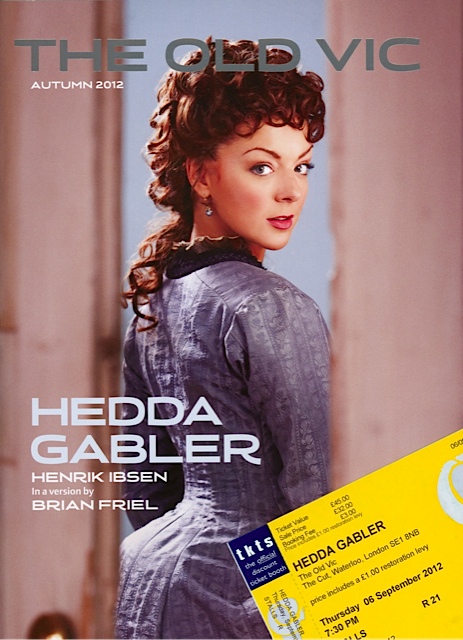
 “I don’t think he’s written a line that’s unnecessary,” Adrian Scarborough remarked about Henrik Ibsen during rehearsals for the latest production of Hedda Gabler at London’s Old Vic, in which Scarborough plays the part of Hedda’s husband. The endorsement is peculiarly out of place, considering that the Old Vic’s Hedda hardly distinguishes itself by—or even strives for—a line-by-line fidelity to Ibsen’s original. Rather than a rewording of previous translations, Brian Friel’s “new version” puts a few new words into the mouths of the old, familiar characters created by his fellow playwright, adding a line here and there that left me questioning their necessity.
Now, few theatergoers around the world are in a position to compare Ibsen’s Norwegian to the translation in which they hear those lines performed; and whether a character (in this case Hedda) says “But of course one has to grow accustomed to anything new” or “New surroundings take a little getting used to” seems to make little difference. Are such substitutions worth the bother? What’s more, are they worthy of a playwright like Friel?
“But of course one has to grow accustomed to anything new.” That line can be found in the American-English translation by Rolf Fjelde, who, in an effort of doing “the very best [a translator] can do,” kept “a conscience-file of revision” in hopes of getting the opportunity “Finally [to] Get It Right.” Fjelde got that chance—and the result seems not particularly in need of further emendation. Playwright Friel, though, is not about to offer his services as a mute transcriber whose job is to interpret without drawing attention to the interpreter and the challenges or impossibilities of arriving at any one definitive text in a given or taken language. Friel does not claim his English version to be the last word—and, rather than having us take his word for it being faithful, wants to have a word with us about it.
To do so, Friel inserts hints of himself into the action, which, aside from Hedda’s quest to destroy, quite literally, the text of patriarchy, involves the contest between two published writers, both western and male. Most overtly, he does this by taking liberties with the lines spoken by the middle-aged Judge Brack who, in Friel’s version, confounds his listeners with Americanisms like “making whoopee” and provides a running commentary on the currency and lifespan of written and spoken language. “Philadelphia, there you go!” Friel seems to say to Fjelde, suggesting that Broadway and the West End may well require or at least warrant alternate versions of Ibsen and arguing that neither variant of English can or should be considered transcontinental, let alone universal.
Unlike Fjelde, Friel reminds us that we are in Norway, having characters drop names of places or remarking on the quality of “Norwegian air.” Yet, also unlike Fjelde, Friel reminds us, by foregrounding the novelty or datedness of words and debating their suitability, that we are not in any particular, definitive place at all but that we are instead in the contested, dangerous territory of language. It is a territory that Hedda seems to control for a while with her probing questions and scathing remarks but that nonetheless delimits and ultimately overmasters her.
As scholar Anthony Roche puts it, Friel demonstrates himself to be “concerned with updating the constantly changing English language that will always require new adaptations of Ibsen, while making subtle additions that perhaps deepen our understanding of the rich emotional lives of the characters.” Friel’s Hedda is almost as much about Ibsen’s characters as it is about the act of reading them … and of interpreting Ibsen. It is a self-conscious take on the act of taking on a classic that, in its reflexivity borders on the by now rather tiresomely postmodern. Give it your best shot, translator, I felt like responding, and let Hedda get her gun and do the rest.
That Hedda couldn’t quite do her job—and that Friel hadn’t quite done his—became apparent from the laughter in the audience even as Hedda was about to do away with herself in the ingenious glass coffin the Old Vic production had prepared for that purpose. “This is my first Ibsen,” commented actress Fenella Woolgar (who took on the part of Thea Elvsted), “and I’m discovering that he is a lot funnier than I anticipated.” Perhaps, that’s because this ain’t quite Ibsen and because Friel isn’t quite the Ibsen-minded processor anyone expecting a traditional Hedda interpretation is likely to expect.
“Translation,” as I said elsewhere (in an essay on the subject) is too mild a word to capture the violent process whereby a text written in one language and time is taken apart and rebuilt in another. Hedda is a violent play; but given that I find myself preoccupied with the making of this Hedda rather than with the unmaking of its nominally central character, I wonder whether Friel has not inflicted some harm, necessary or otherwise, on Hedda and Hedda alike …

 “There’s no family uniting instinct, anyhow; it’s habit and sentiment and material convenience hold families together after adolescence. There’s always friction, conflict, unwilling concessions. Always!” Growing up in a familial household whose microclimate was marked by the extremes of hot-temperedness and bone-chilling calculation, I amassed enough empirical evidence to convince me that this observation—made by one of the characters in Ann Veronica (1909), H. G. Wells’s assault on Victorian conventions—is worth reconsidering. It is not enough to say that there is no “family uniting instinct.” What is likely the case during adolescence, rather than afterwards, is that the drive designed to keep us from destroying ourselves becomes the one that drives us away from each other. Depending on the test to which habit, sentiment and convenience are put, this might well constitute a family disuniting instinct.


 Now, I am not going to get all sentimental and give you the old “tempus fugit” spiel; but I’d like to mention, in passing, that this post (the 355th entry into the journal) marks the beginning of a third year for broadcastellan. Meanwhile, I am resting with a bad back—in the city that never sleeps, of all places. This afternoon, during an inaugural transatlantic video conference with my two faithful companions back home in Wales, my mind excused itself from my heart and took off in reflections about the ways in which technology has assisted in forging a bond between the US and its close ally across the pond, and the degree to which such tele-communal forgings may come across as mere forgeries when compared to the real thing of an actual encounter.
 Well, this isn’t a travel brochure; hence my taking the liberty of adding a question mark to the following: What better place to ring in the new year than in Scotland, where “Auld Lang Syne” is being sung more passionately and the ringing in goes on longer than anywhere else in the world? Having just returned from Glasgow and Edinburgh, I could think of a few alternatives, considering that Scotland’s chief tourist attractions this time of year—the famed Hogmanay festivities, were pretty much wiped out by fierce gales and lashing rains. The British weather! I have mentioned and deplored it often enough in this journal to claim that I was unprepared for its party-pooping force.
 While I have no intention to see that show, I had my share of theatrical treats, foremost among them a revival of Barrie’s What Every Woman Knows and an imaginative staging of Mervyn Peake’s
  Harry Heuser