
Double Hedda: Friel, Ibsen, and the Business of Giving It One’s Best Shot

“I don’t think he’s written a line that’s unnecessary,” Adrian Scarborough remarked about Henrik Ibsen during rehearsals for the latest production of Hedda Gabler at London’s Old Vic, in which Scarborough plays the part of Hedda’s husband.  The endorsement is peculiarly out of place, considering that the Old Vic’s Hedda hardly distinguishes itself by—or even strives for—a line-by-line fidelity to Ibsen’s original.  Rather than a rewording of previous translations, Brian Friel’s “new version” puts a few new words into the mouths of the old, familiar characters created by his fellow playwright, adding a line here and there that left me questioning their necessity.

Now, few theatergoers around the world are in a position to compare Ibsen’s Norwegian to the translation in which they hear those lines performed; and whether a character (in this case Hedda) says “But of course one has to grow accustomed to anything new” or “New surroundings take a little getting used to” seems to make little difference.  Are such substitutions worth the bother? What’s more, are they worthy of a playwright like Friel?

“But of course one has to grow accustomed to anything new.”  That line can be found in the American-English translation by Rolf Fjelde, who, in an effort of doing “the very best [a translator] can do,” kept “a conscience-file of revision” in hopes of getting the opportunity “Finally [to] Get It Right.”  Fjelde got that chance—and the result seems not particularly in need of further emendation.  Playwright Friel, though, is not about to offer his services as a mute transcriber whose job is to interpret without drawing attention to the interpreter and the challenges or impossibilities of arriving at any one definitive text in a given or taken language.  Friel does not claim his English version to be the last word—and, rather than having us take his word for it being faithful, wants to have a word with us about it.

To do so, Friel inserts hints of himself into the action, which, aside from Hedda’s quest to destroy, quite literally, the text of patriarchy, involves the contest between two published writers, both western and male.  Most overtly, he does this by taking liberties with the lines spoken by the middle-aged Judge Brack who, in Friel’s version, confounds his listeners with Americanisms like “making whoopee” and provides a running commentary on the currency and lifespan of written and spoken language.  “Philadelphia, there you go!” Friel seems to say to Fjelde, suggesting that Broadway and the West End may well require or at least warrant alternate versions of Ibsen and arguing that neither variant of English can or should be considered transcontinental, let alone universal.

Unlike Fjelde, Friel reminds us that we are in Norway, having characters drop names of places or remarking on the quality of “Norwegian air.”  Yet, also unlike Fjelde, Friel reminds us, by foregrounding the novelty or datedness of words and debating their suitability, that we are not in any particular, definitive place at all but that we are instead in the contested, dangerous territory of language.  It is a territory that Hedda seems to control for a while with her probing questions and scathing remarks but that nonetheless delimits and ultimately overmasters her.

As scholar Anthony Roche puts it, Friel demonstrates himself to be “concerned with updating the constantly changing English language that will always require new adaptations of Ibsen, while making subtle additions that perhaps deepen our understanding of the rich emotional lives of the characters.”  Friel’s Hedda is almost as much about Ibsen’s characters as it is about the act of reading them … and of interpreting Ibsen.  It is a self-conscious take on the act of taking on a classic that, in its reflexivity borders on the by now rather tiresomely postmodern.  Give it your best shot, translator, I felt like responding, and let Hedda get her gun and do the rest.

That Hedda couldn’t quite do her job—and that Friel hadn’t quite done his—became apparent from the laughter in the audience even as Hedda was about to do away with herself in the ingenious glass coffin the Old Vic production had prepared for that purpose.  “This is my first Ibsen,” commented actress Fenella Woolgar (who took on the part of Thea Elvsted), “and I’m discovering that he is a lot funnier than I anticipated.”  Perhaps, that’s because this ain’t quite Ibsen and because Friel isn’t quite the Ibsen-minded processor anyone expecting a traditional Hedda interpretation is likely to expect.

“Translation,” as I said elsewhere (in an essay on the subject) is too mild a word to capture the violent process whereby a text written in one language and time is taken apart and rebuilt in another.  Hedda is a violent play; but given that I find myself preoccupied with the making of this Hedda rather than with the unmaking of its nominally central character, I wonder whether Friel has not inflicted some harm, necessary or otherwise, on Hedda and Hedda alike …

The Lion in Winter Wonderland; or, What’s That Fir?

Once a year, in the run-up to Christmas, my better half and I make the seemingly interminable journey from Wales to London for some seasonal splurging on art and theater. Now, I don’t travel all the way east to the West End to waste my time on pap like Dirty Dancing. This isn’t snobbery, mind; I simply can’t thrill to a feast of re-processed cheese and the prospect of paying for it through a nose bigger than Jennifer Grey’s old one. Besides, why raid the bottom shelves of our pop cultural cupboard when I’ve got a heaping plateful of squandered opportunities to chew over? During the days of my graduate studies in English and American literature, I had little money to spare for Broadway theatricals, which is why I now tend to seek out revivals of plays I missed the first, second, or umpteenth time around—drama with some history to it, be that pedigree or baggage. James Goldman’s The Lion in Winter has a bit of both.

As an added attraction, the current Theatre Royal Haymarket production also has the ever Ab-fabulous Joanna Lumley, whom I first saw on stage in the 2010 Broadway revival of La Bête. Lumley plays caged lioness Queen Eleanor opposite Robert Lindsay’s Henry II, the husband who keeps her under lock and key.  Witty and fierce, The Lion is a domestic drama fit for the tryingly festive season. All the same, the darn cat is in a confounded state of seasonal disorder.

What those stepping into the auditorium from the audio-visual onslaught that is Christmas time in the city cannot but gasp at is that even Henry’s halls are decked: his French chateau, anno 1183, features a regal Tannenbaum, no less. It certainly had my eyebrows raised to the alert level of WTF: you might expect a Green Knight, surely, but a bebaubled evergreen?

The proud Lion is prepared to pounce, though, ready to defend itself against “turbulent” critics crying bloody murder in the cathedral of culture. Goldman acknowledged that his “play contains anachronisms” such as the “way . . . Christmas is celebrated.” As he states in the notes duly reprinted in the playbill, the ahistorical trimmings are “deliberate”; “though it deals carefully with history,” The Lion “remains a piece of fiction.”

Towering over the assembled branches of Henry’s living family tree, the familiar, dead one serves as a reminder of the storyteller’s presence.  The needling transplant from our present day tells not only of the author’s intervening re-inventiveness but also of his obligation to make that past relevant: the dramatist does not simply stage history; he fashions it. To withhold evidence of this intervention would mean to falsify, to deny the hand and mind involved in the process of transcribing.

Goldman was nonetheless concerned that this never-evergreen might overshadow his research and cast doubt on his responsible interpretation of verifiable historical events. “This play,” he pointed out to his audience, “is accurately based on the available data.”

The elephant of a dislocated trunk aside, The Lion is refreshingly unself-conscious; it is a deluxe soap free from the by now irritating additives of postmodernist reflexivity. For all its modern day translations—of which only its pre-gay lib treatment of the 19th century construct of homosexuality struck me as dated—it affords a close look at historical figures that rarely seem human to us in the accounts of battles and political maneuverings.

If Goldman reduces the sweep of history to an intimate first-family portrait, he chose a subject that warrants such an approach; as historian John Gillingham argued, what “really mattered” to Henry II “was family politics,” in the belief of the failure of which he died. Far from being a Peyton Placeholder, Goldman’s “Christmas Court that never was” has been assembled to bring historical intrigue home.

Mother, She Wrote

“There’s no family uniting instinct, anyhow; it’s habit and sentiment and material convenience hold families together after adolescence. There’s always friction, conflict, unwilling concessions. Always!” Growing up in a familial household whose microclimate was marked by the extremes of hot-temperedness and bone-chilling calculation, I amassed enough empirical evidence to convince me that this observation—made by one of the characters in Ann Veronica (1909), H. G. Wells’s assault on Victorian conventions—is worth reconsidering. It is not enough to say that there is no “family uniting instinct.” What is likely the case during adolescence, rather than afterwards, is that the drive designed to keep us from destroying ourselves becomes the one that drives us away from each other. Depending on the test to which habit, sentiment and convenience are put, this might well constitute a family disuniting instinct.
Not even a mother’s inherent disposition toward her child—to which no analogous response exists in the offspring, particularly once the expediencies that appear to increase its chances of survival are being called into question—is equal to the impulse of self-preservation. I was twenty when I made that discovery; the discovery that there was no love lost between my mother and myself, or, rather, that whatever love or nurturing instinct, on her part, there had been was lost irretrievably.

Years ago, I tried to capture and let go of that moment in a work of fiction:

An early evening in late October. She stands in the dimly lit hallway, a dinner fork in her right hand, blocking the door, the path back inside. The memory of what caused the fight is erased forever by its emotional impact, its lasting consequences. The implement, picked up from the dining table during an argument (some trifle, no doubt, of a nettlesome disagreement), has not yet touched any food today.

In one variant of this recollection, she simply stands there, defending herself. She wants to end the discussion on her terms. In another version (which is the more comforting, thus probably the more distorted one) she keeps attacking with fierce stabs, brandishing the fork as if it were a sword. Was it self-control that kept her from taking the knife instead? She is right-handed, after all. 

Though never hitting its target, the fork, brandished or not, becomes indeed an effective weapon in this fight. It’s an immediate symbol, a sudden and unmistakable reminder that it is in her hands to refuse nourishment, to withhold the care she has been expected to provide for so many years, and to drive the overgrown child from the parental table—and out of the house. 

“Get out. Now!”

She is in control and knows it. She will win this, too, even though the length of the skirmish and the vehemence of the resistance are taxing her mettle. It has been taxed plenty. In this house, coexistence has always been subject to contest, as if decisions about a game of cards, a piece of furniture moved from its usual spot, or even the distribution of a single piece of pie were fundamental matters of survival. In this house, anything could be weaponized. In this house, which since the day of its conception has been a challenge to the ideals of domesticity and concord, has slowly worn down the respect and dignity of its inhabitants, and forced its dwellers into corners of seclusion, scheming and shame, it is only plaster and mortar that keeps those walled within from hurling bricks at each other. 

“I want you out of here. Now. Get out. Out.” Her terse words—intelligent missiles launched in quick succession at the climactic stage of a traumatizing blitz—penetrate instantly, successfully obliterating any doubt as to the severity of her anguish, and, second thoughts thus laid waste to, even the remotest possibility of reconciliation.

This time she really means it. She screams, screeches, and hisses, her words barely escaping her clenched teeth. It is frightening and pathetic at once, this sudden theatrical turn, an over-the-top rendition of the old generation gap standard. Yet somewhere underneath the brilliant colors of this textbook illustration of parent-child conflict and adolescent rebellion is a murky layer of something far more disquieting and unseemly—something downright oedipal.

Words, exquisitely vile, surface and come within reach but remain untransmitted, untransmissible. Addressing her in that way is a taboo too strong to be broken even in a moment of desperate savagery. Instead, the longing for revenge, for a reciprocal demonstration of the pain she, too, is capable of inflicting, will feed a thousand dreams.

Ultimately, it is fear that becomes overpowering. There is more than rage in her expression. It is manifest loathing. Two decades of motherhood have taken their toll.

At last, she slams the door. A frantic attempt to climb back inside, through the open bathroom window, fails when she, with a quick turn at the handle, erects a barrier of glass and metal.

The slippery steps leading to the front door—now away from it—feel like blocks of ice, a bitterness stinging through thin polyester dress socks. There was no time to put on shoes. This is a time to evacuate. Humiliated, cold, and terrified. Thrown out of the house.

Now, contrary to what these fictionalized recollections suggest, I’m not one to cry over spilt mother’s milk; besides, I did return home—through that door—and stayed at my parents’ house for another excruciating two years. It would have been far smarter and far more dignified to let go and move on. I had clearly outstayed my welcome. The realization came to me again the other night when I went to see the A Daughter’s a Daughter, a cool examination of what may happen to close family ties once both mother and child reach maturity. The playwright, who resorted to the pseudonymous disguise of Mary Westmacott, was none other than mystery novelist Agatha Christie.

So, I oughtn’t to have been surprised by the lack of sentiment in the portrayal of a parent-child relationship that goes sour once the expiration date has passed. Think Grey Gardens without the cats. After all, in guessing games like And Then There Were None and The ABC Murders, Christie reduced human suffering to a countdown. And when she went back to the nursery, it was mainly to borrow rhymes that provided titles for some of her most memorable imaginary murders, the ruthless precision of which was a kind of voodoo doll to me during my troubled adolescence.

Still, I was surprised by the chill of the unassuming yet memorable drama acted out by Jenny Seagrove and Honeysuckle Weeks in London’s Trafalgar Studios that December evening. I was surprised by a play—staged for the first time since its weeklong run in 1956—that was not merely unsentimental but unfolded without the apparently requisite hysterics that characterize Hollywood’s traditional approaches to the subject.

To be sure, A Daughter’s a Daughter is hardly unconventional. It is not A Daughter’s a Daughter’s a Daughter. Modest rather than modernist, controlled more than contrived, it is assured and unselfconscious, a confidence to which the apparent tautology of the title attests. Yes, a daughter’s a daughter—and just what acts of filial devotion or maternal sacrifice does that entail? How far can the umbilical bond be stretched into adulthood until someone’s going to snap?

The central characters in Christie’s play reassure anyone who got away from mother or let go of a child that, whatever anyone tells you—least of all arch conservatives who urge you to trust in family because it’s cheaper than social reform—survival must mean an embrace of change and a change of embraces.


Related writings
“Istanbul (Not Constantinople); or, There’s No Boat ‘Sailing to Byzantium’”
“Caught At Last: Some Personal Notes on The Mousetrap”
“Earwitness for the Prosecution”
“On This Day in 1890 and 1934: Agatha Christie and Mutual Are Born, Ill-conceived Partnership and Issue to Follow”

Osage: No County for Old Men

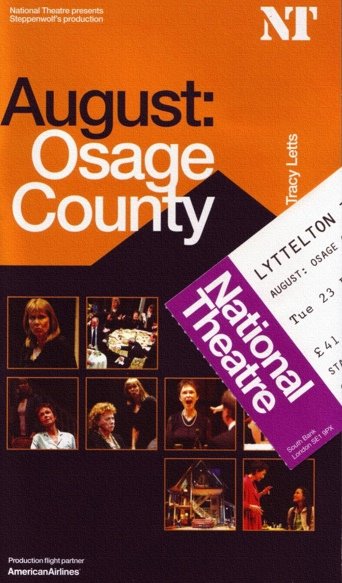
“Life is very long.” That’s the opening line of August: Osage County, which isn’t exactly short, either. Nor is it short on family crisis, on anxiety, guilt, anger . . . and laughs. Pulitzer Prize or not, it’s honest-to-goodness melodrama, homemade (which is best). No wonder it is roping in the crowds. The British, too. Even those who’d expect a play set in Oklahoma to feature dancing cowboys and a rousing rendition of “Oh What a Beautiful Mornin’” I’m one of those folks; and I still went. Couldn’t have had a better ride if I’d been in the surrey with the fringe on top, neither. On account of that nasty eye infection, I missed out on catching the ride on Broadway; but I sure was glad to catch up with it here, with most of the original cast in the house. And what a house!

Not the Lyttleton Theatre, which is just fine; the Weston’s house, I mean, which is somewhere out there in Pawhuska, Oklahoma. Inside, it’s hotter than a blazing summer afternoon on a tin roof, with or without the cat. But crazy old Violet Weston ain’t one for pussyfooting around. Her husband, Bev, is the one who sets us up with that opening line; he’s saying it to the new help he’s hired to take care of Vi (“She’s the Indian who lives in my attic,” Vi later tells the assembled family). To care for her, and that old dark house, is “getting in the of [his] drinking.” Or so he says.

Bev’s a former literature teacher and an even more former poet. That’s why he’s quoting T. S. Eliot, “who bothered to write [that line] down.” I was a little worried about that line. I thought, if he is going on quoting people, I might want to look things up. And who’d stop the play for me! Or try to remember that one name or line or word and then get lose the plot. It’s not a modernist drama, fortunately; and we soon come to realize why Bev’s saying it, and what it means. For Bev, “very long” means too long. He’s had enough of life, of life with Vi, whose mouth is so foul she’s got mouth cancer, and whose mood can be even fouler, no matter how many of those over-prescribed pills she swallows (“Try to get ‘em away from me and I’ll eat you alive”).

Well, Bev is not exactly dry, either; but he’s sober enough to plan and make his exit. Soon after making arrangements with the new help he’s taking himself out of the family picture . . . which is when the fun begins. There’s Vi’s tacky sister Mattie Fae (“Feel it. Sweat is just dripping down my back”); her husband, Charlie (“I don’t want to feel your back”); their bumbling, “complicated” son (“Honey, you have to be smart to be complicated,” Mattie Fae disagrees); Vi and Bev’s three middle-aged daughters, a pot-smoking fourteen-year-old granddaughter (“Look at her boobs,” Mattie Fae exclaims—and she is not the only one taking notice, as one of Vi’s daughters finds out when her fiancé starts “goofin’” with her; and then there’s Vi’s louse of a son-in-law, who likes them younger as well (“You’re a good, decent, funny, wonderful woman, and I love you,” the louse tells his soon-to-be ex-wife, “but you’re a pain in the ass”). Just wait until they all sit down for dinner.

If this sounds like last Thanksgiving to you, you might be squirming in your seat; but, for the rest of us, it comes as a relief to witness a family even more dysfunctional than our own. You couldn’t possibly cram more melodrama into a single play without making it, say, Polyester. But that would be Baltimore.

That’s a Sound All Right, but It Ain’t Music

As much as I enjoy Hollywood musicals, I’ve never sat through The Sound of Music. In fact, before I moved to the US, I had never even heard of the film, let alone anything of the true story behind it. Being born and raised in Germany does have its advantages, you might say; but I am not inclined to be flippant about censorship. Fact is, depictions of Nazism in popular culture were carefully filtered in (West) Germany, even decades after the end of the Third Reich. The reminders of past atrocities and the shared culpability for them were apparently deemed too humiliating or distressing to audiences out to enjoy a bit of cinematic escapism. Perhaps, the decision not to exhibit certain films or to edit and dub them so as to render them inoffensive was based on the notion that the horrors hinted at or exploited for their melodramatic value were too severe to serve as mere diversions. In any case, I was not exposed to the Von Trapps. And when I had my first glimpse of them, I did not feel particularly sorry to have missed out on the acquaintance.

I was as much turned off by the 1960s look of what was meant to have been the late 1930s as I was by those cloying sounds and images. This picture needed to be altogether darker, the music more haunting, more angry and sorrowful than “My Favorite Things.” For years, I avoided what to many remains a sing-a-long occasion. A few weeks ago, the stubborn Teuton in me surrendered at last and got a discount ticket to Andrew Lloyd Webber’s production of the Rodgers and Hammerstein classic at the London Palladium, a production launched and shrewdly promoted back in 2006 by an American Idol-style singing contest in which the British public, along with Sir Andrew, went in search of the perfect Maria.

I can’t say that the West End changed my mind about The Sound of Music. Sure, there are bright and eminently hummable numbers in it, but what is left of the story has less weight than the average supermodel. What is at stake for Maria is not life or liberty, but a chance to trill a few more tunes. No moral dilemma, no sense of danger, no signs of turmoil as Maria grapples with the difficulties of choosing between the convent and the conventional. I don’t expect a treatise on the relationship between fascism and the church; but I sure am tired of those insipid scenes of Sister Activity to which nuns are reduced in popular culture.

In the production’s single instance of dramatically effective set design, the auditorium is transformed into a fascist venue, as brown shirted guards appear in the isles and swastika banners are imposed onto the walls of the Palladium; but the machinery, the show tune factory that is The Sound of Music, does not permit any forebodings to build, any doubt or dread to work on the spectator’s mind. The pageant must go on, dispassionate and smooth as clockwork.

Not everything was quite so well oiled that evening. I knew that what had been mounted here would not amount to anything resembling absorbing melodrama the moment I saw Maria atop a circular platform that was slowly and laboriously tilted in an obvious but feeble imitation of Ted McCord’s Oscar-nominated cinematography. The hills were alive all right; you could hear them aching so loudly that Maria—not the one chosen on the reality program but a paler substitute (the chirpily unengaging Summer Strallen)—couldn’t climb any high note piercing enough to deaden them, spread out as she was on that giant pizza like a slice of parma ham, extra lean.

Less dulcet than the tones produced by those tectonic shifts was whatever emanated from the gaping jaws of the Captain, impersonated that night by Simon MacCorkindale, whose credentials as an actor include, need I say more, featured roles in Falcon Crest and Jaws III. “If you know the notes to sing,” Maria instructs the children in “Do-Re-Mi.” Well, you still can’t “sing most anything” if restricted by the vocal chords of a MacCorkindale, whose rendition of “Edelweiss” should have resulted in his immediate seizure by Nazi officials. The Sound of Music was the croaking Mac’s first—and, let the nuns of the world pray, his last—venture into musical theater.

Decidedly more rewarding both tunefully and dramatically is the current West End production of Carousel at the Savoy, which I saw the following day. Starring Jeremiah James as the troubled Billy Bigelow and an earthy, buxom Lesley Garrett as Nettie, it proved a nutritious alternative to pizza with the Von Trapps.

“With hey, ho, the wind and the rain”: Thoughts on Twelfth Night

Well, this is it. Twelfth Night. In Elizabethan England, Epiphany (6 January) marked the culmination of the winter revels, that topsy-turvy escape to the kingdom of Upsidedownia. For me, it is an apt time to return to this journal in earnest by looking back at my own follies, being that the first daft act of the year has me lying in bed with a cold. I am feeling—to borrow and immediately discard what unaccountably has been declared word of the year—decidedly subprime (wouldn’t below par or having peaked do just fine? Then again, it is a banking or business term and should therefore be ugly and subliterary). I had meant well, braving the wind and the rain, walking our dog after a three-week separation. Just a few days earlier I observed that 2007 has really been a wonderful year; in case yours has proven otherwise, I apologize for rubbing it in like so much VapoRub.

It was a year of traveling and theater-going that, a fall from a ladder notwithstanding (as a result of which my right pinky is now more likely to remain extended during high tea) was free of strife, hardship, and disappointment. Sure, there were those seemingly endless weeks without phone or wireless internet, there was a move into town that fell through, and there were a few minor upsets in my now sidelined teaching career. And then there was that summer that wasn’t. “For the rain it raineth every day.” Yes, it has been a wet year at that. It began in stormy Glasgow and ended in a drizzle on Waterloo Bridge in London, where the annual firework spectacular disappeared behind a thick curtain of sulphurous mist.

Perhaps my greatest folly was the attempt at maintaining this journal while away from home (as I was for about one fifth of the year). Much of what I did manage to convey, pressed for time or bereft of a reliable wireless signal, was—watch me resist neologian inanities—substandard. As I have proved conclusively, I am not cut out to be a post-postmodern Tintin, to mention the titular hero of one of the most engaging theatrical entertainments of 2007, a year filled with delights and sprinkled with duds. Among the duds, aforementioned, were a ballet version of Gone With the Wind, which we caught in Budapest, the Angela Lansbury vehicle Deuce, and the death sentence to musical theater, an art form done away with, rather than revived, in the guise of a cheap concert version of itself that is Spring Awakening.

Among the recent theatrical highlights numbered the New World Stages production of Charles Busch’s Die Mommie Die, with the 2003 film adaptation I have caught up since. It had been seven years, almost to the day, since I saw Busch’s rather more conservative Tale of the Allergist’s Wife, starring (opposite Linda Lavin and Tony Roberts) the wonderful Michele Lee. The star of Die Mommie Die, of course, is the playwright himself. Some unnecessary crudity aside, it is a brilliant evocation of the 1960s and the end of the Hollywood era. It is also a darn good mystery—a rather better mystery than Christie’s nonetheless charming Mousetrap.

I am not a lover of camp, which, according to my own definition, is a wilful act of misreading. Die is a careful reading of the state of the women’s picture in the 1960s, the schlock that reduced a number of silver screen A-listers to sideshow freaks.

The heroine of Die Mommie Die is washed up, all right; but Busch does not derive most of his laughs from strapping her into a ducking stool. His play is as much an homage as it is a send-up (catering to those familiar with the histrionics of Crawford, Davis, and Susan Hayward); and it is this careful balance that, despite some vulgar touches, makes his play succeed both as thriller and farce.

Yes, I am rather traditional when it comes to film and theater, but that is not why I did not care much for Matthew Bourne’s Nutcracker (now playing at Sadler’s Wells)—having enjoyed his Car Man earlier this year—and sought refuge at the Prince Edward Theater to take in one of the final performances of Mary Poppins on New Year’s Day. I am not opposed to trying out something new; but I find more pleasure in finding the new in the supposedly out-of-date.

A great while ago the world begun,
With hey, ho, the wind and the rain,
But that’s all one, our play is done,
And we’ll strive to please you everyday.

Yes, I am back, Monday through Friday. And not going on about the weather—until something well nigh catastrophic or at any rate sensational compels me to break this rule . . .

Playing It by Ear; or, "What Are You Doing New Year’s Eve?"

Well, luckily we are not in Glasgow in the middle of a storm, a misfortune that befell us last New Year’s Eve. The festivities having been called off due to fierce winds, we ended up back in our hotel room shortly before midnight. This year, we are in London and, without having made any definite plans or arrangements, determined to see a show in the West End, go out for a meal, and watch the fireworks along the Thames. To be sure, this is not the time of year to be playing it by ear; but, even without reservations, there is always plenty to see and do in a big town like London. While I don’t like to come to town without a clue about what is on offer at museums and in the theater, I prefer not to have our days all planned out ahead of time. History tells us that getting lost is a great way to discover something new.

Yesterday, heading out from our hotel near Pudding Lane, where the Great Fire of 1666 got started, we took the wrong bus and ended up at King’s Cross. Being there, we decided to have a look at the recently reopened St. Pancras Station. The old Victorian terminus has been turned into a memorial to poet John Betjeman (1906-84), whose words you will find under foot, where they might be drowned out by a stampede of travelers. How wonderful it was to stand there, not having to rush anywhere, taking in the sights and sounds of the old yet new and ever changing scene.

“Imprisoned in a cage of sound / Even the trivial seems profound.” The words my camera captured ring true today. On New Year’s Eve, those cages (the bells with which Betjeman was fascinated) are going to rattle all over the world. And the trivium of a few seconds passing will assume the utmost significance in the eyes and ears of billions.

Oranges Are Just About the Only Fruit

Well, apart from grapes, perhaps. Having left the Big Apple behind us, we started off our trip to London with a roll in the Haymarket. We were not offered any oranges, the vending of which, traditionally, is associated with prostitution; but despite the absence of Cyprians (or Orange-wenches” as referred to in the play), the scene we came upon at the Haymarket was salacious nonetheless. In said 287-year-old Theatre Royal (whose rebuilt venue I captured here in its present condition), The Country Wife was first performed back in 1675. This season, William Wycherley’s bawdy comedy is back, if somewhat condensed (its prologue cropped) and refurbished, with a few visual puns and stagecrafted metaphors added (such as a rendering of the expression “when pigs fly”). The dialogue should best be left unchanged, at least if the revision is as lame as that overheard at the Haymarket that night (something about a doctor being nothing without patience, a pantomime-worthy piece of paronomasia rather more subtle in the original).

Wycherley’s comedy has attracted some of the great actresses of the British theater, including Judy Dench, Helen Mirren, and Maggie Smith. Cast in the role of Lady Fidget (as Edith Evans before her), Patricia Hodge did not quite manage to make the character memorable; but as an ensemble piece, this production succeeded nonetheless as a naughty diversion nowadays referred to as a guilty pleasure.

Mind you, we had consumed a few stomped grapes too many and struggled at first to keep our eyes firmly on the action. Luckily, though, keeping up with this clever Wife is bound to keep anyone up. Take it from an old fruit.

Transatlantic Call: From Radio Reportage to Video Conferencing

Now, I am not going to get all sentimental and give you the old “tempus fugit” spiel; but I’d like to mention, in passing, that this post (the 355th entry into the journal) marks the beginning of a third year for broadcastellan. Meanwhile, I am resting with a bad back—in the city that never sleeps, of all places. This afternoon, during an inaugural transatlantic video conference with my two faithful companions back home in Wales, my mind excused itself from my heart and took off in reflections about the ways in which technology has assisted in forging a bond between the US and its close ally across the pond, and the degree to which such tele-communal forgings may come across as mere forgeries when compared to the real thing of an actual encounter.

I was reminded of this again when, a few hours after my chat, I sat, as of old, on a bench by the East River, in a park named after Carl Schurz, a fellow German gone west who likened our ideals to the stars that, however far beyond our touch, yet assist those guided by them to “reach their goal.” In my hand was a signed copy of a newly purchased biography of Edward R. Murrow (by Bob Edwards). It opens with Murrow’s report from the blitz on London, Murrow’s residence during the war.

The broadcasts from London (as featured and discussed here by Jim Widner) did much to enhance the American public’s understanding of the plight of a people, who, due to Hollywood’s portrayal of the British, seemed stuck-up, remote, and about as real as the fog in which Basil Rathbone and Nigel Bruce waded through some of their adventures. Reports from Britain not only brought home a Kingdom but a concept—the notion of brotherhood untainted by the nationalism whose fervor was responsible for the war.

If not as emotional as Herbert Morrison’s report from Lakehurst during the explosion of the Hindenburg, Murrow’s updates from London were delivered by a compassionate journalist who not only listened in but was a part of what he related while on location. On this day, 21 May, in 1950, British novelist Elizabeth Bowen connected wirelessly with her American audience by speaking via transcription on NBC radio’s University Theater. Bowen referred to her novel The House in Paris (1935) as “New York’s child,” the “fruit of the stimulus, the release, the excitement [she] had received here.” Would she have been able to enter into the feelings of a child lost in a strange house, she wondered, if she “had not just returned from another city, equally new and significant to me?”

There are limits to the connections achieved by the wireless, a controlled remoteness that brings home ideas without ever feeling quite like it. Rather than seeing or hearing, being there is believing. I felt far away during my transatlantic call; but I know I will know what home is now once I get back there . . .

Daddy Cool Vs. Father Time: Getting the Better of 2006

Well, this isn’t a travel brochure; hence my taking the liberty of adding a question mark to the following: What better place to ring in the new year than in Scotland, where “Auld Lang Syne” is being sung more passionately and the ringing in goes on longer than anywhere else in the world? Having just returned from Glasgow and Edinburgh, I could think of a few alternatives, considering that Scotland’s chief tourist attractions this time of year—the famed Hogmanay festivities, were pretty much wiped out by fierce gales and lashing rains. The British weather! I have mentioned and deplored it often enough in this journal to claim that I was unprepared for its party-pooping force.

Since practically all of Glasgow takes a prolonged New Year’s holiday—including the city’s retailers and its museums, at one of which, the Kelvingrove, I spotted those heads dangling above on the day of Saddam Hussein’s hanging—there was little else to do than to seek shelter in a multiplex, mercifully kept open, and to take in a few double features. Fairly disappointed by the politics and pretensions of The Perfume, yet charmed by the slight Miss Potter and amused by the to me surprisingly bright Night at the Museum, I was enthralled at last by Guillermo del Toro’s El Laberinto del Fauno (Pan’s Labyrinth), easily the most exciting movie I have seen on the big screen in years, a film unrivalled by any piece of fiction I have come across in 2006.

Not that 2006 was lacking in cultural pearls, many of which I shared and appraised in this journal. I won’t altogether stoop to lining them up, however popular and convenient such an approach to reviewing might be. Indeed, I find it difficult to name the best and worst of the past twelve months; but let me try, anyway.

In a year during which I picked up far too few books to make up a list, my main literary find was H. G. Wells’s aforementioned Ann Veronica, an uneven but compelling portrait of the British suffragette movement. Rewarding as well was Anthony Trollope’s Cousin Henry, a Kafkaesque exploration of doubt and guilt, while Daphne Du Maurier’s Jamaica Inn, for all its romantic intensity, struck me as dark-aged (and downright fascist) in its vilification of physical otherness.

At the pictures, the most satisfying film of the year may well have been The Illusionist, which I had the fortune to catch during my trip to Istanbul last September. It quietly triumphed over that other vanishing act, Christopher Nolan’s box-office misfire The Prestige; but, as pleased as I was to find James Bond back in form (after decades of discharging tiresome one-liners to demonstrate his cool) and getting to know The Queen in Helen Mirren’s soon-to-be-Academy Award nominated performance, it took a trip to the aforementioned Labyrinth on New Year’s Day to remind me of the magic of the movies, an emotional sway entirely absent in the hackneyed and uninspiring World Trade Center, the most exasperating of my cinematic encounters.

It was a year that convinced me, an inveterate old-time radio aficionado, to pay more attention to BBC radio, having tuned in to provocative (if not always convincing) plays like “Abrogate” (discussed here) and “True West” (reviewed in this post), adaptations like “Sir Gawain and the Green Knight” (with Ian McKellen) and documentaries like “Down the Wires.” Still available online this first week of January 2007 are Alan Bennett’s “The History Boys” as well as drama by Pinter and Stoppard.

By comparison, I still look upon television chiefly as a purveyor of old movies, of which I must have taken in over a hundred this year. The BBC’s serialization of Jane Eyre felt less than fresh, the second season of Desperate Housewives irritated me with its heavy-handed bathos, while the third round of British reality show X Factor was short on personalities for which to root. More enjoyable was the Andrew Lloyd Webber judged How Do You Solve a Problem Like Maria?, which generated a new West End personality to star in the current revival of The Sound of Music.

While I have no intention to see that show, I had my share of theatrical treats, foremost among them a revival of Barrie’s What Every Woman Knows and an imaginative staging of Mervyn Peake’s imaginative staging of Mervyn Peake’s Gormenghast. The musical Daddy Cool, which I caught at London’s Shaftesbury Theatre, was not among them. Stringing together the songs of German pop-crafter Frank Farian (the man behind the late-1970s phenomenon Boney M. and the early-1990s lip-synch duo Milli Vanilli) and forcing them into a narrative that borrows from West Side Story, Romeo and Juliet, and Bollywood, Daddy is a Mamma Mia of a musical that will make even those who fondly remember some of the featured tunes go “Oh, brother!” That said, I still came out humming and, having gone backstage to see fictional gunmoll Ma Baker turn into the affable Michelle Collins, I hardly regret the experience.

Whatever I see, read, or hear this year I shall take in with glee, cheered by the thought of having in broadcastellan a journal in which to document nothing more plainly than the extent of my own folly.