Not Quite[,] Louella

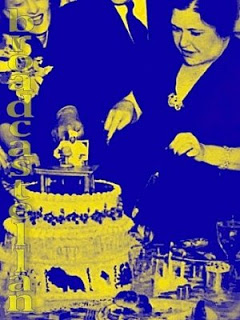
As I add another candle to the cupcake set aside for the celebration of my fourth blogging anniversary and to be consumed in the solitude of my virtual niche, I am once again wondering whether I should not have taken a scandal sheet out of Louella Parsons’s cookbook. You know, serving it while it’s hot, with a pinch of salt on the side. Dishing it out in a bowl the size of China, a tidbit-craving multitude hanging on your gossip-dripping lips. As the first name in name-dropping, Louella (seen below, cutting her own birthday cake, anno 1941) might have done well as a webjournalist, just as she had on the air, despite a lazy delivery that piled fluffs on fluff and a flat voice that makes Agnes Moorehead sound like a Lorelei by comparison. Her hearsay went over well all the same, its nutritional deficiencies giving none cause for contrition.

On this day, 20 May, in 1945, for instance, Louella rattled off this farraginous list of “exclusives”: that silent screen star Clara Bow was “desperately ill again” after suffering a “complete nervous breakdown”; that Abbott and Costello would “not even speak to each other” on the set of their latest movie; that the Cary Grant-Betty Hensel romance was “beginning to totter”; and that “forty Hollywood films ha[d] been dubbed in German” to “counteract the dirty work done by Goebbels.” Just as you finally prick up your ears, indiscriminate Lolly snatches the plate from under your nose.

As an item of “last-minute news,” Louella announced that, with John Garfield going into the navy, his part opposite Lana Turner in The Postman Always Rings Twice was to be played by Van Heflin, who had just received his medical discharge. Doesn’t ring true, does it? Well, that’s the problem with promising “the latest.” It rarely is the last word.

Not that being belated renders your copy free from gaffes and inaccuracies, to which my own writing attests. Yet it isn’t the need to be conclusive or the vain hope for the definite that makes me resist what is current and in flux. I’m just not one to reach for green bananas and speculate what they might taste like tomorrow. I won’t bite when the gossip is fresh; my teeth are in the riper fruit.

So, there is little in it for me to drop names, and pronto. Rather than playing Louella, I fancy myself another Darwin. Darwin L. Teilhet, that is, a fiction writer and early reviewer of American radio programs; he was born 20 May 1904, 101 years to the day that my journal got underway.

It is easy for me to identify with Teilhet, who loved the so-called blind medium without turning a blind eye to the shortcomings of its offerings. In his column in the Forum for May 1932, for instance, he complained that the “dramatic machinery” of Amos ‘n’ Andy “creaks,” but nonetheless insisted that the declared that the “art of broadcasting” was “entirely too important to be ignored or squelched by derogatory attacks. The time, he argued, was

ripe for the conception of a new genus of critic with the radio as his field. 

Intelligently and conscientiously pursued over a period of time, it [the criticism of radio programs] might not only draw to itself a large number of followers among the radio audience but actually have some effect in improving the quality of the programs which are directed at them.

Today, a reviewer of such programs cannot expect to garner any sizeable number of followers, much less to have an effect on what aired decades ago. Tuning in, like virtue, is its own reward; and though the time may not be ripe for the likes of me, it sure seems ripe for the rediscovery of the presumably out-of-date. In these days of economic recession, we might find a return to the low-budget dramatics of radio particularly worthwhile. I, for one, would make the pitch to the networks that abandoned the genre half a century ago.

Time to blow out the candles and get on with it.


Related writings
First entry into this journal
First anniversary
Second anniversary
Third anniversary

For Whom the Bell Tolls . . . Twice

We know that it tolls for all of us, eventually; but which chronometer do we consult to tell the time of departure? Say, for instance, you pass away on this day, 29 August, in London; make it late in the evening. Does that mean Americans will recognize your death as having occurred on the 29th? I guess this calendric reprieve won’t make much difference to the party chiefly involved; but I was wondering about it when I saw that the death of Ingrid Bergman was recorded as 30 August 1982 on the Internet Movie Database, but as 29 August on the official Ingrid Bergman website, and pretty much everywhere else, for that matter. Now, the IMDb is based in Bristol, England, or at least originated there. So, I don’t know just how to account for this discrepancy, or why this much-relied on site does not change the date, which, according to the biographies posted there, is not even recognized by its users.

Certain is that Ms. Bergman was born on this day, 29 August, back in 1915. Certain is also that her Hollywood career came to a screeching halt when the aforementioned gossip columnist Louella Parsons reported in the fall of 1949 that the actress was expecting a child, and that her husband had nothing to do with it. Bergman (last discussed here portraying the adulterous Laura Jesson in a radio adaptation of Noel Coward’s Still Life) had fallen in love with Italian director Roberto Rossellini, and their romance and its issue were so hotly debated in the US, leading a senator to denounce Bergman as a “powerful influence of evil,” that production-code conscious Hollywood closed its lots to her at the height of her career.

Prior to her exile, Bergman was last heard on US radio in two celebrated dramatic roles: as Anna Christie on the Ford Theater (21 January 1949), prophetically billed as the “story of a lost woman who came searching for a new life in a home she had never seen”; and as Nora in a telescoped version of Ibsen’s A Doll House (13 February 1949), produced, no less, by the Episcopal Actors Guild.

Bergman did not return to Hollywood until 1956, but was heard again on US radio as early as January 1954, on the theater program Stage Struck, in an episode discussing “Why Young Actors Try to Break Into the Theatre.” Why, you wonder? Here’s to independent spirits.

A Week with Radio and Television Mirror (August 1949)

This being the 100th birthday of Lurene Tuttle, former “First Lady of Radio” (previously celebrated here), it behoves me to return to my favorite subject. So, all week I am going to flick through the August 1949 issue of Radio and Television Mirror to dig up what I hope to be noteworthy or just plain curious items.

My copy of the old Mirror is getting a bit tatty, having been cherished more for its content than for its potential trade value. The issue contains a short article about Ms. Tuttle, an Indiana native gone Hollywood: “There’s scarcely a radio program on which Lurene hasn’t been heard,” it says, “but she’s no radio Cinderella. She came to radio as a stage actress seasoned by seven years of trouping in stock.”

Cover of Radio and Television Mirror, August 1949

There is an article by Anna Roosevelt, writing about her mother, another former First Lady, wife of the President who first took such great advantage of the new medium of radio; at the time, Anna and Eleanor were heard Monday through Friday afternoon on ABC. Singer Kate Smith, broadcasting daily at noon over the Mutual network, shares recipes and shows readers around her summer residence, Camp Sunshine.

Louella Parsons, the “First Lady of Hollywood,” describes her experience in broadcasting (as illustrated here). She gossiped each Sunday, 9:15 pm over ABC, but was on her summer vacation that August. Kit Trout describes “tag[ging] along” with her husband, NBC reporter Bob Trout (whose Who Said That? was both heard and seen each Saturday at 9 pm); and Jo Stafford, heard Thursday evenings at 9:30 pm over ABC stations, relates what happened during her first audition.

Mary Jane Higby, in character as Joan Davis (the heroine of daytime serial When a Girl Marries) answers reader mail concerning marital problems, while the aforementioned Terry Burton, heard daily in The Second Mrs. Burton continues her own column in the role of “Family Counselor.”

And then there is Blondie (or, rather, Ann Rutherford), telling readers how she relates to her famous radio and movie character:

Radio’s Blondie on a page from Radio and Television Mirror

The letters we get from people who listen to the show often say that the Bumsteads help them to laugh at their own troubles.  When they laugh at the Bumsteads the laughter carries over to their own lives.  It works for us too. In fact it’s often one of us who furnishes the incident from real life. 

The Bumsteads are not only the couple next door to us on the show, we are the Bumsteads, and yes, Blondie is real to me.

In radio and on television, as in its Mirror, fact and fiction merge, making it difficult to tell one from the other. Reading this monthly is like stepping through the looking glass into a reality show, anno 1949. Sanctioned, streamlined or sanitized, what kind of story is history anyway?

Wireless Women, Clueless Men: Louella Parsons, Dirt Dispenser

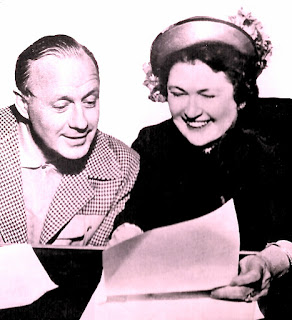
Today, I am closing my series of tributes to women in American radio by devoting this final edition to one of the biggest names in Tinseltown hearsay: Hearstian columnist Louella Parsons. I leave it to Ms. Parsons to dish a little dirt about her on-air scandalmongering, even though that dirt is no more messy than a dusting of confectionary sugar on a well turned cuff. “Well,” Parsons told readers of Radio and Television Mirror Magazine (from an issue of which this picture has been taken), “I can safely say that no one else in the business can boast that her program was almost a radio casualty because of a toothache, a can of soup, and Audie Murphy’s cold! Likewise, I’m the only woman in these parts who’d had the dubious distinction of being almost ‘stood-up’ by Clark Gable. . . .”

Now, she does say “almost.” As it turns out, Gable was scheduled to appear on Parsons’s Hollywood Hotel when he got “snarled up” in a traffic accident. Shortly before the broadcast, he showed up with assorted bruises, welts, and a torn coat; but, according to Parsons, he insisted on going ahead with the live broadcast as scheduled, since, as the enterprising secret sharer put it, “he knew the program was very important to me, and didn’t want to disappoint me.”

He also knew better than to stand up this formidable career ender. So, Parsons’s wounded pride was mended—and Gable’s stardom secure. “Since that day,” Parsons added, “he has had a very special place in my book of friends.” Merely pencilled in, no doubt. This lady dealt in muck, after all, which in her profession is more precious than friendship.

I’ve mentioned Joan Crawford’s mike fright before in this journal. It was a well-known fact the first lady of gossip enjoyed repeating, claiming that the star “ran like a startled faun” every time a microphone was as much as “mentioned” to her. Eventually, the actress’s fear of bad press must have been more pronounced than her microphonophobia, as Parsons got her to go on the air talking about “what an advantage it was to be born on the wrong side of the tracks.”

Carole Lombard, on the other hand, was “completely unruffled when she lost two whole pages of her script. She merely ad libbed her way through, without a pause, and you’d never have known the difference.” Abbott and Costello, in turn, “turned the tables” on Parsons by reading her lines instead of their own. So, the chat hostess obliged by reading theirs, and, “as mad as it may sound,” she discovered that “the program had some semblance of sense to it.” These recollections are not exactly an endorsement of Parsons’s writing; but, by her own admission, “lack of talent has never dimmed [her] enthusiasm.”

Her first program, Hollywood Hotel, was off to a shaky start back in 1934: “My show was probably the worst in existence—I wrote, produced, and directed it all by myself.” Perhaps, it was not so much the writing and directing that were most amiss. Unlike rival columnist Hedda Hopper, Parsons did not have a trained voice, let alone a pleasing one; but she “knew too that is wasn’t how [she] said anything that mattered, because people were interested in what [she] was talking about.”

Sure, she couldn’t “close [her] eyes to television indefinitely,” she concluded. “But until better make-up and lighting are developed,” she vowed to “stick with [her] Hooper” (Hollywood jargon for radio audience).  And stick she did, for better and worse.