
“What is the basic force that makes the human mind function?” The question was posed not at a symposium attended by noted philosophers and physicians, but to the readers of the 27 February 1926 issue of Radio Digest, who were subsequently asked:
What is telepathy? Is it not fundamentally Radio activity, a form of Radio transmission[?] Can the energy that starts a mass of brain cells into motion, that formulates thought and speech[,] be propelled as the voice is propelled from the vibration of the fragile filament in a vacuum tube? Does this energy ever die? Can it be attuned, converted into controlled ether wave movement, refined to audible sensitiveness?
Whoa! One question at a time, if you please—and, thinking as a public speaker—if you expect a question to sink in and elicit a response. Other than “Whoa!” that is. A bit of context would be helpful.
The above is not a passage from Upton Sinclair’s Mental Radio, a treatise written in the late 1920s, published in 1931, and endorsed by Albert Einstein. As the notion that telepathy was “fundamentally” a form of wireless transmission suggests—apart from the fact that it was published in Radio Digest—the context in which the question was posed was wireless transmission—and radio “drama” in particular.
Offering listeners “an opportunity to win fame, honor and bags of gold” for the solution of a mystery about to commence, the editors of Radio Digest got more specific, explaining:
These are questions to be considered in the strange case of Peleg Turner in the first two chapters of A Step on the Stairs, appearing in this issue of Radio Digest. Was it the voice of the dead Peleg that manifested itself, as he had predicted, through the Radio horn for the benefit of his heirs?
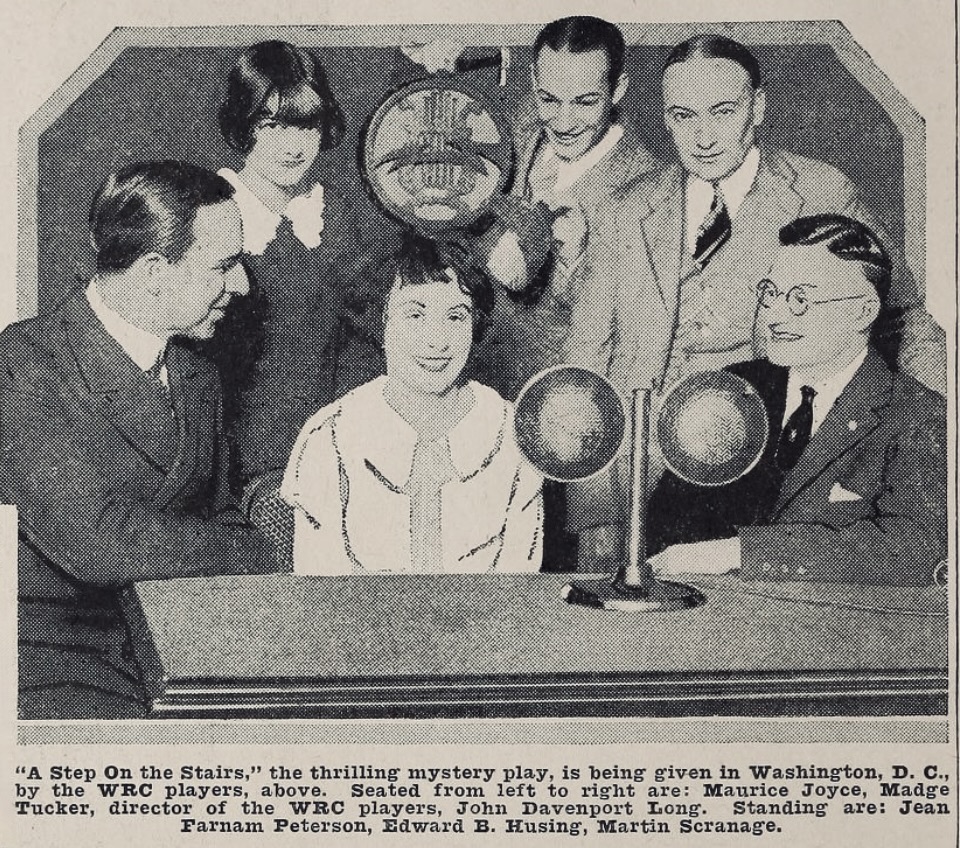
Call it ballyhoo or baloney, with those words, one of the earliest radio serials was launched in February 1926.
Continue reading ““… despite the distortion of the curving horn”: The Wireless, the “Radario,” and the First “Step on the Stairs” (1926)” Harry Heuser