
". . . he has an air": Floyd Gibbons, Wireless Adventurer

“Have voice, will travel.” That was the line my history of broadcasting professor Frank Kahn used to advertise his vocal services in the trade papers of yesteryear. And a voice for radio he did have, even though what he said and how he brought it across was appreciated by next to no one at Lehman College in the Bronx, where he ended up teaching in the cable TV age. Kahn was out of touch and, no doubt, keenly aware of it, incapable or unwilling though he was to do anything about it. “Have voice, will travel”? I mean, who among his students even got this sly reference to a time when the medium of radio was being challenged by sharp-shooting television? “Have voice, will travel.” The line came to mind when, some time ago, I read Douglas Gilbert’s biography Floyd Gibbons: Knight of the Air (1930).

You don’t have to be out of touch to appreciate it, though it sure doesn’t hurt any if you catch up with someone whose fifteen minutes of fame (and airtime) was up nearly three-quarters of a century ago.

“There is no one in the world who can talk like Floyd Gibbons,” his biographer marvelled:

He speaks at a maximum speed of 245 words a minute and at an average speed of 216 words a minute and every word is clearly pronounced, completely enunciated, readily understood.  He dramatizes his speech, just as he dramatizes the news.
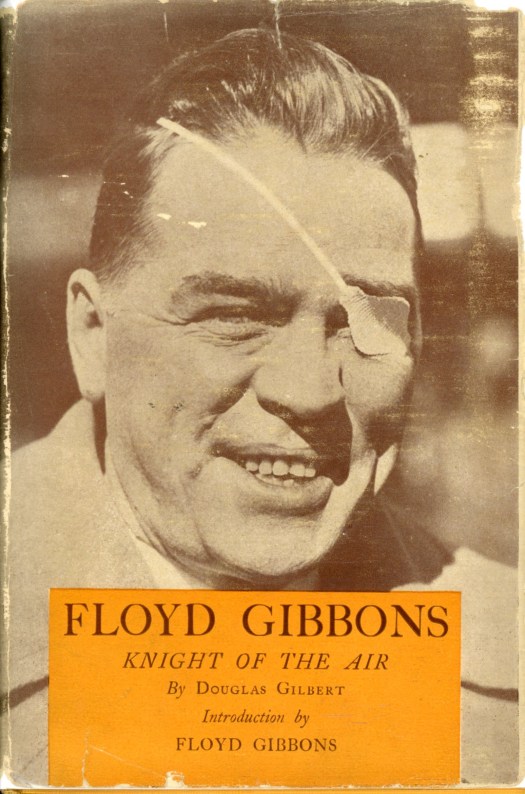
My copy of the book

Gilbert, in turn, “dramatizes” Gibbons’s career.  Indeed, he melo-dramatizes it.  The biographer seems determined to turn the journalist into a swashbuckler and to imbue with romance what, on the air, was down-to-earth and up-to-date.

“He could, and often does, wear any sort of costume,” Gilbert says about Gibbons, “and when he does, he has an air.  It is a negligent and yet perfect air.” Shown with his signature patch (Gibbons lost one eye while, as a newspaper journalist, he was reporting from French battlefields during the First World War), the so-called “Headline Hunter,” then middle-aged, certainly has that “air” of romance about him.

According to Gilbert, Gibbons was through being a roving reporter at the age of forty.  His latest book, The Red Napoleon, which he was in the process of completing back in 1928, was a “prophesy of the next world war and the part radio was to play in it.”  To make such a prophesy, Gibbons consulted NBC president M. H. Aylesworth; and out of his luncheon with the radio executive there “developed the ‘Headline Hunter’ and the ‘Prohibition Poller’ and news gatherer that ma[de] the Literary Digest’s fifteen minutes over WJZ a radio ‘front page.’”

At 40 through with roving? Today at 42 he’s just begun—roaming for fifteen-million persons—their vicarious vagabond of the air, satisfying the gypsy lust of those of us who have never traveled.

“He’s radio’s knight errant,” Gilbert insists, “the listener’s passport to uncharted harbors; their open sesame to Cathay; their vista of a world whose only boundaries are the poles.”

For his audition, performed in front of an “unseen audience of Aylesworth and other NBC officials,” Gibbons recounted his “most exciting experience”—being aboard the Laconia when she was torpedoed.  The event had taken place over a decade earlier, on 25 February 1917; but Gibbons managed to bring it to life and to lend it urgency through the power of his voice.

Back in 1917,

Gibbons had had a hunch, a newspaper man’s hunch when he took the Laconia.  He had been ordered to France as war correspondent.  He refused to go on the ship on which Von Bernsdorff [German ambassador to the US] was sailing because he knew no harm would come to that ship from the Germans.  He chose the Laconia, having a hunch she would be sunk and that he would escape and file a story of the sinking.

In the late 1920s, there was no indication that radio, too, was a ship under fire.  As Gilbert suggests, Gibbons would have gotten aboard anyway, had he known just how much danger lay ahead.  Not many people beside Gibbons imagined in 1930 that radio would become the medium most called upon for up-to-date accounts of warfare.  Had he been born a decade or two later—and not died in 1939—Gibbons would have gone straight into the thick of it and brought his spitfire delivery to a medium to which his voice was so adequately equipped.  Living too early, living too late? All we can hope is that our voices will travel some distance once we are convinced we have something to say . . .

On This Day in 1930: Murder Trial Broadcast Summons Millions to Court

Well, it is Black Friday here in New York—the stores are opening at preposterously early hours and shoppers are lured away from their leftover turkey with promises of early bird specials and nest egg busting savings. Too lazy after a sumptuous Thanksgiving meal, I am not partaking of any 5 AM bargain debasements. Instead, I am going to celebrate yet another milestone in radio drama history—The Trial of Vivienne Ware, which opened on this day, 25 November, in 1930 and ushered in a new age of cross-promotional multimediacy.

“There’s murder in the air,” the New York Times had announced in its Sunday radio section, predicting that The Trial of Vivienne Ware would “occupy the attention of listeners over WJZ’s network for six consecutive nights beginning Tuesday.” Considerably more enthusiastic was the New York American, which declared the six-part serial to be “one of the most stirring mystery radiodramas ever presented,” quoting NBC president M. H. Aylesworth as saying that its script “established a new standard in the creation of radio plays. The simplicity and fidelity of the theme, together with the colorful word and character pictures, stand out in this new field of adaptive writing.”

The New York American—the Hearst “paper for people who think”—had good reason to eulogize the as yet unaired serial as “one of the best radio dramas ever written,” given that the program had been conceived by one of its own feature writers.

Every effort was made to prevent the program from appearing like a cheap marketing ploy and to convince WJZ, New York—the flagship station of NBC’s Blue network—to produce the series in its glass-curtained Times Square studio atop the New Amsterdam Theatre and to broadcast the event locally instead of making the required six half-hour spots available to national advertisers.

Certain to impress NBC executives was the fact that—along with Ferdinand Pecora, Assistant District Attorney of New York, and prominent New York attorney George Gordon Battle—none other than US Senator and Supreme Court Justice Robert F. Wagner had agreed to participate in the mock trial by assuming the role of the presiding judge. The titular heroine was played by Rosamund Pinchot, a stage actress who had appeared in Max Reinhardt’s celebrated staging of The Miracle, and the entire spectacular was supervised by well-known Broadway producer John Golden.

“Ladies and Gentlemen of the Radio Jury,” Wagner addressed the audience during the inaugural broadcast:

You have been called to one of the most trying tasks which befalls the lot of a citizen. You are to try a fellow being on a charge of first degree murder.  It is the more difficult for you in that this defendant has everything which would make life for any young woman most desirable.  Yet it may become your solemn duty to deprive her of her enjoyment of that life.

Standing to gain cash prizes for the most convincing verdict, readers of the New York American were advised to prepare themselves by taking in the published “information” daily, since they might miss “important loop-holes” if they did not “carefully follow the testimony and the evidence” as presented on the radio. “By reading the New York American every morning” throughout the trial and by “tuning in on WJZ each night at the specified time,” readers should be able to form their verdict as to Miss Ware’s guilt or innocence—“just like any other juror.”

According to Radio Digest, verdicts, letters of congratulations, and demands for a sequel were received from places as remote as Canada and Virginia, as well as from ships at sea; an estimated 14,000 listeners eventually acquitted the fictional heroine on trial, with about 2000 arguing the “society girl” to be guilty. More significant for the publisher was that the serial had increased the circulation of the New York American “far in excess of expectations,” as a result of which Hearst papers in San Francisco, Chicago, Los Angeles, Washington, and Omaha sponsored the trial with different casts of local luminaries.

A follow-up trial involving the murder victim’s less privileged “friend,” nightclub singer Dolores Divine, was staged a few weeks after the acquittal of the first defendant. A generic version of the radio scripts for both serials, prefaced by excepts from the printed reports and concluding with the audience verdict, was subsequently published by Grosset and Dunlap, which marketed Kenneth M. Ellis’s The Trial of Vivienne Ware as the “first radio novel, an innovation in both the radio and publishing worlds.”

Unfortunately, no recordings of this interactive multi-media event seem to have survived. I sure would have enjoyed tuning in . . .