“There is a [loose] cannon”: Stephen Vincent Benét’s “Undefended Border” Revisited

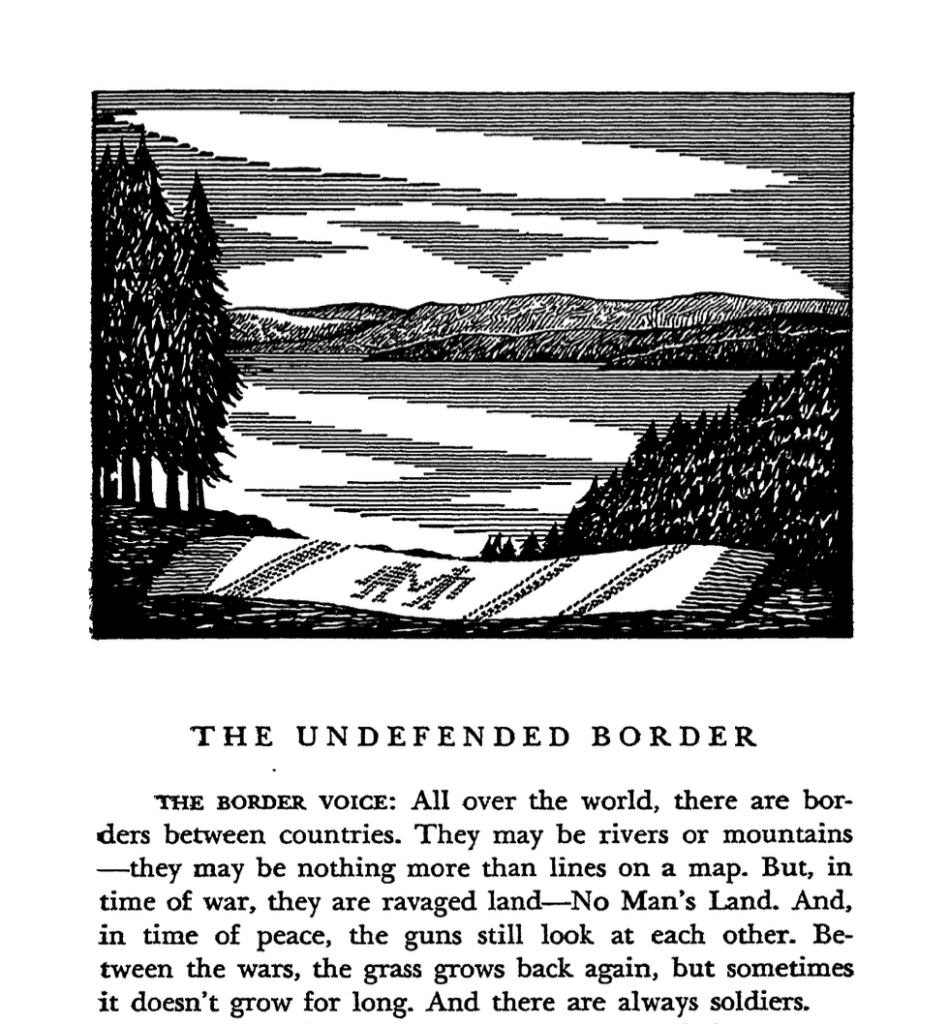
The published script as it appeared in We Stand United, an anthology of radio plays by Stephen Vincent Benét and “decorated” by Ernest Stock.

I commenced this journal back in 2005.   It was intended as a continuation of, and promotional vehicle for, my doctoral study “Etherized Victorians: Drama, Narrative, and the American Radio Play, 1929–1954.”  Its title, broadcastellan, was meant to declare me to be keeper of a vast Luftschloss—a neglected alcazar of the air, immaterially composed of numberless radio recordings I determined to play back.

As of this post, broadcastellan is nearing its twentieth anniversary.  While I do not take this as an opportunity, let alone an excuse, to reissue older posts, I nonetheless wonder: When history seems to be repeating itself, perhaps I may be justified to do the same, if only to demonstrate that not every “been there” necessarily translates into a feeling of “done that,” and that not all twice-told tales are a rehash—not, at least, when you approach them from a perspective that has profoundly, even fundamentally, changed along with the context, your life experience and your attitude toward the world.

I devoted one early entry to “The Undefended Border” (1940), a play by Pulitzer Prize-winning poet Stephen Vincent Benét (1898–1943).  Revisiting it now, in the age of the MAGA tariff wars and annexation threats, I cannot but think of the loose cannon that is recklessly flouting, or at any rate tarnishing, the legacy of the rusty “lone cannon” commemorated in Benét’s play.

Continue reading ““There is a [loose] cannon”: Stephen Vincent Benét’s “Undefended Border” Revisited”

“You Can’t Do Business With Hitler”: A “picture of Nazi trade methods” Re-Viewed in the Second Age of MAGA

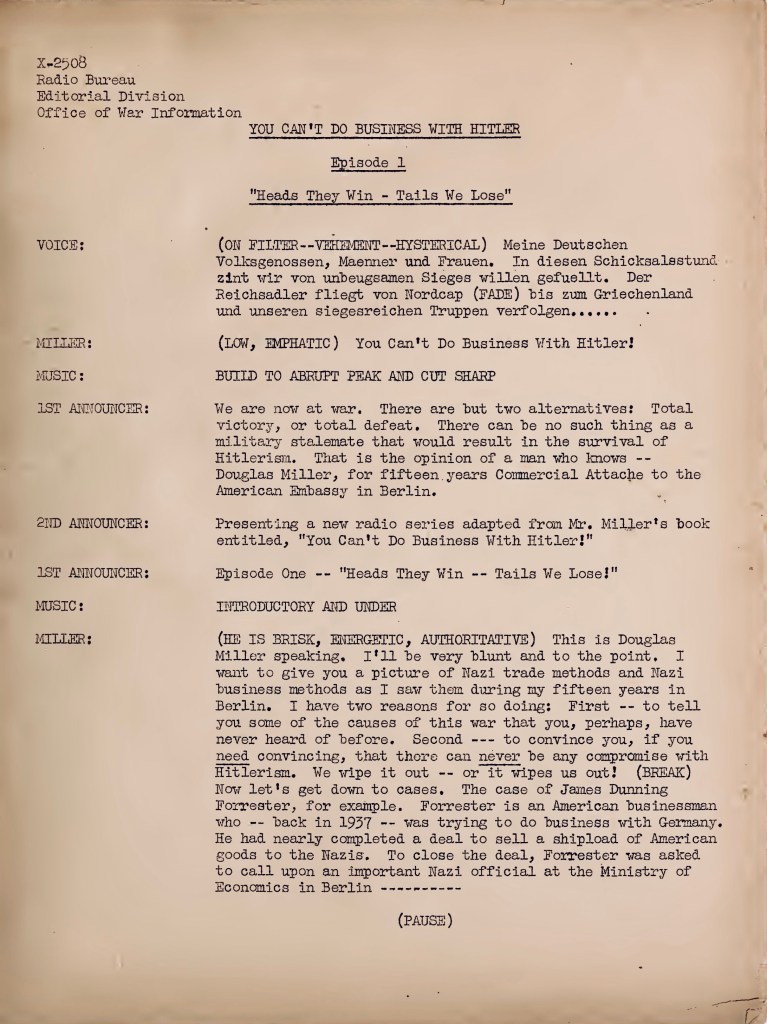
First page of the script for the first episode of You Can’t Do Business with Hitler

“This is Douglas Miller speaking. I’ll be very blunt and to the point.  I want to give you a picture of Nazi trade methods and Nazi business methods as I saw them during my fifteen years in Berlin.”  Intimate and immediate in the means and manner in which, in the days before television and internet, only network radio could reach the multitudes of the home front, the speaker addressed anybody and somebody—the statistical masses and the actual individual tuning in.  The objective was to persuade the US American public that “You Can’t Do Business with Hitler.”

The statement served as the title of a radio program that first went on the air not long after the US entered the Second World War in the aftermath of Japan’s attack on Pearl Harbor, an act of aggression that prompted the United States, and US radio, to abandon its isolationist stance.  Overnight, the advertising medium of radio was being retooled for the purposes of propaganda, employed in ways that were not unlike the methods used in Nazi Germany.

You Can’t Do Business with Hitler was also the title of a book by Miller on which the radio series was based.  Upon its publication, lengthy excerpts appeared in the July 1941 issue of The Atlantic Monthly, the editor of which introduced the article by pointing out that Miller had personally “observed German industry and particularly noted the ruthless determination with which it was directed after Hitler came to power.”

During the 1920s and ‘30s, Miller had served as Commercial Attache to the American Embassy in Berlin and had subsequently written an account of his experience.  In You Can’t Do Business with Hitler, he argued that his long record of service “entitle[d]” him “to make public some of [his] experiences with the Nazis and—after drawing conclusions from them, discussing Nazi aims and methods—to project existing Nazi policy into the future and describe what sort of world we shall have to live in if Hitler wins.”

Posting this—the 855th—entry in my blog, on the day after the national election in Germany in 2025, in which the far-right, stirred by Elon Musk and JD Vance, chalked up massive gains, and in the wake of the directives and invectives with which the second Trump administration redefined US relations with many of its global trading partners—I, too, am projecting, anticipating what “sort of world” we shall find or lose ourselves if “Nazi methods” take hold in and of western democracies.

Far from retreating into the past with a twist of the proverbial dial, I am listening anew to anti-fascist US radio programs of the 1940s to reflect on the MAGA agenda in relation to the strategies of the Third Reich regime, asking myself: Can the world afford to do business with bullies?

Continue reading ““You Can’t Do Business With Hitler”: A “picture of Nazi trade methods” Re-Viewed in the Second Age of MAGA”

“… an America that must never happen—that will never happen!”: Revisiting US American Anti-Third Reich Propaganda in the Second Age of MAGA

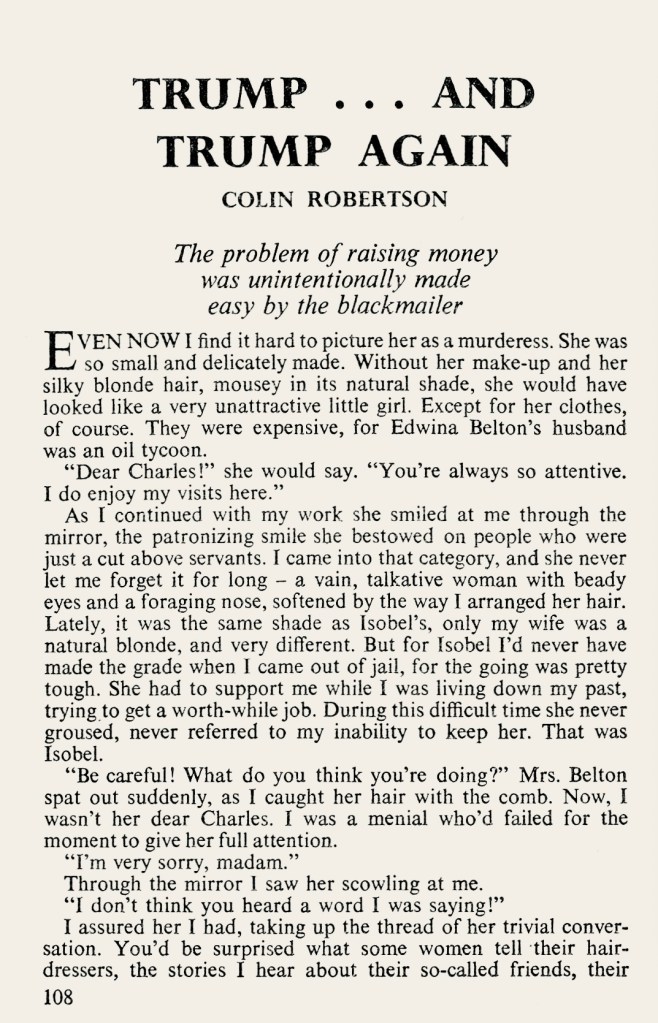
The script for “Chicago, Germany” as it appeared in the June 7-13 issue of Radio Life

Delving into the “Draft and Ideas” folder set aside for this blog, I came across a fragment titled “‘Chicago, Germany’: A 1940s Radio Play for Our Parallel Universe.”  It was intended for posting on 10 November 2016 as a response to a “Trump administration having become a reality.”  The draft was abandoned, but no other piece of writing was published in its place.  

In fact, the next entry in this journal did not appear until 15 May 2017, and it coincided with the opening of Alternative Facts, an exhibition I staged with students at the School of Art, Aberystwyth University, in Wales.

As the abandoned fragment and the ensuing hiatus suggest, the “reality” of the Trump presidency had so rattled me that I could not bring myself to continue a blog devoted to the popular culture of yesteryear, as much as I had always tried to de-trivialize bygone trifles not only by examining them in the context of their time but also by relating them to the realities of the present day.

The exhibition project that kept me busy in the interim, had similar aims.  Alternative Facts provided me, as a curator and educator, with an opportunity creatively to engage with the outrage of MAGA by appropriating a phrase that encapsulated the duplicity and travesty of those early days of spurious swamp-draining.

Fast forward to 20 January 2025, the day that Trump returned to office, by the popular demand that is a product of his populist brand, with the singular and single-minded vengeance of a MAGA-loomaniac.  Pardon the execrable pun, but I find no words other than that crass neologism adequately to describe a US President who pardons rioters storming the Capitol and defecating on democratic principles, much to the Nazi-salute inspiring enthusiasm of enabling, super-empowered and quite literally high-handed oligarchs who, I suspect, will, rather than Elon-gate this reign, eventually assume the gilded let’s-lay-democracy-to-rest-room that, in the interim, is the seat of Trump’s throne,

It struck me that the time was ripe for—and indeed rotten enough—to pick up pieces of that draft in light or dimness of the current and perhaps irrevocably changed political climate, which, far from incidentally, is the only human-made climate change we are likely to hear about from the US government for the duration, as dramatically shortened for our species and for most lifeforms on our planet as that time may have become in the process.

As a melodramatist who staged the end of the earth both on radio and for the movies (in the 1951 nuclear holocaust thriller Five), Arch Oboler would have much to say about all this—except that what Albert Wertheim has called his “penchant for altered reality” was being “married to his anti-fascist zeal” in propaganda plays sponsored by or at least aligned with the objectives of the US government during the FDR years.

Continue reading ““… an America that must never happen—that will never happen!”: Revisiting US American Anti-Third Reich Propaganda in the Second Age of MAGA”