
 Perhaps I shouldn’t be whistling “Consider Yourself” quite so cheerfully today, considering that it was just announced that Jack Wild, Oscar-nominated for his portrayal of Dickens’s Artful Dodger in the 1968 musical Oliver! has passed away at the age of 53 (the generally reliable Internet Movie Database had yet to catch up when last I checked this afternoon). Now, I haven’t been able to get those Oliver! tunes out of my head ever since I saw a production of it last summer, when I was impressed by Peter Karrie’s stirring rendition of “Reviewing the Situation.” Someone else who ought to be reviewing the situation—someone quite possibly sighing “Where Is Love?” along with future James Bond, Daniel Craig, whose birthday is being celebrated today by remarkably few fans of the series—is the current US President, whose waning popularity might as well be measured in disapproval ratings.
Whatever one’s view of the man or his performance, one has to wonder how future generations will look upon his administration and its handling of the so-called war on terror, the US economy, disaster relief and matters environmental. On this day, 2 March, in 1940, a play was broadcast on CBS radio that encouraged Americans to ask question like these and to resist the kind of hero-worship that is the result of blind faith and blatant revisionism.
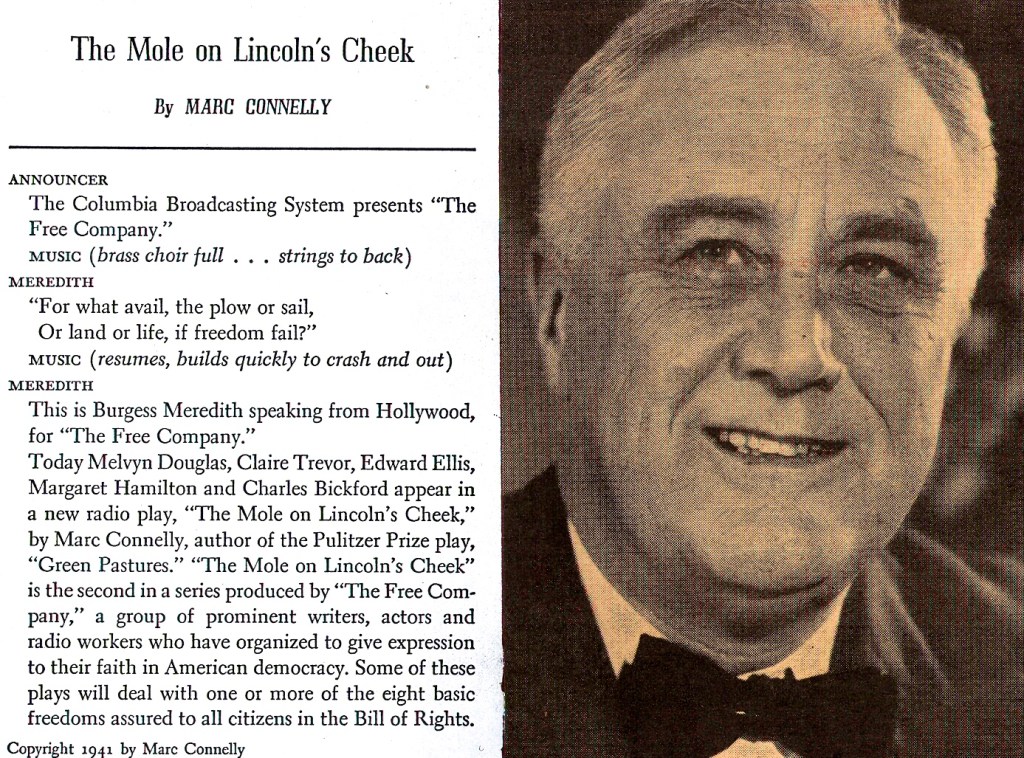
The play was Marc Connelly’s “The Mole on Lincoln’s Cheek” (previously mentioned in connection to Cindy Sheehan). Starring Claire Trevor, Melvyn Douglas, Charles Bickford, and Margaret Hamilton, it was part of a series of original radio dramas produced by the The Free Company, a “group of prominent writers, actors, and radio workers” who “organized to give expression to their faith in American democracy,” as it was put with some confidence in the introduction of each play (recordings of which you’ll find here). Connelly’s play deals with the freedom of speech in education, of which the depiction of Lincoln’s prominent mole is a metaphor. A heated dispute over the use of textbooks that portray America’s leaders in an at times less than flattering manner is dramatized to urge listeners to “resist any temptation to suppress truth or distort it.”
In the words of one of Connelly’s characters—a teacher accused of un-American activities for using a history book whose author points out that John Hancock was a smuggler and that “Andrew Jackson was rough and uncultured, couldn’t even spell—those who try to clean up history are “as reactionary as Mrs. O’Leary’s cow. Put an unexpected truth in front of them and they’ll always kick over the lamp.”
One of the offending line in the textbooks under attack is the assertion that “[i]n many instances the devotion of the leaders in the fight for independence in 1776 was caused less by patriotism than by the opportunity for what today we would call graft.” The teacher who ordered and approves of the textbook, dismisses accusations of anti-Americanism by expressing his belief that “a patriot is someone who exerts himself to promote the well-being of his country.”
“No one can deny that we are living in a changing world. Its social and economic orders are vanishing in front of our eyes. The chief purpose of teaching history is not to glorify the past but to insure the future.” Reviewing the situation, it seems to me that this lesson has been suppressed a few years ago and that much of what is troubling Americans today is the direct result of a momentary overcrowding of the passive, no-matter-what school of patriotism Connelly warned against, a dismissal or downright vilifying of critical thinking that led first to silence and now that the school is being torn down provokes equally immature fits of told-you-so hilarity.
 Harry Heuser