Some Like it . . . How? Youth, Vampires, and Marilyn Monroe

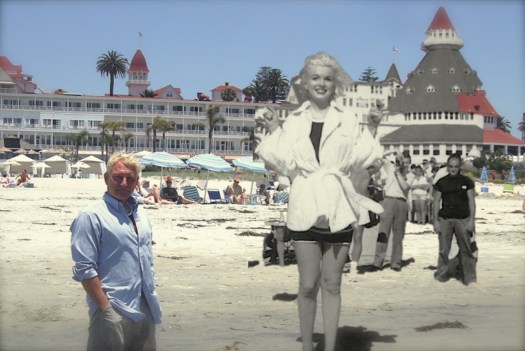
Del Coronado mirage

There I stood, in the shimmering sands of Coronado Beach, California. I had come, of course, to see the famous Hotel—and to share the views once taken in by Marilyn Monroe during the filming of Some Like It Hot. Marilyn was here. Now I was.

Footsteps. Sand. The old hourglass. I won’t indulge in such clichés here; but there is something pathetic about this kind of out-of-sightseeing, this belated catching up and impossible reaching out to which I am prone. The inclination to seek out what is long gone is more than morbid curiosity: it is an approach to life as a retreat from living in which even the here-and-now becomes dreamlike and chimerical. How did this get to be my way of not facing the world?

Marilyn Monroe died before I was born; yet her life and times became a fascination of my teenage years.  Mine were not erotic fantasies.  I did not long for her body.  Nor did I think of her as being gone.  She was never absent for long from the television screen, ever present on the iconic posters I pinned onto the wall above my bed.  Records spinning on the old turntable, her voice filled my room. I had no regrets about never being able to meet her in the flesh; rather, it was a relief.

The wonder of her incorporeal existence made living in the body I loathed more tolerable; and it made the physical relationships I dreaded easier to contemplate in the abstract.  Marilyn—and we call her by her first name because she is more familiar than famous, more girl than goddess—was not some facile paradox: “I Wanna Be Loved by You” and “I’m Through with Love” she sings in the same movie, expressing the hurt and hunger that are far from mutually exclusive.

Our teenage selves are preoccupied with the demands that both nature and society make on us, propositions and impositions captured in that horrible phrase haunting and taunting us until death: “grown up.”  As a response to and rejection of the implied threat—the finality and premature stunting of our infinite potentialities—Marilyn’s afterlife was as much a reproof of society as it was a society-proof alternative: a twilight life, expired and undying, bright though snuffed out, a fragile, indomitable spirit-presence in whose shadowy glow I could luxuriate, just as many a young person nowadays revels in the gothic gloom inhabited by zombies and vampires, except that my imaginings transported rather than dispirited me.

No doubt, this twisted bent of casting myself into times preceding my birth is born of a desire to bring forth alternate selves of mine without having to bear the vagaries of the present or the uncertainties of the future.  Like a life presumably squandered in reverie, bending the past to our will is a testament to a vestigial will power—or would-be power—in which the retrospective becomes invested with the prospect of an ever glimmering what if . . .

The Touchables

The folks who proved that they had made their mark in Hollywood by leaving it in the cement slabs in front of Grauman’s Chinese Theatre had one thing in common. Besides having the stature of a movie star or Tinseltown personality, I mean. They could all stand up, bend down, and exert whatever pressure is required to produce those imprints. Even Charlie McCarthy, apparently. I always thought that it might please the supposed untouchables to be commemorated in a medium that is not as telltale about our inescapable senescence as a photograph or moving image. Many of us can stand up far longer than we can stand looking in the mirror.

Then again, the moving hands of time are readable in our footprints. Shirley Temple’s tiny imprint reminds us that, on 14 March 1935, she was at the height of a career that diminished as she increased in size. Still, the prints are meant to bespeak immortality. We don’t get to see the tracks of Christopher Reeve’s wheelchair, for instance. Nor is Zsa Zsa likely to be given the honor now to join those ladies in cement. These prints are all solid, no matter how much the concrete crumbles. The stars have bodies—and they are able and sound . . .

There is something reassuring in that solidity—if it weren’t for those cracks, and the puzzled looks I come across in the crowd gathered here to take pictures, mainly of themselves in front of a Hollywood landmark. Who was Rudy “My Time Is Your Time” Vallee, anyway? Norma Talmadge, who’s she? What were the Ritz Brothers all about? And who was that Sid fellow for whom they left those cryptic messages?

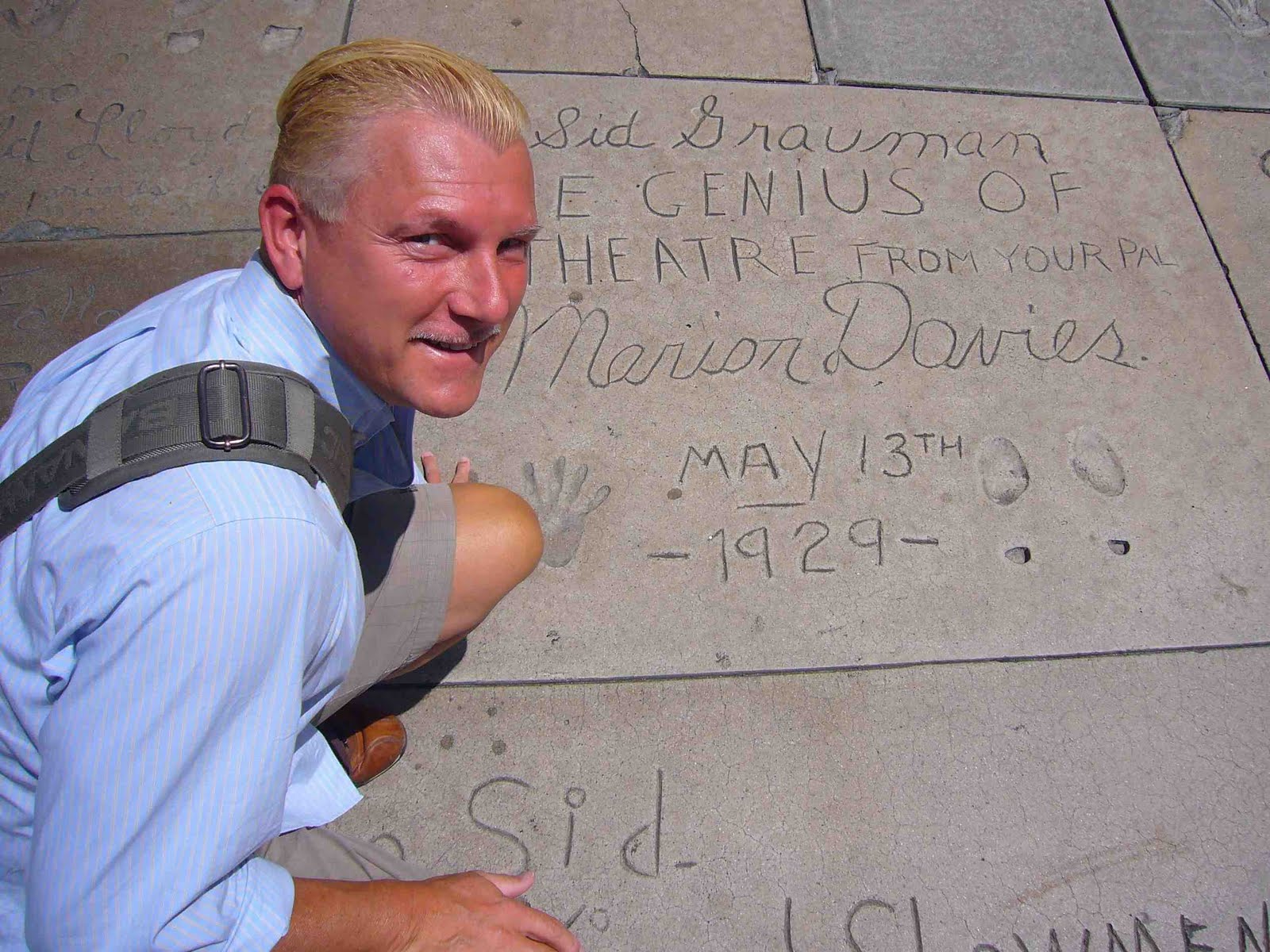
I got the space to myself as I have my picture taken with Marion Davies’s dainty indentations (dated 1929), my palm covering the hollow. No one is likely to pull a Lucy now; the Duke is still standing. Most walk right past—no, over—Ezio Pinza, whose block of concrete has become a mere steppingstone. Not a soul stoops to Monty Woolley. He’s the actor to whom my dog owes his name (I’m telling no one). I, too, I am out of touch.

There is one imprint, though, that keeps impressing after nearly sixty years. You can tell from the grime in the handprints of Marilyn Monroe just how many visitors have bowed down to approximate her posture, crouching over to show that they still look up to her. Screen partner Jane Russell’s palms are eloquently untainted by comparison. Marilyn—and we call her by her first name in recognition of her vulnerability—would be dead within ten years after being immortalized at Grauman’s. Our reaching out to her now is a belated, selfish gesture. You can’t expect rectitude from a crowd bent on lowering themselves for a photo opportunity. Remaining upright here means to be indifferent.

“Wipe your mucky paws,” I want to cry out. Yet these cultural touchstones are unlike other memorials to the untouchables. Here, we touch what we deem worth preserving. We bestow genuine stature with our own hands. We grasp at the chance to grease the Hollywood machine with our grubby palms, to fashion destinies with our filthy fingers. Since greatness does not rub off, most of us leave little more than a smudge. There is humanity in the residue of perspiration.

After the Falls

Having just returned from a trip to Niagara Falls, I was eager to revisit Henry Hathaway’s 1953 technicolor thriller starring Marilyn Monroe. Shrewd, sexy, and sensational, the expertly lensed Niagara is the most brilliantly devised star-making spectacle of Hollywood’s studio era. It has so much going for it that it can afford to be utterly predictable. The Falls are predictable, which does not make them any less exciting. And as much as I enjoy spotting old-time radio performers like the aforementioned Lurene Tuttle or Jack Benny’s jovial announcer Don Wilson, Niagara hardly requires any added attractions to make repeat viewings worth my while. More than the mere setting for a tale of adultery and revenge, the magnificent Falls are a dramatic extension of Monroe’s form and the character she portrays, as well as an obvious metaphor for the rush of desire and the flimsiness of the social fabric with which we attempt to stay it.

No one seems safe from the inexorable and devastating force of Niagara. Not even Jean Peters, the far better half of a couple of second honeymooners so clean as to be emotionally washed up and well past passion. Spending a honeymoon by the falls is something of an endurance test. Either your love proves as strong and permanent as the scenery or the flame is doused and consumed by it. Passion, to be sure, is no requisite for marriage, which is why the falls can be seen as a substitute for it, an ersatz externalization for the unsettling influences those settling in dare not permit themselves to experience.

No matter how many showers she takes, how many times she gets sprayed by the mist, no matter how many times she slips into a new dress, Monroe’s Rose is far from spotless. She is no Lorelei Lee, either, an infantilized siren whose predatory sexuality is rendered innocuous by her apparent simplicity and her chief interest in the monetary value of her prey. According to the Code under which Hollywood operated, a lapsarian anti-heroine like Rose must go down in her own scheme to rid herself of her brooding, volatile husband (Joseph Cotten, whose character is too unsure of himself or his position to control his wife, let alone the film’s point of view).

For the gender-confused and fatalistic teenager I once was, Niagara outlined adult life as an improbable proposition, a threatening, unconquerable front: the terror of “taking the plunge” in conformity and the peril of attempting to go against the stream while stuck in a barrel destined for the Horseshoe Falls. Wet behind the ears, I seemed unlikely to get altogether soaked. My downfall would be suffocation, not rapture. The only recourse that appeared open to me back then was to assume the likeness of a devastating and lamented corpse when the bells were rung on my behalf by the re-producers in charge of casting me aside. I never got entirely over this feeling, but have long since learned to keep afloat.

Many Happy Reruns: Marilyn Monroe at Eighty

I have been accused, at times, of exaggerating matters; but this just about proves it: radio, as a storytelling medium, is dead. I’ve conducted searches on Google and Technorati this morning, using the keywords Gelbart and Abrogate. The result: only 28 mentions in well over 40 million blogs! And no more than 444 via Google, the first entry of which refers searchers to broadcastellan. Considering that thousands of web journals are devoted to American politics and thousands more to the media in general, the lack of publicity a broadcast satire about the Bush administration has been receiving is remarkable.

I am referring, of course, to M*A*S*H creator Larry Gelbart’s “Abrogate,” a recording of which is still available on the BBC homepage. Had Barbara Bush been levitating on television (as she is in Gelbart’s utopia), had her son been denounced as the spawn of Satan (as he is in the fictive senate hearing of “Abrogate”), had Condoleezza Rice, Lynn Cheney and Ms. Bush been likened to the three hags in Macbeth (an image suggested by the radio play), there sure would have been some noise about it.

Radio used to popularize products and people, plays and personalities; now it appears to be the black hole of the multi-media universe. A few weeks ago, I recalled how Marilyn Monroe was being sent on the air to promote her studio, Fox, which had so little use for the young contract player during the late 1940s. She got flustered and faltered, delivering her few lines with less than confidence.

Her radio debut on 24 February 1947 (previously discussed here) was less than auspicious. The play presented that night on the Lux Radio Theatre was an adaptation of the costume drama Kitty. Marilyn was not in it, but was heard instead during a commercial break, peddling soap and plugging the latest film of Betty Grable, her future co-star. She had just been subjected to her first Technicolor screen test, but would remain limited to walk-ons in lesser black and white fare for years to come.

Such rare broadcasts reveal something about the personality of a performer that can be obscured on the screen. On live radio, unlike in the movies, there were no second (or twenty-second) takes. There was the microphone, demanding and daunting. There was the crowd of spectators, gawking at the performers in the studio. And there was Monroe, a nervous young woman, not yet twenty-one, clutching the script she had been instructed to read.

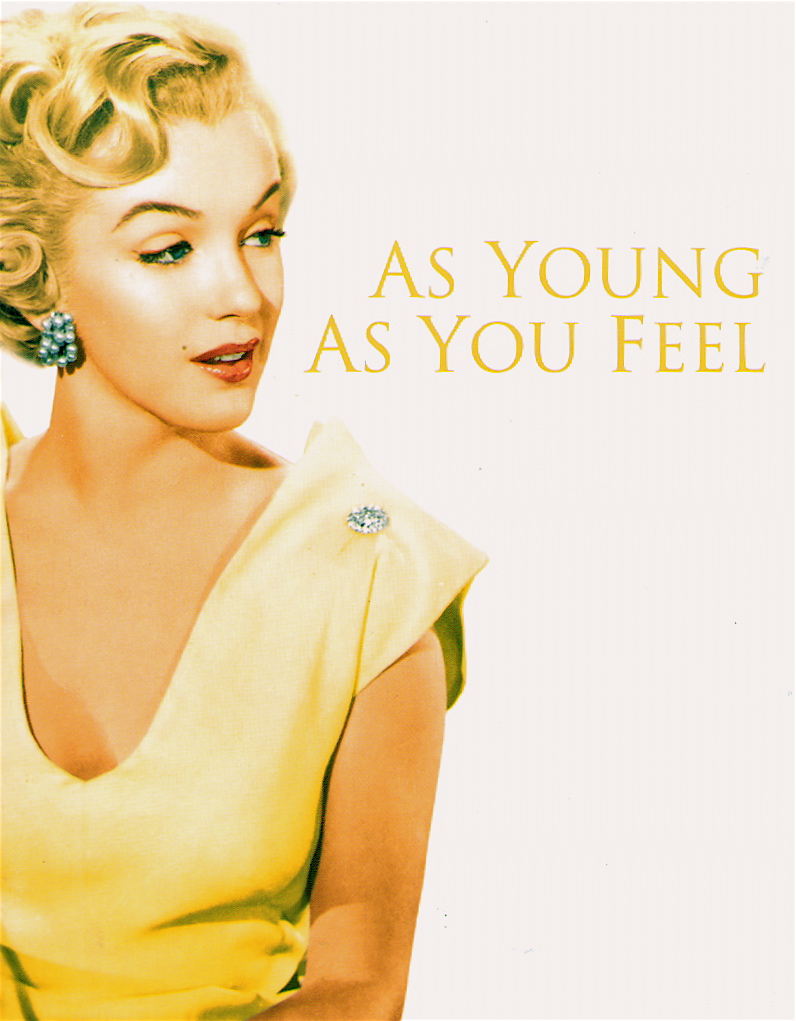
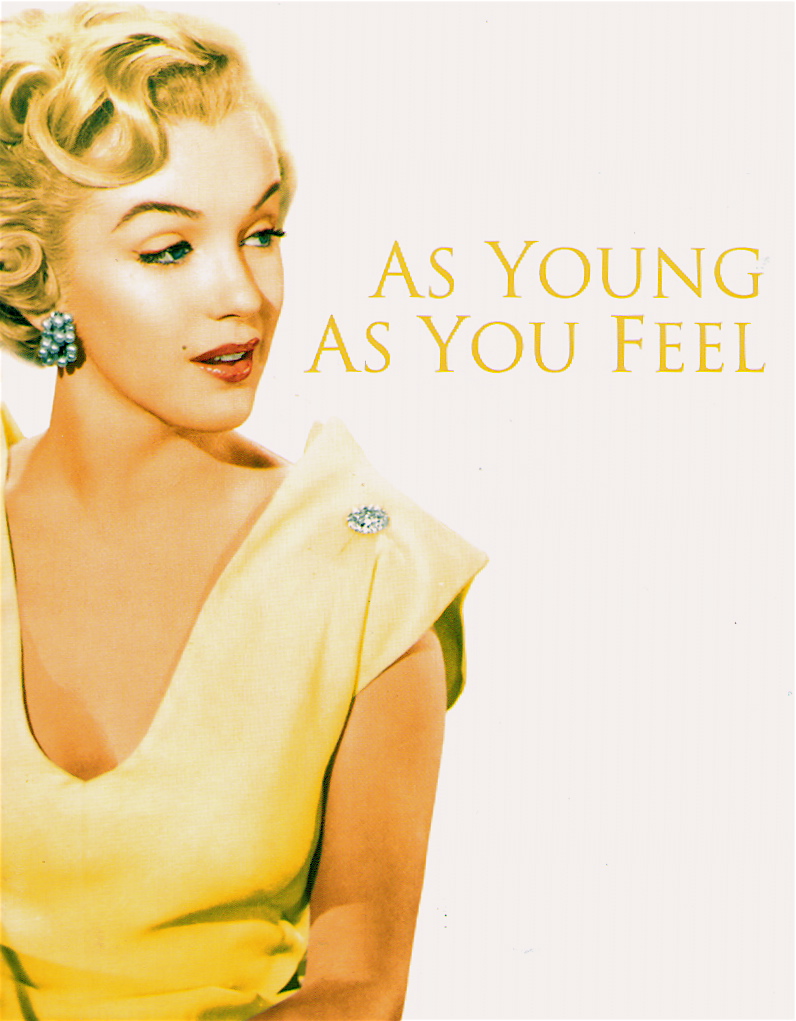
Monroe would have become an octogenarian today; not a pretty picture, perhaps—at least to those who see the aging process as a series of cumulative imperfections. How would the girl formerly known as Norma Jean have matured as a performer? Were she alive and among us now, would she be appearing in television dramas? Would she be discussing her latest autobiography with Larry King? Or would she be hiding from prying eyes, living in seclusion and hoping instead to be recalled as young as she was when Fox finally revealed her charms in Technicolor and Cinemascope? Given Western culture’s obsession with youth, she might now be embracing the microphone she once feared.

Recalling her not as she was or was made out to be, but calling her forth as she is to me, I am going to close my eyes now and listen to Marilyn as she returned to radio on 13 December 1952, with somewhat more assurance and considerably more box-office draw. By then she was being romanced by Charlie McCarthy, the first voice thrown into a ring littered with neglected hats.

Going on the air with Edgar Bergen’s wooden friend was risky business, considering what that chip of a chap had done to the broadcasting career of Mae West (as reported here). Not satisfied with fantasizing about her, Charlie was determined to woe and wed her, taking her home on behalf of us. Theirs was a short-lived engagement. Mine is a lasting passion . . .

Another “Wrong Number,” a False Start for Marilyn, and the Right Answer at Last

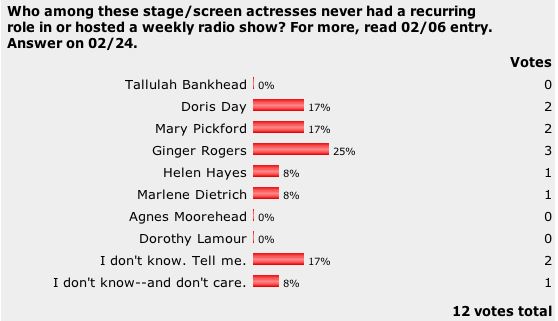
For the past three weeks I have been commemorating the dames, gals, and ladies of the airwaves; but now, the correct answer to the question posed in first broadcastellan quiz can finally be revealed. Thanks to all those who guessed or knew or couldn’t care less—and told me so. Tallulah Bankhead, Doris Day, Mary Pickford, Helen Hayes, Marlene Dietrich, Agnes Moorehead, and Dorothy Lamour—they were all radio regulars at some point in their careers, whereas others, including Ginger Rogers, the lady in question (as guessed by three readers), limited their air time to occasional guest appearances on dramatic programs like the Lux Radio Theatre. And others still, Marilyn Monroe among them, started out in commercials.

On this day, 24 February, in 1947, more than five years before she became a major star, a noticeably nervous Monroe, having waited months for her first movie role while already under contract at Fox, was pushed before the microphone to appear in a commercial break for the Lux production of “Kitty.” Within the few seconds allotted for her radio debut, Monroe was faced with the task of initiating her career (by mentioning her first Technicolor screen test), plugging Betty Grable’s The Shocking Miss Pilgrim (whose costume she got to wear during the test shoot), and peddling Lux “flakes” (which ostensibly kept those costumes fresh and colourful). However alluring her timbre, Monroe fumbled. She could not even get the name of the announcer straight; her voice was rarely broadcast thereafter, even as her film roles remained scarce and undistinguished.

A pleasant voice, while an asset, was not a radio requisite. As I mentioned previously, Louella Parsons did quite well without one, notwithstanding her consternation when being told she had to do without the larynx of Ms. Rogers, who allegedly insisted on getting paid to be interviewed. The giggles and high-pitched screechings of comedy actresses aside, the most celebrated woman’s voice on American radio was the less than pleasing one emanating from Agnes Moorehead. Her virago vocals, by which Joseph Cotton’s character in Since You Went Away claims to have been haunted across the Atlantic, was ideally suited to the role of irate Mrs. Stevenson in that most famous of original old-time radio plays, Lucille Fletcher’s “Sorry, Wrong Number.”

On this day in 1944, Moorehead, shown left during a performance of “Sorry,” once again starred in the role she had originated on the radio thriller anthology Suspense in May 1943. The part was subsequently translated for motion picture audiences and television viewers (by Barbara Stanwyck, Mildred Natwick, Ida Lupino, and Shelley Winters); but, however bitter Moorehead might have been losing the role to Stanwyck on the big screen, no actress would snatch the original from the “First Lady of Suspense.”

It was not until long after Moorehead’s death that Claire Bloom (recently seen on UK television in the last of the second season of Marple), made an attempt at superseding the “First Lady,” not only by recreating the role for radio in 1999, but by starring in a sequel of sorts.

While she had nothing to do with that sequel, radio dramatist Lucille Fletcher was responsible for the 1948 film adaptation. Her involvement did not, however, assure the aesthetic success of the latter, which, for all its high melodrama, has little of the tension generated by the original play. With its numerous flashbacks, the film destroys the intensity of a drama unfolding in real time. Like Allan Ullman’s novelization of Fletcher’s screenplay, it fails to approximate, let alone recreate, the excitement of eavesdropping on someone in mortal danger, someone whose life, like the live broadcast during which it plays out—runs on a decidedly tight schedule beyond our control and influence.

“I wanted to write a show that was ‘pure medium,'” Fletcher remarked about “Sorry, Wrong Number.” She succeeded so well that any adaptation would amount to nothing short of mediocre impurity.