Another Man’s Ptomaine: Was “The Undertaker’s Tale” Worth Exhuming?

Bury this. Apparently, it was with words not much kinder that the aspiring but already middle-aged storyteller Samuel Clemens was told what to do with “The Undertaker’s Tale.” Written in 1877, it was not published until this year, nearly a century after the author’s death. The case of the premature burial has not only been brought to light but, thanks to BBC Radio 4, the disinterred matter has also been exposed to the air (and the breath of reader Hector Elizondo). So, you may ask after being duly impressed by the discovery, does it stink?

To be sure, even the most minor work of a major literary figure is deserving of our attention; and “The Undertaker’s Tale” is decidedly minor. It derives whatever mild titters it might induce from the premise that one man’s meat is another man’s poison or, to put it another way, one man’s dead body is another’s livelihood.

“We did not drop suddenly upon the subject,” the narrator ushers us into the story told to him by his “pleasant new acquaintance,” the undertaker, “but wandered into it, in a natural way.” We should expect slow decay, then, rather than a dramatic exit—and, sure enough, there is little to startle or surprise us here.

There isn’t much of a plot either—but a lot of them. The eponymous character—one Mr. Cadaver—is a kind-hearted chap who cheers at the prospect of an epidemic and who fears for his family business whenever the community is thriving. To him and his lovely, lively tribe there can be no joy greater than the timely demise of an unscrupulous vulture (some simulacrum of a Scrooge), which—death ex machina and Abracacaver!—is just what happens in the end.

In its time, “The Undertaker’s Tale” may have been dismissed as being in poor taste; what is worse, though, is that it is insipid. To bury it was no doubt the right decision as it might have ended Clemens’s literary career before it got underway by poisoning the public’s mind against him. A death sentence of sorts.

It may sound morbid, but, listening to this unengaging trifle, I drifted off in thoughts of home. My future home, that is. No, I am not about to check out; but within a few days now I am going to move to a town known, albeit by very few, as Undertaker’s Paradise.

Back in 2000, the Welsh seaside resort of Aberystwyth served as the setting for a dark comedy thriller with that title. Starring Ben Gazzara, it concerns an undertaker rather more enterprising than Mr. Cadaver in the procuring of bodies. Like Twain’s story before it, the forgotten film is waiting to be dug up and appreciated anew. Unlike Twain’s story, it has no literary pedigree to induce anyone to pick up a shovel. Shame, really. It’s the better yarn of the two.


Related writings
“Mark Twain, Six Feet Under”
“What Those Who Remembered Forgot: Don Knotts (1924-2006) on the Air”

Mark Twain, Six Feet Under

“I have been trying all I could to get down to the sentimental part of it,” Mark Twain remarked on the “subject of graveyards.” Yet, he concluded, there was “no genuinely sentimental part” to the spectacle we make of the act of decomposing. “It is all grotesque, ghastly, horrible.”

Perhaps it takes a higher degree of sentimentality to find the romance in the morbid; but I am capable of just that. Whenever I travel, I enjoy visiting places of interment, particularly those large necropolises with their temples and statues erected in memory of mortals who, while above ground, played a vital role in the workings of our large metropolises.

Bankers and bigwigs seem to insist on occupying the largest dwellings in the cities of the dead. There must be some consolation in knowing that, even when six feet below, one can still get folks to look up in admiration. Writers, by comparison, often have modest graves. They, after all, leave their impressions by filling volumes that, however small by comparison to a mausoleum, are apt and ample monuments to their craft. Tombs are largely reserved for those who managed no tomes.

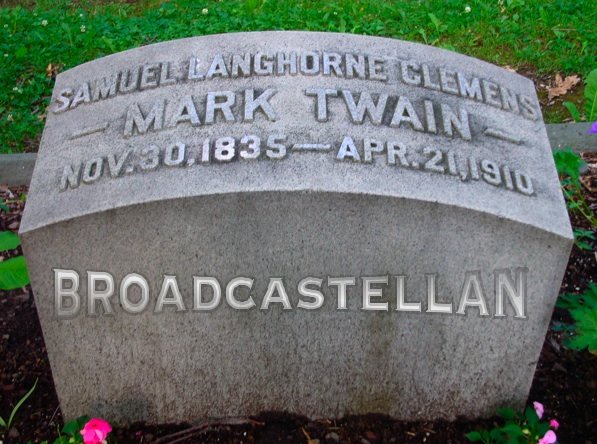
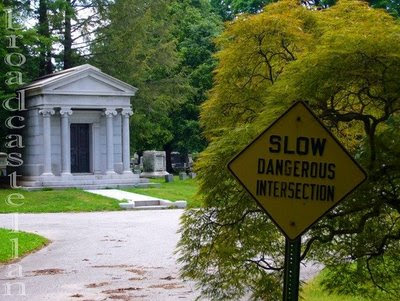
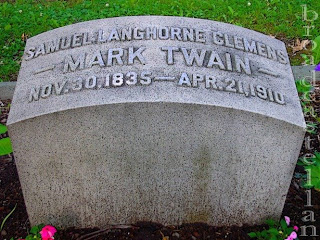
Mark Twain’s own grave is an encasement in point. Last summer, returning to New York City from a trip to Niagara Falls, we had a stopover in the town of Elmira. Since I was in charge of both the map and the guide book, I made sure it was on our way. After all, the humorist from Missouri is buried there. The first thing we did, after securing a room for the night, was to go in search of his final resting place, which we found, eventually, along with that of filmmaker Hal Roach (shown here). However impaired our sense of dimensions after beholding the Falls, the stone (pictured) is less than majestic.

Close to it, though, is a larger monument, about twice as high as the number of feet I presume him to be under, which is precisely the length denoted by the cry of “mark twain” from which Samuel Clemens took his name. The cleverness of the tribute notwithstanding, I wonder whether the writer so honored would have welcomed such a column. Resting assured that monuments are being perpetually erected in the minds of those who read, relish, and recite his words, Mark Twain may well have been better pleased with a more modest disposal, given his attitude toward burials as expressed in Life on the Mississippi:

Graveyards may have been justifiable in the bygone ages, when nobody knew that for every dead body put into the ground, to glut the earth and the plant-roots, and the air with disease-germs, five or fifty, or maybe a hundred persons must die before their proper time; but they are hardly justifiable now, when even the children know that a dead saint enters upon a century-long career of assassination the moment the earth closes over his corpse.  It is a grim sort of a thought.  The relics of St. Anne, up in Canada, have now, after nineteen hundred years, gone to curing the sick by the dozen.  But it is merest matter-of-course that these same relics, within a generation after St. Anne’s death and burial, made several thousand people sick.  Therefore these miracle-performances are simply compensation, nothing more.

Besides, he pointed out (quoting a member of Chicago Medical Society, who was an advocate of cremation), “[f]unerals cost annually more money than the value of the combined gold and silver yield of the United States in the year 1880! These figures do not include the sums invested in burial-grounds and expended in tombs and monuments, nor the loss from depreciation of property in the vicinity of cemeteries.”

Mark Twain was born on this day, 30 November, in 1835; he died nearly a century ago and, whatever his views on the matter of tombstones, has well earned his keep at Woodlawn. Here he immaterializes for us in “The Adventures of Mark Twain” (Cavalcade of America, 1 May 1944), the voice being that of Fredric March. In light of Mark Twain’s remarks, I believe he would have approved of the memorial services a cost-effective medium like radio can provide. Radio gets rid of the body but keeps the spirit alive.