Marlene Dietrich (1951) by Angus McBean, SoAM&G, Aberystwyth University Purchase: Adrian Woodhouse (2016) Funding support: ACE/V&A Purchase Grant Fund and The Art Fund
What draws me in is the blankness of Dietrich’s face, her eyes looking not at us but beyond us, at nothing in particular, with a lack of any definable expression, emotion or urgency. The vacant gaze, bespeaking an unavailability and a refusal to engage, suggests the subject’s control over an image that is all surface: like theatrical curtains, the lids may come down on those eyes any moment now, shutting us out entirely.
It is a blankness that is not nothingness, invested as it becomes with the spectacle it makes of our longing. It is a blankness that is not openness; it gives nothing away while it commands our attention and inspires our awe at its sublime perfection – a perfection that belies the sprezzatura, the rehearsed effortlessness and nonchalance of the performance.
Nothing here encourages us to imagine what those eyes are looking at; nothing that invites us to see anything through those eyes. Those eyes are the event in a face – a site – that is all look. I am glamor, this face says, and what else, what more could you – or anyone – possibly be looking for!
The photograph holds me because the look withholds so much. What we are not getting is a portrait of the sitter, then in her fiftieth year. This photograph, clearly, is not of Dietrich, the person. It is the image of a mask that is already a persona. In this masquerade, as intriguing as anything conceived by Cindy Sherman in her film stills, the image is a simulacrum – the fiction of a fiction of a fiction.
“Ladies and gentlemen. We have grand news for you tonight, for the Lux Radio Theater has moved to Hollywood. And here we are in a theater of our very own. The Lux Radio Theater, Hollywood Boulevard, in the motion picture capital of the world. The curtain rises.”
Going up with great fanfare on this day, 1 June, in 1936, that curtain, made of words and music for the listening multitude in homes across the United States, revealed more than a stage. It showed how an established if stuffy venue for the recycling of Broadway plays could be transformed into a spectacular new showcase for the allied talents at work in motion pictures, network radio, and advertisement.
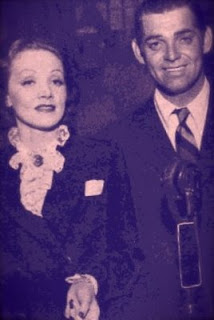
Marlene Dietrich and Clark Gable at the premiere of the revamped Lux Radio Theater program
“Frankly, I was skeptical when the announcement first reached this office,” Radio Guide’s executive vice-president and general manager Curtis Mitchell declared not long after the Hollywood premiere. The program was “an old production as radio shows go,” Mitchell remarked, one that was “rich with the respect and honors” it had garnered during its first two years on the air. Why meddle with an established formula?
Mitchell’s misgivings were soon allayed. The newly refurbished Lux Radio Theater had not been on the air for more than two weeks; and Radio Guide already rewarded it with a “Medal of Merit”—given, so the magazine argued, “because its sponsors had the courage to make a daring move” that, in turn, had “increased the enjoyment of radio listeners.” There’s nothing like a new wrinkle to shake the impression of starchiness.
“I cannot help but feel,” Mitchell continued, that the “two recent performances emanating from Hollywood have lifted it in a new elevation in public esteem. Personally, listening to these famous actors under the direction of Cecil De Mille, all of them broadcasting almost from their own front yards, gave me a new thrill.”
That DeMille had, in fact, no hand in the production did little to diminish the thrill. An open secret rather than a bald lie, the phony title was part of an elaborate illusion. The veteran producer-director brought prestige to the format, attracted an audience with promises of behind-the-scenes tidbits, and sold a lot of soap flakes throughout his tenure; and even if the act wouldn’t wash, he could always rely on the continuity writers to supply the hogwash.
As DeMille reminded listeners on that inaugural broadcast (and as I mentioned on a previous occasion), Lux had “been a household word in the DeMille family for 870 years,” his family crest bearing the motto “Lux tua vita mea.” Oh, Lever Brother!
Perhaps the motto should have been “Manus manum lavat.” After all, that is what the Lux Radio Theater demonstrated most forcibly. In the Lux Radio Theater, one hand washed the other, with a bar of toilet soap always within reach. As I put it in Etherised Victorians, my doctoral study on the subject of radio plays, it
was in its mediation between the ordinary and the supreme that a middlebrow program like Lux served to promote network programming as a commercially effective and culturally sophisticated hub for consumers, sponsors, and related entertainment industries.
With DeMille as nominal producer and Academy Award-winner Louis Silver as musical director, the new productions came at a considerable cost for the sponsor: some $300 a minute, as reported in another issue of Radio Guide for the week ending 1 August 1937. Of the $17,500 spent on “The Legionnaire and the Lady,” the first Hollywood production, $5000 went to Marlene Dietrich, while co-star Clark Gable received $3,500. Those were tidy sums back the, especially considering that the two leads had not even shown up for rehearsals.
The investment paid off; a single Monday night broadcast reportedly attracted as many listeners as flocked to America’s movie theaters on the remaining days of the week. As DeMille put it in his introduction to the first Hollywood broadcast, the audience of the Lux Radio Theater was “greater than any four walls could encompass.” Besides, the auditorium from which the broadcasts emanated was already crowded with luminaries.
“I see a lot of familiar faces,” DeMille was expected to convince those sitting at home: “There’s Joan Blondell, Gary Cooper (he stars in my next picture, The Plainsman), Stuart Erwin and his lovely wife June Collier.”
Also present were Al Jolson, Ruby Keeler, and Franchot Tone. “And I, I think I see Freddie March,” DeMille added in a rather unsuccessful attempt at faking an ad lib. While there is ample room for doubt that any “nine out of ten” of those stars named actually used Lux, as the slogan alleged, they sure made use of the Lux Radio Theater. It was an excellent promotional platform, a soapbox of giant proportions.
A visit to the Lever Art Gallery in Port Sunlight
As I was reminded on a trip to the Lady Lever Art Gallery in Port Sunlight last year, Lever Brothers had always been adroit at mixing their business with other people’s pleasure. Long before the Leverhulmes went west to hitch their wagon on one Hollywood star or another, they had disproved the Wildean maxim that the greatest art is to conceal art and that art, for art’s sake, must be useless.
It is owing to the advertising agents in charge of the Lever account that even the long frowned upon “commercial” did no longer seem quite such a dirty word.
Placing Mitchell Leisen alongside Hollywood’s top flight directors is likely to raise eyebrows among those whose brows are already well elevated. Most others will simply shrug their cold shoulders in“Who he? indifference, a stance with which I, whose shoulders are wont to brush against the dusty shelves and musty vaults of popular culture, am thoroughly familiar by now. Respected for his knack of striking box-office gold but dismissed by his peers, the former art director was not among the auteurs whose works are read as art chiefly because it is easier to conceive of artistic expression as a non-collective achievement: something that bears the clearly distinguishable signature of a single individual. Their careful design aside, little seems to bespeak the Leisen touch, which is as light as it is assured. Stylish and slick in the best Paramount tradition, a Leisen picture stunningly sets the stage under the pretense of drama; otherwise, it has few pretensions.
The epitome and pinnacle of Leisen’s dream factory output is Golden Earrings (1947), a sumptuously lensed romance that makes Nazi Germany look like fairyland, replete with quaint villages, enchanted forests, and lusty gypsies. It is a false image conjured up by the words of a paramour with pierced ears. For the darker side of the tale, nearly hidden from view, we are referred to McLuhan’s “tribal drum”—the radio.
One of those gypsies is played by German expatriate Marlene Dietrich, who approaches the brown-face role of Lydia tongue-in-famously-hollow-cheek. To Leisen, Dietrich “was the most fascinating woman who ever lived,” as he later told David Chierichetti, the chronicler of his career. Cast as reluctant lover, Col. Ralph Denistoun, is Ray Milland, whose lack of regard for his older co-star only enhances the screwball dynamics of this improbable coupling. Sheltered by and disguised as one of her kind, Milland’s Romani wry officer is on a perilous mission to evade his Nazi pursuers and get hold of a formula for poison gas, the kind of weapon that would exterminate thousands of gypsies.
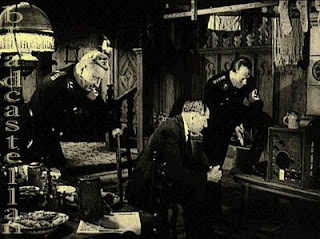
Having previously been captured by the Nazis, Denistoun owes his escape to the master race’s slavish devotion to their master’s voice. He takes full advantage of a radio address by the Führer, guaranteed to distract his captors. The scene in which the Nazi officers rise to hear Hitler’s speech and fall at the hand of their prisoner is an apt metaphor for blind faith and mass-mediated control. Unlike those gypsy earrings, the silence of a people whose ears ring with the brass of Teutonic rhetoric is not golden. A mind closed to independent thought and voices at variance, Golden Earrings suggests, is readily silenced. To be sure, this is retrospective romance; and, its ersatz gypsies roaming quite freely, Leisen’s film shows nothing of the silencing perpetrated by the fascists.
Leisen was not about to denounce the medium he had romanced in two of his earlier revues, The Big Broadcast of 1937 and its 1938 follow-up. Instead, Golden Earrings confronts nationalistic, state-run radio with a distinctly American voice of commercial broadcasting. In the narrative frame, the English officer is seen relating his story to Quentin Reynolds (pictured here with Milland), a news commentator known for his on-air missives to Doktor Goebbels and Herr Schickelgruber.
Rather than spouting anti-Axis propaganda or post-war wisdom, Reynolds is shown as a receiver, a listener tuning in to the wondrous adventure of the strangely un-British Englishman who has come under the influence of a nomadic culture foreign to his people. It is a tall tale a commentator like Reynolds, who would later be libeled in the Hearst press for his alleged lack of patriotism, is not obliged to debunk.
The frame permits Leisen to construct Golden Earrings as a romance, told as it is from the perspective of an unconventional officer summoned by his gypsy love. It is all so fabulously escapist that the enormous gamble of glamorizing Germany so soon after the war paid off without causing much offense. That, in short, is the Leisen touch.
My grandmother refused to listen. She would walk out of the room whenever Marlene Dietrich appeared on the small screen. “She betrayed our country,” Oma would say, referring to Dietrich’s departure for Hollywood about the time the fascists came into power. Actually, Dietrich left a few years earlier; but the Nazis sure failed to lure her back. What a loss it is to turn a deaf ear to what aforementioned radio actor Joe Julian called “an exotic accent” and a “strong voice-presence.” Working with her in Dietrich’s lost radio series Café Istanbul (1952), Julian got a “glimpse behind the public image” and discovered
a woman of strength, warmth, and intelligence, yet so spontaneous that when, during a rehearsal, she overheard one of the actors express doubt that the rest of her body [she was in her early fifties by then] was as youthful as her famous legs, she ripped open her blouse to prove him wrong.
On this day, 8 October, in 1939, Dietrich could provide no such proof of her health and vitality. Scheduled to appear on the Screen Guild program that night, she was forced to call in sick due to a severe cold that, according to Roger Prior, host of the show, had halted the shooting of Dietrich’s comeback feature Destry Rides Again. The star had tried to honor her commitment, but had lost her voice entirely during rehearsals. In what must be one of the most inept voice-overs in Hollywood history, the Screen Guild producers replaced her with . . . Zasu Pitts.
It was all for laughs, of course. After all, Pitts’s voice had about as much sex appeal as fingernails being painstakingly filed . . . with a blackboard. And by casting Pitts opposite the less-than-expressive Gary Cooper, the Guild made the most of this emergency situation. “Is that Marlene Dietrich?” Cooper inquired. The affirmative only produced a terse “Well, so long.” Trying to explain the situation, Prior informed Cooper that “Zasu has Marlene Dietrich’s lines.” “Not from where I’m standing,” Cooper retorted. Together with Bob Hope and the actress billed as “Marlene Zasu Dietrich Pitts”, he nonetheless condescended to co-star in the sketch “The Girl of the Woolly West; or, She Was Wearing Slacks, So She Died Like a Man.” It sure made audience’s anxious for Dietrich’s return.
Nine years later to the day, on 8 October 1948, Dietrich was once again sick—and scheduled to appear on the air. This time, though, she was able to perform her role, cast as she was as the ailing Madame Bovary in the Ford Theater presentation of the novel as adapted by NBC staff writers Emerson Crocker and Brainerd Duffield . Sure, you’ve got to take Madame Bovary with “a pinch of power”; but you won’t be sorry to hear Dietrich breathe her last on the occasion. Besides, who could expect fidelity in the case of Emma Bovary?
“If some of Flaubert’s delicate delineation of character was missing from ‘Bovary’-on-the-air,” critic Saul Carson remarked, “Marlene Dietrich more than made up for this loss in literary flavor by her superb acting in the lead role.” Hardly carrying the chief burden, Dietrich was supported that night by Van Heflin and Claude Rains. “Too often, film stars rely on their screen reputations to cover slipshod work in radio,” Carson conceded; “but these people performed as artists who respected the medium as well as the vehicle.”
If Dietrich’s in it, just about any vehicle will do for me. Unfortunately, the extant recording does about as much justice to her timbre as Zasu Pitts. As for you, grandma, who saw trains depart for the concentration camps without making a noise, I’m just sorry that fascist propaganda robbed you of your senses . . .
Her name was Lola Lola. She was a showgirl. Never mind yellow feathers in her hair. Her dive wasn’t exactly the Copa. She was a practical kind of dame who worked up a sweat making those drool who followed her curves as she did her “Head to Toe” number over at the Blue Angel. She wasn’t the “Angel” . . . at least not until Paramount took her under its ample wing and transformed her into a goddess, a Blonde Venus whose heavenly body was beyond the touch of mortals. It was certainly beyond the thought of body odor.
Last night, as I watched Der Blaue Engel (1930), the German classic responsible for Marlene Dietrich’s career in Hollywood, I thought of that transformation and thought of it as a fortunate mistake. Fortunate because it gave us this iconic figure—slimmer, trimmer than that of the fleshy Lola—and a face that was all cheekbones and arched, pencilled brows. A mistake because all that glamour inhibited an actress who henceforth was thought of as a star, dazzling and distant.
In Hollywood, Dietrich was an exotic figure whose very voice spelled foreign. In Der Blaue Engel, she had an accent as well; but one that told German audiences that she was a girl of the streets and not a creature from Mount Olympus.
Right at the beginning of the film, Lola Lola gets a dousing; her image, that is, which is on display in a shop window. She seems in need of it; her life and trade being none too clean. “Mensch, mach Dir bloss keen Fleck,” she snaps at her short-tempered boss (“don’t soil yourself”), just before she sets out to reduce the respectable academic Dr. Rath (“Dr. Council”) to Professor Unrat (“Professor Refuse”). That is where that box of soap powder comes in, with which the showgirl washes her undies (as pictured above).
Those are Lux flakes, prominently displayed in the center of the frame. Some six years after the success of The Blue Angel, Dietrich once again became associated with the stuff, without having to come in contact with it. On 1 June 1936, she became the first actress to appear in the overhauled Lux Radio Theater, whose stage had been moved from Broadway to Hollywood. After slipping into the role of Amy Jolly in an adaptation of her first American picture (Morocco), Dietrich had a chance to sing Lola Lola’s signature song “Falling in Love Again,” perhaps as a plea to an audience rather less enthralled by her than poor Dr. Rath. In German, that had been “Ich bin von Kopf bis Fuss auf Liebe eingestellt,” lines that translate as follows:
I am from head to toe Ready for love Since that is my world And else nothing.
From head to toe, and every body part in between. Die “fesche Lola” was all flesh; what was returned to us from Paramount Olympus was a shape in shadow and light, a statue made of glamour and enlivened by suggestion. And when audiences were through adoring her, whether irritated by her anaemic vehicles or incensed by the bloodshed in Europe, it was tough for Dietrich to regain the earthiness she had agreed to renounce . . .
Well, howdy. His handsome mug is before me whenever I grab a book from my shelves. Randolph Scott, Series two, Number 385 of Zuban’s “Bunte Filmbilder” (a German line of cigarette cards, issued in 1937). I caught a glimpse of Scott this afternoon when I turned on TV, switching channels for an update on the stock market, the Heath Ledger autopsy, and whatever else made news today. Rage at Dawn (1955) was playing on Channel 4. Checking the Internet Movie Database, I realized that it might have been shown in commemoration of Scott’s birth, on this day, back in 1898.
Now, my frequent encounters with him in my library notwithstanding, I rarely come across his appealing phizog. This is mainly because I don’t care much for the genre in which Scott made his mark. Stagecoach aside, which to me is more of a small-scale Grand Hotel on wheels, I rarely watch Westerns (even though a certain—if unlikely—Texas Lady is prominently displayed in my bedroom). True, Scott co-starred in My Favorite Wife and played opposite Marlene Dietrich on two occasions; but otherwise, there isn’t much on his extensive resume that appeals to me. So, I am once again twisting the dial, the ether being Hollywood’s parallel universe.
Sure enough, apart from recreating his roles in Pittsburghand Belle of the Yukon, Scott can be heard co-starring aforementioned Texas Lady, Claudette Colbert, in an adaptation of Preston Sturges’s ”Palm Beach Story” (15 March 1943), filling the shoes of Joel McCrea. He was to do so again, a few months later, when McCrea did not appear, as scheduled, on the Cavalcade of America program, starring in the propaganda drama ”Vengeance of Torpedo 8” (20 September 1943).
While he did not get much to do or say in the rather dull rehash of Palm Beach Story, Scott was given a chance to prove his comedy skills on a number of occasions. Opposite Gene Tierney, for instance, he was cast in “A Lady Takes a Chance” on the Harold Lloyd hosted Old Gold Comedy Hour (unfortunately no longer available in the Internet Archive). For more laughs, Scott joined Paulette Goddard for a parodic “Saga of the Old West” on Command Performance (21 June 1945). Assigning the parts, Goddard declared: “Randy, you play yourself. A real, two-gun cowboy.”
Turns out that Scott got a chance to play the Ringo Kid, after all. On 4 May 1946, he took on John Wayne’s role in the Academy Award production ofStagecoach. Sharing the microphone with him to reprise the role of Dallas was Claire Trevor, radio’s original Lorelei Kilbourne of Big Town (whom I recently saw in Born to Kill).
To me, the more intriguing performances were Scott’s curtain calls, during which he got to address the audience. Having delivered his lines in the digest of “Palm Beach Story,” the actor was called upon to put his southern charm to work for the war effort, reminding the women on the home front that “it’s men like your own sons and brothers, your husband or sweetheart whom the Red Cross is serving. This year, don’t measure by ordinary standards. Make your contribution to the Red Cross War Fund just as generous as possible.”
“For most of us the war is a distant terror,” he told listeners of the Cavalcade broadcast, “until it is brought forcefully home by those very close to our own lives. Let’s match their effort at the front with ours at home. Back the attack with War Bonds.”
Of course, Scott’s commitment to the war effort went further than those appeals; he was, after all, a veteran of the first World War. And, like many of his fellow actors, he went on tour with the USO (an experience he shared with listeners of Hollywood Star Time).
Meanwhile, the gentleman from Virginia has gone back on the shelf. I shall see him again soon enough, as I reach for another volume on old-time radio. For this spur-of-the-moment tribute to him, Scott made me round up Cavalcade of America and Radio Drama by Martin Grams, as well as John Dunning’s On the Air.
Well, leave it to a couple of old troupers to make me feel a little less sorry for myself. This New Year’s cold is making me feel miserable, cranky, and just about as fresh as a Jackie Mason standup routine. As those subjected to my groanings and whinings will only be too glad to corroborate, I am not one to suffer in silence. Mind you, I groan and whine even without an audience, of which I was deprived this afternoon (save for our terrier, Montague, who showed no signs of interest, let alone compassion). I reckon those noises serve chiefly as a reminder to myself that I am still numbering among the living.
On days like this, when the food tastes stale, I resort to a few extra doses of comfort culture. I seem to derive the greatest pleasure watching or listening to the old. Exposure to youth, in those moments of premature decrepitude, seems rather too cruel to endure.
After a reassuring hour or so with The Golden Girls, I needed to give my burning peepers a rest; so, I quickly went through my old-time radio log and came across this episode of the Big Show, originally aired on this day, 7 January, in 1951. Among Ms. Bankhead’s guests were Fred Allen, joking about his retirement and health problems, Edward G. Robinson, who was heard in a digest of Cornell Woolrich’s After Dinner Story and lamenting years of typecasting, as well as the fabulous Marlene Dietrich, with whose Scarlet Empress I caught up last month at the Museum of Modern Art in New York (a few days ago, I reencountered her in Stage Fright). Now, Dietrich was even older than the hostess of the Big Show—and Bankhead and her team of writers did not let her forget it for a minute.
Marlene, in turn, was permitted to mock Tallulah’s age-imposed invisibility (“I hear so little about you since you have hidden yourself away in radio”) while rubbing it in that she had just been interviewed by the Woman’s Home Companion. “Are they changing the name to Old Woman’s Home Companion?” Bankhead retorted. “Now let’s face it, darling,” she went on to tear at Dietrich’s glamorous persona, “false eyelashes, mascara, powder, rouge, lipstick . . .” “Yes, darling,” Dietrich purred, “but the rest of it is all me.”
“Let’s stop pretending and tell the truth,” Dietrich declared.
There’s no use denying it. I am not quite as young as I used to be. Everybody knows that I am a mother, and now I’m a grandmother. The silly idea women have that they must lie about their age is ridiculous. I don’t care if everybody knows how old I am.
Upon which Dietrich admits to 32 and Bankhead to 31. That cleared up, Dietrich (who performs such “miracles in numbers”) is invited to sing “Falling in Love Again” . . . “just the way [she] sang it 35 years ago,” before she was born.
Culminating in a rendition of “Anything You Can Do,” the Bankhead-Dietrich face-off is another exercise in self-effacement, which quickly became the trademark of The Big Show. Just the kind of kick in the old pants I needed . . .
Well, there she was again, flitting across the screen … unexpected, uncredited—and gone within seconds. You know, the kind of walk-on out of narrative nowhere they call a cameo. How strange, I thought, when I saw her passing by, having just had her on my mind (and in this journal) a few minutes earlier. I could hardly believe my eyes. Yes (as I shared earlier today on Alternative Film Guide), Marlene Dietrich refused to get out of my head last night, even though the anniversary I had just commemorated (her guesting on the Abbott and Costello Show back in 1942) was hardly a memorable one.
There were many other radio anniversaries to consider that day; but somehow it was Marlene’s name that caught my eye, my ear pricking up to the chance of hearing her voice, forced as it was to utter lines so utterly unworthy of her allure and talent. That was that, I thought, as I closed my computer.
Most nights, just before bedtime, I roll down the blind to screen old movies, all of which are duly recorded in the list to the right of this. I watch whatever I can lay my hands on, even though those hands of mine tend to reach for Hollywood fare of 1930s, ‘40s, and early ‘50s, British and German classics or contemporary film being rare exceptions to this rule of my thumbs.
Recently, I asked a fellow web journalist, the sharer of Relative Esoterica, what it is that makes her decide which movie to watch on any given night. It would not be easy for me to answer that question. When last I was in New York City, I purchased a collection of 100 Thrillers, neatly boxed and taking up no more space than a couple of hardcover novels. Many of the titles I watched this year come from out of that one box, however exasperating the quality of the print may be at times.
Going through that box as if it were filled with candy, slowly getting to those items you either don’t care for or are suspicious of (it might have one of those awful pink fillings), I dug up an item titled Jigsaw. I knew nothing about it, other than that it promised a reencounter with the aforementioned Franchot Tone, who was well past his prime when Jigsaw was shot.
As it turns out, Jigsaw (1949) was a veritable radio drama reunion party, being that it was directed by noted radio drama actor-writer-producer Fletcher Markle (previously mentioned here), and co-written by him and fellow radio writer Vincent McConnor, once known for adapting plays and novels for anthology series like NBC University Theater. The original story is by one John Roeburt, himself an expert on radio thrillers. I recalled his name from his 1940s article “Outlook for Radio Mysteries,” in which he remarked:
In its modern adjustment, the radio mystery show, all types and kinds, lives austerely, with a sharp frugality. The fat has been burned away; costs have been trimmed to the bone. Fees and salaries, for performers, writers, directors, are minimum scale only; musical backing is mainly dubbed in from royalty-free records purchased abroad. The mystery show seldom emanates live, as in halcyon years; the rule today is the mechanical taping of shows.
Jigsaw is not a big budget production, either, a trimming of costs to which Markle must have long been accustomed. In fact, he recruited many of his actors from radio. On hand were radio stalwarts like Myron McCormick, Brainerd Duffield, Hedley Rainnie (virtually a stranger to film), and the remarkable Hester Sondergaard (whose voice I last heard in one of Norman Corwin’s plays for radio). There was no getting away from the aural medium that evening. Not that Markle tried. He employed the device of interior narration, as one character commented on another, without uttering a syllable. It is a peculiar form of narrative that only a long career in radio can explain.
Jigsaw offers rather more than it is able to deliver. It wants to be Boomerang, say, or Arthur Miller’s Focus; but it soon gets lost in a romantic tangle that seems at once conventional and imposed. Still, Markle managed to rally quite a few noted figures from screen, press, and radio to lend their support for his directorial debut. And, yes, among those players was none other than Marlene Dietrich, who, in 1948, had twice been directed by Markle in radio productions of “Arabesque” (heard on Markle’s Studio One, co-starring Rainnie) and “Madame Bovary” (soundstaged by the aforementioned Ford Theater, adapted by Duffield).
So, had I read up on Jigsaw beforehand, I might not have been quite so bewildered by this reencounter with Dietrich. Yes, I can explain it now, citing my own ignorance as the source of my surprise; but I can’t quite explain it away. After what I said last night about her desperate attempt at self-promotion on the Abbott and Costello Show, the leading lady just passed me by, noiselessly, as I stared at the screen, gasping in puzzlement. Coincidence, my eye!
Well, they should have been slipped a Mickey Finn, for starters. Those boys in the back room scribbling gags for Bud Abbott and Lou Costello, I mean. On this day, 15 October, in 1942, the comedy duo was called upon to accommodate Marlene Dietrich, who stepped behind the mike to promote what would turn out to be yet another dud: Pittsburgh. Like Hollywood’s film producers, the writers went no farther than to hark back to Dietrich’s image-revamping comeback Destry Rides Again, released three years earlier. Once again, Dietrich was heard singing a few notes of the raucous barroom number that had pre-war audiences “Falling in Love Again” with the formerly untouchable and largely humorless goddess.
Just a few notes, mind. After which promising introduction, the echo of good old Frenchy faded and gave way for the undistinguished lines of a Wild West sketch involving an alleged bank robbery, Bud and Lou going in search of the culprit, and Dietrich, taken as far from her German roots and world politics as the sound-only, accent accentuating medium would allow, emerging as the prime suspect. “What a fresh kid!” Lou exclaims. “What a stale plot,” the guest star is permitted to sneer.
Even without much of one, Dietrich could still rely on an asset as great as her “expensive pins,” of which bespoke and highly insured commodities the writers went through great length to remind the listener by having her talk of the “pin money” her character (“Marlene,” AKA “Black Pete”) had stashing away in her stockings.
Dietrich could read out the box office receipts that qualified her as poison and still make you swallow and like whatever “leperous distilment” (to class this up with some soundbites from Hamlet) oozed into the “porches” of the ear from that celebrated throat of hers. Hope lay at the bottom of her voice box. She could wrap you around her little finger with her vocal chords alone. Pardon the mixed bag of metaphors; this writer is having an off night, too.
Not that the censors were particularly awake that day. Discovering where Marlene is hiding her savings, self-confessed “baaaad boy” Costello, who earlier told his pal about being in love with a bow-legged cowgirl who had a “terrible time getting her calves together,” is invited to take a peek at the secret spot, exclaiming: “What a place to make a deposit!”
However tacky, getting any word in between those Camel commercials on the Abbott and Costello very nearly translated into money in the bank back in 1942, the year during which the show reportedly averaged higher Hooper ratings than Al Jolson, Eddie Cantor, and Fred Allen.
“The power of radio to help careers has never been better illustrated than in the case of the Rowdy Boys of Stage, Screen, and Airwaves,” contemporary commentators Jack Gaver and Dave Stanley remarked (in There’s Laughter in the Air! [1945]). In 1938, they got their break from vaudeville on Kate Smith’s variety show, which featured them until 1940. They landed a prominent time slot filling in for Fred Allen during his 1940 summer hiatus, by which time they were well on their way to movie stardom. In 1942, they topped the popularity poll conducted by the Motion Picture Herald.
Stars and studios could not afford to ignore the “power of radio,” especially when Manpower was not enough to draw in the crowds. Earlier that year (as reported here), Dietrich had been told to get into radio. Her advisor, comedian Fred Allen, whose team of writers were sly enough to peddle a dumb script as a spoof on the drivel that passed for melodramatic radio entertainment by offering Dietrich the lead in a soap opera titled “Brave Betty Birnbaum.”
“The jokes that Abbott and Costello use are not really too important,” Gaver and Stanley summed up. “Half of the battle is their loudness and a sense of constant turmoil.” Yes, brave they had to be, those leading ladies, when they were sent out into the cornfield of radio comedy. In Dietrich’s case, the 1942 harvest would be none too rich.
Well, this is a story sure to give hope to all those who, like me, are prone to misplacing things. Things will show up . . . eventually. In my case, it all started with a set of house keys I buried in a sandbox. Then went my retainers, which disappeared into the trash before they could do much straightening. Nowadays, I am constantly fishing for my glasses, rarely in places where I could have sworn to have left them. So, when I learned today that an earring lost by Marlene Dietrich has been unearthed at last, I just had to pass on the good news. My thanks to James Robert Parish, author of The Paramount Pretties (one of my Christmas presents last year) and It’s Good to Be the King, a new Mel Brooks biography, for alerting me to the story. It goes something like this:
Back in 1934, the glamorous Blue Angel descended upon the spa town of Blackpool, England, where she mingled with the vacationing multitude—purely for the sake of publicity, no doubt—at the Pleasure Beach amusement park. As if to prove that she was almost down to earth, Dietrich took a ride on the Big Dipper, the park’s new wooden rollercoaster. That is pretty much what I did when I went there some seventy years later—except that, rain-drenched as I was, I looked about as glamorous as a pair of wet socks. I sure wasn’t wearing anything that I could not afford to lose. Experience had taught me as much.
Ms. Dietrich, on the other hand, couldn’t afford not to look her most fetching as the stepped into the coaster. She probably looked just as smart leaving the park, with just the one, her hat covering the denuded lobe. At any rate, the earring was missing. No mere bauble, it was dear enough to the future star of Golden Earrings—a romance not based on her Blackpool experience—that she later inquired about it in writing, albeit to no avail. Today, said pearl was dug up from the mud, of which there is plenty in Blackpool, a place so vulgar that it makes San Jose look like a haven of cultural refinement. That, at least, was my impression, not having had the thrill of encountering a star of Ms. Dietrich’s calibre (or any calibre, for that matter), however pleasant the company in which I travelled.
No doubt, the folks who run (or ran down) Blackpool are delighted at this find. It is as if Ms. Dietrich were giving an encore performance from the grave, once again lending allure and intrigue to that aptly named dump of a seaside resort. To me, there could not be a more poignant illustration of the decline of Western civilization than the picture presenting itself to the workers who found said piece of jewelry among false teeth, glass eyes, and a wig, objects not claimed to have been lost by the star. According to a spokesperson for Pleasure Beach, the pearl “appears to have withstood the test of time quite well.” The same can certainly not be said of the site of this dig.
One thing Marlene Dietrich never lost—aside from her place in Hollywood history and the items aforementioned—was her German accent. Nor have I, as you can plainly tell by listening to one of my old-time radio podcasts; but in Ms. Dietrich’s case, the accent was both an asset and an impediment, accounting in part for the many ups and more downs of her career before, during, and after the Second World War.
Just before the golden era of Hollywood and radio drama was up, the aging actress could once more exploit the exotics of her Teutonic timbre. Having to rethink her media exposure at a time when rollercoaster rides and appearances at popular spots like Blackpool were not enough to keep alive a film career that had very nearly run its course, the aging diva began to take full advantage of the magic of radio to star in two dramatic series of her own. Dietrich and the radio—there’s an idea for a future podcast. Now, where did I leave my iPod?



 Placing Mitchell Leisen alongside Hollywood’s top flight directors is likely to raise eyebrows among those whose brows are already well elevated. Most others will simply shrug their cold shoulders in“Who he? indifference, a stance with which I, whose shoulders are wont to brush against the dusty shelves and musty vaults of popular culture, am thoroughly familiar by now. Respected for his knack of striking box-office gold but dismissed by his peers, the former art director was not among the auteurs whose works are read as art chiefly because it is easier to conceive of artistic expression as a non-collective achievement: something that bears the clearly distinguishable signature of a single individual. Their careful design aside, little seems to bespeak the Leisen touch, which is as light as it is assured. Stylish and slick in the best Paramount tradition, a Leisen picture stunningly sets the stage under the pretense of drama; otherwise, it has few pretensions.
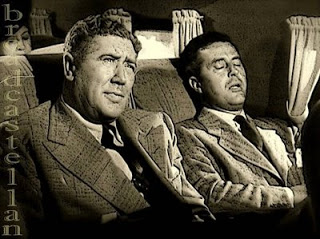 Leisen was not about to denounce the medium he had romanced in two of his earlier revues, The Big Broadcast of 1937 and its 1938 follow-up. Instead, Golden Earrings confronts nationalistic, state-run radio with a distinctly American voice of commercial broadcasting. In the narrative frame, the English officer is seen relating his story to Quentin Reynolds (pictured here with Milland), a news commentator known for his on-air missives to Doktor Goebbels and Herr Schickelgruber.
 My grandmother refused to listen. She would walk out of the room whenever Marlene Dietrich appeared on the small screen. “She betrayed our country,” Oma would say, referring to Dietrich’s departure for Hollywood about the time the fascists came into power. Actually, Dietrich left a few years earlier; but the Nazis sure failed to lure her back. What a loss it is to turn a deaf ear to what aforementioned radio actor Joe Julian called “an exotic accent” and a “strong voice-presence.” Working with her in Dietrich’s lost radio series Café Istanbul (1952), Julian got a “glimpse behind the public image” and discovered

 Well, howdy. His handsome mug is before me whenever I grab a book from my shelves. Randolph Scott, Series two, Number 385 of Zuban’s
  Well, leave it to a couple of old troupers to make me feel a little less sorry for myself. This New Year’s cold is making me feel miserable, cranky, and just about as fresh as a Jackie Mason standup routine. As those subjected to my groanings and whinings will only be too glad to corroborate, I am not one to suffer in silence. Mind you, I groan and whine even without an audience, of which I was deprived this afternoon (save for our terrier, Montague, who showed no signs of interest, let alone compassion). I reckon those noises serve chiefly as a reminder to myself that I am still numbering among the living.
 Well, there she was again, flitting across the screen … unexpected, uncredited—and gone within seconds. You know, the kind of walk-on out of narrative nowhere they call a cameo. How strange, I thought, when I saw her passing by, having just had her on my mind (and in this journal) a few minutes earlier. I could hardly believe my eyes. Yes (as I shared earlier today on
  Well, they should have been slipped a Mickey Finn, for starters. Those boys in the back room scribbling gags for Bud Abbott and Lou Costello, I mean. On this day, 15 October, in 1942, the comedy duo was called upon to accommodate Marlene Dietrich, who stepped behind the mike to promote what would turn out to be yet another dud: Pittsburgh. Like Hollywood’s film producers, the writers went no farther than to hark back to Dietrich’s image-revamping comeback Destry Rides Again, released three years earlier. Once again, Dietrich was heard singing a few notes of the raucous barroom number that had pre-war audiences “Falling in Love Again” with the formerly untouchable and largely humorless goddess.
 Harry Heuser