Inherit the . . . Air: Dialing for Darwin on His 200th Birthday

Before settling down for a small-screening of Inherit the Wind, I twisted the dial in search of the man from whose contemporaries we inherited the debate it depicts: Charles Darwin, born, like Abraham Lincoln, on this day, 12 February 1809. Like Lincoln, Darwin was a liberator among folks who resisted free thinking, a man whose ideas not only broadened minds but roused the ire of the close-minded–stick in the muds who resented being traced to the mud primordial, dreaded having what they conceived of as being set in stone washed away in the flux of evolution, and resolved instead to keep humanity from evolving. On BBC radio, at least, Darwin is the man of the hour. His youthful Beagle Diary is currently being read to us in daily installments; his “Voyages of Descent” with Captain FitzRoy have been newly dramatized; and his theories are the subject of numerous talks and documentaries.
The bicentenary celebrations got underway early at the Natural History Museum in London, where last December I visited an exhibition of artifacts and documents from Darwin’s journeys of discovery, quests that had their origin here in the west of Britain: “In August quietly wandering about Wales, in February in a different hemisphere; nothing ever in this life ought to surprise me,” young Darwin noted.

Nor should resistance to change. Back in 1935 (as Erik Barnouw reminds us in A Tower in Babel), when the hostile response to Darwin’s theories resulted in a media event known as the Scopes Monkey Trial, station WGN, Chicago, took the microphone straight into the courtroom so that listeners might hear defense attorney Clarence Darrow ask prosecutor William Jennings Bryan, “Mr. Bryan, do you believe that the first woman was Eve?”

Bryan professed to believe just that; and unable to sway the jurors from thinking otherwise, Darrow lost the case—a case that, if some politicians had had their way, would not have been made public. It was not just the espousal but the very mention of Darwin’s ideas that was considered a threat. An amendment to ban all broadcasts of “discourses” about Darwin was proposed in the 69th United States Congress. If that amendment had passed, the evolution could not be televised today.

It comes as no surprise either that the two men who penned Inherit the Wind were former broadcast writers; in fictionalizing the trial, they disowned the medium that had imposed so many restrictions upon them, that kept potentially incendiary ideas from being disseminated; that, in the interest of public calm—as opposed to the public interest—was apt to cast aside what it did not dare to cast broadly.

It was not until long after his death that Darrow, once known as the “boy who would argue against everything,” became the subject of a CBS radio documentary; in it, many outspoken thinkers—including Edith Sampson, the first black US delegate appointed to the United Nations—were heard arguing in his defense.

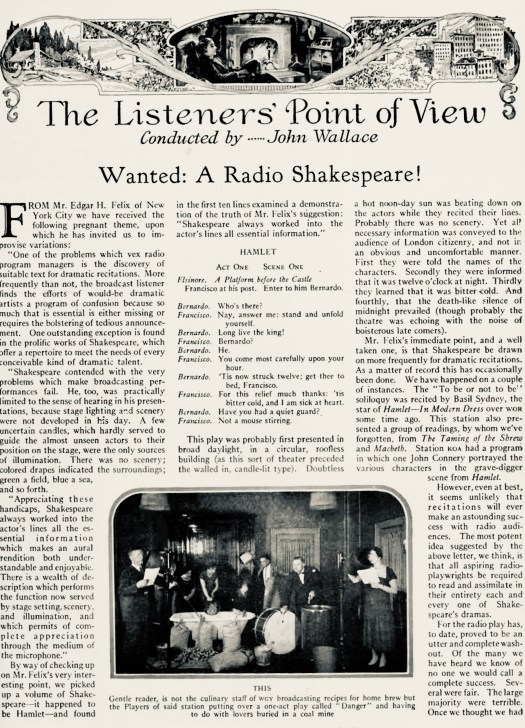
Perhaps, I am overstating my case when say that Darwin was too hot for radio; yet even when his ideas were presented on the air, they needed to be cooled down so as not to inflame anew. In 1946, a dramatization of his career was attempted for The Human Adventure, an educational program produced by CBS in co-operation with the University of Chicago. As Max Wylie put it in his foreword to a published script from the series, The Human Adventure presented

dramatic interpretations of the progress being made in university research throughout the world, progress in any of the thirty thousand research projects that are now being worked on by scholars and scientists in this country and in the centers of learning throughout the civilized world.

The description does not quite fit the episode in question, which transports listeners to a less civilized, less enlightened past. It opens on a “leisurely day in London” anno 1859. On 24 November, to be precise, the very day on which Darwin’s Origin of the Species went on sale. The scene is a bookstore, the dialogue between a young scholar and his formidable aunt who disapproves of Darwinian notions:

When I was a girl, we knew exactly how old the world was. Bishop Ussher proved it in the scriptures. The world, he proved, was created in the year 4004 BC, on a Friday in October at 9 o’clock in the morning.

Not that the lad is particularly up-to-date; “everyone knows that animals don’t change” and that “species remain exactly as created,” he argues. “Every kind fixed and separate.” Darwin’s new book was flung at that rickety bandwagon, as the play drives home. “Instantly, overnight, the lines of conflict are drawn. The complaisant, orthodox world, which is Victorian England, erupts into a storm of controversy.”

The narrative soon shifts from social agitation to the thrill of exploration and pioneering. It emphasizes the spirit of “Adventure” over the dispiritingly “Human” by introducing us to the younger Darwin aboard the Beagle, the eager scientist in his laboratory, and the ailing researcher supported by a loving spouse. Without diverging from facts, the drama suggests that Darwin’s theory were not quite so earth-shattering after all, a similar treatise having preceded it that threatened to render Darwin’s own publication redundant. Without omitting a reference to monkeys, the broadcast refuses to acknowledge that its subject matter continued to make zealots go ape.

Defusing Darwin’s prehistoric time bomb, The Human Adventure argued the “storm of abuse,” the “bitter intemperate, all too human controversy” to be “behind us now.” The voices of protest give way to a demonstration of how Darwin’s words echo the theories of scientists from around the world, an enlightened world united through science. Science fiction, in short.

The Great Dictation: Milton, Munkácsy and the Blind Medium

I did not know what to expect when I stepped inside the Hungarian National Gallery, a war-battered royal palace turned into a public museum during the days of Communist rule in Budapest. Somehow, Hungarian culture has remained a closed book—or rather, a neglected volume—to me; and looking at rooms filled with art depicting scenes from Magyar history made me come face to face again with my own ignorance.

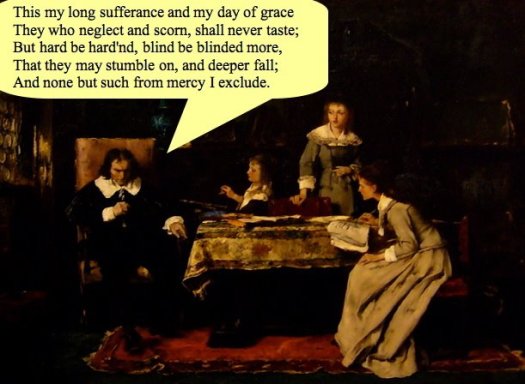
How welcome a sight was “The Blind Milton Dictating ‘Paradise Lost’ to His Daughters.” Yes, that face was familiar, as was the composition, even though I had never troubled myself to note, let alone pronounce, the name of its artist: Mihály Munkácsy. I was surprised to reencounter “Blind Milton” there, knowing it to be on permanent display at New York Public Library on 42nd Street (where it is currently the centerpiece of an exhibition celebrating Milton’s life and works). As it turns out, there are two version of Munkácsy’s painting, the one in New York City being the larger of the two.

This year marks the quatercentenary of Milton’s birth, so we are likely to come across “Blind Milton” in the arts and literature sections of our newspapers or the pages of magazines on history and culture. Even in the 19th-century, the image was frequently reproduced on paper. Indeed, we happened upon such a reproduction at a second-hand bookstore in the Hungarian capital not long after our gallery visit, on the very day it was featured in The New York Times arts section online.

The image became so familiar that, by the twentieth century, the

usual conception of John Milton in the imagination of America’s school children has been a misty mezzotint of a blind man sitting in a dark room dictating Paradise Lost to his bored but dutiful daughters.  That Milton was one of the most fearless and most revolutionary thinkers of his century few youngsters have ever been permitted to know.

.This is how, in 1939, Max Wylie prefaced “The Story of John Milton,” a script from the radio series Adventure in Reading (NBC; 1938-40). The play (by Helen Walpole and Margaret Leaf) tells of blindness, vision, and the specter of persecution as the monumental struggle of the beleaguered poet is being recalled by the voices he called forth in his art.

For twelve years, Milton’s ideas had been in the service of the Commonwealth, until the Restoration threatened to obliterate his words and legacy. Awaiting news from his friend Sir Harry Vane, Milton tries to dictate Paradise Lost to his daughter Mary:

Milton.  You aren’t writing, Mary, you aren’t writing!

Mary.  How can I father? How can I do anything … while we’re waiting for the coming of Sir Harry!

Milton.  Write.  Take down what I say.  “Wolves shall succeed for teachers, grievous Wolves, / Who all the sacred mysteries of Heav’n / To their own vile advantage shall turn. . . .”

Mary.  I cannot.  I cannot.  Paradise Lost may never be finished.

Milton.  Paradise Lost shall be finished.  I’m not a human being any longer, Mary.  I’m an instrument … a vessel … you don’t understand that … but no matter … I may seem hard to you and your sister … but that’s not important either. . . .

Mary.  I shall try to write.  Dictate it again, father.

Milton.  “Wolves shall succeed for teachers, …”

The war of ideas and the fight for their expression—a challenge as urgent in 1660 and 1939 as it is today—is a fitting subject for the so-called blind medium, a medium capable of conjuring images before the mind’s eye not grown dim from lack of exercise.

Milton is accused of treason. The burning of his books, to be executed by “a common hangman,” have been ordered. “Blind among my enemies…. How can I fight?” the poet cries in near despair, until, roused by his visions, he declares:

If, by my own toil, I have fanned the flame that burned out my eyes … then from that darkness will be born new eyes. All natural objects shut away … I can see clearer into life itself….  My vision will not be blurred or turned aside! And so, O, Highest Wisdom, I submit.  I am John Milton, whose sight was taken away that he might be given new eyes.

It is in the opening lines of the third book of Paradise Lost that Milton comments on his condition:

I sung of chaos and eternal night,
Taught by the heav’nly muse to venture down
The dark descent, and up to re-ascend,
Though hard and rare: thee I revisit safe,
And feel thy sovran vital lamp; but thou
Revisit’st not these eyes, that roll in vain
To find thy piercing ray, and find no dawn;
So thick a drop serene hath quenched their orbs,
Or dim suffusion veiled […].
Seasons return, but not to me returns
Day, or the sweet approach of ev’n or morn,
Or sight of vernal bloom, or summer’s rose,
Or flocks, or herds, or human face divine;
But cloud instead, and ever-during dark
Surrounds me, from the cheerful ways of men
Cut off, and for the book of knowledge fair
Presented with a universal blank
Of nature’s works to me expunged and razed,
And wisdom at one entrance quite shut out.
So much the rather thou celestial light
Shine inward, and the mind through all her powers
Irradiate, there plant eyes, all mist from thence
Purge and disperse, that I may see and tell
Of things invisible to mortal sight.

It seems that, in the scene depicted by Munkácsy, Milton is dictating these very lines, at the moment dramatized for Adventure in Reading. His three dutiful daughters look anything but bored. Entrusted with a solemn responsibility and not altogether ignorant of their father’s perilous position, they are rapt and apprehensive as they listen to the dictation, encoded in which is the speaker’s intimate story, a few telling lines in an epic on the fallibility of humankind.