A โ€œkind of monsterโ€: Me[, Fascism] and Orson Welles

It doesnโ€™t happen often that, after watching a 21-century movie based on a 21-century novel, I walk straight into the nearest bookstore to get my hands on a shiny paperback copy of the original, the initial publication of which escaped me as a matter of course. Come to think of it, this never happened before; and that it did happen in the case of Me and Orson Welles has a lot to do with the fact that the film is concerned with the 1930s, with New York City, and with that wunderkind from Wisconsin, the most lionized exponent of American radio drama, into which by now dried up wellspring of entertainment, commerce and propaganda it permits us a rare peek. You might say that I was the target audience for Richard Linklaterโ€™s comedy, which goes a long way in explaining its lack of success at the box office.

And yet, despite the filmโ€™s considerable enticementsโ€”among them its scrupulous attention to verisimilitudinous detail and a nonchalant disregard for those moviegoers who, having been drawn in by Zac Efron, draw a blank whenever references to, say, Les Tremayne or The Columbia Workshop are being tossed into their popcorn littered lapsโ€”it wasnโ€™t my fondness for the subject matter, much less the richness of the material, that convinced me to pick up Robert Kaplowโ€™s novel, first published in 2003. Indeed, it was the glossiness of the treatment that left me with the impression that something had gotten lost or left behind in the process of adaptationโ€”and I was curious to discover what that might be.

On the face of it, the movie is as faithful to the novel as the book is to the history and culture on which it draws.  Much of the dialogue is lifted verbatim from the page, even though the decision not to let the protagonist remain the teller of his own tale constitutes a significant shift in perspective as we now get to experience the events alongside the young man rather than through his mind’s eye.  In one trailer for the film, the voice-over narration is retained, suggesting how much more intimate and intricate this story could have beenโ€”and indeed is in printโ€”and how emotionally uninvolving the adaptation has turned out to be.

Without Samuelsโ€™s narration and with a scene-stealing performance by Christian McKay as Welles, the screen version gives the unguarded protรฉgรฉ, portrayed by the comparatively bland Efron, rather less of a chance to have the final word and to claim center stage, as the sly title suggests, by putting himself first.

The question at the heart of the story, on page and screen alike, is whether successes and failures are born or made.  Prominence or obscurity, life or death, are not so much determined by individual talent, the story drives home, but by the circumstances and relationships in which that talent can or cannot manifest itself.  We know Welles is a phony when he goes around giving the same spiel to each member of the cast who is about to crack up and endanger the opening of the show, insisting that they are โ€œGod-created.โ€  They are, if anything, Welles-created or Welles-undone.

Finding this out the hard wayโ€”however easy it may have looked initiallyโ€”is high school student Richard Samuels who, stumbling onto the scene quite by accicent, becomes a minor player in a major theatrical production of a Shakespearean drama directed by a very young, and very determined, Orson Welles.  Samuelsโ€™s fortunes are made and lost within a single week, at the end of which his name is stricken from the playbill and his life reconsigned to inconspicuity, all on account of that towering ego of the Mercury.

The premise is an intriguing one: a forgotten man who lives to tell how and why he did matter, after allโ€”a handsome stand-in for all of us who blew it at some crucial stage in our lives and careers.  Shrewdly concealing that it was he who nearly ruined the Mercury during dress rehearsal by setting off the sprinklers, Samuels can luxuriate in the belief that he may have inadvertently saved the production by reassuring a superstitious Welles that opening night would run smoothly.

Speculating about the personalities and motives of historical figures, dramas based on true events often insert an imaginary proxy or guide into the scene of the action, a marginal figure through or with whom the audience experiences a past it is invited to assume otherwise real.  And given that Me and Orson Welles goes to considerable length capturing the goings-on at the Mercury Theater, anno 1937, I was quite willing to make that assumption.  Hey, even Joe Cotten looks remarkably like Joseph Cotten (without the charisma, mind).

It was not until I read the novel that I realized that Kaplow and the screenwriters, while ostensibly drawing their figures from life, attributed individual traits and behaviors to different real-life personages.  Whereas actor George Coulouris is having opening night jitters on screen, it was the lesser-known Joseph Holland who experienced same in the novel.

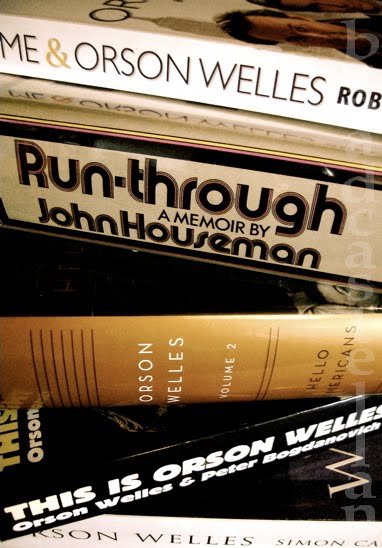
Although quite willing to let bygones be fiction, I consulted Mercury producer John Housemanโ€™s memoir Run-through, which suggests that the apprehensive one was indeed Coulouris.  Housemanโ€™s recollections also reveal that the fictional character of Samuels was based in part on young Arthur Anderson, a regular on radioโ€™s Letโ€™s Pretend program who, like Samuels, played the role of Lucius in the Mercury production.  According to Houseman, it was Anderson who flooded the theater by conducting experiments with the sprinkler valves.

Never mind irrigation; I was trying to arrive at the source of my irritation, which, plainly put, is this: Why research so thoroughly to so little avail? Why be content to present a slight drama peopled with folks whose names, though no longer on the tip of everyoneโ€™s tongue, can be found in the annals of film and theater? The missed opportunityโ€”an opportunity that Welles certainly seizedโ€”of becoming culturally and politically relevant makes itself felt in the character of Sam Leve, the Mercuryโ€™s set designerโ€”a forgotten character reconsidered in the novel but neglected anew in the screenplay.

Andersonโ€™s contributions aside, it is to Leveโ€™s account of the Mercuryโ€™s Julius Caesar that Kaplow was indebted, a debt he acknowledges in the โ€œSpecial thanksโ€ preceding the narrative he fashioned from it.

โ€œ[P]oor downtrodden Sam Leveโ€โ€”as Simon Callow calls him rather patronizingly in his biography of Orson Wellesโ€”was very nearly denied credit for his work on the set.  Featuring prominently in the novel, he is partially vindicated by being given one of the novelโ€™s most poignant speeches, a speech that turns Me and Orson Welles into something larger and grander than an intriguing if inconsequential speculation about a brilliant, egomaniacal boy wonder.

Confiding in Leve, with whom he has no such exchange in the movie, Samuels calls Welles a โ€œkind of monster,โ€ to which Leve replies: โ€œWe live in a world where monsters get their faces on the covers of the magazines.โ€  In this exchange is expressed what mightโ€”and, I believe, shouldโ€”have been the crux of the screen version: the story of a โ€œkind of monster,โ€ a man who professes to turn Julius Caesar into an indictment of fascism, however conceptually flawed (as Callow points out), but who, in his dictatorial stance, refuses to acknowledge Leveโ€™s contributions in the credits of the playbill and shows no qualms in replacing Samuels when the latter begins to assert himself.

โ€œAs in the synagogue we sing the praises of God,โ€ Leve philosophizes in the speech that did not make it into the screenplay, โ€œso in the theatre we sing the dignity of man.โ€  Without becoming overly didactic or metaphorical, Me and Orson Welles, the motion picture, could have put its authenticity to greater, more dignified purpose by not obscuring or trivializing history, by reminding us that Jews like Leve and Samuels were fighting for recognition as the Jewish people of Europe were facing annihilation.

To some degree, the glossy, rather more Gentile film version is complicit in the effacement of Jewish culture by homogenizing the story, by removing the Jewish references and Yiddish expressions that distinguish Kaplowโ€™s novel.  Instead of erasing the historical subtext, the film might have encouraged us to see the Mercuryโ€™s troubled production of Julius Caesar as an ambitious if somewhat ambiguous and perhaps disingenuous reading of the signs of the times, thereby making us consider the role and responsibility of the performing artsโ€”including films like Me and Orson Wellesโ€”in the shaping of history and of our understanding of it.


Related writings
โ€œOn This Day in 1938: The Mercury Players โ€˜dismember Caesarโ€™โ€
โ€œOn This Day in 1937: The Shadow Gets a Voice-overโ€

"2X2L calling CQ. . .": The Night They Made Up Our Minds About Realism

Radio Guide (19 November 1938)

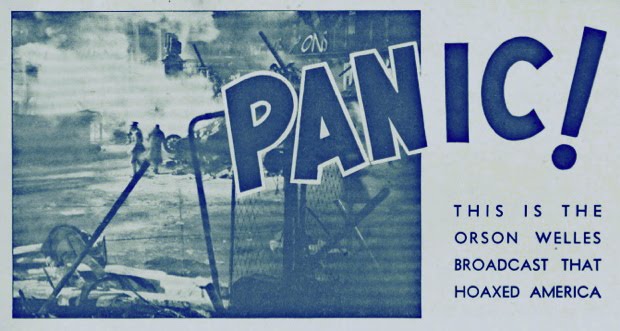
This is just the night for a returnโ€”a return to that old, beloved yet woefully neglected hobbyhorse of mine. You know, the Pegasus of hobbyhorses: the radio. After all, it is the anniversary of the Mercury Theatreโ€™s 1938 โ€œWar of the Worldsโ€ broadcast, a date that lives in infamy for giving those who say that โ€œseeing is believingโ€ an ear-opening poke in the eye. These days, the old Pegasus doesnโ€™t get much of an airing. It may have sprung from the blood of Medusaโ€”but that old Gorgon, television, still has a petrifying grip on our imagination.

What made โ€œThe War of the Worldsโ€ so convincing was that it treated fantasy to the trickery of realism, by turning an old sci-fi yarn into what, too many, sounded like a documentary. As the programโ€™s general editor, John Housemanโ€”who gave up the ghost on Halloween in 1988โ€”recalled about the Mercuryโ€™s holiday offering, not even the script girl had much faith in the material: โ€œItโ€™s all too silly! Weโ€™re going to make fools of ourselves. Absolute idiots.โ€ Instead, the broadcast made fools of thousands by exploiting their pre-war invasion anxieties.

As I put it in Etherized Victorians, broadcast fictions could

tap into what McLuhan argued to be โ€œinherent in the very natureโ€ of radioโ€”the power to turn โ€œpsyche and society into a single echo chamber.โ€

The more urgent concern for broadcasters had always been whether it was proper for radio dramatists to exploit this power at all, especially after the codes of radioโ€™s surface realism had been so forcefully violated by Howard Kochโ€™s dramatization [. . .]. In one of the most disturbing scenes of the play, a speaker identified as a CBS announcer addresses the public to document the end of civilizationโ€”โ€œThis may be the last broadcastโ€โ€”until succumbing to the noxious fumes that spread across Manhattan and extinguish all human life below. ย His body having collapsed at the microphone, a lone voiceโ€”rendered distant and faint by a filterโ€”attempts to establish communication.ย 

It is the voice of a radio operator: โ€œ2X2L calling CQ. . . . 2X2L calling CQ . . . . 2X2L calling CQ . . . New York. Isnโ€™t there anyone on the air? [Isnโ€™t there anyone on the air?] Isnโ€™t there anyone. . . .โ€ ย The Mercury Playersโ€™ โ€œholiday offeringโ€ had not only โ€œdestroyed the Columbia Broadcasting System,โ€ as Welles jested at the conclusion of his infamous Halloween prank, but had pronounced the death of its receiversโ€”the listening public. ย Considering the near panic that ensued, was it advisable to open the realm Esslin called a โ€œregion akin to the world of the dreamโ€ without clearly demarcating it as fantasy by resorting to the spells of Trilby, Chandu, or The Shadow?

After that night, the aural medium as governed by those in charge of the realties of commerce and convenience seemed destined to perpetuate what Trilling referred to as the โ€œchronic American beliefโ€ in the โ€œincompatibility of mind and reality.โ€

Related writings
โ€œโ€˜War of the Worldsโ€™: A Report from the Sensorial Battlefieldโ€
โ€œโ€˜War of the Worldsโ€™: The Election Editionโ€
โ€œThousands Panic When Nelson Eddy Begins to Singโ€

“War of the Worlds”: The Election Edition

View from a London bus, 2005

Teaching undergraduate English in the Bronx while researching my dissertation on old-time radio, I found it difficult if necessary to relate nightly study to daytime work in the classroom. ย I did not want to be one of those educators who think of their ‘job’ as an educator as being at odds withโ€”or in the way ofโ€”an academic careers, success in which is largely dependent on self-promotional efforts rather than years of service.

Reluctant instructors tend to become resentful of their charge, a feeling that is hardly conducive to the far from mutually exclusive activities of teaching and learning. ย Writing this journal has been a way of vindicating my approach, of coming to terms with my inability to squeeze the most out of the degree I earned. ย broadcastellan is not a series of unheard lectures, but a record of my enthusiasms.

Now, where was I going with this? Ah, yes.  โ€œThe War of the Worlds,โ€ the infamous “Panic Broadcast” that was first heard on this day, 30 October, in 1938. The Mercury Theaterโ€™s iconic dramatization of Wells’s futuristic parable and the resulting Hullabaloo (also the title of a 1940 musical comedy inspired by the event) provided me with a rare opportunity to forge a connection between classroom and study.  โ€œThe Warโ€ was the first recording of a radio play I shared with my students, whose listening experience was followed by the inevitable question whether such a performance could still hornswoggle us today.

Being that one of my enthusiasm is American radio drama, I have already discussed the Mercury Theater production and its rival broadcast on previous occasions. Tonight, though, “The War of the Worlds” comes to a mind that is about as uneasy as the minds of those tuning in back then.

Not surprisingly, most of my students argued that we are too sophisticated nowadays to fall for such claptrap.  There is more access to alternative media, more awareness of what is going on around the world.  However comforting it might be to think so, I have never permitted myself to share this view.  I do not conceive of the past as being inferior to the present by virtue of some supposedly natural progression.

Sure, you might snicker at preposterous styles and passing fads.  You might say, in hindsight, that certain political decisions were wrong and that those living in the past should have seen things coming. In short, there are any number of ways to demonstrate your ostensible superiority to folks back then.  Doing so, however, you should have the honesty to admit that your argument is designed to make yourself feel better about the uncertainties and anxieties of the present.

I do not hold with those who look at past generations as an older, hence inferior, model of themselves.  I reject the notion that there has ever been what is frequently referred to as โ€œinnocentโ€ times.  Retrospection breeds contempt.  Too often, it is an act of distancing yourself from events that the present, if properly inspected, proves to be not altogether beyond the possibility of recurrence.

So, could something akin to the headlines-making broadcast be restaged tonight and elicit a similar response, a response frequently attributed to the threat of war that was about to shatter hopes of stability, peace, and prosperity? Are we not on edge enough now to have reached the point of sustainable gullibility? Or are cynicism and apathy an adequate shield against deception?

Have not many of us lived a myth constructed by those who benefit from our desire to believe in something, be it a falsehood about terror and the war on it, be it the promise of economic progress to which every aspect of our existence is made subordinate? The times, it seems, are ripe for a shake-up.

One reader of the so-called panic broadcast, Peter Lowentrout, suggests that listener belief in an attack from Mars was rooted in a โ€œloss of spirit,โ€ the 1920s and 1930s having been โ€œdecades in which the influence of secularization peaked in our general and elite cultures.โ€ Are we more eager to believe in a hoax if we are incapable of or reluctant to believe in anything else? Or is a return to faith a prerequisite for a susceptibility to apocalyptic visions?

In a way, the โ€œpanicโ€ is itself an historical construct; its extent has been exaggerated to permit us that look of superiority we tend to cast on the past. ย Yet what about the present fear change and its mongers, those who look upon of the presidential candidates as a false Messiah and claim him to be alien to the economic needs of an ailing nation, if not downright hostile to those intent on clinging to a status quo that hardly seems worth maintaining?

What about those who think of ecological crises as a matter of fate or charlatanry rather than challenge and opportunity; and who, by claiming it to be either inevitable or false, go on living as if their individual conduct had no influence on the future of this planet? What about those who are disillusioned by the stock market, yet feel threatened by concepts of alternative living that involve something other than the amassing of greenbacks?

Orson Welles’s introductory remarks, at least, are readily applied to our present condition:

With infinite complacence people went to and fro over the earth about there little affairs, serene in the assurance of their dominion over this small spinning fragment of solar driftwood which by chance or design man has inherited out of the dark mystery of Time and Space.

At present, I find it difficult to think of anything other than the US election, which is what reminded me of the challenge I faced in the classroom, the challenge I am facing when keeping a journal that attempts to keep up with the out-of-date? To find relevance in the past and to relate it to the uncertainties that constitute my present, that is the challenge. ย 

While I have no official say in the matter, I shall have certainty next Wednesday. ย On that day, I may even have renewed confidence in the democratic West; but certain and confident is not who I am tonight . . .

Orson and the Count: The Man Cast as The Shadow as the Man Who Cast None

The afternoon couldnโ€™t be any less gloomy. The sky is of a deep blue, the air is fresh, andโ€”until the health hazard that is Tony Blair gets his death wish to turn the West of Britain into a nuclear powerhouse (as if the radioactive Irish Sea weren’t enough of a warning against atomic energy)โ€”a plain and reliable sign that nature, or what remains of it, is still providing an atmosphere in which even those among the ostensibly superior animals may thrive who are least protective of its balance.

Long gone are the days when peril could be apprehended with the naked eye, the days before pesticides made our apples look appealing and generals fought wars with missiles to keep their hands clean. Those were the days when shields and fortresses were things of iron and stone, rather than metaphors for our lack of security. The Middle Ages, in short.

Yet even during those presumably darker days, the invisible was more terrifying than any clear sign of danger, which is how superstitions, sanctioned or otherwise, could capture and enthrall our imagination. The untraceable was always ominous, and clarity suspicious. After all, even if threats eventually manifest themselves, the absence of any such ocular proof of safety or danger is valid only for the moment of looking; it is no insurance against impending peril or against the human failings of sight and oversights.

Every technological means of capturing danger and thereby defusing it gives rise to invisible counterterrors, to elusive weaponry, to secrecy and stealth. No artistic medium was more suited to tapping into those fears of the unseen than radio, the mass medium that, back in 1938, was capable of causing widespread terror by virtue of sound alone.

The man largely responsible for this terror attackโ€”known as “The War of the Worlds”โ€”was an ambitious 23-year-old whose voice was familiar to millions of American as that belonging to Lamont Cranston and his alter ego, The Shadow (introduced here). On this day, 11 July, in 1938, the theatrical Wunderkind took on another, rather more grand and prestigious radio project by mounting his Mercury Theater on the air.

Lurking underneath the cloak of artistic pretensions was the melodramatic excess that had made The Shadow such a radio triumphโ€”the ghastly and lurid that generated chills more pleasant than any news from Europe, darkening in the shadow of fascism. The opening attraction of the now legendary Mercury Theater on the Air was an adaptation of Bram Stokerโ€™s Dracula, which, during those days, was not yet the academically respectable narrative it today, despite Wellesโ€™s insistence that it could be found in โ€œevery representative library of classic English narratives.โ€

The Mercury‘s “Dracula” (recently podcast, with an excellent introduction by Jim Widner) is unabashed blood and thunder. And, despite its toning down of the novel’s overt sexuality and its counterbalancing installation of an intellectual woman like Mina Harker (played by Shadow sidekick Agnes Moorehead), this adaptation for radio is more in keeping with the original novel than any filmic adaptation. Tearing down the house with neo-Gothic hooey, Welles and fellow adaptor John Houseman retain some of the structure of Stoker’s novel, a story assembled from various manuscripts, gathered by those who join forces to make sure that Dracula is out for the count.

Like the novel, the radio adaptation emphasizes the use of modern technology (train and typewriter, telegram and phonograph) as weapons against an ancient curse, a past insisting on making its presence felt. It is a past so present that, ultimately, it can only be conquered by forces as old as itself: the solidarity of individuals rising against a despotic power and the reassuring solidity of a piece of wood driven through a heart of darkness.

The Mercury‘s “Dracula,” like its subsequent production of “The War of the Worlds” (discussed here), may be read as a comment on fascisms: the rallying of western democracy against the threat of a blood-sucking dictator to the east of them. It is a comforting romance, this triumph of unityโ€”and of radio as a unifying force. Yet, as those under the influence of that instrument of are often unaware, the prominent figures casting shadows in our midstโ€”more ingratiating and integrated than the lonesome Countโ€”can be much more difficult to hold accountable, discount or counter.

On This Day in 1938: Thousands Panic When Nelson Eddy Begins to Sing

Last night, I watched The Red Dragon (1945), another one in the long-running series of Charlie Chan movies. To my surprise, there was a familiar voice in the cast: Barton Yarborough, one of the three comrades of the I Love a Mystery radio serial I’m going to review, starting tomorrow. On the radio, Yarborough’s Texan drawl was taking center stage, and, “honest to grandma,” I’ll sure enjoy hearing it again in the weeks to come. Before I get started, however, I need to acknowledge the anniversary of what is unquestionably the most famous of American radio plays, the Mercury Theatre production of “The War of the Worlds.”

Airing on this day, 30 October, in 1938, it had a profound effect on millions of Americansโ€”the hundreds who panicked while tuning in and the considerably greater number of radio listeners who would suffer the consequences of this prank: FCC regulations, censorial squeamishness, and a whole lot of spiritless broadcast drama. Could Nelson Eddy be to blame for it all?

As “The War of the Worlds” got underway, Eddy was just about to burst into song on The Chase and Sanborn Hour. Now, CBS’s sustaining (that is, commercial-free) Mercury Theatre broadcasts were no match for NBC’s Sunday night feature, the ratings behemoth sponsored by the makers of Chase and Sanborn Coffee; about ten times more listeners tuned in to the latter than could be convinced to hear young Orson Welles and his celebrated players.

And yet, to most Americans, the main attraction of The Chase and Sanborn Hour was not Nelson, lord of the operetta, but ventriloquist dummy Charlie McCarthy (pictured above, sort of, by yours truly). So, once Charlie (or Edgar Bergen, the man who gave him life) stepped away from microphone to let Mr. Eddy sing, quite a few listeners might have felt compelled to twist the dial, tuning in “The War of the Worlds” just as the arrival of the Martians was being announced in a series of fictive bulletins.

Having missed Welles’s introduction, which alerted listeners to the fictional nature of the program, those turned off by operetta and not crazy about highbrow theatricals would have been more likely to fall for news about “The War.”

Back in the late 1990s, when Robert J. Brown examined “The War of the Worlds” in Manipulating the Ether, this particular episode of the The Chase and Sanborn Hour was not yet widely known to radio scholars; now that recordings of this broadcast are readily available, we should really give it a listen to get the larger picture. As I discovered anew a few weeks ago, it is a mistake to dismiss the response to the Mercury Theatre‘s Halloween hoax as a symbol of an ostensibly innocent past.

On This Day in 1938: The Mercury Players “dismember Caesar”

โ€œLetโ€™s be sacrificers, but not butchers,โ€ Brutus implores his co-conspirators prior to the assassination of Julius Caesar. This line might have served as a motto for the Mercury Players when Orson Welles and company decided to adapt their stage success Julius Caesar for radio. They needed to butcher Shakespeareโ€™s play, or at least trim it down considerably; and they were making such a sacrifice to accommodate a larger audienceโ€”millions who might not have had the opportunity to take in a production of such a play in their rural communities. It was the butchery of high art and a sacrifice to lowly commerce.

โ€œO, that we then could come by Caesar’s spirit,
And not dismember Caesar!โ€ Brutus (played by Welles), exclaimed. โ€œBut, alas,

Caesar must bleed for it. And, gentle friends,
Letโ€™s kill him boldly, but not wrathfully.
Letโ€™s carve him as a dish fit for the gods,
Not hew him as a carcass fit for hounds.

The 11 September 1938 broadcast of Julius Caesar is remarkable for several reason. To begin with, it offered an alternative to the not always inspired programming of the commerce and common denominator oriented networks. And not only was the radio-readied production an ingenious exercise in adaptation but a poignant and timely commentary on the crisis in Europe that was about to plunge the world into war.

11 September 1938 was certainly no less innocent than the day we now commemorate as 9/11. โ€œThis is the history of a political assassination,โ€ we are told about the story of Julius Caesar, a โ€œdictator for lifeโ€ upon whom were bestowed โ€œhonorsโ€ that โ€œseemed to exceed the limits of ordinary human ambition.โ€ As in the Mercury stage production, the radio adaptation dropped the togas to lay bare the urgency of Shakespeareโ€™s drama, a play that was at once a revenge fantasy and a call to reason. Could a people under the rule of a despot be expected to rise against their leader? Could the forceful removal of such a ruler bring about a new and better world?

To drive home that the broadcast was not an invitation to a literary soiree but a call for a political debate, the Mercury Theater on the Air drew upon the services of H. V. Kaltenborn as a narrator. Kaltenborn was among the most prominent and respected radio commentators of his day. What he uttered was news, not ancient history; and it was certainly not highbrow hooey. His commentary, based upon Plutarchโ€™s Parallel Lives (the source for Shakespeareโ€™s play) but sounding thoroughly contemporary, helped to bridge the gaps in this considerably abridged script, which was acted out by the chief players original cast (Welles as Brutus, Martin Gabel as Cassius, George Coulouris as Antony, and Joseph Holland as Caesar). Kaltenborn assumed a role well suited to Shakespearean theater, which relied on eloquent words rather than elaborate stagecraft to relate its stories.

โ€œHow many ages henceโ€ Cassius remarks shortly after the assassination, โ€œShall this our lofty scene be acted over, / In states unborn and accents yet unknown!โ€ In the Mercury Theater on the Air production, these lines are uttered by Brutus, Wellesโ€™s ego being comparable to that of Caesar. Yet, rather than playing the ham and exulting the hoped-for glories of the crimeโ€”โ€œpeace, freedom, and libertyโ€โ€”Wellesโ€™s Brutus is subdued and plaintive, adding a question mark to the lines. After all, the very โ€œpeace, freedom, and libertyโ€ of the West was at stake if fascism continued to spread in Europe and threaten the world. A voice like that of the noble, thoughtful conspirator Brutus might not be heard in future โ€œstates unbornโ€ or โ€œaccents yet unknown.โ€

Of course, the Mercury Players also had to deal with the limits of liberty and freedom at homeโ€”and on the air. In a climate controlled by advertisers and the FCC, a climate that did not allow for overt political commentary, the Mercury Theater on the Air production of Julius Caesar war remarkably bold and as cunningly executed as Caesarโ€™s assassination. To the โ€œcommon eyeโ€ (or ear), Brutus insists, โ€œWe shall be purgers, not murderers.โ€ The Mercury Playersโ€™ butchery of lines and characters was a worthwhile sacrifice . . .

Could a people under the rule of a despot be expected to rise against their leader? Could the forceful removal of such a ruler bring about a new and better world? Surely the crisis in the Middle East raised similar questionsโ€”but when was the last time CBS television presented a play like Julius Caesar?